VA Disability Compensation Lawyers 2026: Fees, Accreditation, and Who Can Legally Help You
Quick Answer
- Only VA-accredited attorneys and claims agents can legally charge you fees for representation .
- Fees are capped at 20% of past-due benefits for direct-pay agreements .
- VSO representatives are always free, and no one can charge you for an initial claim .
VA disability compensation lawyers are private attorneys accredited by the Department of Veterans Affairs to represent veterans in benefit claims and appeals. They can charge fees only after VA issues an initial decision on your claim, and those fees are capped at 20% of past-due benefits when paid directly from your award .
That’s the core rule. But the VA claims system is full of traps. Unaccredited “claims coaches” and “consultants” operate outside the law, charging veterans thousands for help that accredited representatives provide for free or at regulated rates .
This article breaks down who can legally represent you, how fees work, the difference between accredited and unaccredited help, and how to spot predators targeting veterans in 2026.
The Facts
| Detail | Status |
|---|---|
| Who can charge fees | Only VA-accredited attorneys and claims agents |
| When fees can start | After VA issues an initial decision on the claim |
| Fee cap for direct-pay agreements | 20% of past-due benefits |
| Reasonableness presumption | Fees ≤20% presumed reasonable; >33.33% presumed unreasonable |
| VSO representation cost | Always free |
| Unaccredited representation | Prohibited by federal law |
| Criminal penalties for violations | Removed in 2006; pending restoration via SAFEGUARD Act |
Who can legally charge fees for VA disability representation?
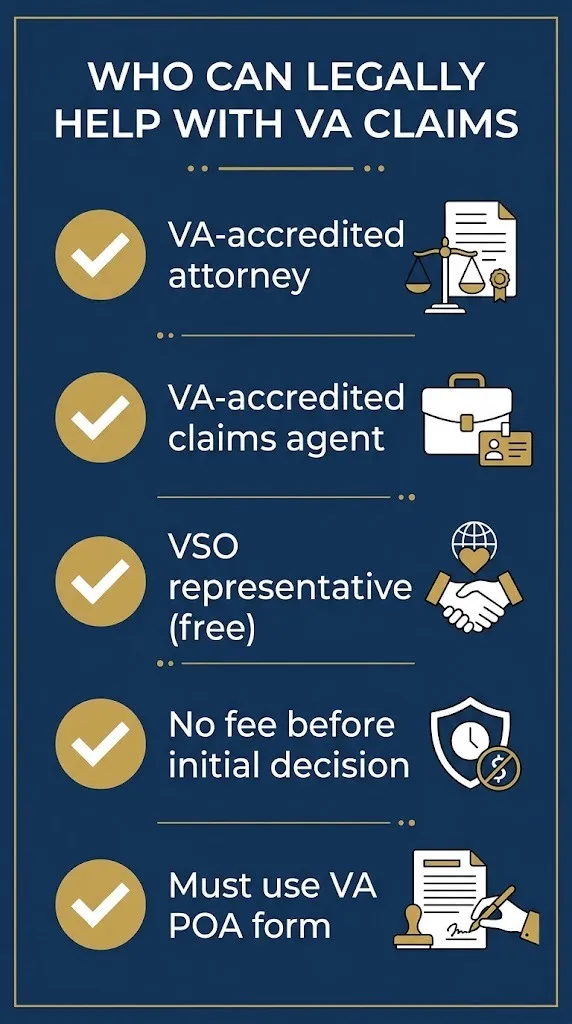
Only VA-accredited attorneys and claims agents can legally charge fees for helping with VA disability claims . VSO representatives cannot charge, and unaccredited individuals cannot charge under any circumstances .
Accreditation means the individual has passed VA’s character review and met specific qualifications. Attorneys must be in good standing with a state bar. Claims agents must pass a written exam on VA law and procedures .
The three types of accredited representatives are:
- VSO representatives: Free help, recommended by recognized veterans organizations
- Attorneys: State bar members in good standing, can charge after initial decision
- Claims agents: Non-attorneys who pass VA’s exam and character review
If someone offers to help with your VA claim and they’re not on VA’s accreditation list, they’re breaking federal law by charging you .
How much can a VA disability lawyer charge?
VA disability lawyers can charge up to 20% of past-due benefits when VA pays them directly from your award . Fees between 20% and 33.33% get scrutinized for reasonableness. Anything above 33.33% is presumed unreasonable .
The 20% cap applies to direct-pay fee agreements, where VA withholds your back pay and pays the attorney directly. For agreements where you pay the attorney yourself, the cap isn’t automatic, but VA can review the fee for reasonableness if you dispute it .
Here’s how the payment structure typically works:
| Fee Agreement Type | How Payment Works | Cap or Review |
|---|---|---|
| Direct-pay agreement | VA withholds from past-due benefits | 20% cap |
| Non-direct-pay agreement | You pay attorney directly | VA can review for reasonableness |
| Hourly or flat fee | You pay as agreed | Must still be reasonable |
VA’s Office of General Counsel can review any fee agreement if the claimant disputes it. The agency collected $422.2 million in attorney and agent fees over the last 12 months . That’s a lot of money flowing through the system, which is why the rules matter.
Reality Check
If someone promises to help you with your VA disability claim and asks for payment before you have an initial VA decision, they’re violating federal law. The only exception is a disinterested third party paying on your behalf . No legitimate accredited attorney will charge you to file an initial claim, because that’s prohibited . If they ask for your VA.gov login or banking information, walk away immediately .
What is the difference between accredited and unaccredited representatives?
Accredited representatives are vetted by VA’s Office of General Counsel and held to professional standards. Unaccredited representatives operate outside that system, often illegally .
The differences matter for your wallet and your claim:
| Factor | Accredited | Unaccredited |
|---|---|---|
| Can access VA systems | Yes | No |
| Can charge fees | Yes, after initial decision | Never for initial claims |
| Bound by VA conduct rules | Yes | No |
| Subject to VA discipline | Yes | No (but other agencies can act) |
| Must use POA form | Yes (VA Form 21-22 or 21-22a) | No, and that’s a red flag |
Unaccredited “claims coaches” often advertise on social media and promise big results. They charge exorbitant fees for work that accredited VSOs provide for free .
How do you verify a VA disability lawyer is accredited?
Verify accreditation through VA’s Office of General Counsel Accreditation Search Index before signing anything . The VA maintains a public database where you can search by name or state .
Here’s the verification process:
- Go to VA’s accreditation search tool.
- Enter the attorney or claims agent’s name.
- Confirm their status is active.
- Ask for their VA accreditation number.
- Check that they use the correct POA form (VA Form 21-22a) .
If someone can’t provide an accreditation number or asks you to sign a contract without VA’s POA form, they’re not accredited . That’s the clearest warning sign.
What can VA disability lawyers actually do for you?
VA disability lawyers can gather evidence, write legal arguments, and represent you in appeals after VA issues an initial decision . They can also help with supplemental claims, higher-level reviews, and Board of Veterans’ Appeals cases .
They can’t help you file the initial claim for a fee. That’s prohibited. And they can’t guarantee outcomes or promise specific ratings .
Accredited attorneys and claims agents are bound by VA’s standards of conduct, which require them to:
- Provide competent representation
- Act with reasonable diligence and promptness
- Be truthful with claimants and VA
- Avoid unreasonable or unlawful fees
What are “claim sharks” and how do they target veterans?
“Claim sharks” are unaccredited companies or individuals that charge veterans illegal fees for VA claim assistance . They operate outside VA’s accreditation system and exploit gaps in enforcement.
The problem exploded after 2006, when Congress removed criminal penalties for violating the fee restrictions. VA’s Office of General Counsel can’t prosecute unaccredited actors, only discipline accredited ones .
Predatory tactics include:
- Charging 6 times the amount of a veteran’s increased benefits
- Using “coaching” or “consulting” labels to dodge the rules
- Advertising heavily on social media with unrealistic promises
- Requiring contracts without VA’s POA forms
- Asking for VA.gov login credentials
Key Takeaway: The safest path is a free VSO representative for initial claims and an accredited attorney or claims agent for appeals. Never pay an unaccredited “coach.”
What is the SAFEGUARD Veterans Act?
The SAFEGUARD Veterans Act is pending legislation that would restore criminal penalties for unaccredited representatives who charge veterans illegal fees . It would also prohibit VA accreditation for anyone convicted of unauthorized solicitation or fee charging.
The bill targets “claim sharks” who exploit the current enforcement gap. Senator Angus King, a co-sponsor, said these actors “prey on veterans at some of the most vulnerable moments in their lives” .
Other provisions include:
- Prohibiting robocalls to obtain VA claims information
- Requiring VA to track accredited agents
- Increasing warnings to veterans about predatory practices
The legislation hasn’t passed yet. Until it does, enforcement remains limited .
What happens next
Ongoing: VA continues monitoring accredited representatives and reviewing fee agreements for reasonableness .
Pending: SAFEGUARD Veterans Act awaits Congressional action to restore criminal penalties .
Ongoing: State attorneys general pursue enforcement against unaccredited claims companies .
Ongoing: Veterans can report unaccredited actors to VA OIG, FTC, or state AG offices .
Frequently Asked Questions
How much can a VA disability lawyer charge?
Up to 20% of past-due benefits for direct-pay agreements. Fees above 33.33% are presumed unreasonable .
Can a lawyer charge me before my VA claim is decided?
No. Attorneys and claims agents can only charge fees after VA issues an initial decision on your claim .
Are VA disability lawyers worth it?
It depends on your case. VSOs provide free help with initial claims. Lawyers may add value for complex appeals or Board hearings .
How do I check if a VA lawyer is accredited?
Use VA’s Office of General Counsel Accreditation Search Index. Ask for their accreditation number .
What is a claim shark?
An unaccredited company or individual that charges illegal fees for VA claim help .
Can I fire my VA disability lawyer?
Yes. You can discharge your representative at any time and appoint a new one .
What if a lawyer asks for my VA.gov login?
Never share it. Accredited representatives don’t need your login because they have POA access .
What is the SAFEGUARD Veterans Act?
Pending legislation to restore criminal penalties for unaccredited representatives charging veterans illegal fees .
VA disability lawyers can be valuable for appeals, but they can’t charge you for initial claims, and their fees are capped at 20% of past-due benefits. Verify accreditation before signing anything, and remember that VSO help is always free .
The single most important step: check VA’s accreditation search tool before you trust anyone with your claim .