Brooke Shields Playboy Lawsuit 2026: The Case Explained, Fact by Fact
Quick Answer
- The lawsuit is verified real, decided by New York’s highest court on March 29, 1983.
- Shields lost both rounds of litigation. No damages or settlement were ever paid.
- There’s no claim deadline because there’s no claim process tied to this case.
The Brooke Shields Playboy lawsuit is a real, decades-old case, not an open matter you can join. Courts ruled against Shields in 1983, finding her mother’s consent to nude childhood photographs legally binding.
Anyone searching this in 2026 is usually researching child consent law, a documentary reference, or a recent AI-imagery ruling that cites the case. The single fact that matters most: no settlement exists, so there’s nothing to file for.
This article breaks down what actually happened in court, what it means today, and why legal commentators keep citing a 1983 ruling in 2026 news. One thing worth knowing upfront: Shields sued in two separate courts and lost in both.
The Facts
| Case | Shields v. Gross, 58 N.Y.2d 338 (N.Y. 1983) |
| Status | Closed. Final ruling issued March 29, 1983 |
| Fund Size | None. No settlement was ever reached |
| Est. Per Person | Not applicable. This was an individual lawsuit, not a class action |
| Claim Deadline | None. There’s no claim process |
| Administrator | Not applicable |
| Proof Needed | Not applicable |
Is the Brooke Shields Playboy lawsuit a real case?
Yes. Shields v. Gross is a documented, published legal case, decided in both federal and New York state court in 1983. It is not an urban legend or exaggerated tabloid claim.
The federal ruling is published at 563 F. Supp. 1253 (S.D.N.Y. 1983). The state ruling, which set the controlling precedent, is published at 58 N.Y.2d 338, 461 N.Y.S.2d 254, 448 N.E.2d 108 (N.Y. 1983).
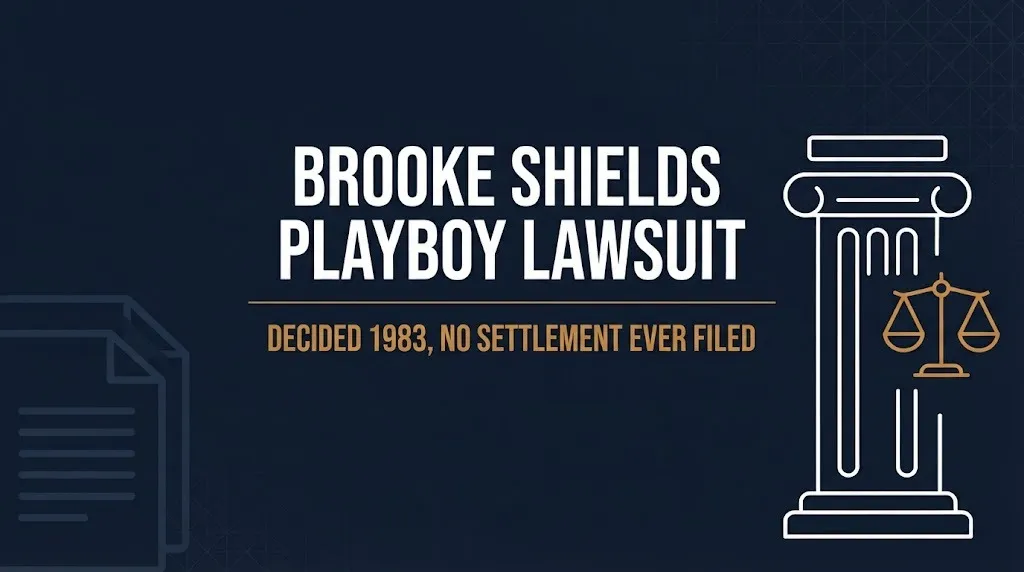
Verified facts from the record:
- Photographer Garry Gross photographed Shields nude in 1975, when she was 10 years old
- Her mother, Teri Shields, signed the consent releases
- Shields was paid $450 for the photo sessions
- She filed suit in 1981 to stop further distribution
- The New York Court of Appeals ruled against her on March 29, 1983
You can verify this yourself through published case law databases. No court docket search should be necessary, since both opinions are public record.
Is there a settlement fund tied to this lawsuit you can claim from?
No. There has never been a settlement fund, claim form, or administrator connected to Shields v. Gross. The case ended with a court decision, not a negotiated agreement.
This distinction gets lost in a lot of coverage. A ruling and a settlement are not the same outcome, and only one of them creates something to claim.
Why there’s nothing to file for:
- The case was an individual lawsuit, never certified as a class action
- Shields sought an injunction and damages, not a shared fund
- The court sided with the defendants, Gross and Playboy Press
- No later agreement or payout followed the ruling
It works something like a small claims case that goes to a judge and the plaintiff loses. There’s no refund program afterward, because the court sided with the other party.
Key Takeaway: No settlement fund has ever existed for this case, so there is no 2026 claim window to watch for.
Who won Shields v. Gross, and what did the ruling say?
Garry Gross and Playboy Press won. New York’s highest court held that valid parental consent for a minor’s commercial photographs is binding and cannot be revoked later by the child.
The decision split the court, 4 to 3, showing the issue wasn’t unanimous even among the judges deciding it.
Core legal findings:
- New York Civil Rights Law Section 50 permits parental consent for a minor’s use in advertising or trade.
- That consent, once validly signed, binds the child even into adulthood.
- The photographs were found “not erotic or pornographic,” in the court’s own words, except to what one justice called “possibly perverse minds.”
- Continued publication would not cause Shields irreparable harm, the majority concluded.
Justice Edward Greenfield’s trial-level opinion was blunt about the underlying tension. He wrote that Teri Shields was trying to be “maternally protective but exploitative at the same time.”
Did Brooke Shields receive any money from this case?
No damages were awarded to Shields through the litigation. The only payment on record is the original $450 modeling fee from the 1975 photo sessions themselves.
That fee came years before the lawsuit and had nothing to do with its outcome. It was a standard session payment, agreed to by her mother at the time.
| Payment | Amount | Source |
|---|---|---|
| Original 1975 session fee | $450 | Paid by Playboy Press for the photo sessions |
| Damages sought in litigation | Compensatory and punitive damages | Sought in 1981, denied by the courts |
| Settlement payout | Not applicable | No settlement was ever reached |
Shields sought compensatory and punitive damages, along with a permanent injunction blocking further use of the photos, when she filed suit in 1981. Neither request succeeded.
Reality Check: There is no legitimate claim form, settlement notice, or payout process connected to the Brooke Shields Playboy lawsuit, so treat any site or message claiming otherwise as false. No administrator exists to contact, no fund exists to draw from, and no court order authorizes payments to the public under this case name.
What prompted Brooke Shields to sue in the first place?
Shields sued to stop the continued distribution of nude photographs taken of her at age 10, after the images kept resurfacing in new publications years later. She filed suit in 1981.
The photos came from a 1975 bathtub photo session with Garry Gross. Two of them appeared in a 1976 Playboy Press book titled “Sugar ‘n’ Spice.”
The republication history that led to the suit:
- Large enlargements appeared in a Fifth Avenue boutique’s windows
- The images showed up in at least five more publications over time
- A French magazine published photos again in 1980, when Shields was 15
- Shields tried to buy the negatives outright before suing, and that attempt failed
By 1981, Shields was an established young actress. She argued a minor should be able to disaffirm consent a parent gave before the child could understand the consequences.
What does the ruling mean for parental consent law today?
The ruling established that valid, written parental consent for a minor’s commercial photographs is binding under New York law and survives the child reaching adulthood. That’s the case’s core legal takeaway, and it hasn’t been overturned.
The finding rested specifically on New York Civil Rights Law Section 50, which explicitly authorizes parental consent in this context.
What tipped the ruling against Shields:
- The 1975 consent form gave Gross unlimited rights to use and publish the images
- Shields and her mother had used the photographs themselves at points, including in a book about Shields
- That prior use undercut arguments that consent was ever meant to be narrow
- Courts generally deferred to parental judgment rather than second-guessing it
Key Takeaway: Shields v. Gross remains the controlling New York precedent that a parent’s valid consent for a minor’s photographs cannot later be revoked by the child.
Did the courts find the photographs violated child pornography laws?
No. The 1983 courts found the photographs did not meet the legal definition of pornography that applied under the law at the time. This is a separate finding from the consent ruling, and the two get conflated often.
Justice Greenfield described the images as “not erotic or pornographic,” except, in his words, to “possibly perverse minds.” That’s a direct legal conclusion from the era’s standards.
Factors the court weighed:
- Whether the images met 1980s New York’s legal pornography standard
- Whether the photographs carried artistic or newsworthy value
- Whether ongoing publication would cause Shields lasting harm
Legal commentators consistently flag that this standard reflects early-1980s law, not the far stricter child safety statutes in place today.
Why does this 1983 case keep appearing in 2026 legal coverage?
The case keeps resurfacing because it’s a foundational precedent in ongoing debates over who controls a child’s image, a question technology keeps reopening. Legal writers cite it whenever new consent or imagery disputes involving minors come up.
Public interest also got a boost from Shields’ own 2023 Hulu documentary, “Pretty Baby: Brooke Shields,” which revisited the case in her own words.
Where the case shows up in current discussion:
- Cited in debates over state laws making a person’s name, image, and likeness commercially transferable
- Referenced in coverage of AI-generated child imagery court rulings
- Discussed in advocacy pushing for stronger child performer protections
- Brought up whenever public figures discuss childhood exploitation in media
On August 25, 2026, the Seventh Circuit Court of Appeals ruled in United States v. Anderegg that the First Amendment protects private, in-home possession of AI-generated child sexual abuse material that does not depict a real child. Commentary connecting that ruling back to Shields v. Gross points to the same unresolved question: the law still catching up to how children’s images can be made and used without real consent.
Key Takeaway: Legal commentators treat Shields v. Gross as a recurring reference point in 2026 debates over AI-generated imagery and children’s rights to their own likeness.
Has Brooke Shields discussed the case publicly in recent years?
Yes. Shields addressed it directly in her 2023 Hulu documentary, offering a more layered account of her mother’s decisions than the court record alone provides.
She described her mother’s reasoning without fully excusing it, saying her mother believed staying closely involved in her life meant keeping her safe.
What Shields has said:
- She has called the photo sessions and later publicity exploitative
- She has said she still doesn’t fully understand her mother’s choices
- Her daughter Rowan has separately criticized related 1978 film work
- Shields has said she would handle a similar situation differently with her own children
That documentary is largely why the case still generates search interest in 2026, even though nothing new has happened in court.
Is there any current lawsuit connecting Brooke Shields and Playboy?
No. As of September 16, 2026, there is no active or newly filed lawsuit between Brooke Shields and Playboy over these photographs. The case concluded with a final judgment back in 1983.
If a 2026-dated headline references this case, it’s almost certainly discussing its legal legacy, not new litigation.
How to check a 2026 headline yourself:
- Look for a named court and case number in the story.
- Determine if it describes new filings or historical analysis.
- Check whether Shields is quoted taking new legal action.
- Confirm the story isn’t describing an unrelated Shields matter.
- Search the case name in a public court records database directly.
Without those markers, “2026” in a headline about this case is almost always a publish date, not evidence of new activity.
What ongoing legal influence has Shields v. Gross had?
The case is regularly cited in reform discussions around child performer protections, though New York’s underlying consent statute has stayed largely intact since the ruling. Its real influence lives more in legal scholarship and advocacy than in a direct legislative overhaul.
Where its influence is most visible today:
- Referenced in scholarship on morphed and synthetic child imagery cases
- Cited in debates over transferable name, image, and likeness laws
- Used by child-safety advocates as a warning example against broad parental transfer rights
- Discussed alongside newer state and federal responses to AI-generated child exploitation material
The recurring pattern legal writers point to: each new imaging technology reopens a version of the same question Shields raised in 1981.
What happens next regarding this case’s legal legacy?
No pending litigation: Shields v. Gross has no open docket activity, appeal, or reopening as of September 16, 2026.
Ongoing: Legal commentary continues citing the case alongside AI-generated child imagery rulings, including the August 25, 2026 Seventh Circuit decision in United States v. Anderegg.
Expected ongoing: State legislative debates over transferable name, image, and likeness rights will likely keep referencing the case.
Expected ongoing: Legal and child-safety scholarship will continue using the case as new consent questions emerge from new technology.
Frequently Asked Questions
Is the Brooke Shields Playboy lawsuit a documented, real case?
Yes. It’s formally titled Shields v. Gross and is published in both federal and New York state case law from 1983.
Anyone can verify it through public legal record databases.
Did Brooke Shields win against Playboy and Garry Gross?
No. The New York Court of Appeals ruled against her on March 29, 1983.
The court found her mother’s consent to the photographs legally binding and irrevocable.
Can you file a claim tied to the Brooke Shields Playboy case?
No. No settlement fund, class action, or claims process has ever existed for this case.
It concluded through a court ruling, not a negotiated payout.
How old was Brooke Shields when the photographs were taken?
She was 10 years old in 1975, when photographer Garry Gross took the images.
They were later published in the 1976 Playboy Press book “Sugar ‘n’ Spice.”
Why did courts rule against Brooke Shields’s claims?
Courts found her mother’s written consent, valid under New York Civil Rights Law Section 50, could not later be revoked by Shields.
That legal reasoning decided both the federal and state rulings.
Did the court call the photos child pornography?
No. The 1983 ruling found the images were not pornographic under the legal standards applied at the time.
That finding reflects decades-old law, not today’s stricter child safety statutes.
How does this case connect to news from 2026?
Legal commentators cite it alongside newer rulings, including an August 25, 2026 Seventh Circuit decision on AI-generated child imagery.
The original 1983 case itself has no new court activity.
Has Brooke Shields spoken about this case recently?
Yes, most notably in her 2023 Hulu documentary “Pretty Baby: Brooke Shields.”
She discussed her mother’s choices and described parts of her childhood as exploitative.
If you’re researching this case, start with the published court opinions rather than secondhand summaries. There’s no deadline to track and no claim process to worry about, since the case closed permanently in 1983.