Kroll Settlement Administration Email 2026: Real, Fake, and How to Tell
Quick Answer
- Kroll Settlement Administration LLC is a real court-appointed administrator, not a scam.
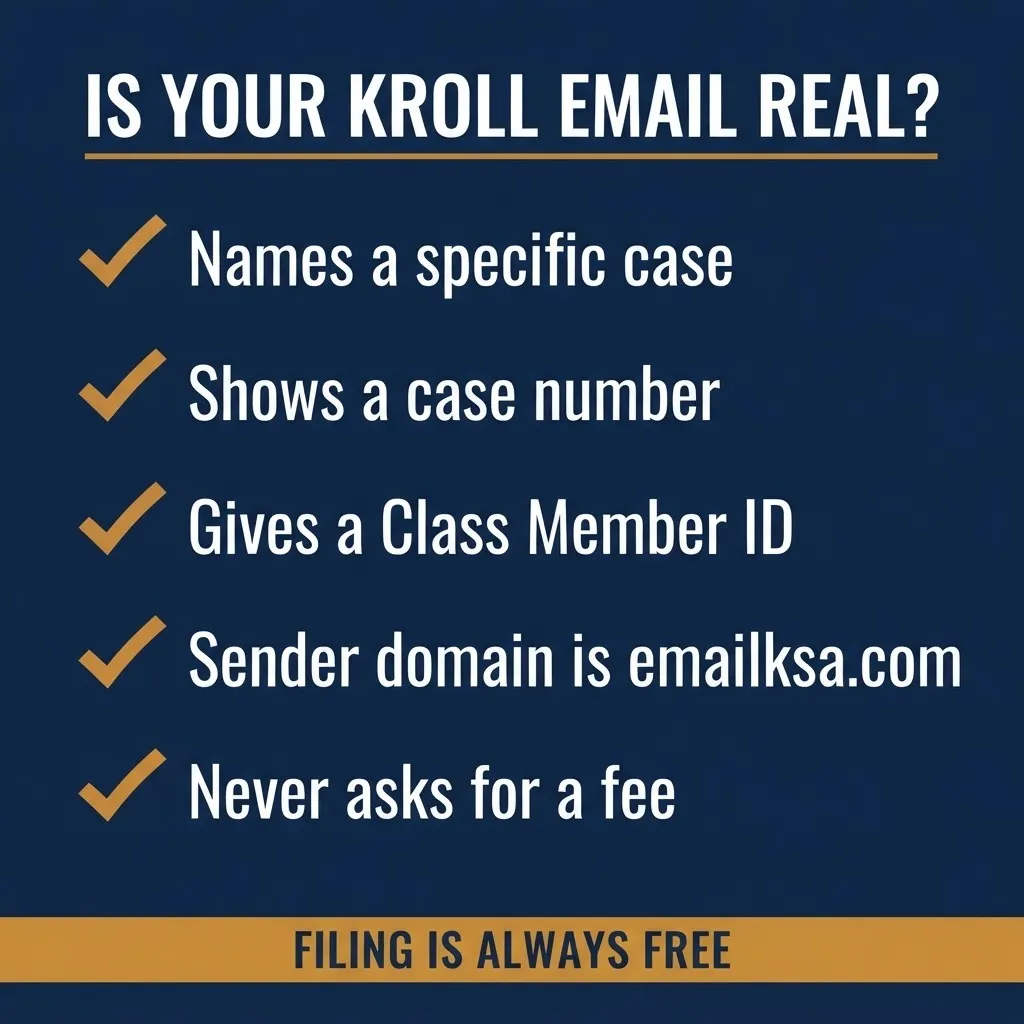
- Real Kroll notices come from case-specific addresses on the sending domain emailksa.com.
- No legitimate Kroll email asks for a fee, crypto, or a banking password.
A Kroll Settlement Administration email is usually legitimate, because courts appoint Kroll to notify class members by email. One documented real example used the address [email protected], confirmed by the school district whose families received it.
That said, impersonation is documented too. In April 2025, a federal bankruptcy court filed a formal phishing notice about fake emails sent from a lookalike Kroll address.
Below is how to separate the two, what the real notices pay, and where Kroll’s biggest current case stands. One detail most guides skip: a federal judge removed Kroll from a $600 million settlement in 2025, and Kroll agreed to pay $17.25 million back.
The Facts
| Case | Kroll-run class actions. Largest active: In re AT&T Inc. Customer Data Security Breach Litigation, MDL No. 3:24-md-03114-E |
| Status | AT&T settlement awaiting final approval, hearing held January 15, 2026 |
| Fund Size | $177 million in the AT&T case ($149M and $28M pools) |
| Est. Per Person | Not yet determined, pro rata after fees and costs |
| Claim Deadline | Closed December 18, 2025 in the AT&T case. Other cases differ |
| Administrator | Kroll Settlement Administration LLC |
| Proof Needed | Class Member ID from your notice. Documents only for loss claims |
Is a Kroll Settlement Administration email legit or a scam?
A Kroll Settlement Administration email is legitimate in most cases, because Kroll is a court-appointed administrator that sends notices by court order. Its appointment appears in federal and state court orders across dozens of cases.
Email notice is not optional. Settlement agreements routinely require the administrator to email every class member with a valid address on file.
What tells you it’s real:
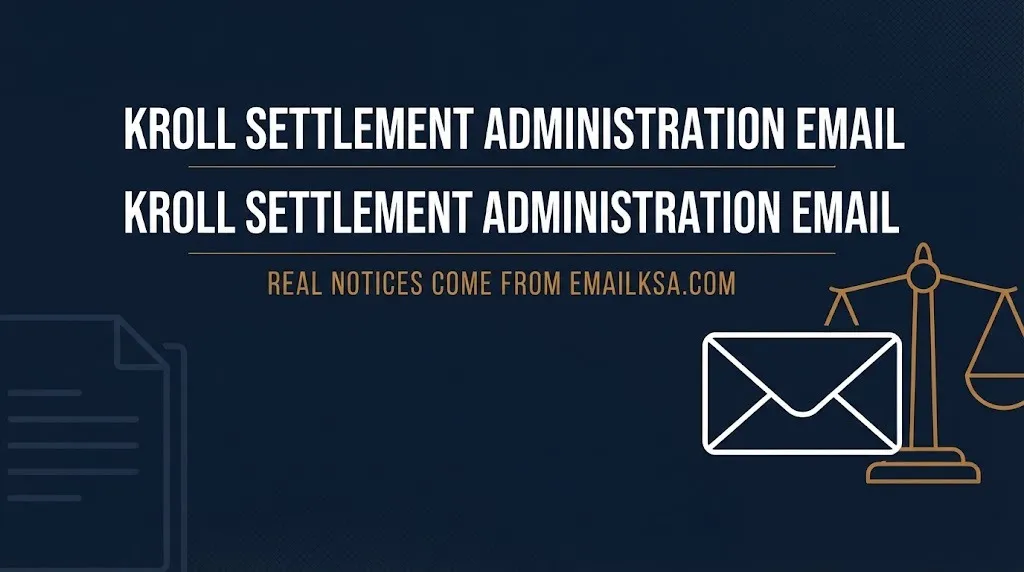
- It names a specific case and often a case number
- It points to one case-specific settlement website
- It includes a Class Member ID, Claim ID, or a unique PIN
- It asks for nothing you’d hesitate to write on a postcard
What tells you it’s fake:
- A demand for a fee to “release” your payment
- A request for your full Social Security number through a link
- Pressure to act within hours
- Any mention of gift cards, wire transfers, or cryptocurrency
Treat it like a package delivery text. You don’t click the link. You go to the source yourself.
What email address does Kroll send settlement notices from?
Real Kroll notices are sent from case-specific addresses on Kroll’s sending domain, emailksa.com. The pattern puts the case name before the address, then the shared sending domain after it.
One verified example comes from the PowerSchool Naviance settlement. The notice arrived from [email protected], and the school district publicly confirmed it as a court-approved notification.
What to check in the sender field:
- Open the full sender address, not just the display name.
- Look at the parent domain, the part right before “.com”.
- Confirm the case name in the address matches the case in the email.
- Watch for hyphens, extra letters, or swapped characters.
- Compare it against the contact details on the official settlement site.
Display names are trivial to fake. The domain is the part that’s hard to forge convincingly.
Note that Kroll’s restructuring and bankruptcy arm uses different domains from its class action group. That’s a source of confusion scammers exploit.
What does a real Kroll settlement email actually contain?
A genuine Kroll notice explains the case, your rights, the deadlines, and how to act, without demanding sensitive data upfront. Court-approved notice language is standardized, which makes deviations easy to spot.
Here’s what the AT&T notice program looked like in practice.
| Element | AT&T settlement detail |
|---|---|
| Case | In re AT&T Inc. Customer Data Security Breach Litigation |
| Case number | MDL No. 3:24-md-03114-E, N.D. Texas |
| Administrator | Kroll Settlement Administration LLC |
| Hotline | (833) 890-4930 |
| Mailing address | P.O. Box 5324, New York, NY 10150-5324 |
The court itself filed a notice on the docket in October 2025 listing Kroll’s contact information and stating the official site was the only authorized website for the case.
Real notices tell you not to contact the court or the defendant for claim information. Scam notices rarely bother.
Key Takeaway: A real Kroll email names the case, gives a Class Member ID, and asks for no money at any stage.
How much do Kroll settlement emails actually pay?
Payout amounts are set by the court and the settlement agreement, not by Kroll, and most are not yet determined when notices go out. Kroll processes claims. The judge approves the distribution plan.
The AT&T settlement shows how tiers work when they exist.
| Claim type | Reported maximum |
|---|---|
| Documented losses, first breach | Up to $5,000 |
| Documented losses, second breach | Up to $2,500 |
| Both breaches combined | Up to $7,500 |
| Standard tiered payment | Pro rata share, amount unannounced |
| Social Security number exposure | Five times the standard share |
Documented loss claims required paperwork showing losses fairly traceable to the specific breach. General inconvenience did not qualify for the higher tiers.
Roughly 4.38 million claims were filed against notices sent to about 99.7 million potential class members. The more valid claims filed, the smaller each pro rata share becomes.
Why doesn’t the email tell you your payout amount?
The email can’t give you a number because the amount isn’t calculated until claims are validated and the court approves fees. That’s a legal sequence, not evasion.
Three things must finish first: claim review, final approval, and the fee award. Only then can the administrator divide the net fund.
What gets deducted before you:
- Court-approved attorney fees and costs
- Administrative expenses and taxes
- Escrow fees
- Class representative service awards
In the AT&T case, the official settlement website states the amount available for cash payments is unknown. Any site quoting a final per-person AT&T figure is guessing.
Consider it like an insurance claim on a shared policy limit. Your share depends on how many other claims come in.
Reality Check: Kroll will never call or text you first to deliver settlement money, and filing a claim is always free. No real administrator asks for a fee, your banking password, gift cards, or cryptocurrency to release a payment. If a message claiming to be from Kroll demands any of those, it’s fraud, and you can report it to the FTC.
How do you verify a Kroll email before clicking anything?
Verify by going around the email, never through it. Type the official settlement address yourself or search the case name, then compare what you find against the message.
Public court records exist for a reason. A real class action settlement is documented on a docket you can look up.
Steps to confirm a notice:
- Read the case name and case number in the email body.
- Close the email and search that case name independently.
- Open the official settlement site directly, not through the message.
- Confirm the administrator listed there is Kroll Settlement Administration LLC.
- Check that the deadlines on the site match the email.
- Call the hotline printed on the official site, not the one in the email.
- If anything conflicts, stop and treat the email as suspect.
Federal cases appear on PACER. The court docket outranks any email.
Kroll’s class action group was formerly known as Prime Clerk, so older references to that name are not automatically a red flag.
What should you do if you already clicked or shared information?
Act immediately on the credentials and accounts you exposed, then document what happened. Speed matters more than certainty about whether the message was fake.
The documented phishing pattern targets exactly this moment. In one bankruptcy matter, fake emails asked recipients to supply wallet details to complete a claim.
If you gave information away:
- Change the password on any account you entered credentials for.
- Enable two-factor authentication on that account.
- Call your bank if you shared account or card details.
- Freeze your credit at Equifax, Experian, and TransUnion, which is free.
- Save the email with full headers as evidence.
- Report it to the FTC and to the real administrator through official contact details.
- Watch statements for small test charges over the following weeks.
Nothing about this makes you careless. Court notices are unfamiliar by design, and that’s the gap scammers work in.
Key Takeaway: Verify a settlement email through the official site and court docket, never through links inside the message itself.
How do you contact Kroll Settlement Administration directly?
Contact Kroll through the phone number and mailing address published on the official settlement website for your specific case. Each case has its own hotline and its own PO box.
There is no single universal Kroll claim line that covers every settlement. That’s why the case name on your notice matters.
Contact details confirmed in court filings:
- AT&T settlement hotline: (833) 890-4930
- AT&T settlement mail: P.O. Box 5324, New York, NY 10150-5324
- Kroll’s corporate settlement administration page, reachable by searching the company name
Reporting indicates Kroll uses a separate PO box in West Sacramento, California for many data breach notification mailings. Those envelopes are frequently breach notices offering credit monitoring, not settlement checks.
Never use contact details supplied only inside a suspicious message. Pull them from the official site or the court filing instead.
What should you do if Kroll sent you a deficiency notice?
A deficiency notice means your claim was submitted but something is missing or unverified, and it carries its own hard deadline. Ignoring it can disqualify your claim while still binding you to the settlement.
In the AT&T case, the deficiency and class membership verification response deadline was September 8, 2026. That date has passed.
What a deficiency response requires:
- Respond only through the method the notice specifies
- Provide the exact proof requested, not your whole file
- Do not resubmit documents already accepted unless told to
- Do not send sensitive documents by ordinary email
- Keep the confirmation and your Class Member ID
The official AT&T FAQ states that a claimant who fails to verify class membership by the deadline will not qualify for a benefit but stays bound by the agreement.
That asymmetry is worth saying plainly. You can lose the payment and keep the release.
Which Kroll settlements have been emailing people in 2026?
Kroll has sent notices this year on data breach, education technology, and consumer cases across several courts. The case names in your inbox will differ depending on which companies held your data.
Confirmed Kroll-administered matters with 2026 dates include the following.
| Case | Key 2026 dates |
|---|---|
| AT&T data breach (MDL 3:24-md-03114-E) | Hearing Jan 15, 2026; deficiency deadline Sept 8, 2026 |
| Cencora / The Lash Group data incident | Claim deadline Jan 19, 2026; hearing Feb 5, 2026 |
| PowerSchool Naviance | Email notice program active in 2026 |
| Jackson v. Ciox Health (Datavant) | Settlement announced May 20, 2026 |
The Cencora matter involved a $40 million fund before Judge Cynthia M. Rufe in the Eastern District of Pennsylvania. The Datavant case, in Maricopa County Superior Court, proposed $900,000.
Deadlines in each case are separate. Getting one Kroll email says nothing about whether you’re in another case.
Where does the AT&T settlement Kroll is running stand now?
The $177 million AT&T data breach settlement remains pending final approval, with no payment date announced. The final approval hearing was held January 15, 2026 before Judge Ada E. Brown in the Northern District of Texas.
No final order had been entered as of late August 2026, more than seven months after the hearing.
Where the money sits:
- Total fund: $177 million
- First breach pool: $149 million
- Second breach pool: $28 million
- Claims filed: roughly 4.38 million
- Claim window: closed December 18, 2025
The official settlement site confirmed in an April 2026 update that Kroll was reviewing and processing claims while the court considered approval.
A hearing is not an approval. A district judge faces no deadline to rule after a fairness hearing, and the wait says nothing about the outcome.
Key Takeaway: Kroll’s biggest current case has 4.38 million filed claims and still no final approval order.
When will Kroll settlement payments actually arrive?
Payment timing depends on the court, and no Kroll case publishes a distribution date before final approval. Three gates have to clear in order.
Those gates are final approval, expiration or resolution of appeals, and completion of claim validation.
The standard sequence:
- Claim deadline passes.
- Administrator reviews claims and issues deficiency notices.
- Court holds the final approval hearing.
- Judge enters a final approval order.
- Appeal window runs and any appeals resolve.
- Administrator calculates pro rata shares.
- Payments issue by the methods the agreement allows.
Reported payment methods across Kroll settlements include mailed check, direct deposit or ACH, PayPal, Venmo, Zelle, and virtual prepaid cards. Failed electronic payments typically fall back to a paper check.
It’s the delayed tax refund problem. The amount may be settled long before the money moves.
Who is Kroll Settlement Administration?
Kroll Settlement Administration LLC is a court-appointed class action administrator and part of Kroll, the global risk and financial advisory firm. Courts appoint it to run notice, claims processing, and distribution.
Its class action group was formerly known as Prime Clerk, and Kroll has publicly described more than 50 years of combined industry experience behind the practice.
What Kroll does and doesn’t do:
- Does: send court-approved notices by email and mail
- Does: operate the official case website and hotline
- Does: review claims and flag deficiencies
- Does: issue payments once the court authorizes them
- Doesn’t: decide who wins the case
- Doesn’t: set your payment amount
That last line matters. Calling Kroll to argue your payout is like calling the post office about a tax refund amount. Wrong office.
Kroll is one of roughly a dozen administrators courts regularly appoint. Others include Epiq, Angeion, and similar firms.
Has Kroll ever been removed from a settlement?
Yes. On June 11, 2025, U.S. District Judge Benita Y. Pearson removed Kroll as administrator of the $600 million East Palestine train derailment settlement with Norfolk Southern.
The court found sufficient reason to believe Kroll had not properly implemented the court-approved Plan of Distribution. Epiq Class Action and Claims Solutions was appointed in its place.
What the record shows:
- More than 55,000 claims were filed in that settlement
- The court cited miscalculated Voluntary Exposure payments
- Kroll acknowledged roughly $4.8 million in overpayments from calculation errors
- Class counsel pursued a civil contempt process over the failures
- In December 2025, the court approved Kroll paying $17,250,000 to the settlement class
Payments to residents were delayed for more than a year while an audit ran.
This is an administration failure, not fraud. Money from Kroll-run settlements is still real money, but the record undercuts any claim that administrators never make mistakes worth checking.
Why did you get a Kroll email when you never joined a lawsuit?
You received it because class members are identified from a company’s own records, not because you signed up for anything. Defendants hand over customer lists, and the administrator emails everyone on them.
That’s how class actions work. You’re in the class by circumstance, then you choose whether to claim, opt out, or do nothing.
Common reasons an email lands in your inbox:
- A company you used had a data breach
- You bought a product covered by the class definition
- You held an account during a defined class period
- Your child used a platform a school district licensed
Doing nothing usually means staying in the class and giving up the right to sue over the released claims. Opting out preserves that right but forfeits the payment.
Check your spam folder before assuming you were excluded. Court notices get filtered constantly.
Key Takeaway: You’re included in a class because of a company’s records, not because you ever opted in.
Is a Kroll letter the same as a Kroll email?
No. Kroll sends several different mail types, and a great many of them are not settlement notices at all. The most common physical envelope is a data breach notification offering free identity monitoring.
Those come from a Kroll mailing operation, reported as a West Sacramento, California PO box. Receiving one does not mean a settlement exists.
| What arrives | What it usually means |
|---|---|
| Breach notice letter | Your data was exposed. Monitoring offered, no payment |
| Class notice email | A settlement exists. Deadlines apply |
| Deficiency notice | Your claim needs more information |
| Payment email or check | The court approved distribution |
Read the document type before reacting. A monitoring offer and a settlement claim form are different animals with different deadlines.
Kroll settlement mail typically arrives care of Kroll Settlement Administration LLC at a case-specific PO box, with the case name printed on it.
What happens next for Kroll-administered settlements?
Pending: Judge Ada E. Brown’s final approval ruling in the AT&T data breach settlement. No decision date has been set.
After approval: The appeal window opens, and payments cannot issue until it closes or appeals resolve.
Expected after that: Kroll finishes claim validation and calculates pro rata shares.
Expected later: Distribution by check, ACH, PayPal, Venmo, Zelle, or virtual prepaid card, depending on the agreement.
Ongoing: New Kroll email notice programs launch as courts grant preliminary approval in other cases.
Frequently Asked Questions
Is the email from Kroll Settlement Administration a scam?
Usually no. Kroll is a real court-appointed administrator that sends notices by court order.
Verify the case name on the official settlement website before acting on anything.
What domain do real Kroll settlement emails come from?
Case-specific addresses on Kroll’s sending domain, emailksa.com.
One confirmed example was [email protected] in the Naviance case.
Does Kroll ever ask for money to release a payment?
No. Filing a claim and receiving a payment are always free.
Any fee demand, gift card request, or crypto request is fraud.
Why hasn’t the AT&T settlement paid anyone yet?
The court has not entered a final approval order after the January 15, 2026 hearing.
Payments cannot be authorized until approval, appeals, and claim validation all finish.
Can I still file an AT&T settlement claim?
No. The claim window closed December 18, 2025 and claim forms are no longer available.
The September 8, 2026 deficiency deadline applied only to existing claimants.
How do I check my Kroll claim status?
Use the official settlement website for your case with your Class Member ID or Claim ID.
You can call the hotline printed on that site if you lost the number.
Was Kroll ever fired from a settlement?
Yes. A federal judge removed Kroll from the $600 million East Palestine settlement on June 11, 2025.
Kroll later agreed to pay $17.25 million to the settlement class.
Does a Kroll letter mean I’m owed money?
Not necessarily. Many Kroll mailings are data breach notices offering credit monitoring, not payments.
Read the document type before assuming a settlement exists.
Open your notice, find the case name, then verify it on the official settlement website yourself. Save your Class Member ID somewhere you’ll find it again.
If you filed in the AT&T case, keep your confirmation and update your contact details. That settlement still has no final approval order as of September 16, 2026.