Erb’s Palsy Lawsuits 2026: Settlement Amounts, Averages, and How Claims Work
Quick Answer
- Erb’s palsy lawsuits are individual medical malpractice claims, not a class action with one payout.
- Recent awards range from about $1 million to $6.71 million in the US and £325,000 to £2.6 million in the UK.
- No claim deadline exists because there is no fund. State and UK limitation rules set your filing window.
If you searched “Erb’s palsy lawsuits” hoping to find one settlement to file against, that is not how this works. Erb’s palsy claims are birth injury malpractice cases, and each one is filed against the specific doctor, midwife, or hospital involved in that delivery.
That means no settlement administrator, no claim form, and no shared payout pool. What does exist: a long track record of verdicts and settlements, with wide ranges depending on injury severity and state caps.
This article breaks down real 2025 and 2026 numbers, the factors that drive value, state-by-state rules, and how the Montgomery case reshaped consent law in the UK. One number that surprises most readers: the average birth injury malpractice settlement sits around $1 million.
The Facts
| Case | Erb’s palsy birth injury claims (individual, not class action) |
|---|---|
| Status | Ongoing individual claims and trials, no settlement fund |
| Fund Size | Not applicable, no central fund exists |
| Est. Per Person | About $1 million average US, up to $6.71 million verdicts |
| Claim Deadline | State statute of limitations, often 2 to 5 years, or by child’s 11th birthday in Maryland |
| Administrator | None, claims handled by your attorney against the provider |
| Proof Needed | Medical records, expert testimony, evidence of negligence |
Is the Erb’s palsy lawsuit real or a scam?
Erb’s palsy lawsuits are real. They are medical malpractice claims filed against doctors, midwives, and hospitals when excessive force during delivery damages the brachial plexus nerves.
There is no central fund, no claim portal, and no mass settlement. Every case is filed individually, usually by the child’s parents as guardians. If someone promises you a payout from an “Erb’s palsy settlement fund,” that is a scam.
The injury itself is real and documented. According to NIH data, Erb’s palsy occurs in about 2.9 per 1,000 live births . Many cases resolve with therapy. Severe cases cause permanent weakness or paralysis in one or both arms.
A real claim requires proof that negligence caused the injury. That usually means showing the provider used excessive traction, failed to perform the McRoberts maneuver, or delayed a needed C-section .
How much is an Erb’s palsy lawsuit settlement worth in 2026?
An Erb’s palsy lawsuit settlement is worth anywhere from a few hundred thousand dollars to over $6 million, depending on injury severity, the strength of the negligence evidence, and the jurisdiction’s damage caps.
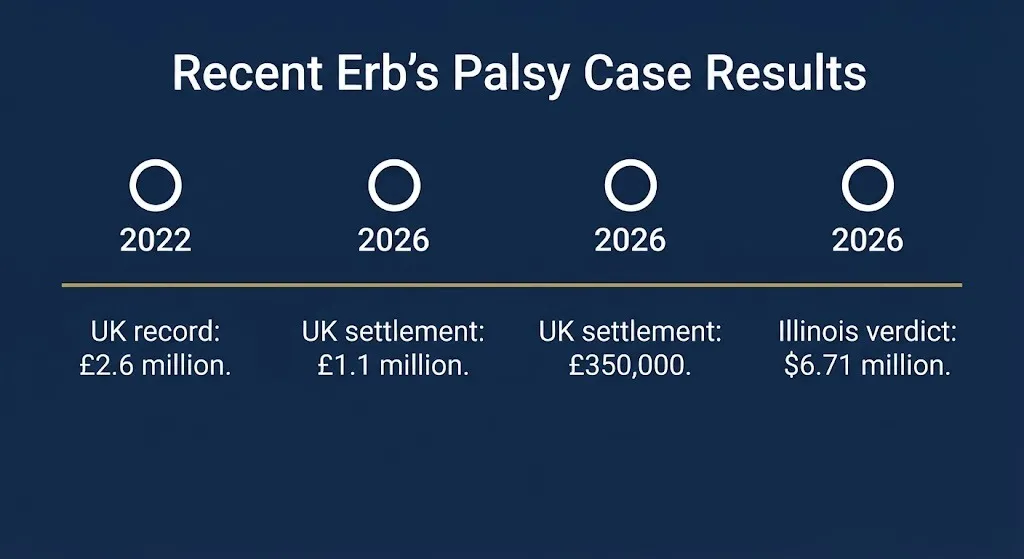
Recent verified awards and settlements:
| Case | Amount | Jurisdiction | Year |
|---|---|---|---|
| Bilateral arm paralysis verdict | $6,716,000 | Illinois | 2026 |
| Record UK Erb’s palsy settlement | £2,600,000 | UK | 2022 |
| Group II Erb’s palsy settlement | £1,100,000 | UK | 2026 |
| Group II Erb’s palsy settlement | £940,000 | UK | 2026 |
| Permanent brachial plexus settlement | £350,000 | UK | 2026 |
| Luton birth negligence settlement | £325,000 | UK | 2026 |
| Permanent arm injury settlement | $1,000,000 | New York | 2026 |
The average birth injury malpractice settlement sits around $1 million, according to data from Sokolove Law . That is an average, not a floor or ceiling. Severe bilateral injuries with lifelong care needs push higher.
Not yet determined: Any individual case’s exact value. No public dataset of Erb’s palsy settlements exists.
Reality Check
No one will text you Erb’s palsy settlement money first. These are individual malpractice claims, not a class action fund. Filing is handled through your attorney, and reputable birth injury lawyers work on contingency with no upfront fee. If someone charges you a fee to “process” an Erb’s palsy claim, that is a scam.
Who may qualify for an Erb’s palsy lawsuit?
You may qualify for an Erb’s palsy lawsuit if your child’s brachial plexus injury was caused by medical negligence during delivery. The injury alone is not enough. You must show the provider breached the standard of care.
Common qualifying scenarios:
- Excessive traction applied during shoulder dystocia
- Failure to perform the McRoberts maneuver, which has a 90 percent success rate
- Improper use of forceps or vacuum extractors
- Failure to order a timely C-section for a large baby
- Failure to recognize or respond to shoulder dystocia
- Assigning a high-risk breech delivery to an inexperienced resident
Risk factors that support a claim include macrosomia (large baby), maternal diabetes, breech position, and prolonged second-stage labor .
You do not qualify just because your child has Erb’s palsy. Some cases happen without negligence. An experienced attorney can review your records and tell you whether a claim is viable.
How do you file an Erb’s palsy lawsuit?
You file an Erb’s palsy lawsuit by hiring a birth injury attorney, gathering medical records, and filing a complaint in the appropriate court before the statute of limitations runs out.
Steps to file:
- Contact a birth injury attorney for a free case review
- Request all prenatal, delivery, and postnatal records
- Have a medical expert review the records for negligence
- File a notice of claim if your state requires one
- Submit a Certificate of Qualified Expert in states like Maryland
- File the complaint in circuit or superior court
- Complete discovery and expert depositions
- Negotiate a settlement or proceed to trial
Most Erb’s palsy cases settle before trial. The Sullivan Papain case settled at mediation in July 2026, just two months before trial was scheduled . The $6.71 million Illinois verdict went to a jury only after the defense refused to accept shared responsibility .
Key Takeaway: Erb’s palsy claims require proof of negligence, not just the injury. Most settle before trial, but verdicts can reach $6.71 million in severe bilateral cases.
What is the average Erb’s palsy settlement amount?
The average Erb’s palsy settlement is not published in any official dataset. Attorney-reported figures suggest a range of hundreds of thousands to over $1 million for moderate to severe cases.
Sokolove Law reports an average birth injury malpractice settlement around $1 million . The Birth Injury Lawyers Group describes a range from “hundreds of thousands of dollars to over one million dollars” .
Factors that push settlements higher:
- Permanent versus temporary injury
- One arm versus both arms affected
- Need for future surgeries or lifelong therapy
- Lost parental income during care
- Reduced lifetime earning capacity for the child
- Whether the provider’s conduct was egregious
Factors that limit settlements:
- State caps on non-economic damages
- Weak evidence of causation
- Shared fault by the parents (rare but possible)
- Expired statute of limitations
Maryland caps non-economic damages at about $905,000 for 2025, though economic damages have no cap . Alabama’s medical malpractice cap is lower. Jurisdiction matters enormously.
What is the Montgomery Erb’s palsy lawsuit?
The Montgomery Erb’s palsy lawsuit is a landmark UK Supreme Court case, Montgomery v Lanarkshire Health Board, that changed how doctors must obtain informed consent. The case involved shoulder dystocia and Erb’s palsy.
Mrs Montgomery was diabetic and expected a large baby. Her consultant put the risk of shoulder dystocia at 9 to 10 percent. He did not tell her that risk because he believed serious harm was unlikely .
During delivery in 1999, shoulder dystocia occurred. The baby was deprived of oxygen and suffered hypoxic brain damage and Erb’s palsy.
Mrs Montgomery argued she should have been told about the shoulder dystocia risk and offered a C-section. She said she would have chosen the surgery. Lower courts dismissed her claim. The UK Supreme Court ruled in her favor in 2015.
The decision shifted the test from what a reasonable doctor would disclose to what a reasonable patient would want to know . It raised the burden on doctors to discuss material risks and alternatives before treatment.
How do state damage caps affect Erb’s palsy settlements?
State damage caps affect Erb’s palsy settlements by limiting how much you can recover for non-economic losses like pain and suffering. Economic damages are usually not capped.
Examples of state rules:
| State | Non-Economic Cap | Filing Deadline |
|---|---|---|
| Maryland | About $905,000 (2025) | Child’s 11th birthday |
| Alabama | Lower cap applies | 2 years, exceptions for minors |
| Illinois | No cap in this case | Varies by discovery rule |
| New York | No cap | Continuous treatment doctrine may toll |
Maryland allows full recovery of economic damages: medical care, therapy, adaptive equipment, special education, and lost parental wages . The non-economic cap still represents meaningful compensation for a child’s restricted life.
In the UK, there are no statutory caps. Awards are based on assessed need. The record settlement of £2.6 million in 2022 exceeded the previous high of under £2 million .
How does the continuous treatment doctrine affect filing deadlines?
The continuous treatment doctrine can extend your filing deadline if your child received ongoing care related to the original injury. But courts apply it narrowly.
In Ganess v. City of New York, a man born with Erb’s palsy in 1973 waited nearly 11 years to file. He argued the continuous treatment doctrine should toll the statute of limitations because he received follow-up care at a hospital clinic .
The New York Court of Appeals rejected that argument. The court said vague assertions of yearly visits were not enough. You must show an established, ongoing course of treatment related to the original condition.
The lesson: do not rely on the continuous treatment doctrine to buy time. File as soon as you suspect negligence. Evidence fades, records get lost, and memories blur.
Key Takeaway: State caps and filing deadlines vary widely. Maryland caps non-economic damages at about $905,000 and requires filing by the child’s 11th birthday. Do not wait.
How long do Erb’s palsy lawsuits take to resolve?
Erb’s palsy lawsuits typically take two to five years from filing to resolution. Complex cases with disputed liability can take longer.
The Bond Turner case was filed in 2020 after previous solicitors closed it. By the time new counsel was instructed, the mother’s own claim was already statute-barred. It took until 2026 to secure a £350,000 settlement .
The RWK Goodman case that settled for £1.1 million involved a 17-year-old client. The case had been running for years, with liability initially disputed on a 90/10 split before settling on full liability .
The Illinois case that produced the $6.71 million verdict involved a client born in 1990. The case took decades to reach trial .
Long timelines are common. Birth injury cases require extensive expert review, and defendants often fight hard. Patience and good counsel matter.
What happens next in a typical Erb’s palsy case?
Here is the expected path for most Erb’s palsy claims:
Initial consultation: Attorney reviews records at no cost.
Investigation: Medical experts assess negligence and causation. This can take months.
Notice and filing: Notice of claim filed if required, then the complaint.
Discovery: Depositions, document exchange, expert reports. Often 12 to 24 months.
Mediation or settlement conference: Most cases resolve here.
Trial: If no settlement, a jury decides. Verdicts can be higher but riskier.
Appeal: Either side can appeal, adding more time.
No deadline exists because this is not a settlement fund. Your state’s statute of limitations controls.
Frequently Asked Questions
Is there an Erb’s palsy settlement I can claim?
No. Erb’s palsy lawsuits are individual malpractice claims, not a class action.
There is no fund, no administrator, and no claim form.
You must file against the specific provider or hospital involved.
How much is the average Erb’s palsy settlement?
The average birth injury malpractice settlement is around $1 million.
Severe cases with lifelong care needs can exceed $6 million.
Every case is different, and no official dataset exists.
Can I still file an Erb’s palsy lawsuit years later?
It depends on your state’s statute of limitations.
Maryland requires filing by the child’s 11th birthday.
Some states use a discovery rule that may extend the deadline.
What is the Montgomery Erb’s palsy case about?
Montgomery v Lanarkshire Health Board is a UK Supreme Court case.
It changed how doctors must obtain informed consent.
The ruling favored the patient and raised disclosure duties.
Do I need a lawyer to file an Erb’s palsy claim?
Yes. These cases require medical experts and complex evidence.
Birth injury lawyers work on contingency with no upfront fee.
Representing yourself is not realistic for this type of case.
What proof do I need for an Erb’s palsy lawsuit?
You need medical records, expert testimony, and evidence of negligence.
The injury alone is not enough. You must show a breach of the standard of care.
Common proof includes excessive traction, failure to perform McRoberts, or delayed C-section.
How long does an Erb’s palsy lawsuit take?
Most cases take two to five years from filing to resolution.
Complex or disputed cases can take longer.
The 2026 Illinois verdict involved a client born in 1990.
Are Erb’s palsy settlements capped?
Economic damages are usually not capped.
Non-economic damages for pain and suffering are capped in many states.
Maryland’s cap was about $905,000 in 2025.
What should you do if your child has Erb’s palsy?
Gather your child’s medical records, including prenatal, delivery, and postnatal notes. Note any risk factors like large birth weight or shoulder dystocia. Contact a birth injury attorney for a free review before any deadline runs.
The number to remember: about $1 million average, but severe cases can reach $6.71 million. The deadline to remember: Maryland requires filing by your child’s 11th birthday, and other states have their own rules.
Do not wait. Evidence disappears, and deadlines do not move.