Food Poisoning Lawsuit Settlement Amounts in 2026: What Cases Really Pay
Quick Answer
- Yes, you can sue over food poisoning, but no single national settlement fund exists.
- No public average exists; most payouts are confidential, and one individual case reached $15.6 million.
- Filing deadlines run from one year (Kentucky, Louisiana) to six years (Maine); most states allow two.
A food poisoning lawsuit is a civil claim against the restaurant, maker, or seller of the food that made you sick. Food-safety attorney Bill Marler says individual cases have resolved from a few thousand dollars to $30 million.
No national fund exists, so there’s no single claim form to file. Your illness, your proof, and your state’s deadline decide what happens next. That deadline can be as short as one year.
This guide covers real settlement figures, severity tiers, and the evidence that expires first. One surprise: the only government dataset on awards is more than 20 years old.
| The Facts | |
|---|---|
| Case | No single case; individual injury suits and outbreak-specific class actions |
| Status | Ongoing, varies by outbreak |
| Fund Size | Not applicable, no single fund |
| Est. Per Person | No public average; attorney-reported range of a few thousand dollars to $30 million |
| Claim Deadline | 1 to 6 years depending on state; check yours |
| Administrator | None for individual suits; class actions name their own |
| Proof Needed | Medical records, lab-confirmed pathogen, proof of the meal or product |
Is there an official food poisoning lawsuit settlement in 2026?
No single official settlement covers food poisoning as a whole; each outbreak creates its own cases.
That’s why searches for one claim form go nowhere. Two different kinds of cases exist, and they pay for different things.
| Case type | Who it covers | What it usually pays for |
|---|---|---|
| Individual injury lawsuit | One sick person or family | Medical bills, lost wages, pain and suffering |
| Class action | Buyers of one recalled product | Purchase refunds, sometimes injury payments |
Boar’s Head shows the split. Its $3.1 million class fund reimbursed purchases made between May 10 and August 12, 2024. Families of people who died settled separately.
In the sources we checked, no food-poisoning-specific class claim period is open as of November 1, 2026. Several pages ranking for this topic describe “food lawsuits” with named companies, fund sizes, and fairness hearings. We couldn’t match those details to any court docket, CDC notice, or settlement administrator.
Why are food poisoning settlement amounts kept secret?
Most food poisoning settlements stay secret because both sides usually sign confidentiality terms.
Marler Clark, a food-safety law firm, says those clauses benefit the company and the victim. The result is a distorted public record. Only the biggest, most dramatic outcomes tend to surface.
Think of home prices if only mansions got listed. The “average” would mislead every buyer.
Severity stretches the spread even wider. A mild norovirus episode and an E. coli case ending in kidney failure can differ by a factor of 1,000, according to Marler Clark.
One caution: firms that publish these ranges earn fees from the cases they win. Treat every range as an informed estimate, not a court record.
What is the average food poisoning settlement?
No reliable average food poisoning settlement exists, because most payouts are never published.
The only government dataset is a USDA Economic Research Service study of 175 jury verdicts. It found an average expected award of $41,888. For wrongful death, the figure was $183,053.
| Measure | Figure | What it covers |
|---|---|---|
| Expected award, all cases | $41,888 | 175 jury verdicts, USDA study |
| Expected award, wrongful death | $183,053 | Same study |
| Plaintiffs who won at trial | Fewer than one-third | Same study |
| Individual case range | A few thousand dollars to $30 million | One attorney’s career, self-reported |
The data covers verdicts, not settlements, and it’s decades old. Fewer than one-third of those plaintiffs won anything.
So any site quoting a precise average is guessing. Marler’s own range shows why a single number can’t work.
Key Takeaway: No official average exists; the only government dataset covers 175 trial verdicts and is decades old.
What are food poisoning settlement amounts by illness severity?
Food poisoning settlement amounts track medical outcome, and five severity tiers describe the pattern best.
| Tier | Medical picture | Published dollar anchor |
|---|---|---|
| 1. Mild illness, no hospital | A few days, resolves alone | None published; often too small to litigate alone |
| 2. Hospitalized, full recovery | ER or inpatient care, recovery in weeks to months | None published |
| 3. Serious complications | HUS, Guillain-Barre syndrome, reactive arthritis | None published |
| 4. Permanent injury or organ damage | Dialysis, transplant, neurological harm | $15.6 million (Jack in the Box, 1993) |
| 5. Wrongful death | Often Listeria; elderly, pregnant, or immunocompromised victims | $183,053 expected trial award; $4 million reported (Boar’s Head, 2025) |
We left blanks on purpose. No verified public figure exists for tiers 1 through 3. Anyone quoting a dollar amount there isn’t citing a source.
Tier 1 cases rarely reach court alone. They matter most when they’re part of a larger outbreak with many plaintiffs.
What are the largest food poisoning settlements on record?
The largest known individual food poisoning settlement is $15.6 million, paid after the 1993 Jack in the Box E. coli outbreak.
Brianne Kiner, the most seriously injured survivor, suffered HUS, strokes, and permanent organ damage. Total settlements from that outbreak exceeded $100 million across hundreds of victims.
| Case | Amount | What it was |
|---|---|---|
| Jack in the Box, one survivor | $15.6 million | Individual injury settlement |
| Jack in the Box, all victims | More than $100 million | Combined settlements |
| Chipotle | $25 million | Criminal fine, described as the largest for food safety violations |
| Daily Harvest lentil crumbles | $7.67 million | Class fund, Southern District of New York |
| Mid America Pet Food | $5.5 million | Salmonella class fund; claims closed February 5, 2026 |
| Boar’s Head wrongful death | $4 million | Reported settlement, September 2025 |
| Boar’s Head class action | $3.1 million | Purchase reimbursement fund |
Read the table carefully. A criminal fine isn’t a payout to sick people. Class funds get split among many claimants.
Only the first row is one person’s recovery for catastrophic injury.
What factors raise or lower a food poisoning settlement?
Seven factors move a settlement up or down inside its severity tier.
- Pathogen and clinical course. E. coli O157:H7 causing HUS in a child differs sharply from a 48-hour norovirus case.
- Defendant conduct. Prior violations, known risks, or a failure to recall tainted product raise value.
- Victim vulnerability. Children under 5, adults over 65, pregnant women, and immunocompromised people face higher medical risk.
- Epidemiological evidence. CDC or state health department links, plus whole genome sequencing, strengthen a case.
- Outbreak size. Dozens of sick people usually point to a clear source.
- Defendant resources. A national chain with a $50 million policy presents different economics than a food truck.
- State law. Strict liability rules, negligence standards, and damage caps vary.
Marler Clark reports that cases tied to an investigated outbreak consistently settle for more than isolated ones. Prompt medical care and a lab-confirmed culture help most.
Key Takeaway: Severity, pathogen, and proof drive settlement value, and no source can responsibly give you one number.
Do class action food settlements pay more than individual lawsuits?
Class action food settlements usually pay refunds, while injury lawsuits pay for medical harm and losses.
| Feature | Class action | Individual lawsuit |
|---|---|---|
| Pays for | Mostly refunds; sometimes injuries | Medical harm and losses |
| Cost to join | Free claim form | Often a contingency fee; ask |
| Release | Payment may waive related claims | Negotiated in your settlement |
| Timing | Set by court approval dates | Often 12 to 24 months |
Boar’s Head denied wrongdoing in its class settlement, and a federal court approved it. Administrators warned that a rescheduled hearing or appeals could delay payments.
Read the release before you accept. Daily Harvest class members who were paid generally gave up related claims against the company.
It’s like taking store credit for a broken appliance. Fast, but it can close the complaint.
Reality Check: No one texts you settlement money first, and filing a legitimate class claim is always free. Be wary of any page naming a company, fund size, and hearing date you can’t find on a court docket or CDC notice. Several “food lawsuit” pages updated in October 2026 describe cases we couldn’t verify anywhere.
Are food poisoning settlements taxable?
Money received for physical illness or injury is generally not taxable federal income under IRS Section 104(a)(2).
The exceptions matter. Any portion of a settlement labeled punitive damages or interest is typically taxable. That split is negotiated, so it affects your bottom line.
Ask a tax professional before you sign. The label on each dollar can change what you owe.
Can you sue for food poisoning?
Yes, you can sue for food poisoning if you can link your illness to a specific food and a seller or maker at fault.
Lawyers choose from several legal theories: negligence, strict liability, breach of warranty, and product liability. Each can carry its own deadline.
You may have a case if:
- A doctor’s record or lab test confirms a foodborne illness.
- You can tie the illness to one meal or product.
- Other people got sick, or a health agency named the source.
- The seller or maker was negligent, or the product was defective.
- You’re still inside your state’s filing window.
Hospitalization isn’t required. But Marler Clark notes that cases without significant medical documentation are hard to pursue. Without records, proving both the illness and its source gets difficult.
Key Takeaway: Class funds refund purchases, injury lawsuits pay for harm, and both depend on proof you gather early.
How do you file a food poisoning lawsuit?
You file a food poisoning lawsuit by building medical and purchase evidence first, then filing a complaint before your state’s deadline.
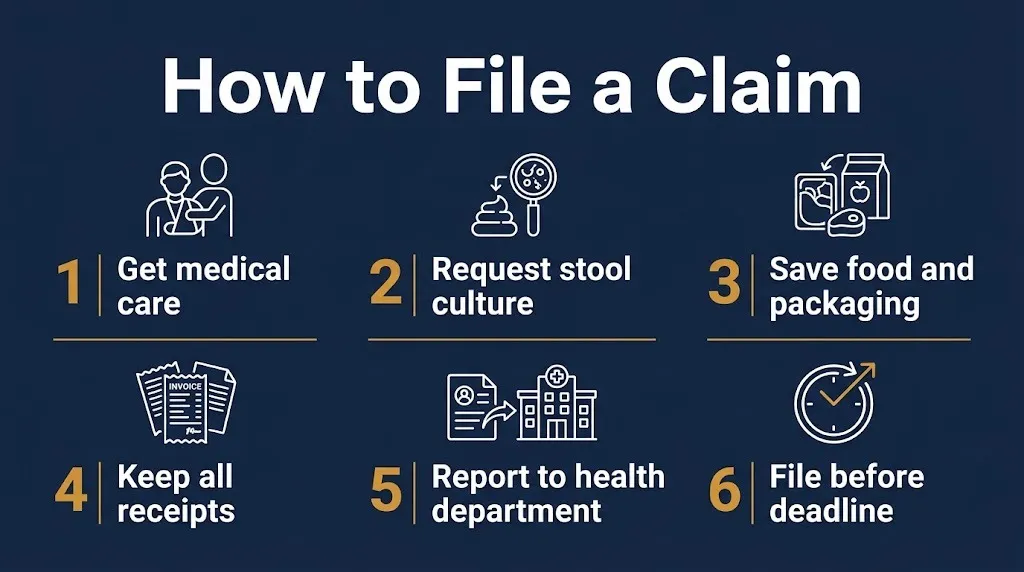
- See a doctor and ask for a stool culture.
- Refrigerate leftover food and packaging; don’t freeze them.
- Keep receipts, delivery confirmations, and card statements.
- Write down everything you ate in the 72 hours before symptoms.
- Report the illness to your local health department.
- Ask a food-safety attorney about evidence preservation letters.
- File suit before your state’s statute of limitations expires.
Preservation letters ask restaurants and suppliers to keep footage and records. Attorneys send them before surveillance video gets overwritten.
A class action works differently. You’d submit a free claim form to the settlement administrator, usually with a receipt or proof of purchase.
What evidence do you need to prove food poisoning?
You need proof of three things: the illness, the pathogen, and the food that carried it.
Most of that proof disappears fast. Here’s how quickly, based on Marler Clark’s guidance.
| Evidence | How fast it disappears |
|---|---|
| Stool culture | Must be collected within 48 to 72 hours of symptoms |
| Restaurant or store video | Often overwritten in 7 to 30 days |
| Leftover food and packaging | Frequently thrown away within days |
| Witness memory | Fades within weeks |
A confirmed pathogen is the backbone. Without one, linking you to a specific source gets much harder.
CDC data cited by Marler Clark suggests about 29 Salmonella cases go unreported for every confirmed one. Many of those lacked a timely lab sample.
How long do you have to file a food poisoning lawsuit?
Most states give you two years to file a food poisoning lawsuit, but the range runs from one year to six.
| Window | States (examples) |
|---|---|
| 1 year | Kentucky, Louisiana |
| 2 years | California, Texas, New York, Ohio, Pennsylvania, Illinois, Georgia, about 20 others |
| 3 years | Arkansas, D.C., North Carolina, South Carolina, Maryland, Montana, New Mexico, others |
| 4 years | Florida (negligence), Nebraska, Utah, Wyoming |
| 6 years | Maine |
Several rules can shift the clock:
- Discovery rule: In many states the clock starts when you knew the cause, not when you ate.
- Minors: Many states pause the clock until a child turns 18.
- Government food: School, military, or public-event claims can require notice within 60 to 180 days.
- Federal claims: The Federal Tort Claims Act requires an administrative claim within two years.
- Wrongful death: North Carolina allows three years for injury but two for wrongful death.
Ask a licensed attorney in your state to confirm your exact date.
Key Takeaway: The legal deadline gives you years, but the evidence gives you days.
Do you need a lawyer, and how do attorney fees work?
No law requires a lawyer, but outbreak cases turn on lab evidence, health agency records, and expert testimony.
Many food-safety firms work on contingency. That means fees come out of a recovery, and you owe nothing if the case loses. Case costs vary by firm, so ask who pays them if you lose.
Get three things in writing before you sign:
- The fee percentage
- Who covers case costs
- How costs are deducted from your share
Remember, firms publishing settlement ranges have a stake in your hiring them. Compare at least two before choosing.
How long does a food poisoning lawsuit take to settle?
Most food poisoning lawsuits settle within 12 to 24 months, though catastrophic or multi-plaintiff cases can run longer.
Marler Clark describes four phases: investigation, formal legal action, negotiation, and resolution. Most cases end in settlement, not trial.
During discovery, lawyers request the defendant’s internal records: HACCP plans, sanitation logs, temperature monitoring, employee illness policies, and supplier audits. That stage often moves slowly.
Think of a tax refund under review. Nothing moves until every document checks out.
Boar’s Head shows the range. Recalls began in July 2024. The first wrongful death case settled in December 2024 on confidential terms. A $4 million wrongful death settlement was reported in September 2025.
Which food poisoning lawsuits are active in 2026?
As of November 1, 2026, the sources we checked show filed lawsuits but no announced settlement amounts for 2026 outbreaks.
| Case | Key date | Status |
|---|---|---|
| The Kebab Shop and Olympia Foods, E. coli O157 | Filed May 29, 2026, Los Angeles County Superior Court | Pending; no settlement reported |
| Live it Up Greens, Salmonella | 45 infected in 21 states as of January 14, 2026 | First federal suits filed |
| Ramsey’s Diner desserts, Salmonella | Lawsuit reported April 18, 2026 | Pending; 68 cases linked |
| Boar’s Head, Listeria | 2024 outbreak | Class fund approved; wrongful death cases settled |
| Mid America Pet Food, Salmonella | Claim deadline February 5, 2026 | Closed |
The Kebab Shop filing was brought by Marler Clark and Quirk Law Firm for a mother and her child. Nine Californians were infected, six of them children. A separate Orange County suit involves a 3-year-old Costa Mesa girl with acute kidney failure.
Pending cases show allegations, not findings. Courts haven’t ruled on them.
Key Takeaway: 2026 outbreak cases are filed but unresolved, so no verified payout figures exist yet.
What causes the food poisoning cases that end up in court?
Court cases mostly involve bacteria like Salmonella, E. coli, and Listeria, because they cause the most severe harm.
CDC estimates that 48 million Americans get sick from foodborne disease each year. About 128,000 are hospitalized, and 3,000 die. The estimate comes from CDC’s 2011 national report.
Known pathogens explain only a fraction. Thirty-one of them cause 9.4 million illnesses a year, while 38.4 million come from unspecified agents. Among known pathogens, Salmonella causes about 35% of hospitalizations and 28% of deaths.
Incubation times complicate cases:
- Staphylococcus aureus: 1 to 6 hours
- Listeria: 1 to 4 weeks
- Hepatitis A: 15 to 50 days
Long-term harm adds weight. Marler Clark cites more than 200,000 Americans a year developing lasting conditions, including about 164,000 cases of irritable bowel syndrome and 33,000 of reactive arthritis.
What happens next if you think you have a case?
Your next steps follow evidence deadlines first and legal deadlines second.
Today: Document symptoms, save food and packaging, and keep every receipt.
Within 48 to 72 hours of symptoms: Ask for a stool culture before the lab window closes.
Within 60 to 180 days: File notice if a government-run facility served the food.
Expected 12 to 24 months after filing: Most cases settle, often after discovery.
1 to 6 years after illness: Your state’s statute of limitations closes the courthouse door.
Frequently Asked Questions
How much is a food poisoning lawsuit worth?
No verified average exists, and values depend on illness severity.
Attorney Bill Marler reports individual cases from a few thousand dollars to $30 million.
Mild cases often settle for far less than hospital cases.
Can I sue a restaurant if I never went to the hospital?
You can, but cases without medical records are hard to pursue.
A confirmed stool culture strengthens any claim.
Without it, proving the illness and its source gets difficult.
Is there a food poisoning class action I can claim right now?
In the sources we checked, no food-poisoning-specific class claim period is open as of November 1, 2026.
Boar’s Head and Mid America Pet Food claims have closed.
Check each official settlement website before you act.
What is the highest food poisoning settlement ever?
One of the largest known is $15.6 million, paid to Brianne Kiner after the 1993 Jack in the Box outbreak.
She suffered HUS, strokes, and permanent organ damage.
Total settlements from that outbreak exceeded $100 million.
Does the clock start when I eat or when I get sick?
In most states it starts when you knew or should have known the food caused your illness.
That’s called the discovery rule.
It matters most for slow pathogens like Listeria.
Can I sue if my child got sick?
Yes, a parent or guardian can file for a child at any time.
Many states pause the deadline until a child turns 18.
Filing early still protects evidence.
How long until I get paid after a settlement?
Payment timing depends on the agreement, and we found no verified standard timeline.
Class action administrators warn that appeals or rescheduled hearings can delay checks.
Individual settlements follow the terms your lawyer negotiates.
Start with the facts you can control. Save the food, request the test, and keep every receipt. If a class claim opens, confirm it on the official settlement website before filing anything.
Your state’s deadline, anywhere from one to six years, is the date that counts.