Ford EcoBoost Class Action Lawsuit 2026: Status, Cases, and What Owners Can Do
Quick Answer
- Yes, several real Ford EcoBoost lawsuits exist, but no settlement, claim form, or payout is available.
- Payout amounts are not yet determined; no court has certified a class in the active coolant cases.
- No claim deadline exists because no settlement exists; class certification remained undecided in an August 2026 case update.
The Ford EcoBoost class action lawsuit is real, but it isn’t one case. Four separate federal lawsuits target four different engine families, and none has produced a settlement.
The biggest, Miller v. Ford, covers 1.5L, 1.6L, and 2.0L engines in the Eastern District of California. Its proposed classes span 19 states. The court hasn’t decided whether to certify them.
This guide sorts each case by status, money, and what you can do today. One surprise: the case over 2.7L and 3.0L engines was dismissed in March 2026, even though Ford recalled some of those engines.
| The Facts | |
|---|---|
| Case | Miller v. Ford (No. 2:20-cv-01796) and Nelson v. Ford (No. 2:24-cv-02231), Eastern District of California |
| Status | Pending; class certification briefing; no class certified |
| Fund Size | Not yet confirmed; no settlement |
| Est. Per Person | Not yet determined |
| Claim Deadline | None; no settlement or claims process exists |
| Administrator | Not yet appointed |
| Proof Needed | Check claim form if one is ever approved; keep repair records now |
Is there a Ford EcoBoost class action lawsuit in 2026?
Yes, but it’s really four separate federal cases, each aimed at a different EcoBoost engine.
| Case | Engine | Court | Status as of November 1, 2026 |
|---|---|---|---|
| Miller v. Ford | 1.5L, 1.6L, 2.0L | E.D. California | Pending; class certification briefing |
| Nelson v. Ford | 2.3L | E.D. California | Pending; class certification briefing |
| Barkus v. Ford | 2.7L, 3.0L V6 | E.D. Michigan | Dismissed (reported March 28, 2026) |
| Bolton v. Ford | 1.0L three-cylinder | D. Delaware | Named plaintiffs voluntarily dismissed (reported December 1, 2024) |
Most pages blur these cases together. That’s how owners end up asking about a lawsuit that doesn’t exist. Each case has its own plaintiffs, vehicles, and rulings.
Only the two coolant cases remain active. A proposed class action isn’t a settlement. It’s a request for permission to sue on behalf of many owners at once.
Is the Ford EcoBoost class action lawsuit real or a scam?
The lawsuits are real, but no official payout exists to claim today.
You can verify them yourself. Federal filings sit on PACER under public case numbers.
- Miller v. Ford Motor Company: No. 2:20-cv-01796-DAD-CKD
- Nelson v. Ford Motor Company: No. 2:24-cv-02231-DAD-CKD
- Bolton v. Ford Motor Company: No. 1:23-cv-00632, District of Delaware
- Barkus v. Ford Motor Company: Eastern District of Michigan
Plaintiffs’ counsel in the coolant cases include Capstone Law, Kershaw Talley Barlow, Lieff Cabraser Heimann & Bernstein, Berger Montague, Newsom Law, and Thrash Law Firm. Those firms recruit owners, so expect contact forms on their pages.
Here’s the scam signal. At least two 2026 guides ranking for this topic discuss owner compensation. No fund, administrator, or claim form exists to back that up.
Has Ford settled the EcoBoost class action lawsuit?
No, Ford hasn’t settled any EcoBoost class action as of November 1, 2026.
An August 2026 case update from Kershaw Talley Barlow says the court hasn’t ruled on class certification. We found no settlement notice, preliminary approval order, or administrator for any of the four cases.
What Ford has done instead is issue recalls and repair programs, with mixed results for owners.
| Engine | Ford’s response |
|---|---|
| 2.7L, 3.0L V6 | 2024 recall plus a warranty extension (program 24N12) up to 10 years or 150,000 miles |
| 1.0L three-cylinder | Oil pump drive belt recall for 2016 to 2018 Focus and 2018 to 2022 EcoSport |
| 1.5L, 1.6L, 2.0L | Coolant-level sensors, which plaintiffs call a stopgap |
| 2.3L | Low-coolant sensors and calibration changes, per plaintiffs; no recall verified |
A voluntary dismissal, like the one in the 1.0L case, doesn’t prove money changed hands. The reports we found don’t disclose any terms.
Key Takeaway: Four separate Ford EcoBoost lawsuits exist, but none has produced a settlement, fund, or claim form.
Which Ford EcoBoost engines and vehicles are involved?
Four EcoBoost engine families appear in the lawsuits, and each case lists different vehicles.
| Engine | Models and years | Limits |
|---|---|---|
| 1.5L, 1.6L, 2.0L (Miller) | 2013 to 2019 Escape and Fusion; 2015 to 2018 Edge; 2016 to 2019 Lincoln MKC and MKZ | Proposed classes in 19 states |
| 2.3L (Nelson) | 2015 to 2024 Mustang; 2019 to 2024 Ranger; 2016 to 2024 Explorer; 2021 to 2024 Bronco; 2015 to 2020 Lincoln MKC; 2020 to 2022 Lincoln Corsair | California, Michigan, Florida law claims |
| 2.7L, 3.0L V6 (Barkus) | 2022 Bronco; 2021 to 2022 F-150, Edge, Explorer, Lincoln Nautilus, Lincoln Aviator | Dismissed |
| 1.0L (Bolton) | 2016 to 2017 Fiesta; 2018 to 2021 EcoSport; 2016 to 2018 Focus | Named plaintiffs dismissed |
Being listed isn’t the same as being in a class. No class exists yet in the two active cases.
Miller’s proposed classes cover buyers and lessees in these states: Arkansas, California, Colorado, Florida, Georgia, Illinois, Indiana, Kansas, Maryland, Michigan, Minnesota, Nebraska, New Jersey, North Carolina, Ohio, Tennessee, Texas, Washington, and Wisconsin.
Nelson is narrower. The court dismissed its nationwide fraudulent-concealment class claim.
How much money could you get from the Ford EcoBoost class action lawsuit?
Not yet determined. No settlement fund exists, and no court has certified a class in the active cases.
Any figure you see online is a guess. Here’s what we can and can’t say.
| Item | Status |
|---|---|
| Settlement fund | None |
| Per-owner payout | Not yet determined |
| Repair reimbursement | Not yet determined |
| Vehicle buyback | Sought in the 1.0L case; not granted |
| Attorney fees | Sought in the 1.0L case; amount not set |
| 2.7L, 3.0L damages | Filed claiming at least $5 million in total; case dismissed |
The $5 million figure is a filing threshold, not a payout. It tells you nothing about what any owner would receive.
Think of it like a store announcing a refund policy before writing the policy. The headline exists, but the rules don’t.
What are the plaintiffs asking Ford to pay or fix?
The plaintiffs want free permanent repairs, owner notification, and compensation, but no court has granted any of it.
These are allegations, not findings.
- Miller (coolant, 1.5L to 2.0L): Plaintiffs say faulty cylinder head seals let coolant leak into cylinders. They call Ford’s fixes “Band-Aid” measures.
- Nelson (coolant, 2.3L): Plaintiffs want Ford to notify all owners and stop sales until a permanent, no-cost repair exists.
- Bolton (1.0L oil pump): Plaintiffs sought vehicle buybacks and attorney fees. They alleged Ford knew of the problem by 2016.
- Barkus (2.7L, 3.0L): Plaintiffs said they overpaid for vehicles with defective intake valves.
Plaintiffs in the coolant cases also say replacement engines can fail the same way. They put out-of-warranty replacement costs at thousands or tens of thousands of dollars.
Key Takeaway: No payout figure exists; the lawsuits seek repairs, notice, and compensation that no court has ordered.
Can you get reimbursed for an EcoBoost repair right now?
Only through Ford’s own programs, and only for specific engines.
For the 2.7L and 3.0L V6 intake valves, Ford ran a recall covering a reported 90,736 vehicles. Dealers were told to test engines and replace failures. The warranty extension runs up to 10 years or 150,000 miles.
For the 1.0L, Ford recalled 2016 to 2018 Focus and 2018 to 2022 EcoSport vehicles over oil pump drive belt tensioner failures. A report put that recall at 139,730 vehicles.
For the coolant engines, no recall was verified as of our March 2026 report. A Ford technical service bulletin doesn’t extend your warranty. Federal rules require reimbursement of pre-recall repairs only if a recall happens, with exceptions for repairs done under warranty.
Reality Check: No one has a Ford EcoBoost claim form, and no one can legally promise you a payout today. Filing a legitimate class claim, if one opens, is always free. Skip any “claim helper” asking for a fee, a deposit, or your bank details upfront.
Can you join the Ford EcoBoost class action lawsuit?
You can’t join yet, because no class has been certified.
If a court certifies a class, it sets the class definition and the notice procedures. Members then receive official notice. Kershaw Talley Barlow says it’s too early to say who ends up in any class.
You may fall inside a proposed class if:
- You own or lease a listed model with the listed engine.
- Your model year matches the case table above.
- You bought or leased in one of Miller’s 19 states.
- For the 2.3L case, your claim arises in California, Michigan, or Florida.
Class certification also triggers opt-out rights. Opting out preserves your ability to sue separately, but it forfeits any class payment.
How do you protect your claim if you own an EcoBoost Ford?
You protect your claim by documenting the engine, the symptoms, and every repair dollar now.
- Confirm your engine size from your VIN or under-hood label.
- Match your model and year against the case tables.
- Gather your purchase or lease paperwork.
- Collect every repair order, invoice, and diagnostic report.
- Photograph coolant loss, warning lights, or white exhaust, and note dates.
- Ask your dealer to put any warranty refusal in writing.
- Report symptoms to NHTSA and keep the confirmation.
- Run your VIN through NHTSA’s recall lookup now and then.
Kershaw Talley Barlow recommends keeping records of repairs, out-of-pocket costs, and communications with Ford or dealers. Those same records would likely matter if a settlement ever opens.
Key Takeaway: You can’t claim anything yet, but repair records and written warranty refusals are the proof any future payout would likely require.
What does class certification mean, and when will the judge rule?
Class certification is the ruling that decides whether a lawsuit can proceed for a defined group of owners.
Miller and Nelson have reached that stage. The court told both sides to use consolidated briefing. No ruling and no verified hearing date exist as of November 1, 2026.
One site says certification hearings are approaching. We couldn’t verify a date.
The ruling matters for three reasons:
- A denial can shrink a case to a few named owners.
- A grant lets the case proceed for everyone in the class.
- A grant also opens the door to settlement talks and notice.
Certification isn’t a win on the merits. Plaintiffs would still have to prove the defect.
How long will the Ford EcoBoost class action lawsuit take?
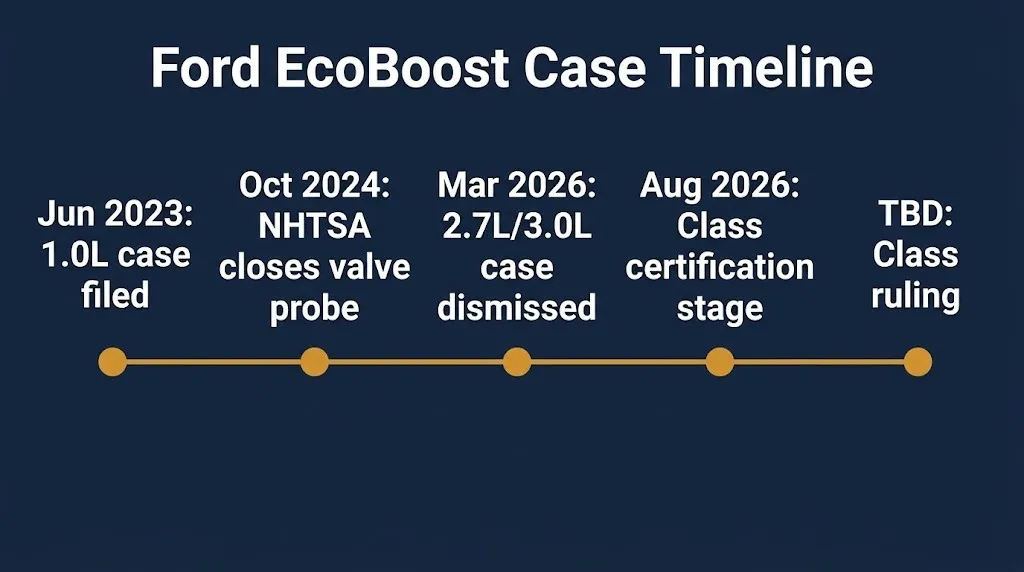
No one can say, and Miller is already six years old.
| Date | Milestone |
|---|---|
| 2020 | Miller filed (case number 2:20-cv-01796) |
| August 10, 2022 | Court granted in part and denied in part Ford’s motion to dismiss |
| March 7, 2023 | Hearing on Ford’s challenge to the amended complaint |
| June 2025 | 256-page consolidated complaint reported |
| August 2026 | Class certification briefing stage |
| TBD | Class certification ruling |
It’s like a warranty dispute bouncing between a dealer and a manufacturer. Each round resets the clock.
Settlement timing is unknowable. Class settlements also need preliminary approval, notice, and a final approval hearing.
Why was the 2.7L and 3.0L EcoBoost lawsuit dismissed?
Judge Terrence G. Berg dismissed Barkus v. Ford because the plaintiffs lacked standing to allege a defect in their own engines.
The plaintiffs hadn’t suffered an engine failure. They argued they overpaid for vehicles with defective intake valves.
The judge accepted that overpayment can be a real injury. But he said plaintiffs must plausibly allege a defect that’s widespread enough to reach their vehicles.
Three facts drove the ruling:
- Ford admitted defective valves in vehicles built May 1 through October 31, 2021, and recalled them.
- Ford argued the plaintiffs’ vehicles were built earlier.
- The judge said a recall alone doesn’t raise a plausible inference of defect.
NHTSA estimated about 1% of vehicles had defective valves at peak. The agency closed its 27-month probe in October 2024, and the lawsuit followed about six weeks later. Appeal status is not yet confirmed.
Key Takeaway: A judge tossed the 2.7L and 3.0L case because owners couldn’t show their own engines were defective.
What happened to the 1.0L EcoBoost oil pump lawsuit?
The 1.0L case, Bolton v. Ford, ended when the named plaintiffs voluntarily dismissed it, as reported December 1, 2024.
It was filed June 9, 2023, in the District of Delaware. It alleged an oil pump defect that can destroy the three-cylinder engine, often soon after the 60,000-mile powertrain warranty ends.
On July 8, 2024, the court largely denied Ford’s motion to dismiss. Ford had argued the recall made the case unnecessary. The judge said plaintiffs could claim their vehicles were worth less despite free recall repairs.
The court did dismiss express warranty claims, two Magnuson-Moss Warranty Act claims, equitable relief claims, and Michigan consumer claims. Ten named plaintiffs later dropped the case. The reports we found don’t disclose settlement terms.
What did NHTSA open against the 2.0L EcoBoost in September 2026?
NHTSA opened defect petition DP26008 against Ford on September 3, 2026, according to a September 11 report by The Auto Wire.
The listing names engine and engine cooling as the component. The summary reads “Loss of Motive Power.” The report ties it to 2015 to 2018 Ford Edge models with the 2.0L engine.
A defect petition is not an investigation or a recall. Under federal rules, NHTSA must notify the petitioner of its decision within 120 days of receiving the petition. If it denies the petition, it must publish its reasons.
The agency polices safety risk, not durability. In 2024, it denied a Hyundai petition after weighing the automaker’s warranty extension. That’s the bar here.
What is the alleged EcoBoost coolant intrusion defect?
The alleged defect is coolant leaking into the engine cylinders instead of staying in the cooling system.
Plaintiffs say it can cause overheating, cracked cylinder heads, oil dilution, corrosion, and fires. Kershaw Talley Barlow lists these owner symptoms:
- Low or disappearing coolant
- Overheating
- Misfires or rough running
- White exhaust smoke
- Warning lights
- Loss of power
- Repeated coolant top-ups
In the 2.3L case, plaintiffs say coolant leaks through grooves where the cylinder head meets the block, damaging the seal. Ford has faced this family of problems before. In March 2017, it recalled certain 1.6L vehicles over cylinder heads that could overheat and crack. Ford said it knew of 26 underhood fire reports.
Key Takeaway: Coolant intrusion is an allegation in two active cases, and no court has found it to be a defect.
What do Ford’s own service bulletins say about coolant intrusion?
Ford’s own bulletins describe coolant intrusion in 2.0L engines, though they don’t amount to a court finding.
In 2018, Ford issued Special Service Message 47204 for certain 2015 to 2018 Fusion, MKZ, MKC, Escape, and Edge models. It attributed rough running to coolant intrusion from corrosion on the engine block, according to The Auto Wire.
The test is simple. Technicians pressurize the cooling system to 20 psi for five hours. If it drops 4 psi, they pull the spark plugs and look for coolant.
Technical Service Bulletin 19-2346, dated December 19, 2019, formalized the fix as a long block replacement. The listed labor runs 15.0 hours for an all-wheel-drive Edge and 13.3 for front-drive.
A TSB tells dealers how to repair a car. It doesn’t oblige Ford to pay. That gap is why owners of older Edges often foot the bill.
What happens next?
Several decisions are pending, and none has a confirmed date.
Expected, date not yet confirmed: The court rules on class certification in Miller and Nelson.
Expected within 120 days of NHTSA receiving the petition: NHTSA grants or denies DP26008 (receipt date not yet confirmed).
If a class is certified: The court approves a class definition and orders notice to members.
If a settlement is reached: Preliminary approval, notice, a claim deadline, and a final approval hearing follow (all dates TBD).
Not yet confirmed: Whether Barkus plaintiffs appeal or refile.
Frequently Asked Questions
Is there a Ford EcoBoost settlement I can claim?
No, no Ford EcoBoost settlement is open for claims as of November 1, 2026.
None of the four cases has a fund, administrator, or claim form.
Check court records before trusting any claim site.
Which Ford EcoBoost engines are named in the lawsuits?
Four engine families are named: 1.0L, 1.5L to 2.0L, 2.3L, and the 2.7L and 3.0L V6s.
Only the 1.5L to 2.0L and 2.3L cases remain active.
Each case lists specific models and years.
Can I sue if my EcoBoost engine was never recalled?
Possibly, but the 2.7L and 3.0L case failed partly because plaintiffs couldn’t show their own engines were defective.
The coolant cases allege defects without a recall.
Whether those claims succeed is undecided.
How much will I get from the Ford EcoBoost class action?
The amount is not yet determined because no settlement or certified class exists.
Lawsuits seek repairs, notice, and compensation.
No court has ordered any of it.
Do I need my own lawyer to be in a class action?
If a class is certified, the court sets notice procedures, and members typically don’t need their own lawyer.
Individual claims are different.
Ask any attorney about fees and costs in writing.
Does Ford’s warranty extension cover my engine?
It may, if you have a recalled 2.7L or 3.0L vehicle covered by program 24N12.
The extension runs up to 10 years or 150,000 miles.
Confirm your VIN with a Ford dealer.
Where can I check the court records?
Federal filings are on PACER under the case numbers for Miller and Nelson.
Miller is No. 2:20-cv-01796-DAD-CKD.
Nelson is No. 2:24-cv-02231-DAD-CKD.
Start with the facts you control. Confirm your engine size, match it to the case tables, and keep every repair order and written dealer refusal.
Then watch for the class certification ruling in Miller and Nelson. Until a court approves a settlement, no claim deadline, claim form, or payout exists.