Lisinopril Lawsuit 2026: Kidney Failure Claims, MDL Status, and Payouts
Quick Answer
- Lisinopril lawsuits would be individual injury claims; we found no MDL, class action, or settlement.
- Payouts are not yet determined; no fund exists, and published dollar ranges lack court records.
- No claim deadline exists; filing deadlines for injury suits vary by state, so check yours.
A lisinopril lawsuit is an individual injury claim. No class action, MDL, or settlement exists as of November 1, 2026.
This matters most to patients who developed acute kidney injury or kidney failure while taking the blood pressure drug. The FDA-approved label already lists acute renal failure as a possible effect.
This guide sorts verified facts from lead-generation marketing. One surprise: the main 2026 blood pressure drug settlement we found covers valsartan, losartan, and irbesartan, not lisinopril.
| The Facts | |
|---|---|
| Case | No single case; individual product liability claims against drug makers |
| Status | No lisinopril MDL, class action, or settlement verified |
| Fund Size | Not yet confirmed; none exists |
| Est. Per Person | Not yet determined |
| Claim Deadline | None; injury filing deadlines vary by state |
| Administrator | Not yet appointed; none exists |
| Proof Needed | Medical and pharmacy records; check any future claim form |
Is there a lisinopril lawsuit in 2026?
We found no named, docketed lisinopril lawsuit in public sources as of November 1, 2026.
That doesn’t mean no one has sued. Individual injury cases can be filed in state or federal court without any news coverage. It means nothing verifiable exists for you to join.
| Claim you’ll see online | Verified? | What we found |
|---|---|---|
| Lisinopril MDL | No | No Judicial Panel on Multidistrict Litigation order found |
| Lisinopril class action | No | None found |
| Lisinopril settlement | No | None found |
| Named kidney case with a docket number | Not yet confirmed | None matched |
| Lisinopril recalls | Yes | Two Class II recalls, 2024 and 2025 |
One competing 2026 guide describes active litigation in four states, discovery, and possible bellwether trials. We couldn’t match any of that to a docket or court order.
Is there a lisinopril class action or MDL?
No lisinopril class action or MDL exists in the records we checked as of November 1, 2026.
An MDL is a federal process that sends similar cases to one judge for pretrial work. The Judicial Panel on Multidistrict Litigation (JPML) decides whether to create one. It usually needs many filed cases first.
The PPI heartburn drug litigation shows the bar. The JPML turned down a first request in February 2017, when only 15 cases existed. It approved a second request on August 2, 2017, with 161 actions.
Any real MDL leaves a paper trail:
- A JPML transfer order
- An MDL number
- A named judge
- A master complaint
- Plaintiff fact sheet deadlines
One guide says an MDL is “possible in late 2026.” That’s speculation, not a filing.
Is the lisinopril kidney failure lawsuit real or a scam?
The kidney risk is documented on the drug’s label, but any page promising a lisinopril payout today is unverified.
One legal-marketing blog says lisinopril carries boxed warnings for kidney and liver damage. The current FDA label shows a boxed warning for fetal toxicity only. Kidney effects appear in the regular warnings section.
Treat these as scam signals:
- A guaranteed payout or “settlement amount”
- A deadline with no court order behind it
- A “claim center” that won’t name its law firm
- Any fee to check eligibility
Key Takeaway: No lisinopril MDL, class action, or settlement is verified, so any payout figure online is a marketing estimate.
Has anyone won or settled a lisinopril lawsuit?
We found no verified lisinopril settlement or jury verdict as of November 1, 2026.
A 2024 law-firm blog said it found no news stories or court records of lisinopril settlements. A 2023 explainer said the same about class actions. Our own search for 2026 turned up nothing new.
Individual settlements can be confidential, so silence isn’t proof that none exist. But a dollar figure with no case behind it isn’t evidence either.
| Claim made online | What we verified |
|---|---|
| Settlements from $50,000 to over $1 million | No settlement or verdict found |
| Wrongful death payouts of $500,000 and up | None found |
| Bellwether trials approaching | No MDL exists, so no bellwether pool |
| Active cases in four states | No matching docket found |
How much is a lisinopril kidney failure lawsuit worth?
Not yet determined. No settlement fund exists, and we found no published verdicts to benchmark against.
Value in any drug injury case depends on facts you can’t read off a website:
- Severity: recovered kidney function versus dialysis or transplant
- Proof that lisinopril, not another cause, drove the injury
- Other risk factors, such as diabetes, chronic kidney disease, or NSAID use
- Medical bills and lost income
- State law on damages
| Item | Status |
|---|---|
| Settlement fund | None |
| Per-patient payout | Not yet determined |
| Published verdicts | None found |
| Competitor dollar ranges | Unsourced |
It’s like pricing a house with no comparable sales. Anyone quoting a number is guessing.
Reality Check: No one texts you lisinopril settlement money first, and no lisinopril claim form exists. Be wary of sites that collect your medication history and call themselves “claim centers.” Never stop a prescribed drug because of an ad.
What would a lisinopril kidney failure case have to prove?
A case would have to prove lisinopril, not something else, caused your kidney injury.
The label makes that harder. It already warns that drugs acting on the renin-angiotensin system can cause changes in renal function, including acute renal failure. A defendant would point to that warning, plus any other risk factor in your chart.
A case generally needs these five pieces:
- A confirmed diagnosis, such as acute kidney injury or kidney failure.
- Pharmacy records showing the maker, dose, and dates.
- Lab results showing kidney function before and after.
- A medical expert tying the injury to the drug.
- A legal theory, such as a manufacturing defect or contamination.
If your doctor didn’t monitor your kidneys as the label directs, that may be a different claim against a provider. It follows different rules.
Key Takeaway: A lisinopril kidney claim turns on causation, because the label already warns of renal failure and names other risk factors.
Who may qualify to sue over lisinopril kidney failure?
You may have a claim worth a lawyer’s review if records tie a kidney injury to lisinopril use, but no one qualifies for payment today.
Reviewers typically look for these facts:
- A doctor diagnosed kidney injury during or after lisinopril use.
- Pharmacy records show your dose and dates.
- Lab results show kidney function changed after you started.
- An expert could plausibly link the injury to the drug.
- You’re within your state’s filing window.
Brand versus generic matters. Lisinopril comes as brand products like Prinivil and Zestril and as generics from makers such as Lupin and Camber. Pre-existing kidney disease can complicate a case, though it doesn’t automatically end one.
How do you file a lisinopril lawsuit?
You file a lisinopril lawsuit through an attorney who files a complaint in court, not through an online claim form.
- Request your full medical and kidney lab records.
- Get pharmacy records showing brand or maker, dose, and dates.
- Keep pill bottles and note the lot numbers.
- Write a timeline of symptoms, labs, and diagnoses.
- Report the reaction to FDA MedWatch.
- Ask a product liability attorney to review causation.
- File before your state’s deadline.
Ask any firm who pays case costs if the claim loses. Get fee terms in writing.
How long do you have to file a lisinopril lawsuit?
Filing deadlines for lisinopril injury claims are set by your state, and no lisinopril-specific deadline exists.
| Deadline type | Status |
|---|---|
| Class action claim deadline | None; no settlement exists |
| MDL registry deadline | None; no MDL exists |
| Injury statute of limitations | Varies by state; ask an attorney |
| Medical malpractice deadline | Differs by claim type; may be shorter |
Some states start the clock when you learned the injury might be drug-related. Others start at the injury. That difference can decide a case.
Think of it like a warranty clock that starts on different days depending on the store. Write down the date a doctor first mentioned your medication.
Key Takeaway: You can’t file for a payout today, but you can preserve the records any future case would need.
Should you stop taking lisinopril because of a lawsuit?
No, don’t stop lisinopril because of an ad; talk to your prescriber first.
The label says lowering blood pressure reduces the risk of fatal and non-fatal cardiovascular events, mainly strokes and heart attacks. Stopping on your own trades one risk for another.
Ask your prescriber these questions:
- Which kidney labs should I get, and how often?
- Do my other medicines raise kidney risk?
- Should I avoid NSAID painkillers?
- What symptoms mean I should call you right away?
The label tells patients to report swelling of the face, lips, or tongue immediately. It also says to report lightheadedness and signs of infection.
What lisinopril recalls have happened, and do they count?
Two recent FDA recalls involved lisinopril products, but recalls aren’t lawsuits and don’t create payouts.
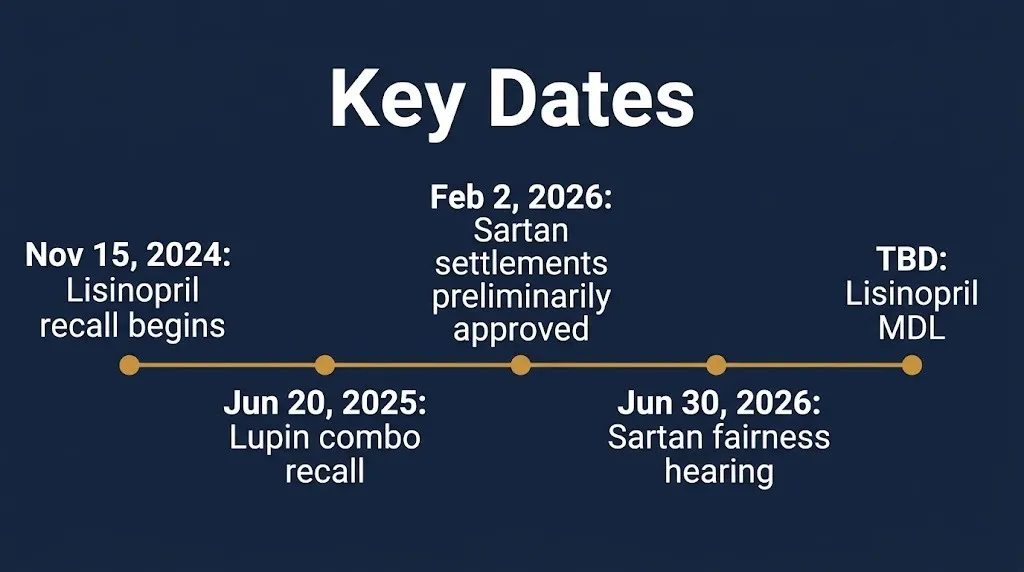
| Recall | Date | Reason | Scope |
|---|---|---|---|
| D-0061-2025: Evaric lisinopril 10 mg, 90-count, distributed by Walmart | Began November 15, 2024 | Metal fragment found in a tablet | 222,600 bottles; lot 241103; Class II |
| D-0532-2025: Lupin lisinopril and hydrochlorothiazide 20 mg/12.5 mg | June 20, 2025 | Foreign tablet found in a sealed bottle | Nationwide; Class II |
Neither recall entry we saw cites kidney injury. Check the lot number on your bottle against the FDA Enforcement Report.
A recall can still matter later. Contamination is a different legal theory than a label warning.
Is the valsartan and losartan lawsuit the same as a lisinopril lawsuit?
No, the valsartan, losartan, and irbesartan MDL covers a different drug class, not lisinopril.
Those drugs are angiotensin receptor blockers. Lisinopril is an ACE inhibitor. The JPML created MDL No. 2875 in the District of New Jersey on February 14, 2019, and expanded it to losartan and irbesartan on December 18, 2019.
Economic-loss settlements received preliminary approval on February 2, 2026, totaling $15,264,489.80.
| Settling defendant | Drug | Amount |
|---|---|---|
| Hetero | Valsartan | $11,365,489.80 |
| Aurobindo | Irbesartan | $2,000,000 |
| Vivimed | Losartan | $1,899,000 |
The claim, opt-out, and objection deadline was June 2, 2026. A fairness hearing was set for June 30, 2026; the outcome is not yet confirmed. Personal injury claims were excluded.
Why is it hard to sue a generic lisinopril maker?
Federal law makes failure-to-warn claims against generic drug makers very hard, and many lisinopril labels come from generic makers.
In PLIVA v. Mensing (2011), the Supreme Court held that failure-to-warn claims against generic makers are generally preempted. Generics must copy the brand label and can’t change it alone. In Mutual Pharmaceutical v. Bartlett (2013), it extended that to design-defect claims that turn on warnings.
| Claim type | Generic maker | Brand maker |
|---|---|---|
| Failure to warn | Generally preempted (Mensing, 2011) | Not preempted (Wyeth v. Levine, 2009) |
| Design defect tied to warnings | Preempted (Bartlett, 2013) | Not addressed in our sources |
| Manufacturing defect or contamination | Different analysis; ask an attorney | Different analysis; ask an attorney |
This is why recalls and contamination matter more than label arguments in generic drug cases.
Does the lisinopril label warn about kidney failure?
Yes, the FDA-approved label warns that lisinopril can cause changes in renal function, including acute renal failure.
| Label section | What it says |
|---|---|
| 5.3 Impaired Renal Function | Monitor kidney function periodically; at-risk patients may develop acute renal failure |
| 5.4 Hypotension | Low blood pressure can be complicated by oliguria, azotemia, acute renal failure, or death |
| 7.3 NSAIDs | In elderly or volume-depleted patients, may worsen kidney function |
| 7.4 Dual blockade | Combining RAS drugs raises kidney risk |
The boxed warning covers fetal toxicity only. The label shows a 7/2021 revision, and DailyMed lists a current version published June 8, 2026.
A warning on the label cuts both ways. It confirms the risk is real. It also gives a defendant a strong answer to a failure-to-warn claim.
What raises kidney risk for people taking lisinopril?
Kidney risk rises with certain conditions and drug combinations, according to the label.
Patients whose kidneys depend on the renin-angiotensin system may be at particular risk. The label names renal artery stenosis, chronic kidney disease, severe heart failure, recent heart attack, and volume depletion.
| Label data point | Figure |
|---|---|
| Minor, reversible creatinine rise, hypertension patients | About 2% |
| Same rise, heart failure patients on diuretics | 11.6% |
| Renal dysfunction after heart attack, lisinopril vs. none | 2.4% vs. 1.1% |
| Stopped for renal dysfunction, age 75 and over vs. younger | 4.8% vs. 1.3% |
In the VA NEPHRON trial, adding lisinopril to losartan raised acute kidney injury and hyperkalemia in 1,448 patients. It’s like a recall notice that names specific vehicles: the risk isn’t equal for everyone.
Key Takeaway: The label ties kidney risk to specific conditions and drug combinations, which is where any causation fight would start.
What happened in the PPI kidney lawsuits?
The PPI heartburn drug litigation shows what a real kidney-drug mass tort looks like: hundreds of filed cases before an MDL formed.
The first federal PPI kidney suit, against AstraZeneca, was filed in May 2016 in the Southern District of Illinois. It was voluntarily dismissed in March 2017. The JPML created the New Jersey MDL on August 2, 2017.
Plaintiffs alleged chronic kidney disease, acute interstitial nephritis, and kidney failure. Drugwatch reports kidney warnings didn’t reach PPI labels until 2014. A $425 million settlement followed in October 2023.
| Factor | PPI litigation | Lisinopril |
|---|---|---|
| Filed federal cases at MDL creation | 161 | None verified |
| Kidney warning | Added to labels in 2014 | Already on current label |
| Settlement | $425 million (October 2023) | None |
What happens next?
Expected, date not yet confirmed: A JPML hearing only happens if lawyers file a lisinopril motion; none was found as of November 1, 2026.
Result not yet confirmed: The June 30, 2026 fairness hearing outcome in the sartan MDL.
Ongoing: FDA posts new recall entries in its Enforcement Report, so recheck your lot number.
Ongoing: DailyMed posts label updates; the current version is dated June 8, 2026.
If a case emerges: Look for a docket number, a named defendant, and a court order before trusting any claim page.
Frequently Asked Questions
Is there a lisinopril class action lawsuit?
No lisinopril class action is verified as of November 1, 2026.
We found no class action, MDL, or settlement in the records we checked.
Check court dockets before trusting any claim site.
Can lisinopril cause kidney failure?
Yes, the label says lisinopril can cause changes in renal function, including acute renal failure.
Risk is higher with kidney disease, heart failure, dehydration, or NSAID use.
Ask your prescriber about kidney lab monitoring.
Is there a lisinopril settlement I can claim?
No lisinopril settlement is open for claims.
The valsartan, losartan, and irbesartan settlements cover different drugs.
Their claim deadline passed on June 2, 2026.
How much is a lisinopril lawsuit worth?
The amount is not yet determined because no settlement or verdict benchmark exists.
Severity, causation, and state law drive value.
Treat unsourced dollar ranges as marketing.
Can I sue if I took generic lisinopril?
Possibly, but federal preemption makes failure-to-warn claims against generic makers hard.
Contamination or manufacturing defect theories follow a different analysis.
Ask an attorney which claims fit your records.
Does the valsartan settlement cover lisinopril?
No, the valsartan settlement covers valsartan, losartan, and irbesartan only.
Lisinopril is an ACE inhibitor, not an angiotensin receptor blocker.
The settlement also excluded personal injury claims.
What should I do if I think lisinopril hurt my kidneys?
Call your prescriber before changing your medicine, then gather your records.
Request medical, lab, and pharmacy records.
Report the reaction to FDA MedWatch.
Gather your pharmacy records, kidney lab results, and bottle lot numbers now. Then check the court docket or JPML order before trusting any “claim center.”
No lisinopril MDL, class action, or settlement is verified as of November 1, 2026, so no claim deadline exists.