Vioxx Lawsuit 2026: The $4.85 Billion Settlement Is Closed, the Investor Case Paid Out, and New Claims Are Barred
Quick Answer
- Is it real? Yes. Merck paid $4.85 billion to resolve about 60,000 personal injury claims over Vioxx.
- How much? Individual payouts varied by injury and proof. The fund is exhausted, not available for new claims.
- Key deadline? The personal injury claim deadline passed in 2008. The investor claim deadline passed in 2016.
The Vioxx lawsuit is one of the largest pharmaceutical settlements in U.S. history, and it is also completely closed. If you are searching this in 2026 because you took Vioxx and wonder whether you can still file, the answer is no. The claims window shut more than 15 years ago.
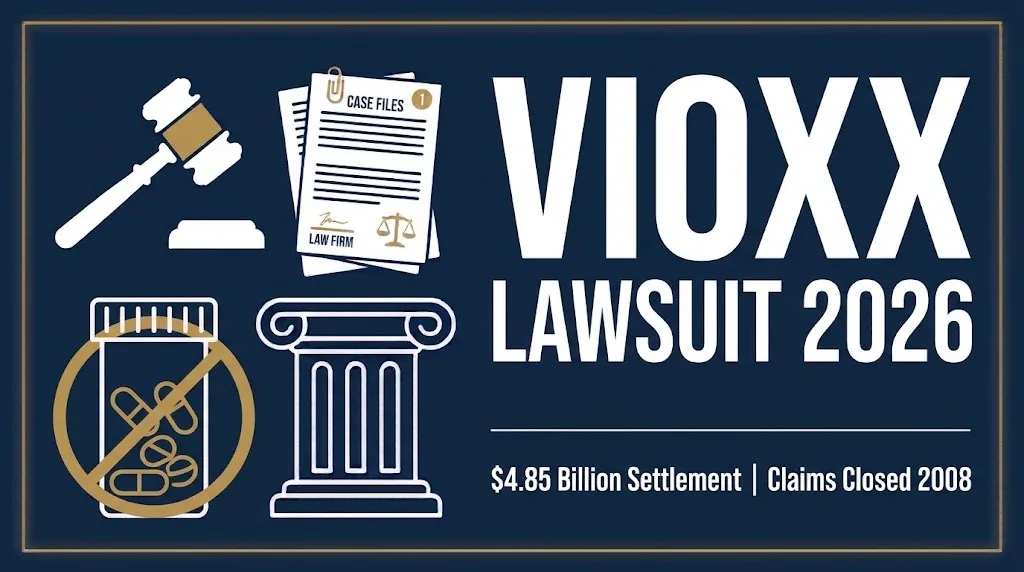
Merck pulled Vioxx from the market in September 2004 after research linked the painkiller to doubled heart attack and stroke risk. The company faced roughly 26,600 lawsuits at its peak and settled the bulk of them in November 2007 for $4.85 billion . A separate investor class action settled for $830 million and received final approval in June 2016 .
This article explains what the settlement covered, how the payout tiers worked, why the deadline is permanent, and what the 2026 legal landscape looks like for anyone still holding a Vioxx-related injury. One detail most summaries skip: the personal injury deal was not a class action, and each claim was evaluated individually through a three-gate process.
The Facts
| Case | In re Vioxx Products Liability Litigation, MDL No. 1657 (E.D. La.) |
| Court | U.S. District Court, Eastern District of Louisiana |
| Status | Personal injury settlement closed. Investor settlement paid. No new claims. |
| Fund Size | $4.85 billion (personal injury); $830 million (investor class) |
| Est. Per Person | Not determinable. Individual awards varied by injury and proof. |
| Claim Deadline | Personal injury: 2008 (passed). Investor: 2016 (passed). |
| Administrator | BrownGreer (personal injury); Epiq Systems (investor class) |
| Proof Needed | Medical records proving heart attack or ischemic stroke, plus prescription proof |
Is the Vioxx Lawsuit Real and What Was It About?
The Vioxx lawsuit was real, and it alleged that Merck concealed the cardiovascular risks of its blockbuster arthritis painkiller. Vioxx (rofecoxib) was approved in 1999 and pulled from the market in September 2004 after a study confirmed it doubled the risk of heart attack and stroke .
Merck denied wrongdoing throughout the litigation. The company fought cases individually for years, winning most of the early trials, before agreeing to the global personal injury settlement in November 2007 .
The settlement resolved myocardial infarction (heart attack) and ischemic stroke claims filed or tolled on or before November 8, 2007 . It did not cover hemorrhagic strokes or transient ischemic attacks. Those claims were excluded by the agreement’s terms.
How Much Did the Vioxx Settlement Pay Per Person?
There is no single per-person payout figure for the Vioxx settlement, because awards were determined individually based on injury severity, age, and proof of use. The $4.85 billion fund was divided into $4 billion for heart attack claims and $850 million for ischemic stroke claims .
Claimants had to pass three gates to qualify:
- Injury gate: Objective medical proof of heart attack or ischemic stroke.
- Duration gate: Documented receipt of at least 30 Vioxx pills.
- Proximity gate: Pills taken within 14 days before the injury event.
Merck’s settlement agreement set a minimum participation threshold. The deal would only trigger if at least 85% of eligible heart attack claims, 85% of ischemic stroke claims, 85% of death claims, and 85% of claims involving more than 12 months of use enrolled by March 1, 2008 .
Not yet determined does not apply here. The fund was fixed, allocated, and closed. Any figure you see online claiming a specific “average Vioxx payout” is an estimate or a lawyer’s marketing, not a court record.
Who Qualified for the Vioxx Personal Injury Settlement?
You may have qualified if you suffered a heart attack or ischemic stroke after taking Vioxx, and your claim was filed or tolled by November 8, 2007. The settlement applied only to U.S. legal residents whose injury occurred in the United States .
The enrollment process required a signed release and medical records. Claimants who failed to submit materials by the November 30, 2008 deadline received a “Non-Submitting Program Claimant” notice and had 15 business days to appeal to a Special Master .
Reality Check: No one is accepting new Vioxx claims in 2026. If a service offers to “reopen” your Vioxx case or “recover unclaimed settlement funds” for a fee, it is a scam. The settlement program is closed, the administrator has disbursed the fund, and no court has authorized a new claim window.
What Was the Vioxx Investor Class Action Settlement?
The Vioxx investor class action is a separate case that settled for $830 million and received final approval in June 2016. It covered people who purchased Merck common stock or call options, or sold put options, between May 21, 1999 and October 29, 2004 .
The settlement class was broader than the earlier certified class, extending the end date from September 29 to October 29, 2004. An additional $232 million fee and expense fund was established, with any unused portion credited back to the class fund .
The claims administrator for the investor settlement was Epiq Systems. That claim window is closed. Payments were distributed after the 2016 approval, and no further claim process exists in 2026.
Why Can’t You File a Vioxx Lawsuit in 2026?
You cannot file a new Vioxx lawsuit in 2026 because the statute of limitations has expired in every U.S. jurisdiction. The drug was withdrawn in 2004, and the settlement program that resolved qualifying claims closed more than 15 years ago.
The settlement agreement itself was limited to claims filed or tolled by November 8, 2007 . Claims not enrolled by that date were not part of the resolution program and are barred by the passage of time. Forty-two states, Puerto Rico, and the District of Columbia have statutes of limitations of three years or less, and courts in multiple jurisdictions ruled that the Vioxx limitations period expired years ago .
The only legal activity connected to Vioxx in 2026 is academic and historical. Legal scholars and medical researchers still cite the case as a landmark in pharmaceutical liability, but no court is accepting new Vioxx injury claims .
Key Takeaway: The Vioxx settlement was a closed, fixed fund. The personal injury claim window shut in 2008, the investor claim window shut in 2016, and no new Vioxx lawsuit can be filed in 2026.
What Other Vioxx-Related Settlements Exist?
Beyond the personal injury and investor settlements, Merck resolved other Vioxx-related claims through smaller deals. In 2009, the company agreed to pay $80 million to settle private third-party payor claims, including actions in New Jersey and the federal MDL .
A Missouri state court class action settled for a minimum of $39 million, with a potential value of up to $220 million if all eligible claimants participated. That settlement covered Missouri residents who took Vioxx but lacked proof of purchase; they could receive $180 by submitting an affidavit, while those with proof received $90 for each month they took the drug .
Merck also faced criminal and civil charges from the federal government. In 2011, the company paid over $1.6 billion to resolve allegations related to its marketing of Vioxx, including a $950 million criminal fine .
What Happens Next for Anyone Still Holding a Vioxx Claim?
Nothing is scheduled. There is no court process, no administrator accepting claims, and no settlement fund with remaining money for new claimants. The personal injury program has been wound down, and the investor class has been paid.
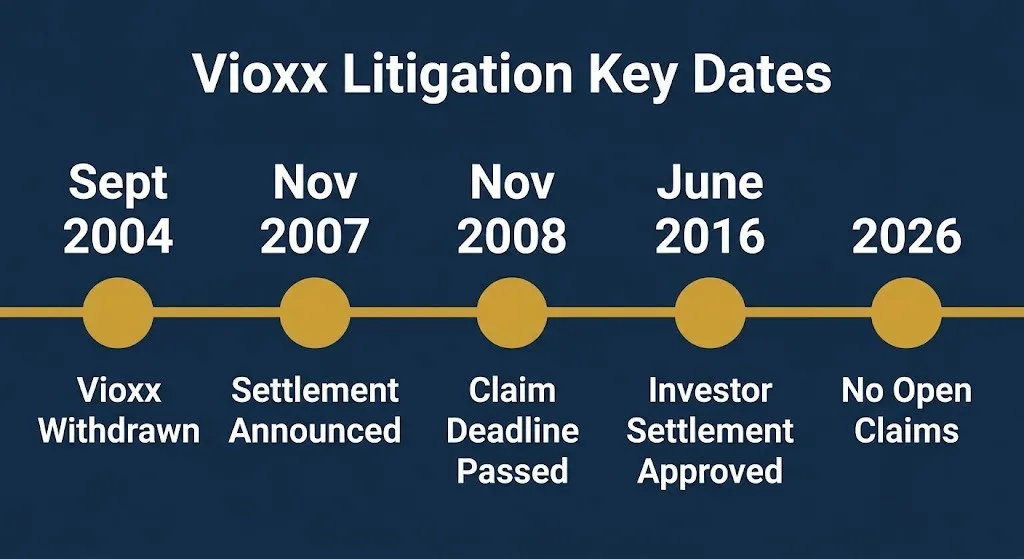
2007: Personal injury settlement agreement announced.
2008: Claim submission deadline passed.
2016: Investor class settlement approved.
2026: No active Vioxx litigation or claim process.
If you believe you have an unclaimed Vioxx-related claim, the only legitimate step is to check with the original claims administrator (BrownGreer for personal injury, Epiq for investor class) using the contact information from your original notice. Do not pay a third party to search for you.
Frequently Asked Questions
Can I still file a Vioxx lawsuit in 2026?
No. The statute of limitations has expired, and the settlement claim windows closed years ago.
How much did the Vioxx settlement pay per person?
Individual payouts varied. The fund was $4.85 billion, divided between heart attack and stroke claims, and awards depended on injury and proof.
What was the Vioxx settlement amount?
Merck paid $4.85 billion to settle personal injury claims and $830 million to settle an investor class action.
Did Merck admit fault in the Vioxx settlement?
No. Merck denied liability and said the settlement was not an admission of wrongdoing.
Who administered the Vioxx settlement?
BrownGreer handled the personal injury claims. Epiq Systems handled the investor class settlement.
What injuries qualified for the Vioxx settlement?
Heart attacks and ischemic strokes. Hemorrhagic strokes and transient ischemic attacks were excluded.
Is there any Vioxx money left for new claimants?
No. The settlement funds were allocated and distributed to qualifying claimants who filed by the deadlines.
What You Should Know About Vioxx in 2026
The Vioxx story is over as a legal matter. The drug was pulled in 2004, the personal injury settlement closed in 2008, and the investor settlement paid out after 2016. No court is accepting new claims.
If you took Vioxx and have ongoing health concerns, talk to your doctor. If you received a notice about a Vioxx settlement and never responded, check your records against the administrator’s original contact information. The most important date is November 8, 2007, the cutoff for claims to be included in the personal injury resolution.