Savannah Workers Compensation Attorneys 2026: How to Vet a Lawyer, What Georgia Law Pays, and Where the Real Deadlines Sit
Quick Answer
- What does a Savannah workers’ comp attorney do? Handles injury claims against employers and insurers under Georgia’s no-fault system, from benefit disputes to settlement.
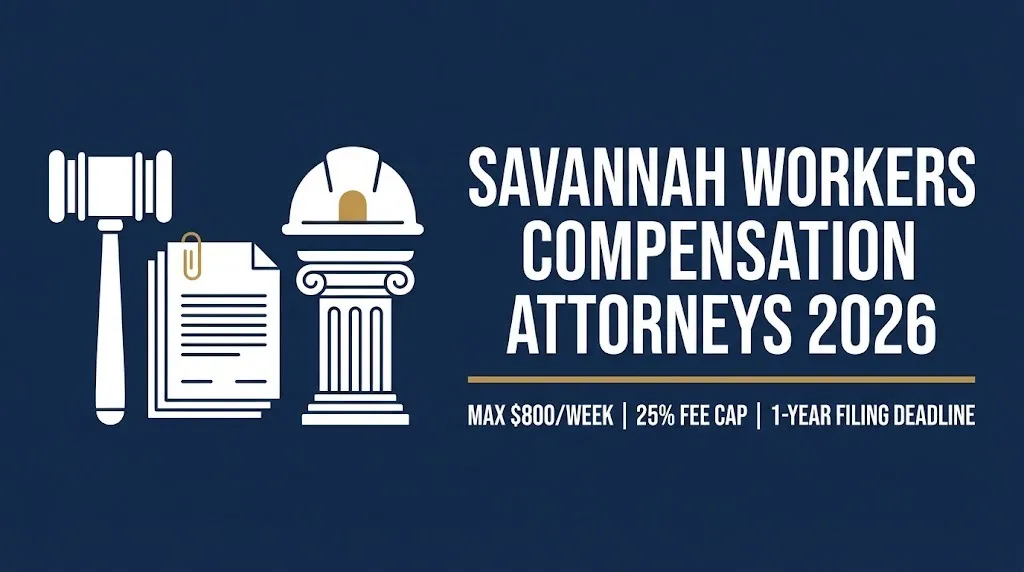
- How much does it cost? Most work on contingency, with fees capped at 25% of the recovery of weekly benefits, subject to State Board approval.
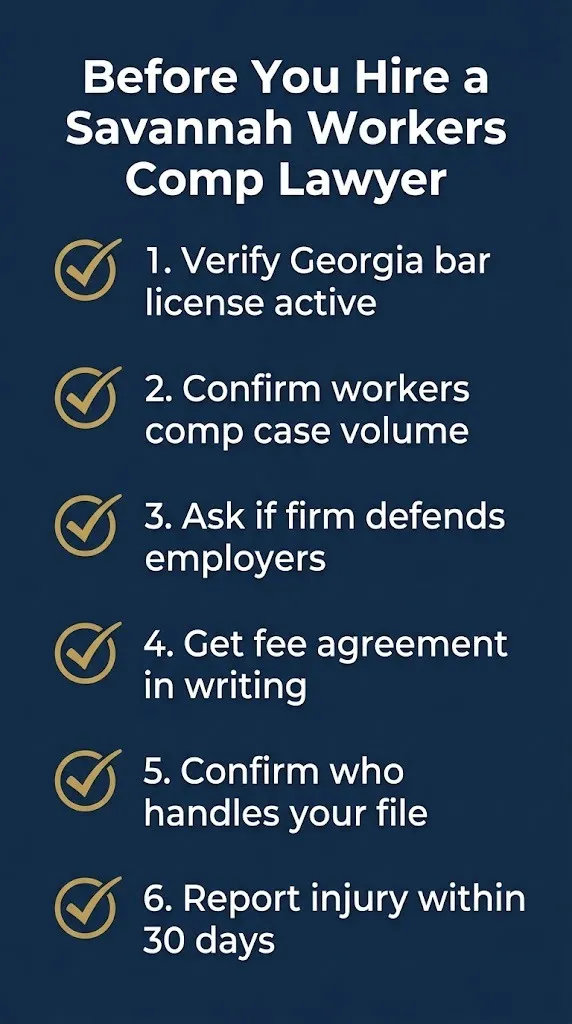
- Key deadline? Report the injury to your employer within 30 days and file with the State Board within 1 year.
A Savannah workers compensation attorney is a Georgia-licensed lawyer who represents injured workers in claims against employers and their insurance carriers. But the term covers a wide range of practices, from solo practitioners who have handled Savannah claims for decades to regional firms with billboard budgets.
If you’re searching for a lawyer right now, you’ve probably been hurt on the job and you’re already getting pressure from an adjuster. The system is designed to move fast on the front end and slow on the back end. Knowing the rules before you sign anything is the difference between a fair settlement and a lowball check.
This article breaks down the verified Georgia workers’ comp rules that apply to Savannah claims, how to vet a lawyer before you hire one, what the 2026 benefit caps actually mean for your case, and the deadlines that can kill a claim if you miss them. One detail most roundups skip: the fee cap in Georgia is set by statute, not by the free market, and a lawyer who doesn’t explain that cap upfront is a red flag.
The Facts
| State Agency | Georgia State Board of Workers’ Compensation |
| System Type | No-fault, exclusive remedy against employer |
| Max Weekly TTD (2026) | $800 per week |
| Max Weekly TPD (2026) | $533 per week |
| Max PPD Payout (2026) | $90,000 for injuries on or after Jan. 1, 2026 |
| Attorney Fee Cap | 25% of weekly benefit recovery, subject to Board approval |
| Notice Deadline | 30 days to report injury to employer |
| Filing Deadline | 1 year to file with the State Board |
What Does a Savannah Workers Compensation Attorney Do?
A Savannah workers compensation attorney handles the legal side of a work injury claim, from ensuring benefits get paid to negotiating a settlement that accounts for future medical costs. The lawyer does not guarantee an outcome, and no ethical attorney will promise you a specific number.
The core work includes documenting the injury, dealing with the insurer’s authorized treating physician panel, calculating the compensation rate, and negotiating or litigating disputes before the State Board. Georgia’s system is no-fault, which means you don’t have to prove your employer did anything wrong. But you do have to prove the injury happened at work and that you followed the procedural rules.
The most common reason people hire a lawyer is a denied or underpaid claim. Insurance adjusters have teams whose job is to minimize payouts, and they start low . A lawyer who handles these cases daily knows where the gaps are in the insurer’s position and how to close them.
How Much Does a Savannah Workers Comp Lawyer Cost?
Most Savannah workers compensation attorneys work on a contingency basis, meaning they get paid only if you recover benefits or a settlement. Georgia law caps attorney fees in workers’ comp cases at 25% of the recovery of weekly benefits, and the fee must be approved by the State Board .
That cap is important. Unlike personal injury cases, where contingency fees can run 33% to 40%, Georgia workers’ comp fees are tightly regulated. The cap applies to the weekly benefit portion of the recovery, and the State Board reviews the fee agreement to make sure it’s reasonable.
Here’s the plain comparison. Hiring a workers’ comp lawyer in Georgia is like using a regulated utility: the price is set by rule, not by negotiation. Ask any lawyer you interview to explain the fee cap and how the State Board approval process works. If they can’t explain it clearly, keep looking.
How Do You Choose a Savannah Workers Compensation Lawyer?
You choose a Savannah workers compensation lawyer by checking three things: Georgia bar licensing, actual workers’ comp experience, and whether the firm represents injured workers or employers. The last one matters more than most people realize.
Some Savannah attorneys practice on both sides. Patricia Paul at Oliver Maner, for example, lists workers’ compensation defense and claimant issues among her practice areas . Jonathan Wilson at Swift Currie represents employers and insurers exclusively . Neither is a problem on its own, but you should know which side a firm usually sits on before you call.
Here is a checklist to run before you hire:
- Confirm the Georgia bar license is active and in good standing.
- Ask how many workers’ comp cases the attorney handles per year, not total cases.
- Ask whether the firm represents employers or insurers in any of its work.
- Check the State Board’s approved attorney list if you need a starting point.
- Ask for the fee agreement in writing before you sign anything.
- Confirm who will actually handle your file, not just who answers the phone.
Savannah has attorneys with long track records in this field. Ralph Lorberbaum at Zipperer, Lorberbaum, Beauvais & Gotwalt has been licensed in Georgia since 1973 and selected to Super Lawyers for workers’ compensation from 2006 through 2026 . That kind of tenure is verifiable, and it’s the kind of detail you should look for.
What Is the 2026 Georgia Workers Comp Maximum Benefit?
Georgia’s maximum weekly temporary total disability benefit is $800 per week in 2026. For injuries on or after January 1, 2026, the maximum permanent partial disability payout rose to $90,000, up from $75,000 under the prior rules .
Here is the 2026 benefit table:
| Benefit Type | 2026 Maximum |
| Temporary Total Disability (TTD) | $800/week |
| Temporary Partial Disability (TPD) | $533/week |
| PPD Maximum Payout | $90,000 (injuries on/after Jan. 1, 2026) |
| Minimum Weekly Benefit | $50/week |
The caps are set in the statute, not indexed to inflation, which means they change only when the General Assembly acts . That makes the January 2026 increase a meaningful one for anyone hurt this year. If your injury happened in 2025, the older caps may apply to your claim.
Your actual compensation rate is two-thirds of your average weekly wage, up to the cap. If you earned $600 per week before the injury, your rate is $400. If you earned $1,800 per week, your rate is capped at $800.
What Is the Deadline to File a Workers Comp Claim in Savannah?
You must report the injury to your employer within 30 days and file a formal claim with the Georgia State Board of Workers’ Compensation within 1 year of the injury. Missing either deadline can cost you benefits.
The 30-day rule comes from O.C.G.A. § 34-9-80. The one-year filing rule comes from O.C.G.A. § 34-9-82, with extensions in some cases to one year after the last authorized medical treatment or two years after the last income benefit payment, whichever is later .
Here is the filing sequence:
- Report the injury to your supervisor in writing within 30 days.
- Get medical treatment from a doctor on your employer’s posted panel.
- Confirm the employer filed a First Report of Injury with the State Board.
- Track your wage replacement checks against your calculated rate.
- File a WC-14 claim form with the State Board if benefits are denied or stall.
- Request a hearing if the insurer disputes the claim.
The one-year clock is the one that kills claims. If you’re anywhere near the deadline and you haven’t filed, contact the State Board directly to confirm whether a claim exists under your Social Security number .
Key Takeaway: The 30-day notice rule and the one-year filing rule are separate deadlines. Missing either can end your claim, and neither resets because you hired a lawyer.
What Is the Difference Between a Stipulated Settlement and a Clincher in Georgia?
A stipulated settlement keeps your medical benefits open for a defined period, while a clincher agreement closes the entire claim permanently in exchange for a lump sum. The choice between them is the most consequential decision in a Georgia workers’ comp case.
Under a stipulated settlement, the insurer agrees to pay authorized medical treatment for a period (often up to 400 weeks from the injury date) and weekly income benefits if you’re out of work or on light duty . It is not a full and final resolution.
A clincher agreement, by contrast, ends the claim forever. You get one payment, and you give up all future medical care, weekly benefits, and vocational rehabilitation for that injury . That includes future surgeries, medications, and therapy that may be years away.
The trap is that a clincher offer looks like a lot of money on the day it arrives. If you have a back injury that may need surgery in five years, the clincher number has to account for that cost, or you’ll be paying it yourself. Future medical costs for a back surgery can run into the tens of thousands or more over a lifetime .
Reality Check: No adjuster will tell you that a clincher agreement wipes out your future medical rights. That is the single most important thing to understand before you sign one. Ask any lawyer you hire to walk you through a future medical cost projection before you accept a clincher number.
Why Does the Choice of Doctor Matter in a Savannah Work Injury Case?
The choice of doctor matters because the authorized treating physician assigns your impairment rating, which drives a large part of your settlement value. Georgia employers must provide a panel of at least six physicians, and you generally have the right to choose from that panel under O.C.G.A. § 34-9-201 .
If the panel is invalid or doesn’t include a specialist relevant to your injury, your right to choose broadens. A panel that lists only general practitioners for a serious orthopedic injury is a problem worth challenging.
The impairment rating is where insurers push hardest. A low rating from a friendly company doctor translates directly into a lower PPD payout. A 5% rating versus a 15% rating on the same injury can mean thousands of dollars in difference .
If the rating seems too low, Georgia law allows a second opinion from another qualified physician. That step costs time, but it can change the settlement math significantly.
What Happens Next After a Savannah Work Injury?
The timeline after a Savannah work injury moves through notice, medical treatment, maximum medical improvement, and either settlement or a State Board hearing. The first 30 days set the tone for everything that follows.
Day 1 to 30: Report the injury in writing and get on the employer’s doctor panel.
Weeks 1 to 12: Treatment, wage replacement checks, and documentation.
At Maximum Medical Improvement: The doctor assigns an impairment rating.
After rating: Negotiate a stipulated settlement or a clincher, or file a WC-14 if benefits are disputed.
If disputed: A hearing before an administrative law judge at the State Board.
If settled: The State Board reviews and approves the agreement.
Mediation is common in Georgia workers’ comp cases, especially for clincher agreements. A neutral mediator, often a retired judge or experienced attorney, helps both sides reach a number. It is confidential and not a trial, but it is often where the real negotiation happens .
Frequently Asked Questions
How much does a Savannah workers comp attorney charge?
Georgia law caps attorney fees at 25% of the recovery of weekly benefits, subject to State Board approval. Most attorneys work on contingency.
What is the maximum weekly workers comp benefit in Georgia for 2026?
The maximum TTD benefit is $800 per week. The maximum PPD payout rose to $90,000 for injuries on or after January 1, 2026.
How long do I have to report a work injury in Savannah?
You must report the injury to your employer within 30 days. The formal claim with the State Board must be filed within one year.
Can I choose my own doctor for a Georgia workers comp injury?
You generally choose from your employer’s posted panel of at least six physicians. If the panel is invalid, your choice may be broader.
What is a clincher agreement in Georgia workers comp?
It is a lump sum settlement that closes your claim permanently, including future medical care and weekly benefits.
Do I need a lawyer for a Savannah workers comp claim?
You are not required to have one, but claims involving denied benefits, low impairment ratings, or a clincher offer are worth reviewing with an attorney.
What happens if my Georgia workers comp claim is denied?
You can file a WC-14 claim form with the State Board and request a hearing. The one-year filing deadline still applies.
What You Should Do Before You Hire a Savannah Workers Compensation Attorney
Verify the license first. Go to the State Bar of Georgia website and confirm the attorney’s status. Then ask the two questions that separate real workers’ comp practices from generalists: how many claims do you handle per year, and do you represent employers or insurers in any of your work?
Report your injury in writing within 30 days, even if you’re not sure you need a lawyer yet. The notice deadline doesn’t wait for you to decide. The most important number in your case is not the settlement offer. It’s the one-year filing deadline with the Georgia State Board of Workers’ Compensation, and it runs from the date of your injury.