Best Workers Compensation Attorneys 2026: How to Find Qualified Counsel, What They Cost, and What They Actually Do
Quick Answer
- What they do: Workers’ comp attorneys handle denied claims, negotiate settlements, and represent you at hearings before the workers’ compensation board.
- What they cost: Most work on contingency, meaning no upfront fees. You pay only if you win, typically 15% to 25% of benefits.
- Key credential: State bar certification as a workers’ compensation specialist signals verified expertise and ongoing training.
If you got hurt on the job and your claim was denied, you are probably wondering whether you need a lawyer and how to find a good one. The answer depends on the complexity of your case. Simple claims often resolve without representation. Contested claims rarely do.
Workers’ compensation attorneys navigate a system with its own judges, rules, deadlines, and evidence requirements. An experienced lawyer knows how to document your injury, negotiate with insurers, and present your case before a judge if needed. Studies show workers with attorney representation receive significantly higher settlements than those who go it alone.
This article explains what workers’ comp attorneys actually do, how their fees work in 2026, what credentials to look for, and the questions you should ask before hiring anyone.
The Facts
| What They Do | Handle denied claims, negotiate settlements, represent at hearings |
|---|---|
| Typical Fee | 15% to 25% of benefits recovered, set by state law |
| Payment Structure | Contingency, no upfront costs in most cases |
| Key Credential | State bar certification as workers’ comp specialist |
| Fee Approval | Required by workers’ compensation board in most states |
| PA Maximum Benefit | $1,394 per week as of 2026 |
What Does a Workers’ Compensation Attorney Do?
A workers’ compensation attorney handles the legal side of your injury claim so you can focus on recovery. They gather medical evidence, file paperwork, negotiate with insurance companies, and represent you at hearings if your claim is disputed.

The scope of work depends on where your claim stands. If you just filed and the insurer accepted liability, you may not need a lawyer yet. If your benefits were denied, reduced, or cut off, an attorney becomes essential.
Here is what a workers’ comp lawyer typically does:
- Navigate state-specific rules: Workers’ comp laws vary by state. A local attorney knows the deadlines, filing requirements, and procedural quirks.
- Document your injury: They work with your doctors to ensure medical evidence clearly links your condition to your job.
- Negotiate settlements: Insurance companies employ adjusters trained to minimize payouts. An attorney knows how to counter their tactics.
- Represent you at hearings: If your case goes before a workers’ compensation judge, your lawyer presents evidence and cross-examines witnesses.
- Protect your benefits: They fight attempts to reduce or terminate your weekly checks.
The strongest workers’ comp lawyers build every claim as if it will be litigated. They secure treating doctor opinions early, document work restrictions, and anticipate the insurer’s medical and vocational evidence before it arrives .
How Much Do Workers Compensation Attorneys Cost in 2026?
Most workers compensation attorneys cost nothing upfront. They work on contingency, meaning their fee comes out of your settlement or award only if you win. The typical fee ranges from 15% to 25% of benefits recovered, and most states cap the percentage by law .
Pennsylvania caps workers’ comp attorney fees at 20% of benefits. Every fee agreement must be approved in writing by a Workers’ Compensation Judge before the attorney can collect anything . Virginia follows a similar structure: 20% for lump-sum settlements, 15% for scheduled loss agreements, and up to 20% for hearing outcomes .
Here is what that looks like in real dollars:
| Settlement Amount | Attorney Fee (20%) | You Receive |
|---|---|---|
| $20,000 | $4,000 | $16,000 |
| $50,000 | $10,000 | $40,000 |
| $100,000 | $20,000 | $80,000 |
Case expenses like medical record retrieval, filing fees, and expert evaluations are usually advanced by the firm and reimbursed from the settlement. You typically do not pay these out of pocket .
In some situations, your employer or their insurer may be required to pay your attorney fees directly. Pennsylvania law provides for fee-shifting when an employer contests your claim without reasonable cause or unreasonably delays payment. When that happens, you receive 100% of your benefits without any attorney fee deduction .
Reality Check: No Attorney Can Promise a Specific Outcome
Reality Check: Be wary of any lawyer who guarantees a specific settlement amount or outcome. No attorney can promise a win. Reputable workers’ comp lawyers work on contingency and won’t ask for large upfront payments. If someone demands thousands of dollars before doing any work, walk away.
What Should You Look for in a Workers Compensation Attorney?
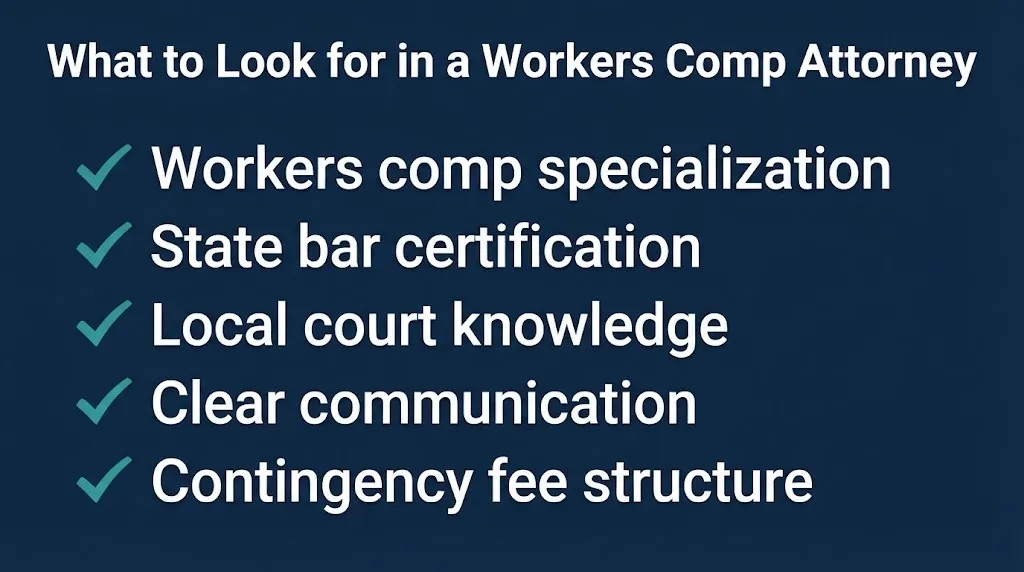
You should look for experience, specialization, local knowledge, and clear communication. Not every lawyer who handles personal injury understands the workers’ comp system. You want someone who works in that system regularly.
Here are the key factors:
- Experience and specialization: Ask how much of their practice is devoted to workers’ compensation. You want a lawyer who appears before workers’ comp judges regularly, not a general practitioner who takes occasional claims .
- Certification: Some state bars certify legal specialists in workers’ compensation. A certified specialist has passed a written exam, demonstrated extensive experience, completed ongoing education, and been favorably evaluated by peers and judges .
- Local knowledge: Workers’ comp laws vary by state. A local attorney knows your state’s rules, the local judges, and how insurance companies in your area operate .
- Communication: Choose someone who explains things clearly and keeps you informed. Ask who will actually handle your case if it goes to a hearing .
- Fee transparency: Understand their fee structure before signing anything. Ask about case expenses and who pays them .
Key Takeaway: Workers with attorney representation receive settlements 30% to 40% higher than those without.
What Questions Should You Ask Before Hiring a Workers Compensation Attorney?
You should ask about litigation experience, fee structures, communication, and how they handle cases like yours. These questions help you understand who will actually handle your case and whether they are the right fit .
Here are questions that reveal real experience:
- How much of your practice is devoted to workers’ compensation?
- How many cases like mine have you handled from start to hearing?
- Who will personally handle my case if my benefits are disputed?
- How often do you appear before workers’ compensation judges?
- What usually determines whether a claim is accepted, settled, or litigated?
- How do you prepare a claim from the beginning in case the insurer disputes it?
- What challenges do you expect in a case like mine?
- What percentage will you take, and does that change if my claim is denied?
A lawyer who regularly litigates can walk you through what a hearing actually involves. They should be able to name the real hurdles, not promise an easy result .
What Red Flags Should You Watch For?
You should avoid attorneys who lack workers’ comp experience, guarantee outcomes, or demand large upfront fees. Most reputable workers’ comp lawyers work on contingency and only get paid if you recover benefits.
Watch for these warning signs:
- Lack of specialization: Avoid lawyers who don’t focus on workers’ comp or have limited experience in the area .
- Poor communication: If an attorney is hard to reach or doesn’t explain things clearly, they may not serve you well.
- Unrealistic promises: No lawyer can guarantee a specific settlement amount .
- High upfront fees: Reputable workers’ comp attorneys don’t require large payments before starting work.
- Pressure to settle quickly: If a lawyer pushes you to accept an offer before you’ve reached maximum medical improvement, get a second opinion.
What Is a Certified Workers Compensation Specialist?
A certified workers compensation specialist is an attorney who has met additional requirements beyond standard bar admission. California, North Carolina, and other states offer this certification through their state bars .
To become certified in California, an attorney must:
- Pass a written examination in workers’ compensation law
- Demonstrate extensive and varied experience in the field
- Complete additional ongoing education requirements
- Be favorably evaluated by other attorneys and judges
Certification signals that the attorney has made a commitment to stay current with the law. Workers’ compensation law is complex and constantly changing. A certified specialist meets higher standards to maintain proficiency .
When searching for an attorney, you can check your state bar’s website for a list of certified specialists in workers’ compensation law. This is one of the fastest ways to identify qualified candidates.
How Do Attorney Fees Work in Different States?
Attorney fees in workers’ compensation cases are regulated differently in every state. Most set caps or require board approval before an attorney can collect.
In New York, attorney fees must be approved by the Workers’ Compensation Board. The fee schedule includes specific calculations based on the type of award. For temporary total disability continuation, the fee is one-third of one week’s compensation. For schedule loss of use, it’s 15% of the compensation due above previous payments .
In Pennsylvania, fees are capped at 20% of benefits recovered, and every agreement must be approved by a Workers’ Compensation Judge .
In Oregon, maximum attorney fees are adjusted annually based on the state’s average weekly wage. As of July 1, 2025, the maximum fee under one section was $6,357, and the reasonable hourly rate was $485 .
The common thread: workers’ comp fees are almost always lower than personal injury contingency fees, which range from 33% to 40%. The system is designed to keep representation accessible for injured workers .
What Happens Next If You Hire a Workers Comp Attorney?
Initial Consultation: Most attorneys offer free consultations. You discuss your injury, your claim status, and whether representation makes sense.
Investigation: The attorney gathers medical records, wage statements, and any evidence about how the injury occurred.
Claim Filing or Appeal: If you haven’t filed yet, the attorney handles the paperwork. If your claim was denied, they file an appeal.
Negotiation: The attorney communicates with the insurance company on your behalf, countering low offers and building your case for a fair settlement.
Hearing (if needed): If the insurer disputes your claim, the attorney represents you before a workers’ compensation judge.
Settlement or Award: If you settle, the fee is deducted and you receive the net amount. If you win at a hearing, benefits are awarded and fees are approved by the judge.
Frequently Asked Questions
How much does a workers compensation attorney cost?
Most workers’ comp attorneys charge 15% to 25% of benefits recovered, paid only if you win. Pennsylvania caps fees at 20%.
Do I need a lawyer for my workers comp claim?
You may not need a lawyer for a simple, accepted claim. If your claim is denied, your benefits are cut off, or you face a complex injury, an attorney can protect your interests.
What is the best way to find a workers compensation attorney?
Check your state bar’s list of certified specialists in workers’ compensation law, ask other attorneys for referrals, and read client reviews.
What percentage do workers comp lawyers take in Pennsylvania?
Pennsylvania caps workers’ comp attorney fees at 20% of benefits. Every fee agreement must be approved by a Workers’ Compensation Judge.
Can I get my attorney fees paid by my employer?
In some states, yes. If an employer contests your claim without reasonable cause or delays payment, the employer may be required to pay your attorney fees.
What should I ask a workers comp lawyer before hiring?
Ask about their experience with cases like yours, who will handle your case, their fee structure, and what challenges they expect.
Is it worth hiring a workers comp attorney?
Studies show workers with attorney representation receive settlements 30% to 40% higher than those without. For contested claims, representation is often essential.
What if my workers comp claim was denied?
A denial is not the end of your case. You can appeal to the Workers’ Compensation Appeal Board. An attorney can handle the appeal process for you.
What You Should Do Next
If your claim was denied or your benefits were cut off, contact a workers’ compensation attorney in your state. Most offer free consultations and work on contingency, so there is no upfront cost to explore your options.
The single most important fact: workers with attorney representation receive settlements 30% to 40% higher than those who represent themselves. Do not settle a contested claim without getting a professional opinion.