Workers Compensation Exemption 2026: State Rules, Forms, and Who Qualifies
Quick Answer:
- Workers compensation exemptions are real and allow certain business owners and workers to opt out of mandatory coverage.
- Exemption rules vary by state, with Florida requiring a formal application and New York having narrower exemptions.
- Deadlines and forms differ by state, and filing incorrectly can leave you personally liable for workplace injuries.
Workers compensation exemption rules allow certain individuals to opt out of mandatory coverage. The rules exist in most states, but the specifics vary dramatically depending on where you operate.
If you are a sole proprietor, independent contractor, or corporate officer, you may be eligible for an exemption. But the process is not automatic. Most states require a formal filing with the state workers compensation agency.
This article covers verified exemption rules for Florida, New York, and general principles that apply nationwide. One surprising detail: Florida has issued thousands of stop-work orders against employers who claimed exemptions they did not legally qualify for.
The Facts
| Case | State workers compensation exemption statutes |
| Status | Active, enforced by state agencies |
| Fund Size | Not applicable |
| Est. Per Person | Not applicable |
| Claim Deadline | Varies by state |
| Administrator | State workers compensation divisions |
| Proof Needed | Business registration, job classification, exemption application |
What Is a Workers Compensation Exemption?
A workers compensation exemption is a legal waiver that allows certain business owners or workers to opt out of mandatory workers compensation coverage.
The exemption removes the requirement to carry workers compensation insurance. It also removes the right to receive workers compensation benefits if you are injured on the job.
The trade-off is significant. If you opt out, you lose the safety net that workers compensation provides. Medical bills and lost wages after a workplace injury become your personal responsibility.
Exemptions exist because the workers compensation system was designed for employees, not business owners. Sole proprietors, partners, and certain corporate officers are not traditional employees. The system allows them to opt out.
The exemption process varies by state. Some states require a formal application and approval. Others allow automatic exemption based on business structure.
Misusing an exemption carries serious consequences. If you claim an exemption but actually have employees, you face fines, stop-work orders, and personal liability for injuries.
Key Takeaway: An exemption trades mandatory coverage for personal risk, and the rules vary significantly by state.
Who Qualifies for a Workers Compensation Exemption?
The workers compensation exemption applies primarily to sole proprietors, partners, and certain corporate officers who do not have employees.
Sole proprietors are the most common exemption category. A sole proprietor running a business without employees is generally not required to carry workers compensation on themselves. Some states require a formal exemption filing to document this status.
Partners in a partnership may qualify for exemption. The rules vary by state, but most allow partners to opt out of coverage.
Corporate officers occupy a gray area. Many states count corporate officers as employees for workers compensation purposes unless they file an exemption. The exemption allows officers to exclude themselves from coverage, but not other employees.
Limited liability company members are treated differently across states. Some states treat LLC members like sole proprietors. Others treat them like corporate officers requiring a formal exemption.
Independent contractors present the most contested area. A true independent contractor is not an employee and therefore not subject to workers compensation requirements. But misclassification is rampant, and many workers labeled as contractors are legally employees.
The number of employees matters. Exemptions for owners do not extend to staff. If you have even one employee, that employee must be covered.
Key Takeaway: Owner exemptions are common, but they never excuse an employer from covering actual employees.
What Is the Workers Compensation Exemption in Florida?
The Florida workers compensation exemption is a formal process that allows certain business owners and workers to opt out of mandatory coverage.
Florida requires a specific exemption application filed with the Florida Division of Workers’ Compensation. The application, known as a Notice of Election to Be Exempt, must be submitted online or by mail.
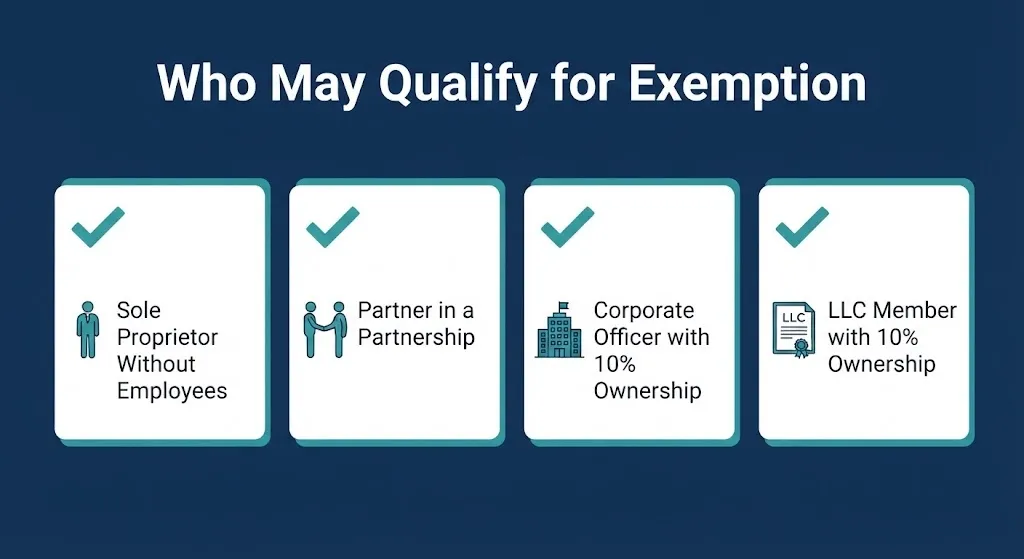
Who can file for exemption in Florida:
- Sole proprietors without employees
- Partners in a partnership without employees
- Corporate officers who own at least 10% of the corporation
- LLC members who own at least 10% of the LLC
- Construction industry workers in certain classifications
The construction industry exemption is unique to Florida. Construction workers can file for exemption as independent contractors, but the rules are strict and frequently audited.
Filing fees apply. The Florida exemption application requires a fee, typically around $50 per exemption. The fee may change, so check the current rate before filing.
An approved exemption is valid for two years. After that, it must be renewed.
The exemption does not cover anyone else. If you file an exemption but later hire employees, you must obtain workers compensation coverage for those employees immediately.
Key Takeaway: Florida has one of the most formal exemption processes, with applications, fees, and renewal requirements.
How to File a Workers Compensation Exemption in Florida
Filing a workers compensation exemption in Florida requires completing an application, paying a fee, and submitting the form to the state.
Here is the step-by-step process:
- Determine if you meet the eligibility criteria for exemption in Florida.
- Gather your business registration documents, including your entity type and ownership percentage.
- Visit the Florida Division of Workers’ Compensation website.
- Complete the Notice of Election to Be Exempt form online or download the paper version.
- Pay the filing fee, which is approximately $50 per exemption.
- Submit the application and retain proof of filing.
- Receive your exemption certificate and keep it with your business records.
- Renew the exemption before it expires, typically every two years.
The online filing system processes most applications quickly. Paper filings take longer.
Do not operate without coverage while waiting for an exemption. If you have employees, you must have coverage in place regardless of your exemption status.
If you are a construction industry worker, the exemption process has additional requirements. You may need to provide proof of industry classification and complete a different application.
The comparison to renewing a professional license is apt. The process is straightforward, but missing the renewal date creates legal exposure.
Reality Check: An exemption certificate is not a shield against misclassification claims. If you use an exemption to avoid covering workers who are legally employees, you face fines up to $1,000 per day in some states and personal liability for workplace injuries.
What Is the Workers Compensation Exemption Form?
The workers compensation exemption form is the official document used to apply for exemption from mandatory coverage in states that require formal filing.
Each state uses its own form. Florida uses the Notice of Election to Be Exempt. Other states use different names and formats.
The form typically requires:
- Business name and address
- Business entity type (sole proprietorship, partnership, corporation, LLC)
- Ownership percentage for corporate officers and LLC members
- Federal Employer Identification Number or Social Security Number
- Description of business activities
- Signature under penalty of perjury
Submitting a false exemption form carries serious consequences. The signer certifies under penalty of perjury that the information is accurate. False statements can lead to criminal charges in addition to civil penalties.
The form does not grant coverage. It removes the requirement to carry coverage. The distinction matters because many people mistakenly believe the form provides some protection.
Some states do not require a formal form. Exemption may be automatic based on business structure. Check your state’s rules before assuming you need to file anything.
Who Is Exempt from Workers Compensation in New York?
New York workers compensation exemptions are narrower than many other states, with specific rules for different worker categories.
New York requires workers compensation coverage for most employers, including those with one employee. The employee threshold is lower than many states, making exemptions more important for small operators.
Exempt categories in New York include:
- Sole proprietors without employees
- Partners in a partnership
- Certain corporate officers who own the business
- Independent contractors who meet the legal test
- Certain agricultural workers on small farms
- Domestic workers working fewer than 20 hours per week
Corporate officers in New York have specific rules. An officer of a corporation with no employees other than officers may be exempt. Once the corporation hires non-officer employees, coverage is required for everyone.
The exemption for sole proprietors is not automatic in all circumstances. If a sole proprietor works as a subcontractor on a construction project, the general contractor may require proof of workers compensation coverage.
New York’s construction industry has strict requirements. Independent contractors in construction must meet specific criteria to avoid employee status. The New York Construction Industry Fair Play Act creates a presumption that construction workers are employees.
The comparison to a home inspection before purchase is useful here. You need to verify your status before assuming you are exempt.
Key Takeaway: New York exemptions exist but are narrower than many states, and misclassification in construction carries severe penalties.
Are Independent Contractors Exempt from Workers Compensation?
Independent contractors are generally exempt from workers compensation requirements, but only if they meet the legal definition of an independent contractor.
The distinction between an independent contractor and an employee is the most contested area in workers compensation law. The label does not matter. The actual working relationship does.
States use various tests to determine contractor status:
- The control test examines who controls how, when, and where the work is performed.
- The economic realities test examines whether the worker is economically dependent on the employer.
- The ABC test, used in some states, presumes worker status unless three specific criteria are met.
If a worker is misclassified as an independent contractor but is legally an employee, the employer faces penalties, back premiums, and personal liability for injuries.
The misclassification problem is widespread. Many employers classify workers as contractors to avoid payroll taxes and workers compensation premiums. State enforcement has increased in recent years.
Some states now require independent contractors in certain industries to carry their own workers compensation coverage. Even if you are exempt from mandatory coverage, a client may require proof of coverage as a contract condition.
The exemption does not protect you from personal injury costs. If you are injured as an independent contractor, you have no workers compensation claim. You must pay your own medical bills unless you can sue a third party.
Key Takeaway: True independent contractors are exempt, but misclassification is common and carries serious consequences for employers.
What Is the Penalty for Not Having Workers Compensation?
The penalty for not having required workers compensation coverage varies by state but typically includes daily fines, stop-work orders, and personal liability.
Daily fines are the most common penalty. Florida imposes fines up to $1,000 per day for each day coverage was required but not maintained. New York imposes similar penalties through its Workers Compensation Board.
Stop-work orders are particularly severe. A stop-work order shuts down business operations until coverage is obtained. Defying a stop-work order can lead to additional fines and criminal charges.
Personal liability is the hidden penalty. An employer without coverage is personally responsible for all medical bills and wage loss benefits for any injured worker. There is no insurance company to absorb the cost.
Criminal penalties apply in extreme cases. Willful failure to maintain coverage can result in misdemeanor or felony charges depending on the state and the circumstances.
The financial exposure from one injury can exceed what years of premiums would have cost. The comparison to driving without car insurance is direct and accurate.
Some states post violators publicly. The naming and shaming adds reputational damage to the financial penalties.
Key Takeaway: The penalties for noncompliance far exceed the cost of coverage, and a single workplace injury can bankrupt an uninsured employer.
Can a Sole Proprietor Get Workers Comp for Themselves?
A sole proprietor can voluntarily purchase workers compensation coverage for themselves in most states, even though they are not required to do so.
The coverage is optional because a sole proprietor is not an employee. The workers compensation system was designed for employees, not business owners.
Voluntary coverage makes sense in certain situations. If a sole proprietor works as a subcontractor, the general contractor may require proof of coverage. Some clients include coverage requirements in contracts.
The coverage protects the sole proprietor if injured on the job. Without coverage, the sole proprietor pays medical bills and lost income from personal funds or private insurance.
The cost of voluntary coverage is based on the same factors as standard policies: industry classification, payroll, and claims history.
Some states allow sole proprietors to purchase coverage through the state fund. Others require purchase through private carriers.
The decision to purchase voluntary coverage is a risk assessment. If your work is dangerous and your health insurance is limited, coverage may be worth the premium. If your work is low-risk and you have savings, you may choose to opt out.
Key Takeaway: Voluntary coverage is available but optional for sole proprietors in most states.
What Is the Difference Between an Exemption and a Waiver?
An exemption and a waiver are functionally the same in workers compensation law, referring to the act of opting out of mandatory coverage.
The terms are used interchangeably in most states. Some states call the process an exemption. Others call it a waiver. The legal effect is the same.
The document filed with the state may be called an exemption application, a waiver form, or a notice of election to be exempt. The names vary, but the substance is identical.
The key distinction is between an owner exemption and an employee waiver. Owners can exempt themselves from coverage. Employees generally cannot waive their rights to workers compensation coverage because the law protects them from pressure to opt out.
Some states allow employees to waive coverage in limited circumstances. These waivers are rare and typically require proof of alternative coverage.
The confusion between terms creates opportunities for scams. Be wary of any service that charges high fees to file an exemption that you can file yourself for a modest state fee.
Key Takeaway: Exemption and waiver mean the same thing, and owner exemptions never extend to actual employees.
What Happens Next for Workers Compensation Exemption Rules in 2026?
Here is the expected timeline for workers compensation exemption developments in 2026:
Throughout 2026: State legislatures consider bills addressing misclassification and exemption abuse.
Spring 2026: Florida’s exemption renewal period continues for existing certificate holders.
Mid 2026: New York enforcement actions against misclassified employers continue through the Workers Compensation Board.
Late 2026: Potential new regulations on independent contractor classification in certain industries.
Ongoing: States increasingly coordinate with the IRS and Department of Labor on misclassification enforcement.
The trend across all states points toward stricter enforcement of exemption rules. The days of casual exemption claims without documentation are ending.
The most important action for business owners is verifying current exemption status and ensuring any actual employees are covered.
Frequently Asked Questions
What is a workers compensation exemption?
It is a legal waiver that allows certain business owners to opt out of mandatory workers compensation coverage.
Who qualifies for a workers comp exemption in Florida?
Sole proprietors, partners, and corporate officers with at least 10% ownership may qualify.
How much does a Florida workers comp exemption cost?
The filing fee is approximately $50 per exemption as of 2026.
How long is a Florida workers comp exemption valid?
The exemption is valid for two years and must be renewed.
Can an LLC member file for exemption in Florida?
Yes, if the LLC member owns at least 10% of the company and files the required form.
Is workers compensation required for independent contractors?
No, true independent contractors are not required to carry coverage, but misclassification is common.
What happens if I misclassify an employee as a contractor?
You face fines, back premiums, stop-work orders, and personal liability for workplace injuries.
Can I get workers comp for myself as a sole proprietor?
Yes, voluntary coverage is available even when mandatory coverage is not required.
If you are considering a workers compensation exemption, verify your eligibility with your state agency. File the correct form before operating without coverage.
The most important date is the day you start work. Coverage or a valid exemption must be in place before then, not after an injury occurs.