Who Pays Workers Compensation? The 2026 Employer Funding Rule Explained
Quick Answer
- Workers compensation is paid by your employer, not by you or the government.
- Employers buy insurance or self-insure to cover workplace injury costs.
- You pay nothing from your paycheck for workers comp coverage.
Workers compensation is paid by employers, not employees. That’s the bedrock rule in every U.S. state. Your boss buys a policy or sets aside funds to cover medical bills and lost wages if you get hurt on the job .
The confusion is understandable. You see deductions on your pay stub for Social Security and Medicare. Workers comp isn’t one of them. It’s a business expense, like rent or electricity, and your employer can’t charge you for it .
This article breaks down exactly who funds the system, how premiums get calculated, what happens when an employer doesn’t carry coverage, and what you need to know if you’re hurt at work in 2026.
The Facts
| Detail | Verified Status |
|---|---|
| Who pays premiums | Employers only, never employees |
| How employers pay | Private insurance, state funds, or self-insurance |
| Employee payroll deduction | Prohibited in all states |
| Benefit types covered | Medical, wage replacement, disability, death benefits |
| Waiting period before wage benefits | Typically 3 to 7 days, varies by state |
| Wage replacement rate | Generally 60% to 80% of pre-injury wage |
| Maximum weekly benefit (2026) | Varies by state, e.g., $1,627 in Alaska |
| Premium rate example (2026) | 1.931% of wages in Western Australia |
Who pays workers compensation?
Your employer pays for workers compensation coverage, not you and not the government . Employers are legally required to carry this insurance in nearly every state .
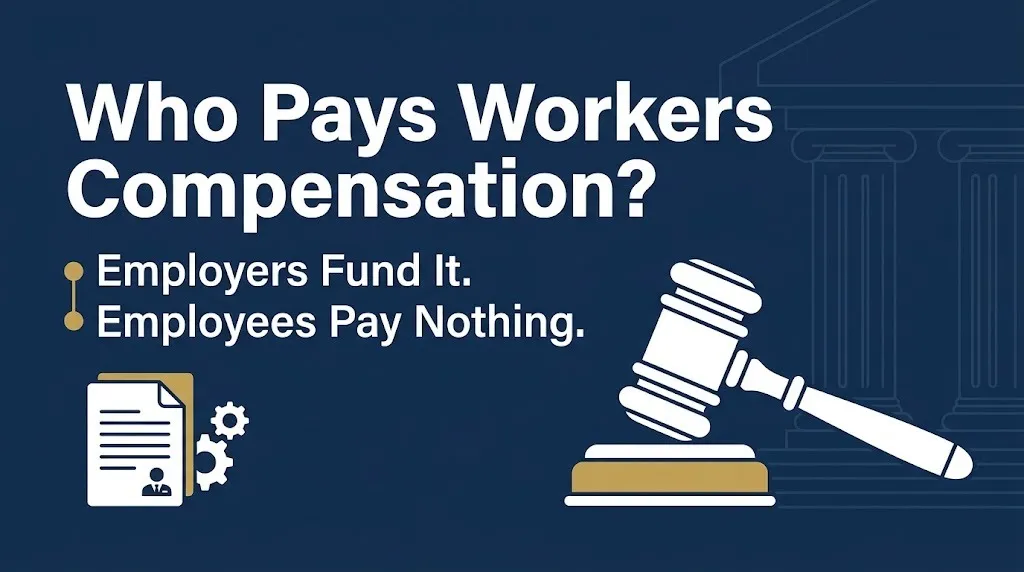
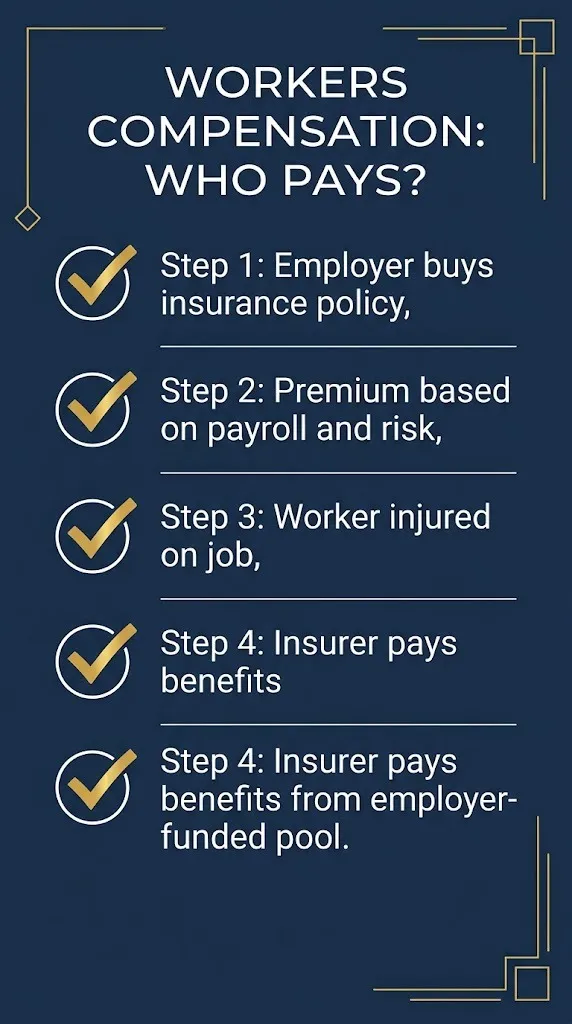
The funding mechanism works through premiums. Your employer pays an insurance company or state fund based on payroll and risk classification. That money sits in a pool to pay claims when workers get hurt .
Some large companies self-insure, meaning they set aside their own money to pay claims directly . But the principle stays the same: the employer foots the bill.
You should never see a “workers comp” line on your pay stub. If you do, that’s a red flag. Employers cannot pass this cost to employees in any U.S. jurisdiction .
How do employers pay for workers compensation?
Employers pay through insurance premiums, self-insurance, or state-funded programs. The method depends on company size, financial strength, and state rules .
Most small and mid-sized businesses buy a policy from a private carrier. Premiums are calculated per $100 of payroll, adjusted for the industry’s risk level . A construction company pays more than an office staffing firm because injury rates are higher .
Large companies with strong balance sheets often self-insure. They set aside reserves and pay claims directly. This can save money, but it requires state approval and proof of financial capacity .
A few states run monopolistic state funds where all employers must buy coverage through the state. Other states have competitive state funds that compete with private insurers .
| Funding Method | Who Uses It | How It Works |
|---|---|---|
| Private insurance | Most employers | Premiums paid to carrier, claims handled by insurer |
| Self-insurance | Large, financially strong companies | Employer pays claims directly from reserves |
| State fund (competitive) | Employers in some states | State-run insurer competes with private market |
| State fund (monopoly) | Employers in a few states | State is the only option for coverage |
Key Takeaway: Workers compensation is funded entirely by employers through premiums, self-insurance reserves, or state funds. Employees contribute nothing.
Do employees contribute to workers compensation?
No. Employees never contribute to workers compensation premiums in the United States. The entire cost falls on the employer .
This is different from Social Security and Medicare, where you split the cost with your boss. Workers comp is a pure employer expense .
Some workers confuse workers comp with short-term disability insurance. Short-term disability often involves employee-paid premiums. Workers comp does not. If you’re asked to pay for workers comp coverage, that’s illegal in every state .
The rule exists to keep the system simple and to ensure coverage isn’t tied to an employee’s ability to pay. Your employer bears the cost because the law places the liability on them for workplace injuries .
How are workers compensation premium rates calculated?
Premium rates are calculated based on payroll, industry classification, and claims experience. Insurance carriers use these factors to determine how much an employer pays .
The base rate is expressed as a dollar amount per $100 of payroll. A clerical worker might have a rate of $0.30 per $100, while a roofer might be $15 per $100 .
Industry classification matters because some jobs are simply more dangerous. The National Council on Compensation Insurance (NCCI) develops classification rates that states adopt or modify .
Experience rating adjusts the rate up or down based on the employer’s own safety record. Companies with fewer claims get discounts. Companies with more claims pay surcharges .
| Factor | Impact on Premium | Example |
|---|---|---|
| Payroll size | Higher payroll = higher premium | A 100-employee firm pays more than a 10-employee firm |
| Industry risk | Higher risk = higher rate | Construction pays more than accounting |
| Claims history | More claims = surcharge | A company with 5 claims pays more than one with 1 |
| Safety programs | Fewer claims = discount | Experience rating credits reward safe workplaces |
Key Takeaway: Premiums are based on what you do, how many people you employ, and how safely you operate. The employer writes the check.
What happens if an employer doesn’t have workers compensation?
If an employer doesn’t carry workers compensation, they face fines, criminal charges, and direct liability for injuries. Most states make it a misdemeanor or felony to operate without coverage .
In some states, uninsured employers can be sued directly by injured workers for full damages, not just the limited workers comp benefits. That means the employer could owe pain and suffering, punitive damages, and more .
State funds often step in to pay benefits to injured workers when the employer is uninsured. Then the state goes after the employer to recover the money, plus penalties .
You can check whether your employer has coverage by contacting your state workers compensation board or commission. Most states maintain online databases where you can search by employer name .
What benefits does workers compensation pay for?
Workers compensation pays for medical care, wage replacement, disability benefits, and death benefits. The exact package depends on the injury and your state’s rules .
Medical benefits cover doctor visits, hospital care, surgery, prescriptions, and rehabilitation. There’s no deductible or copay for covered treatment in most states .
Wage replacement benefits start after a waiting period, usually 3 to 7 days. If you’re off work longer than a set period (often 14 to 21 days), the waiting period gets paid retroactively .
Permanent disability benefits apply if your injury leaves lasting impairment. These can be lump sums or ongoing payments, depending on severity .
Death benefits go to surviving family members if a workplace injury is fatal. These cover burial expenses and ongoing income replacement for dependents .
| Benefit Type | What It Covers | When It Applies |
|---|---|---|
| Medical | Doctor, hospital, surgery, prescriptions | Immediately for covered injuries |
| Temporary disability | Partial wage replacement | After waiting period, while you recover |
| Permanent disability | Lump sum or ongoing payments | When injury leaves lasting impairment |
| Supplemental job displacement | Training for new work | If you can’t return to your old job |
| Death benefits | Burial costs and family income | If injury is fatal |
Key Takeaway: Workers comp covers medical bills and part of your lost wages. The employer’s premium funds every dollar of it.
Reality Check
Workers compensation is not a government handout, and it’s not deducted from your paycheck. If a boss or HR representative tells you that you need to contribute to the premium, that’s illegal in every state. You can report it to your state labor department. Also, legitimate workers comp claims never require you to pay a fee to file. If someone offers to “process” your claim for money upfront, walk away.
How long do you have to file a workers compensation claim?
You generally have 30 to 90 days to report a workplace injury, but shorter deadlines apply in some states. Reporting late can jeopardize your benefits .
The clock starts on the date of injury for most claims. For occupational diseases that develop over time, the clock may start when you first knew or should have known about the condition .
Every state has a statute of limitations for filing the formal claim, separate from the initial reporting deadline. These range from one to three years in most jurisdictions .
The safest approach: report any workplace injury to your supervisor immediately, in writing, and keep a copy. Then contact your state workers compensation board if you have questions about deadlines .
What happens next
Ongoing: Employers continue funding workers compensation through premiums and self-insurance reserves.
Expected 2026-2027: State regulators review premium rates annually, with some states approving decreases and others increases based on claims data .
TBD: Federal legislative activity on workers compensation standards remains pending.
Ongoing: Injured workers can file claims through their employer’s carrier or state fund.
Frequently Asked Questions
Who pays for workers compensation insurance?
Your employer pays for it. Employees never contribute to workers compensation premiums in any U.S. state .
Can my employer deduct workers comp from my paycheck?
No. It’s illegal for an employer to charge employees for workers compensation coverage .
What happens if my employer doesn’t have workers comp insurance?
The employer faces fines, criminal charges, and direct liability for your injury. State funds may pay your benefits and then seek reimbursement from the employer .
How much does workers comp pay?
Most states replace 60% to 80% of your pre-injury wage, subject to state maximums. The exact rate depends on your state and your average weekly wage .
Do I have to pay taxes on workers compensation benefits?
No. Workers compensation benefits are not taxable income at the federal level, and most states follow the same rule.
How long after an injury do I have to file a claim?
You should report the injury to your employer immediately, typically within 30 days. The formal claim deadline varies by state, often one to three years .
What if I can’t return to my old job after an injury?
Some states offer supplemental job displacement benefits to pay for retraining. Others offer permanent disability settlements if your injury prevents you from returning to your previous work .
Does workers comp cover independent contractors?
Generally, no. Independent contractors aren’t employees, so they usually aren’t covered. But some states have rules that treat certain workers as employees regardless of how they’re labeled .
Workers compensation is a straightforward system at its core. Your employer pays. You don’t. If you’re hurt on the job, the money is already there to cover your care.
The single most important thing to remember: report your injury immediately and confirm your employer’s coverage with your state workers compensation board .