Charleston Workers Compensation Lawyer 2026: Deadlines, Costs, and How to Choose
Quick Answer
- A Charleston workers compensation lawyer works on contingency, and South Carolina law caps their fee at one-third of your recovery.
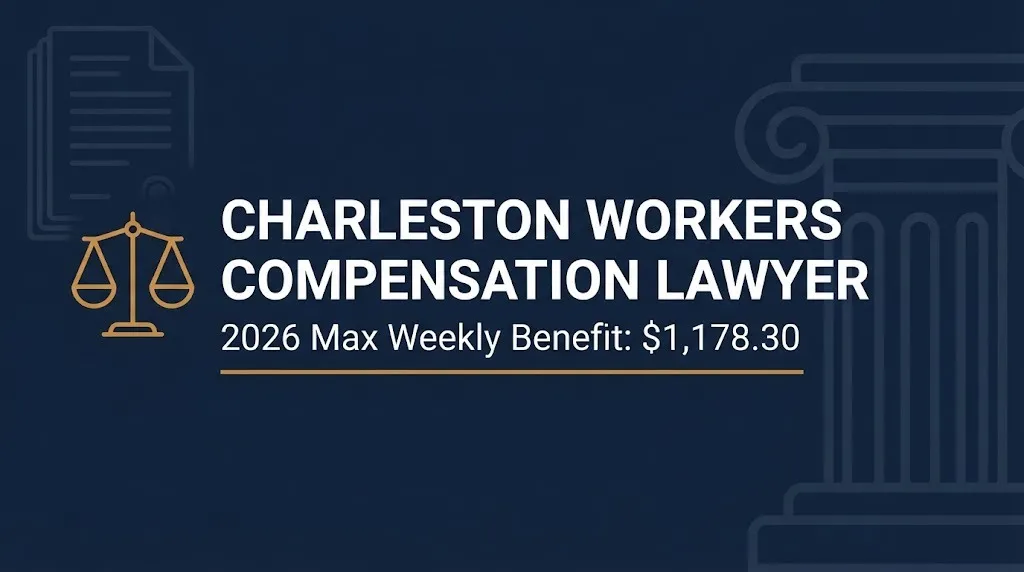
- The 2026 maximum weekly benefit is $1,178.30, set by the SC Workers’ Compensation Commission for injuries on or after January 1, 2026.
- You generally have 2 years from your injury date to file a claim, but only 90 days to report it to your employer.
If you got hurt on the job in Charleston or North Charleston, a workers compensation lawyer helps you navigate a system with strict deadlines and a state agency that is not on your side by default. South Carolina law caps what any attorney can charge you at one-third of your recovery, and that fee only gets paid if you actually win.
This affects anyone injured while working in Charleston County, whether you work at the port, in construction, in healthcare, or in hospitality. The number that matters most right now: you have just 90 days to report your injury to your employer, and 2 years to formally file a claim with the South Carolina Workers’ Compensation Commission.
This article covers what a Charleston workers compensation lawyer actually does, what one costs, the real state deadlines, and how to vet one before you hire them. One detail that surprises a lot of injured workers: your lawyer cannot get paid until the state Commission itself signs off on the fee in writing.
The Facts
| Applies To | On-the-job injuries and occupational illnesses in Charleston, North Charleston, and across South Carolina |
| Program Type | State-run, no-fault workers’ compensation system, not a lawsuit or class settlement |
| Governing Agency | South Carolina Workers’ Compensation Commission, headquartered in Columbia |
| Max Weekly Benefit (2026) | $1,178.30, effective for injuries on or after January 1, 2026 |
| Claim Deadline | 2 years from the date of injury to file with the Commission |
| Notice Deadline | 90 days to report the injury to your employer |
| Attorney Fee Cap | One-third (33%) of recovery, contingency basis, requires Commission approval |
| Proof Needed | Medical records, injury report, and a completed Form 50 (Form 52 for death claims) |
Do you actually need a workers compensation lawyer in Charleston
You are not legally required to hire a lawyer to file a South Carolina workers’ comp claim, but a lawyer becomes far more valuable once anything about your case gets contested. Simple claims with clear medical documentation and a cooperative employer sometimes resolve without one.
A lawyer matters most when your claim gets denied, when you have a permanent injury, when your employer disputes that the injury happened at work, or when the insurance company offers a settlement that looks low. Attorneys who focus on workers’ comp know how the Commission’s mediation and hearing process works, since disputed claims may be required to go through mediation before a hearing.
Key Takeaway: The more your employer or their insurer disputes your claim, the more a lawyer’s knowledge of Commission procedure actually matters.
How to tell if a Charleston workers compensation lawyer is legitimate and qualified
A legitimate workers’ comp lawyer in South Carolina is licensed by the South Carolina Bar and takes cases on contingency, meaning you owe nothing upfront. That single detail is the fastest way to spot a real practice from a predatory one.
Check these before hiring:
- Confirm active South Carolina Bar membership through the Bar’s public attorney search
- Ask whether workers’ compensation is a primary practice area, not a side offering
- Ask directly whether the fee is contingency-based and capped at one-third under state law
- Confirm the firm handles hearings before the Commission, not just paperwork
- Ask how many years the attorney has practiced specifically in workers’ comp
Reality Check: No legitimate workers’ comp lawyer charges you an upfront retainer or hourly fee for a standard claim. If someone asks for money before doing any work, that is a red flag, and South Carolina’s fee cap and Commission approval requirement exist specifically to prevent that kind of overcharging.
How much does a workers compensation lawyer in Charleston SC cost
A Charleston workers compensation lawyer generally costs nothing out of pocket, since South Carolina law limits their fee to a maximum of one-third of whatever they recover for you. If they do not win your case, you typically owe nothing.
The Commission must approve the fee arrangement in a written order before any money changes hands. Your attorney submits a form showing the total settlement, the fee taken, any reimbursed case costs, and the net amount you receive.
| Cost Element | Verified Rule |
|---|---|
| Upfront retainer | Not required; contingency basis |
| Maximum attorney fee | One-third (33%) of the recovery |
| Approval required | Yes, by written Commission order |
| Case costs (records, filing fees) | Typically advanced by the attorney, reimbursed from settlement |
Not yet determined: the exact dollar amount you would owe in any specific case, since that depends entirely on your final settlement or award amount, which varies case by case.
How much can you actually recover in a South Carolina workers comp claim
Not yet determined for your specific case, since South Carolina workers’ comp benefits are calculated individually based on your average weekly wage, injury severity, and whether you have a temporary or permanent disability.
What is confirmed is the state’s ceiling. The Commission approved the maximum weekly compensation rate at $1,178.30 for injuries occurring on or after January 1, 2026. This rate equals 66⅔% of an individual’s average weekly wage, capped at the statewide average weekly wage for the preceding fiscal year.
Compare this to a delayed tax refund: the government has a formula, but the exact amount still depends on your specific numbers, not a flat rate everyone gets.
Categories of compensation generally available under South Carolina law include:
- Temporary total disability, paid while you cannot work at all
- Temporary partial disability, paid if you can work in a limited capacity
- Permanent partial or total disability, based on injury severity
- Medical expense coverage tied to the work injury
- Death benefits for surviving family members in fatal cases
Key Takeaway: The state sets a weekly benefit ceiling, currently $1,178.30 for 2026, but your actual recovery depends on your wage history and injury classification.
What is the 2026 maximum weekly workers comp benefit in South Carolina
The 2026 maximum weekly workers’ compensation rate in South Carolina is $1,178.30. The Commission approved this figure at its Business Meeting on December 15, 2025, effective for injuries arising on or after January 1, 2026.
This rate is not arbitrary. Under Title 42 of the South Carolina Code of Laws, it equals 66⅔% of a worker’s average weekly wage, and it cannot exceed the state’s average weekly wage as certified by the South Carolina Department of Employment and Workforce.
This is a ceiling, not a guarantee. Most injured workers receive less than the maximum, since your rate is based on your own actual wages before the injury.
How to file a workers compensation claim in Charleston SC
You start a South Carolina workers’ comp claim by reporting your injury to your employer, then filing Form 50 with the Commission if the claim needs to be formalized.
- Report the injury to your employer in writing within 90 days.
- Seek medical treatment and make sure it gets documented as work-related.
- Follow all doctor’s orders and attend every follow-up appointment.
- Complete and file Form 50 with the South Carolina Workers’ Compensation Commission.
- Keep copies of all medical records and correspondence.
- If the claim is denied or disputed, consider mediation, which may be required under Commission regulations.
- If mediation fails, request a formal hearing before a Commissioner.
- Consult a workers’ comp attorney before any of these steps if your injury is serious.
Key Takeaway: Missing the 90-day notice deadline can let the insurance company deny your claim even if you are still well within the two-year statute of limitations.
What to look for when hiring a workers compensation attorney in Charleston
Look for an attorney who regularly appears before the South Carolina Workers’ Compensation Commission and can explain your specific deadlines clearly during a free consultation. Vague answers about timelines are a warning sign.
Questions worth asking directly:
- How many workers’ comp hearings have you handled before the Commission?
- Do you charge anything if my case does not succeed?
- Will you personally handle my case, or will it be passed to a paralegal?
- How do you communicate case updates, and how often?
- Have you handled cases involving my type of injury or industry before?
A free initial consultation is standard in this field, so use it to evaluate fit, not just credentials.
Questions to ask before hiring a North Charleston workers compensation lawyer
Ask a North Charleston workers’ comp lawyer the same core questions you would ask any attorney in the state, since South Carolina’s rules apply statewide, not just downtown Charleston. Location within the Charleston area does not change the underlying law.
Additional practical questions:
- Do you travel to Commission hearings held outside Columbia?
- Can you handle my case remotely if I cannot travel to your office?
- What is your estimated timeline for a case like mine?
- Do you have experience with Charleston-area employers or industries, such as port or shipping work?
- What happens if my employer retaliates against me for filing?
Key Takeaway: Physical office location matters less than whether the attorney regularly practices before the Commission and understands Charleston-area industries.
What happens if your workers comp claim is denied in South Carolina
If your claim is denied, you generally have the right to request mediation and, if that fails, a formal hearing before a Commissioner. Denial is not automatically the end of your case.
South Carolina’s Commission may require or allow mediation under Regulations 67-1802 through 67-1809, a process that has been in effect since June 28, 2013. During mediation, a neutral, Commission-certified mediator works with both sides to try to reach a resolution before a formal hearing becomes necessary.
If mediation does not resolve the dispute, either side can request a hearing, where a Commissioner reviews evidence, testimony, and medical records before issuing a ruling. From there, further appeal levels exist within the Commission’s review process.
Reality Check: A denial letter is not a final answer. It is the start of a formal dispute process that most injured workers are better positioned to navigate with legal representation.
What is the workers compensation claim deadline in South Carolina
The workers’ comp claim deadline in South Carolina is generally 2 years from the date of your injury, and missing it typically forfeits your right to benefits permanently.
There are separate, shorter deadlines layered on top of that main statute of limitations:
| Deadline Type | Time Limit |
|---|---|
| Report injury to employer | 90 days from date of injury |
| File formal claim (Form 50) | 2 years from date of injury |
| File for worsening condition | 1 year from last benefit payment |
| Death benefit claims | Up to 2 years for surviving spouse or children |
Occupational diseases and certain fatality cases can have different timing rules, since some conditions take years to develop or diagnose.
Key Takeaway: The 90-day notice deadline is far shorter than the 2-year filing deadline, and missing the earlier one can sink a claim before the later deadline even becomes relevant.
How long does a South Carolina workers comp case take
Not yet determined for any individual case, since timing depends heavily on whether your employer disputes the claim, whether mediation resolves it, and how backed up the Commission’s docket is at the time.
Straightforward, undisputed claims with clear medical documentation tend to move faster than contested cases requiring mediation or a formal hearing. Disputed cases involving permanent disability determinations or death benefits generally take longer, since they require more medical and vocational evidence.
Your attorney should be able to give you a realistic estimate for cases similar to yours during your initial consultation, based on their own case history rather than a generic timeline.
How does workers compensation work in South Carolina
South Carolina workers’ compensation is a no-fault insurance system, meaning you do not need to prove your employer caused your injury to receive benefits. This is different from a personal injury lawsuit, which does require proving fault.
Almost every South Carolina business with four or more employees must carry workers’ compensation insurance. In exchange for this no-fault coverage, injured workers generally cannot sue their employer directly for the injury, since workers’ comp is the exclusive remedy in most cases.
Benefits available under the system include:
- Medical treatment coverage tied to the work injury
- Wage replacement while you cannot work
- Permanent disability compensation for lasting impairment
- Death benefits for surviving family members
What injuries and jobs are most affected in Charleston and North Charleston
Charleston’s economy includes port and maritime work, construction, healthcare, tourism, and manufacturing, all of which carry real on-the-job injury risk. Each industry tends to produce different injury patterns.
Common workplace injury categories in this region include repetitive strain injuries, falls, vehicle accidents for delivery and transport workers, and heavy equipment injuries tied to port and shipping operations. Occupational illnesses, including conditions from long-term exposure to certain chemicals or repetitive tasks, are also compensable under South Carolina law, though they follow different statute of limitations rules than sudden injuries.
Key Takeaway: The type of injury and industry you work in can change which deadlines and evidence rules apply, which is another reason case-specific legal advice matters more than general information.
What is the South Carolina Workers Compensation Commission
The South Carolina Workers’ Compensation Commission is the state agency responsible for overseeing and deciding all workers’ comp disputes statewide. It is headquartered at 1333 Main Street, Suite 500, Columbia, South Carolina 29201.
The Commission is composed of seven commissioners and is not affiliated with your employer, your employer’s insurance carrier, or the general court system. While headquartered in Columbia, hearings are held across the state, including in the Charleston area, so you generally do not need to travel to Columbia for your case to be heard.
The Commission’s role is neutral: it interprets and enforces South Carolina’s workers’ compensation laws, rules on disputed claims, and approves attorney fee arrangements before any fee is paid out.
What Happens Next
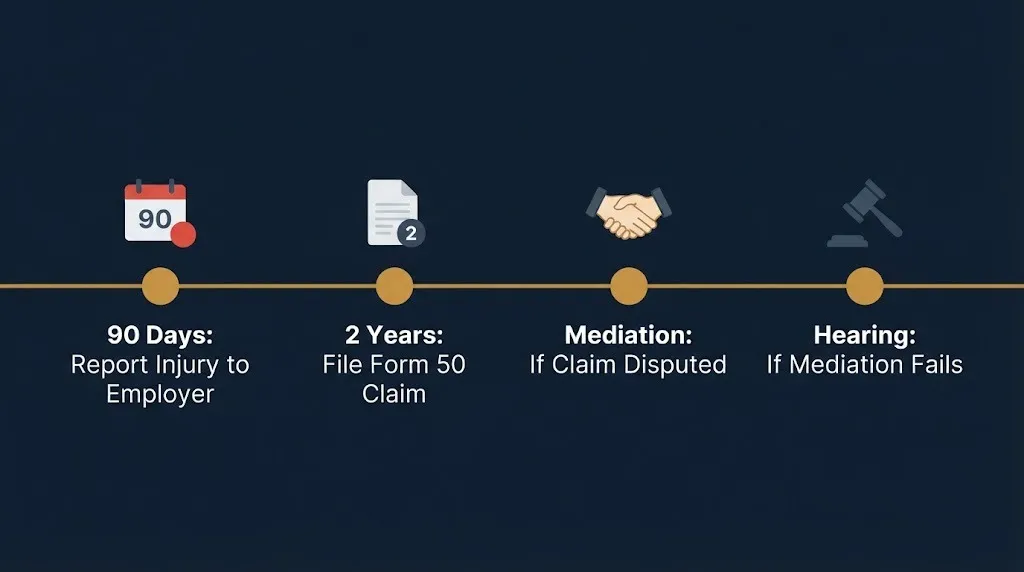
Within 90 days of injury: You must report the injury to your employer in writing to preserve your claim.
Within 2 years of injury: You must file Form 50 with the Commission or lose your right to benefits.
If disputed: Your case may be required to go through mediation under Commission regulations before a hearing is scheduled.
If mediation fails: Either side can request a formal hearing before a Commissioner.
Ongoing: The Commission reviews and must approve any attorney fee before it is paid from your settlement or award.
Frequently Asked Questions
Do I need a lawyer to file a workers comp claim in Charleston?
No, hiring a lawyer is not legally required to file a claim in South Carolina.
A lawyer becomes more valuable if your claim is denied, disputed, or involves a permanent injury.
How much does a workers compensation lawyer cost in South Carolina?
South Carolina caps workers’ comp attorney fees at one-third of your recovery, and the fee is contingency-based.
You generally pay nothing upfront, and the fee only applies if your lawyer successfully recovers benefits.
What is the deadline to file a workers comp claim in South Carolina?
You generally have 2 years from the date of your injury to file a formal claim with the Commission.
You also have only 90 days to report the injury to your employer, which is a separate, shorter deadline.
What is the maximum workers comp payment in South Carolina for 2026?
The maximum weekly compensation rate for 2026 is $1,178.30, effective for injuries on or after January 1, 2026.
Your actual weekly benefit depends on your own average weekly wage and is typically lower than this ceiling.
Can I still get workers comp if the accident was partly my fault?
Generally yes, since South Carolina workers’ compensation is a no-fault system.
You do not need to prove your employer was negligent to receive benefits, though certain exceptions can apply.
What happens if my workers comp claim is denied?
You generally have the right to pursue mediation and, if that fails, request a formal hearing before a Commissioner.
A denial is the start of a dispute process, not necessarily the final outcome.
Where does my workers comp hearing take place if I live in Charleston?
Hearings are held across South Carolina, including in the Charleston area, even though the Commission is headquartered in Columbia.
You generally do not need to travel to Columbia for your case to be heard.
Is workers compensation the same as a personal injury lawsuit?
No, workers’ compensation is a no-fault insurance system, while a personal injury lawsuit requires proving fault.
In most cases, accepting workers’ comp means you cannot separately sue your employer for the same injury.
If you were hurt on the job in Charleston or North Charleston, your first priority is reporting the injury to your employer in writing within 90 days. From there, calendar the two-year filing deadline and gather your medical records before speaking with a workers’ compensation attorney about your options.