Workers Compensation Attorneys in 2026: What They Cost, What They Change, and When You Actually Need One
Quick Answer
- Workers compensation attorneys typically work on contingency and take 15% to 25% of your settlement, no upfront fee.
- The national average workers’ comp settlement is about $44,179, though most individual claims fall between $2,000 and $60,000.
- If your claim was denied, you usually have a strict appeal window, often just 30 to 90 days, so acting fast matters more than finding the “best” lawyer.
Workers compensation attorneys represent injured employees who are fighting an insurance company, an employer, or a denied claim to get medical bills and lost wages paid. They don’t work for free, but almost all of them only get paid if you win, and state law usually caps their fee.
That single fact answers most of what people search for: is a lawyer worth it, and what does it cost. But the more useful question is when hiring one actually moves the needle, versus when you can handle a straightforward claim on your own.
This guide breaks down real fee structures, real settlement data, state-by-state deadlines, and the appeal process, all pulled from state labor boards, national safety data, and insurance industry benchmarking. One detail that surprises most readers: denied claims that get appealed with a lawyer settle for nearly five times more, on average, than claims that go through without one.
The Facts
| Topic | Hiring a workers’ compensation attorney |
| Typical fee structure | Contingency, 15% to 25% of the award, state-capped |
| National average settlement | Approximately $44,179 (National Safety Council data) |
| Median settlement (actual claimants) | Approximately $21,800 (Martindale-Nolo survey) |
| Initial denial rate | Roughly 20% to 25% of claims nationally |
| Employer injury notice deadline | Usually 30 to 120 days, varies by state |
| Formal claim filing deadline | Usually 1 to 3 years, varies by state |
| Where to verify your state’s rule | Your state workers’ compensation board or commission |
Not every number above applies to your case. Your state, your injury, and whether your claim was denied all change the math. Treat this table as a starting point, not a quote.
Workers’ Compensation Lawyer Near Me: How to Actually Vet One
A workers’ compensation lawyer near you is one licensed in your state who handles claims before your state’s compensation board, not just a nearby personal injury firm. Location matters here more than in most legal fields because workers’ comp is state law, not federal law, and procedure differs sharply state to state.
Look for three things before you sign anything:
- State-specific board experience. Ask how many hearings they’ve done in front of your state’s actual workers’ comp board or commission.
- Board certification or specialty listing. Some states recognize workers’ comp as a certified specialty, which signals real caseload experience.
- A written fee agreement before you sign anything. Reputable firms won’t ask you to sign blind.
Free consultations are standard across the industry. Use that first call to ask pointed questions, not just to get a sales pitch.
Key Takeaway: A workers’ comp lawyer only helps if they’re licensed and experienced in your specific state’s board procedure, not just injury law in general.
Workers’ Compensation Attorney vs. Workers’ Compensation Lawyer: Is There a Difference?
There is no legal difference between a workers’ compensation attorney and a workers’ compensation lawyer. Both terms describe the same licensed professional who represents injured workers in comp claims.
Firms and search engines split the phrasing for marketing reasons, not legal ones. “Attorney” tends to show up more in formal filings and referral directories, while “lawyer” shows up more in everyday search queries.
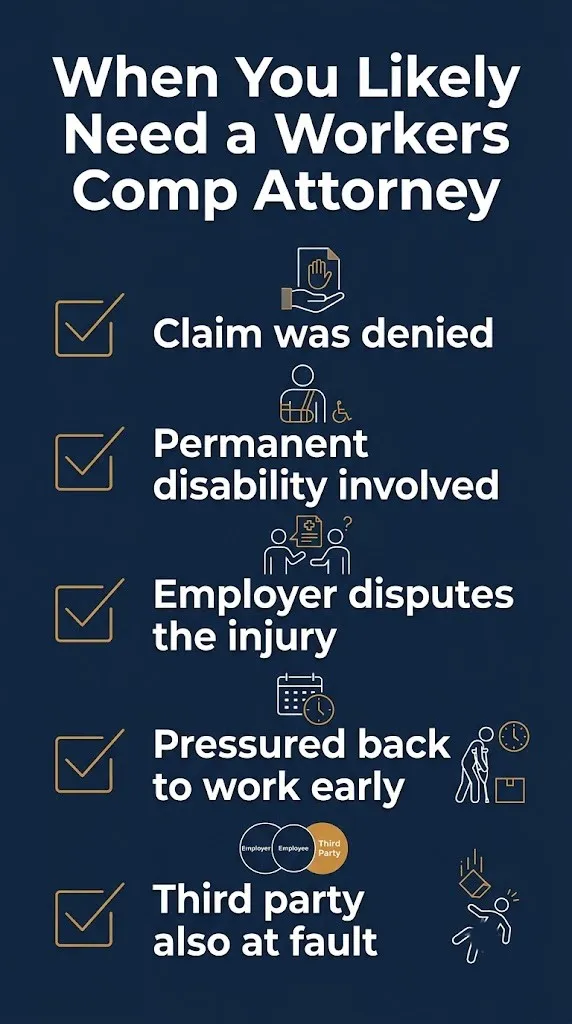
What actually varies between professionals is practice focus. Some handle only workers’ comp. Others mix it with personal injury or Social Security disability. If your case involves a third party (a contractor, a defective machine, a negligent driver), you want someone who can run a workers’ comp claim and a separate injury claim at the same time.
Best Workers Compensation Attorney: What “Best” Actually Means for Your Case
The best workers’ compensation attorney for your situation is the one with a strong track record specifically on your type of injury and in your state’s system, not the one with the biggest billboard.
Case value varies enormously by injury type. According to National Safety Council data, head and spine injury claims average roughly $91,844, more than double the overall average, while claims for minor sprains often settle for a few thousand dollars. A lawyer who mostly closes small claims fast isn’t necessarily wrong for you, but they may not be the right fit for a catastrophic injury.
Ask any firm you’re considering:
- How many cases like mine have you closed in the past two years?
- What was the range of outcomes on those cases?
- Will you personally handle my hearing, or does it go to an associate?
A firm that answers those specifically, with real numbers, is a stronger sign than online reviews alone.
Denied Workers’ Compensation Claim Attorney: What Happens After a Denial
A denied workers’ compensation claim attorney reviews why your claim was rejected, gathers stronger medical and procedural evidence, and files your appeal before your state’s strict deadline. Missing that appeal window usually ends your case for good, regardless of how legitimate the injury is.
Roughly one in four claims gets denied initially nationwide, often for procedural reasons rather than a genuine dispute over whether the injury happened. Common denial reasons include:
- Late notice to the employer
- Disputed cause of the injury (employer claims it wasn’t work-related)
- Insufficient or conflicting medical evidence
- Missed paperwork deadlines
Here’s the number that should change how you think about denials. Insurance industry benchmarking from Lockton found 27.5 percent of non-denied claims are litigated, while 70.6 percent of denied claims are litigated. And the payout gap is stark: non-litigated, non-denied claims resulted in average net claim compensation of $7,489, while denied litigated claims resulted in average net claim compensation of $36,991. In plain terms, fighting a denial with legal help tends to produce a far larger payout than simply accepting a small, quiet settlement. Risk & InsuranceRisk & Insurance
Reality Check: A denial letter is not the end of your case, and it’s not proof the injury wasn’t real. Insurance companies deny a large share of claims as a first move. Appealing is normal, common, and often successful, especially with legal representation. Filing an appeal is free; you never need to pay a “processing fee” to keep your claim alive.
How Much Does a Workers’ Compensation Attorney Cost?
Workers’ compensation attorneys almost always work on contingency, meaning you pay nothing upfront and the fee comes out of your settlement only if you win. Most states cap this fee between 15% and 25% of the award, and the fee itself typically needs approval from the workers’ comp board or judge before it’s paid out.
This differs from a lot of legal fields. You aren’t billed hourly, and you don’t pay a retainer. If your claim is denied entirely, you generally owe nothing.
| State (example) | Typical Attorney Fee Cap | Fee Approval Required |
|---|---|---|
| California | Up to 15% of the award, board-set | Yes, by a workers’ comp judge |
| New York | Set by board on a case-by-case basis | Yes |
| Florida | Statutory sliding scale, generally 20% or less | Yes |
| Texas | Board-approved, typically capped | Yes |
Exact percentages and caps change by legislation, so confirm your state’s current cap with your state workers’ compensation agency or your attorney before signing a fee agreement.
Key Takeaway: Contingency fees mean a lawyer only gets paid when you do, which is why hiring one to fight a denial rarely costs you money out of pocket.
Workers Compensation Lawyer Near Me: State Filing Deadlines You Cannot Miss
Every state sets its own deadline for reporting an injury to your employer and a separate, longer deadline for filing the formal claim. Missing either one can end your right to benefits.
Florida requires 30 days to notify your employer and 2 years to file the claim. California requires 30 days to notify your employer and 1 year to file the claim. Pennsylvania allows 120 days to notify the employer and 3 years to file. Illinois allows 45 days to notify the employer and 3 years to file, or 2 years from the last workers’ comp payment.
For work-related repetitive stress injuries or occupational diseases, deadlines often reset from the date of diagnosis rather than the date of the original injury, since the harm builds up over time rather than happening all at once.
Quick reference, don’t wait for a deadline to sneak up:
- Report the injury to your employer immediately, don’t wait for symptoms to worsen.
- Get the required claim form (often called a first report of injury) from your employer or state board.
- File within your state’s formal deadline window.
- Keep copies of every form, letter, and medical note.
- If denied, calendar your appeal deadline the same day you get the denial letter.
Because these deadlines can change through legislation, always verify current requirements with your state’s workers’ compensation agency or a licensed attorney in your state.
Abogado Para Workers Compensation: Getting Help in Spanish
Many workers’ compensation firms across states with large Spanish-speaking workforces, including California, Texas, and Florida, offer bilingual intake and full case handling in Spanish. Language should never be a barrier to filing a legitimate claim or appealing a denial.
When searching for an abogado para workers compensation, ask specifically whether the attorney handling your hearing speaks Spanish, not just the intake staff. Medical translation accuracy during your case matters as much as the legal argument itself.
Colorado Workers Compensation Lawyers and Other State-Specific Searches
Searches like “Colorado workers compensation lawyers,” “workers compensation attorney Sacramento,” or “workers compensation Texas attorney” all point to the same underlying need: a lawyer licensed in that specific state’s system, since procedure and deadlines are set at the state level, not federally.
A national firm advertising in your city may still farm the case out to local counsel. Ask directly whether the attorney signing your agreement is the one appearing at your hearing, or whether your case gets referred out.
Key Takeaway: Workers’ comp law is state-specific, so “near me” searches matter more here than in almost any other area of law.
Best Workers Compensation Lawyers Near Me: Red Flags to Watch For
Not every firm advertising heavily is a good fit, and a few warning signs show up repeatedly in state bar complaints and consumer forums.
Watch for:
- Guarantees of a specific settlement amount before reviewing your medical records
- Pressure to sign a fee agreement on the first call
- Requests for payment before any work is done (legitimate contingency firms don’t charge upfront)
- Vague answers about who will actually handle your hearing
None of these automatically mean fraud, but they’re worth pushing back on before you commit.
How Much Is My Workers’ Comp Case Worth?
Settlement value depends on injury severity, lost wage history, permanent disability rating, and your state’s benefit formula, so no single number applies to every case. The national average sits around $44,179, but that figure gets pulled hard in both directions by outliers.
A Martindale-Nolo survey of actual claimants found a median settlement closer to $21,800, with over half of workers receiving between $2,000 and $20,000. Only a small share, roughly 8%, land in the $60,000 to $100,000 range, and catastrophic injuries can push far beyond that.
| Injury Type (approximate national average) | Estimated Range |
|---|---|
| Minor sprain or strain | $2,000 to $20,000 |
| Back or spine injury | Often above overall average |
| Head or brain injury | Around $91,844 |
| Permanent partial disability | Wide range, often six figures |
Not yet determined is the honest answer for any specific reader’s case until an attorney reviews medical records, wage history, and your state’s disability rating schedule. Treat any online calculator, including this article’s ranges, as a rough starting point only.
Is Workers’ Compensation Taxable?
Workers’ compensation benefits and settlements are generally not taxable under federal law. The IRS excludes them from taxable income under Section 104(a)(1) of the Internal Revenue Code.
One exception matters: if you also receive Social Security Disability Insurance, part of your workers’ comp settlement can offset your SSDI payment, which can carry its own tax implications. If you’re receiving both, a tax professional should review your specific numbers before you finalize a settlement.
What Happens Next: Typical Timeline After You Hire an Attorney
Timelines vary by state and by whether your claim is contested, but most cases follow a similar shape.
Day 0 to 30: Report the injury, get initial medical treatment, and file the claim form with your employer’s insurer.
30 to 90 days: Insurer accepts or denies the claim. If denied, the appeal clock starts immediately.
Expected 3 to 9 months: If contested, the case moves through mediation or a formal hearing before the state workers’ comp board or judge.
Expected 6 to 18 months: Settlement negotiation or judge’s award, followed by fee approval if an attorney is involved.
Ongoing: Structured or lump-sum payment begins once the settlement or award is finalized and approved.
Exact timing depends heavily on your state’s caseload and whether either side appeals further.
Frequently Asked Questions
Do I need a lawyer for a simple workers’ comp claim?
Not always. If your injury is minor, your employer accepted the claim without dispute, and your medical bills are being paid, many workers handle it without one.
A lawyer becomes far more valuable the moment a claim is denied or disputed.
How much does a workers’ compensation lawyer take from my settlement?
Most work on contingency, typically 15% to 25%, and state law usually caps and approves the exact percentage.
You generally pay nothing unless you win.
What if my employer doesn’t have workers’ comp insurance?
You may still have options through a state uninsured employer fund, but the process differs from a standard claim.
An attorney familiar with your state’s fund can explain your specific path.
Can I be fired for filing a workers’ comp claim?
Retaliation for filing a legitimate claim is illegal in every state, though proving retaliation can be its own legal fight.
Document any change in treatment, discipline, or termination timing right after you file.
How long do I have to appeal a denied claim?
Appeal windows are typically short, often 30 to 90 days, and vary by state.
Contact an attorney the same day you receive a denial letter to avoid missing it.
Is workers’ compensation the same as a personal injury lawsuit?
No. Workers’ comp is a no-fault system that pays regardless of who caused the injury, while personal injury requires proving negligence.
Some cases involve both, if a third party outside your employer contributed to the injury.
What’s the difference between temporary and permanent disability benefits?
Temporary disability pays while you’re recovering and expected to return to work.
Permanent disability applies when a doctor determines you have lasting impairment, and it usually pays out differently by state formula.
Do I have to see a doctor chosen by my employer’s insurer?
Many states let the employer or insurer direct initial treatment, at least for a set period.
Rules on switching to your own doctor vary significantly by state, so check your state board’s rule before assuming you’re stuck.
Filing on time matters more than finding the perfect lawyer on day one. Check your state’s workers’ compensation board for your exact deadlines, and if your claim gets denied, calendar the appeal window the moment you get that letter.
The single number worth remembering: roughly one in four claims gets denied initially, and appealing with legal help routinely produces a far larger outcome than accepting the first answer.
Sources checked July 14, 2026: National Safety Council workers’ compensation cost data, Martindale-Nolo claimant settlement survey, Lockton workers’ compensation benchmarking report, FindLaw state statute of limitations directory, state workers’ compensation board publications for California, Florida, Pennsylvania, and Illinois.
lawcompensate.com is an independent news publisher, not a law firm. This article is information, not legal advice. Verify current details with your state’s workers’ compensation board or a licensed attorney before filing.