Atlanta Workers Compensation Lawyer 2026: What a Georgia Attorney Actually Does for Your Claim
Quick Answer
- An Atlanta workers compensation lawyer handles your claim, appeals, and settlement under Georgia law.
- Attorney fees in Georgia are capped at 25 percent of your weekly benefits, not your settlement.
- You have one year from your injury date to file a Georgia workers compensation claim.
If you were hurt at work in Atlanta, you may be wondering whether you need a lawyer and what one would actually do for you.
A workers compensation lawyer in Georgia handles the paperwork, fights denials, negotiates settlements, and represents you at hearings before the State Board of Workers’ Compensation.
The fee rules are set by Georgia law. You do not pay upfront. The lawyer takes a percentage of what they recover for you.
This article explains what an Atlanta workers compensation attorney does, what it costs, when you need one, and how the Georgia system works in 2026.
The Facts
| Item | Details |
|---|---|
| Governing Body | State Board of Workers’ Compensation |
| Attorney Fee Cap | 25 percent of weekly benefits |
| Claim Filing Deadline | One year from injury date |
| Reporting Deadline | 30 days to employer |
| Benefit Rate | Two-thirds of average weekly wage |
| 2026 Legislative Change | None confirmed |
Is It Worth Hiring an Atlanta Workers Compensation Lawyer?
Hiring a lawyer is usually worth it if your claim is denied, disputed, or involves serious injury.
A lawyer can identify mistakes in your claim, gather medical evidence, and negotiate a higher settlement. Studies and industry reporting suggest represented workers recover more than unrepresented workers.

Here is when a lawyer matters most:
| Situation | Lawyer Value |
|---|---|
| Claim denied | High, handles appeal |
| Injury requires surgery | High, increases settlement leverage |
| Employer disputes injury | High, gathers evidence |
| Permanent disability | High, calculates future value |
| Minor injury, no dispute | Lower, may handle alone |
Key Takeaway: The bigger your injury and the more your employer fights, the more a lawyer matters.
What Does a Workers Compensation Lawyer Do in Georgia?
A Georgia workers compensation lawyer handles your claim from filing through settlement or hearing.
The lawyer prepares the WC-14 form, which officially starts your claim with the State Board of Workers’ Compensation. They also gather medical records, communicate with the insurance carrier, and represent you at hearings.
Here is what the lawyer does:
- Files the WC-14 claim form with the state board.
- Gathers medical records and wage documents.
- Communicates with the insurance adjuster.
- Negotiates weekly benefits and medical care.
- Requests hearings when disputes arise.
- Prepares you for testimony.
- Negotiates lump sum settlements.
- Represents you at mediation or trial.
How Much Does a Workers Compensation Lawyer Cost in Atlanta?
Georgia law caps attorney fees at 25 percent of your weekly benefits.
The fee comes out of the benefits the lawyer recovers for you. You do not pay a retainer or hourly rate.
For lump sum settlements, the fee is usually 25 percent of the settlement amount, subject to State Board approval.
Here is how the fee works:
| Recovery Type | Fee Cap |
|---|---|
| Weekly benefits | 25 percent |
| Lump sum settlement | 25 percent, board approved |
| Medical benefits | No fee on medical care |
Reality Check: A legitimate workers compensation lawyer never asks you to pay upfront. If a lawyer demands money before taking your case, walk away.
What Is the Deadline to File a Workers Compensation Claim in Georgia?
You have one year from the date of your injury to file a claim with the State Board of Workers’ Compensation.
You should report the injury to your employer within 30 days. Missing that deadline can hurt your claim, but the one-year filing deadline is the hard cutoff.
Here are Georgia’s deadlines:
| Action | Deadline |
|---|---|
| Report injury to employer | 30 days |
| File WC-14 claim | One year from injury |
| Request hearing after denial | Varies by case |
| Appeal board decision | 20 days from award |
What Is the Georgia State Board of Workers’ Compensation?
The State Board of Workers’ Compensation is the Georgia agency that administers workers compensation claims.
It provides forms, schedules hearings, approves settlements, and enforces the rules. The board’s website is where you file the WC-14 form.
Here is what the board does:
| Function | What It Means |
|---|---|
| Claim filing | Accepts WC-14 forms |
| Hearings | Administrative law judges decide disputes |
| Settlement approval | Reviews and approves lump sums |
| Appeals | Hears challenges to judge decisions |
| Enforcement | Penalizes employers without insurance |
How Much Is My Georgia Workers Compensation Case Worth?
Your case value depends on your average weekly wage, your impairment rating, and whether you need surgery.
Georgia pays two-thirds of your average weekly wage, up to a state maximum. The maximum adjusts annually.
Here is the calculation for a worker earning $1,000 per week:
| Calculation Step | Amount |
|---|---|
| Average weekly wage | $1,000 |
| Compensation rate (66.67%) | $666.67 |
| State maximum cap | Applied if above |
| Weekly benefit | $666.67 |
Permanent partial disability benefits are based on a schedule of body parts. Each body part has a set number of weeks.
What Is a Georgia Workers Compensation Settlement?
A Georgia workers compensation settlement is a lump sum payment that closes your claim.
Settlements are voluntary. The insurance company does not have to settle, and neither do you.
The State Board of Workers’ Compensation must approve every settlement. A judge reviews the agreement to make sure it is fair.
Here is what a settlement means:
| Item | What It Does |
|---|---|
| Lump sum payment | One-time payment to you |
| Claim closure | You give up future benefits |
| Medical settlement | May or may not include future medical care |
| Board approval | Required for validity |
What Is a WC-14 Form in Georgia?
The WC-14 form is the official claim form in Georgia workers compensation.
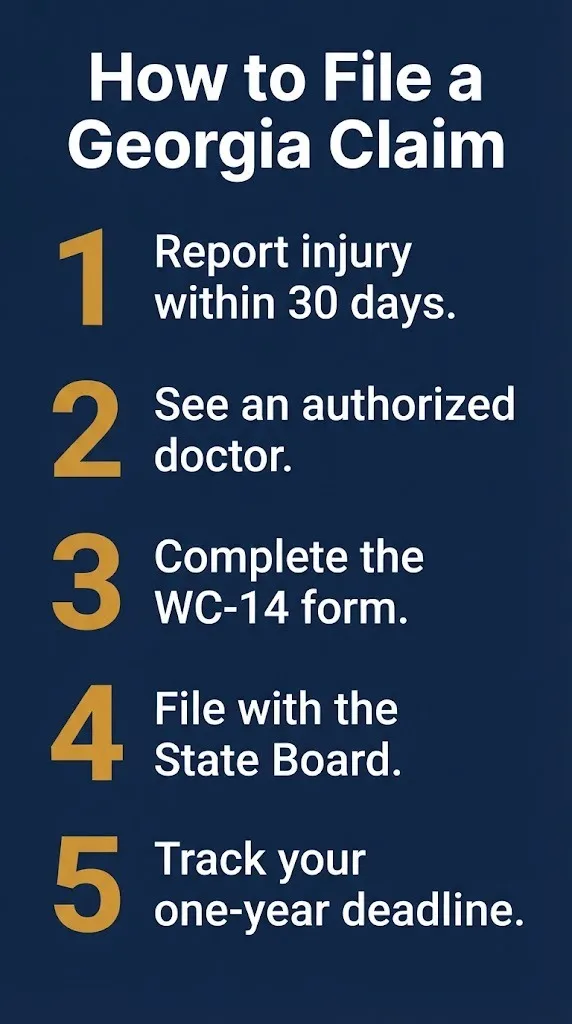
It tells the State Board of Workers’ Compensation that you were injured and want benefits. Without it, you have no formal claim.
Here is what the form includes:
- Your name and contact information.
- Your employer’s name and address.
- The date and description of your injury.
- The body parts affected.
- Your average weekly wage.
- The insurance carrier if known.
- Your signature and date.
Can I Handle My Georgia Workers Compensation Claim Without a Lawyer?
You can handle a simple, undisputed claim without a lawyer. Many workers do.
But if the insurer denies your claim, disputes your injury, or offers a low settlement, a lawyer changes the balance.
Here is the honest comparison:
| Factor | Without Lawyer | With Lawyer |
|---|---|---|
| Cost | No fee | 25 percent of recovery |
| Claim filing | You do it yourself | Lawyer handles it |
| Denial appeal | You fight alone | Lawyer represents you |
| Settlement value | Often lower | Typically higher |
| Time investment | High | Low for you |
What Happens Next
Expected 2026: No Georgia workers compensation law changes are pending.
Ongoing: The State Board of Workers’ Compensation continues processing claims and hearings.
Your move: Report your injury now, file the WC-14 before the one-year deadline, and consult a lawyer if your claim is denied.
An Atlanta workers compensation lawyer is not required for every claim. But for serious injuries, denials, or low settlement offers, a lawyer changes the outcome.
The Georgia system gives you one year to file. The fee rules protect you from upfront costs.
Your job is to report the injury, file the claim, and get help when the insurance company pushes back.