Workers Compensation Insurance Broker 2026: Who They Represent and How They Get Paid
Quick Answer
- A workers comp broker works for the employer, not the insurance company .
- Brokers are paid by carrier commissions, typically 8% to 12% of premium .
- Brokers owe a limited duty of reasonable care, not a full fiduciary duty .
A workers compensation insurance broker represents the employer buying coverage, not the insurance carrier selling it. That distinction is written into state licensing rules and reinforced by court decisions .
If you run a business with employees, you’re legally required to carry workers comp in nearly every state. The broker’s job is to shop your risk across multiple carriers, negotiate terms, and help you stay compliant .
This article breaks down exactly who the broker works for, how they get paid, what legal duties they owe you, and how to pick one who won’t leave you exposed when a claim hits.
The Facts
| Detail | Verified Status |
|---|---|
| Who broker represents | The employer/buyer of insurance |
| Legal duty owed | Reasonable care, diligence, and judgment in procuring insurance |
| Full fiduciary duty | Limited; applies mainly to handling client money |
| Standard commission range | 8% to 12% of premium |
| State fund commission range | 3% to 6% |
| Who pays the commission | The insurance carrier, built into premium |
| Licensing required | Yes, in all U.S. states |
| Workers comp self-regulation | Some states use codes of practice instead of formal registration |
Who does a workers compensation insurance broker represent?
A workers compensation insurance broker represents the employer buying coverage, not the insurance company . The California State Personnel Board defines the role plainly: “A licensed workers’ compensation broker who represents the buyer of insurance and has a legal duty to help the buyer obtain appropriate coverage” .

That means the broker’s job is to find you the best policy for your business, not to sell you whatever the carrier wants to push. American Insuring Group puts it this way: “An insurance broker is a free agent who works for the client, not the insurance company” .
This is different from a captive agent who works for one insurer. A broker can shop your risk across multiple carriers, compare rates, and negotiate terms on your behalf .
How does a workers compensation broker get paid?
A workers compensation broker gets paid through commission from the insurance carrier, not from you directly . The commission is built into the premium you pay, but it’s paid by the insurer to the broker .
Standard commission rates run between 8% and 12% of the total premium for most commercial policies . For state fund coverage, commissions are lower, typically 3% to 6%, because state funds aren’t competing for market share the same way private carriers are .
Here’s the key point: you don’t write a separate check to the broker in most cases. The commission comes out of the premium the carrier collects . That’s why working with a broker usually doesn’t cost you extra compared to buying direct.
| Coverage Type | Typical Commission Range |
|---|---|
| Private carrier workers comp | 8% to 12% |
| State fund workers comp | 3% to 6% |
| Large premium programs | Negotiated, often reduced |
Key Takeaway: Your broker’s commission is paid by the carrier and built into your premium. You don’t pay a separate broker fee in most workers comp transactions .
Does a workers compensation broker owe you a fiduciary duty?
A workers compensation broker owes you a limited duty of reasonable care, not a full fiduciary duty . That’s an important distinction if you think your broker is legally required to act as your trusted adviser in every situation.
The California Court of Appeal addressed this directly in Tanner Construction v. HUB International. The court held that “insurance brokers owe a limited duty to use reasonable care, diligence and judgment in procuring the insurance requested by an insured” . The court also stated there’s “no authority supporting a fiduciary duty that would extend to areas beyond the recognized duty” .
What does that mean in practice? Your broker must do a competent job finding the coverage you asked for. But they don’t have to investigate whether the insurer is financially sound, and they don’t have to advise you on every risk your business faces . That’s a much narrower duty than what a lawyer or financial adviser owes you.
If you want your broker to take on additional duties, you need to get that in writing. The court in Randle v. Farmers noted that a broker’s duty stays limited “absent special circumstances,” such as holding themselves out as an expert .
Reality Check
A workers comp broker is not your lawyer, your accountant, or your financial adviser. If you need legal advice about coverage obligations or want someone to audit your entire risk profile, that’s outside the broker’s standard scope. Don’t assume your broker is reviewing every contract you sign or catching every exposure. Their job is to procure the insurance you request, and their duty stops there unless you’ve agreed to something more .
How do you choose a workers compensation insurance broker?
Choose a broker with workers comp specialization, multiple carrier relationships, and experience in your industry . Not every broker knows how experience modification rates work or how to classify your employees correctly .
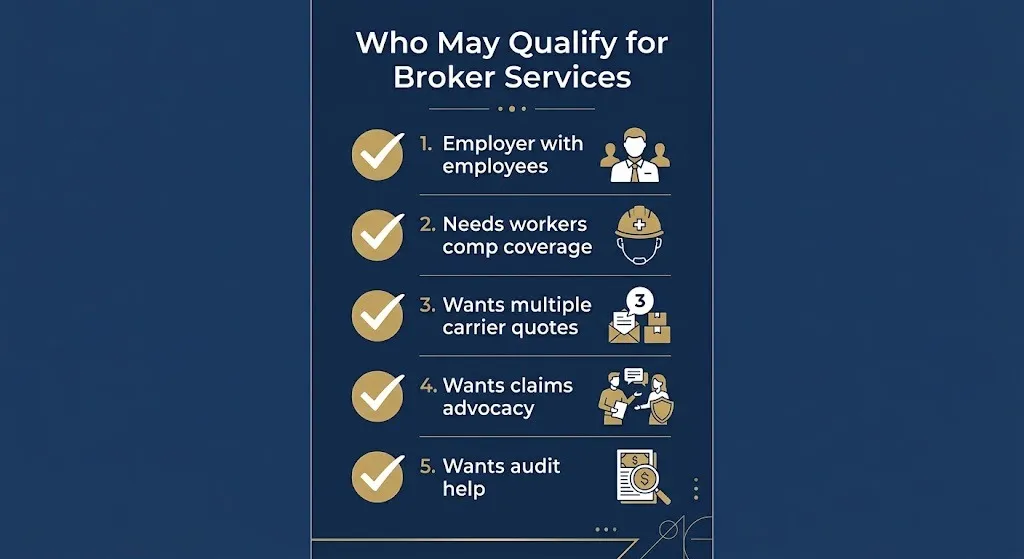
Here’s what to look for:
- Multiple carrier access: A broker who can only quote one company isn’t really brokering
- Industry experience: Ask how many businesses like yours they insure
- Experience mod knowledge: They should explain how your claims history affects premiums
- Claims advocacy: Good brokers help manage claims, not just sell policies
- Safety program guidance: They should suggest ways to lower your risk over time
The National Association of Insurance Commissioners recommends working with specialized brokers for small business coverage . The Independent Insurance Agents & Brokers of America can help you find qualified professionals in your area .
What should you ask a workers compensation broker before signing?
Before you sign anything, ask these questions and get the answers in writing :
- Are you licensed in my state to place workers compensation?
- How many carriers will you solicit quotes from?
- How is your commission structured, and does it change if I pick a higher premium?
- Do you have experience with my industry’s classification codes?
- Will you help manage claims and audits after the policy is bound?
- What’s your process when my experience mod changes?
- Do you have any financial relationship with a specific carrier you’re recommending?
A broker with nothing to hide will answer all seven without hesitation. If they dodge the commission question or can’t name the carriers they work with, keep looking.
What happens next
Ongoing: Employers renew workers comp policies annually, with broker assistance on re-marketing .
Ongoing: Brokers help with audits, claims management, and classification reviews throughout the policy term .
TBD: Some states may consider formal broker registration schemes for workers comp in the future .
Ongoing: Policyholders can switch brokers mid-term using a Broker of Record letter, though carrier rules vary .
Frequently Asked Questions
Who does a workers compensation broker work for?
A workers comp broker works for the employer buying coverage, not the insurance carrier .
How much does a workers compensation broker cost?
Most brokers are paid by carrier commission, typically 8% to 12% of premium, built into what you pay the insurer . You usually don’t pay a separate fee.
Does a workers comp broker owe a fiduciary duty?
Brokers owe a limited duty of reasonable care in procuring coverage, not a full fiduciary duty beyond handling client money .
Can a workers comp broker guarantee a claim will be covered?
No. California regulations state that brokers and insurers cannot guarantee coverage outcomes .
What is a Broker of Record letter?
A BOR letter changes the agent of record with the insurance carrier, assigning future commission and service rights to the new broker .
Do I need a broker if I buy workers comp from a state fund?
You can buy directly, but a broker can still help with classification, audits, and claims advocacy even for state fund coverage .
How do brokers help lower my workers comp premiums?
Good brokers review your experience mod, suggest safety programs, ensure correct employee classification, and re-market your policy at renewal .
What if my broker doesn’t shop my policy around?
That’s a red flag. A broker who only presents one carrier isn’t functioning as a true broker. You can switch using a Broker of Record letter .
Your workers comp broker works for you, not the carrier. Their commission comes from the insurer, their duty is to procure the coverage you request, and their value shows up when claims and audits happen.
The single most important thing to remember: ask your broker directly who they represent, and get their commission structure in writing .