Penalty for Not Having Workers Compensation Insurance 2026: State-by-State Fines, Criminal Charges, and What Injured Workers Can Recover
Quick Answer
- Every state except Texas requires most employers to carry workers comp insurance, with penalties for non-compliance ranging from daily fines to criminal charges.
- California’s new SB 291 law imposes a $10,000 minimum penalty for uninsured sole-owner contractors and $20,000 for other contractors.
- Injured workers at uninsured employers can often file claims through state trust funds or pursue civil lawsuits that bypass normal workers comp limits.
If your employer didn’t have workers compensation insurance when you got hurt, the penalty they face doesn’t automatically put money in your pocket. The system is designed to punish the employer and, in some states, route your medical bills and lost wages through a special fund. But the rules are state-specific, and the dollar amounts vary wildly.
This article breaks down the verified penalty structures across multiple states for 2026, explains what happens when an uninsured employer injures a worker, and shows you exactly how to check if your employer is covered. The most surprising verified detail: New York courts can assess penalties based on a formula that produced a $145,000 fine in one recent case, but employers have successfully appealed the calculation when they weren’t given a chance to challenge it.
The Facts
| Case | No single national case. Penalties set by individual state laws and workers compensation boards. |
| Status | Active enforcement across all states in 2026; California SB 291 took effect January 1, 2026. |
| Fund Size | Not applicable. Penalties go to state funds, not a settlement pool. |
| Est. Per Person | Not applicable. Penalties are paid by employers to the state. |
| Claim Deadline | Varies by state. Check your state workers compensation board. |
| Administrator | State workers compensation boards and departments of labor. |
| Proof Needed | Employment relationship, injury during employment, employer lacked coverage. |
What is the penalty for not having workers compensation insurance?
The penalty for not having workers compensation insurance is a mix of fines, business shutdown orders, criminal charges, and full liability for employee injuries, with the specific amount depending on your state. In most states, the penalty isn’t a one-time fine. It’s a daily or per-employee assessment that can add up fast.
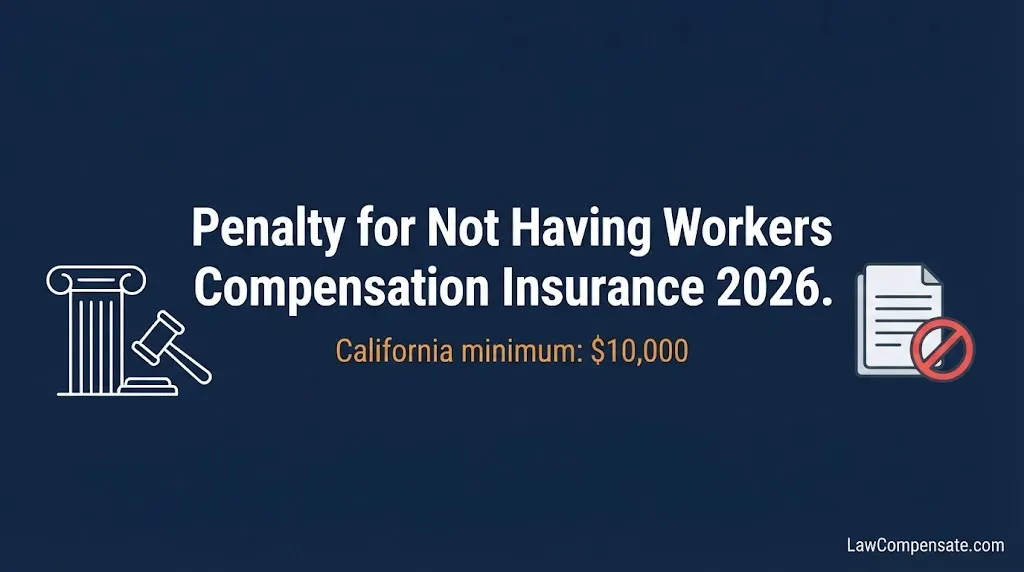
California’s SB 291, effective January 1, 2026, sets a $10,000 minimum penalty for uninsured sole-owner contractors and a $20,000 minimum penalty for other uninsured contractors . Those are statutory minimums. The state can seek more.
Connecticut law allows a fine of not more than $50,000 for failure to insure, and the employer can be enjoined from entering into any contracts of employment . In a December 2025 case, the owner of a Connecticut construction company was arrested and charged with two counts of noncompliance after an employee was seriously injured on a jobsite with no policy in effect. The state paid $85,489.22 in medical and indemnity benefits through the Second Injury Fund .
California also imposes a $10,000 fine, potential one-year prison sentence, and a state penalty of up to $100,000 for failing to carry required coverage . The state can issue a stop order that halts your business operations until you get insured.
Key Takeaway: Penalties for uninsured employers are not a one-time slap on the wrist. They are daily, escalating, and in some states criminal.
How much can an employer be fined for no workers comp insurance in 2026?
Fines for no workers comp insurance in 2026 range from $100 per day in some states to $50,000 maximums in others, with California’s new contractor minimums now among the highest statutory floors in the country. A single state can have multiple penalty layers: a criminal fine, a civil assessment, and a separate penalty formula tied to the injured worker’s claim.
Here’s how several states stack up based on verified penalty structures:
| State | Key Penalty | Source |
|---|---|---|
| California | $10,000 minimum for sole-owner contractors, $20,000 minimum for other contractors (SB 291, effective Jan 1, 2026) | |
| Connecticut | Fine up to $50,000; injunction against employment contracts | |
| Florida | $1,000 or twice the premium owed over 3 years, whichever is greater; stop-work order with $100 daily penalty | |
| Illinois | Fine up to $500 per day of default; minimum penalty $10,000 | |
| Kansas | Penalty may be double the premium owed or $25,000, whichever is greater | |
| New York | Formula-based: $1,000 per 10-day period of non-compliance, or up to two times the cost of compensation for payroll |
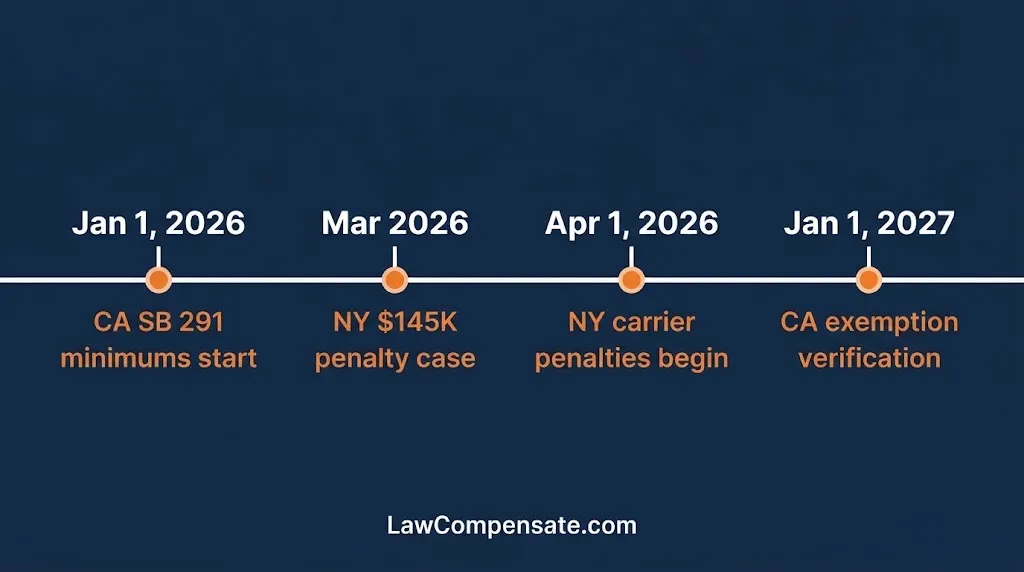
New York’s formula is particularly aggressive. In Matter of Cortez v Royal Stone Cabinet & Tile Inc., the Workers’ Compensation Board assessed a $145,000 penalty against an employer that failed to secure coverage. The appellate court upheld the finding of employment but remanded the penalty calculation because the employer didn’t get a fair chance to challenge the math .
That case shows you something important: the penalty isn’t always final. Employers can appeal if the procedure was flawed.
What is the penalty for not having workers compensation insurance in NY?
The penalty for not having workers compensation insurance in New York is a mandatory assessment of $1,000 for each 10-day period of non-compliance, or up to two times the cost of compensation for the employer’s payroll during the violation period, whichever formula the Board applies . It’s not discretionary. If the Board finds the employer violated WCL § 50, the penalty under § 26-a is mandatory.
The $145,000 penalty in the Royal Stone case came from the first formula. That’s 145 ten-day periods. At $1,000 per period, the math gets ugly fast.
New York also gives the Board power to penalize insurance carriers who file proof of coverage transactions late, which indirectly affects employers. Under Subject Number 046-1802, effective April 1, 2026, carriers who fall below an 85% timely filing rate face $50 penalties for each 10-day period a transaction is late . That’s the carrier’s penalty, not the employer’s, but it shows how seriously the state treats coverage documentation.
Separately, a March 2026 Court of Appeals decision in Gonzalez v. Northeast Parent & Child Society held that attorneys cannot collect legal fees on late payment penalties assessed against carriers under WCL § 25 . That’s a procedural ruling, but it clarifies that the 20% late payment penalty goes to the claimant, not their lawyer.
What happens if you’re injured and your employer has no workers comp insurance?
If you’re injured and your employer has no workers comp insurance, you can still get benefits in most states, but the path is different and often slower. You may file a claim through a state Uninsured Employers Fund or pursue a civil lawsuit that isn’t limited by workers comp’s normal damage caps.
California operates the Uninsured Employers Benefits Trust Fund (UEBTF). If your employer was illegally uninsured when you got hurt, the UEBTF can step in to pay your workers comp benefits . The state then goes after the employer to recover what it paid.
You also may be able to sue your employer in civil court. Normally, workers comp is the exclusive remedy for workplace injuries. That protection disappears when the employer breaks the law by not carrying insurance. In California, you may be able to seek damages that exceed standard workers comp benefits, including pain and suffering in some circumstances .
Connecticut’s Second Injury Fund operates similarly. In the Milardo case, the fund paid $85,489.22 for an injured employee whose employer had no policy . The employer was then criminally charged.
Iowa law states this consequence plainly: employers without coverage “lose the protection of workers’ comp laws” and can be liable for the full amount of damages under regular tort law .
Reality Check: No state agency will text you about your uninsured employer penalty. If someone contacts you claiming they can get you money from your employer’s fine, it’s a scam. Penalties go to the state. Your recovery comes from a claim, a trust fund, or a lawsuit.
How do I check if my employer has workers compensation insurance?
You can check if your employer has workers compensation insurance through your state workers compensation board’s online coverage verification tool, usually for free and without notifying your employer. Most states maintain a searchable database of active policies.
Each state’s system works differently. New York employers must file proof of coverage with the Workers’ Compensation Board, and that data is available through the Board’s IC Inquiry Application . California employers must file certificates with the Contractors State License Board if they’re licensed contractors . Connecticut uses the National Council on Compensation Insurance database to verify coverage .
Here’s how to check in five steps:
- Go to your state workers compensation board’s website.
- Find the coverage verification or proof of coverage search tool.
- Enter your employer’s legal business name and address.
- Look for an active policy that covers your date of injury.
- If no policy appears, contact the board’s compliance unit before confronting your employer.
If you’re in a state where the search tool isn’t obvious, call the workers compensation board directly. They can tell you if a policy is on file without revealing your name.
What states have the toughest penalties for uninsured employers in 2026?
California, New York, Connecticut, and Illinois have the toughest verified penalty structures for uninsured employers in 2026, combining high fines, daily accrual, criminal exposure, and fund-backed benefits for injured workers.
California stands out for its new SB 291 minimums. A $20,000 minimum for a corporation that employs workers without coverage is a hard floor . The old maximum fine was $30,000. Now the minimum is two-thirds of that maximum. The state also requires the Contractors State License Board to establish a verification process for exemption claims by January 1, 2027, to catch contractors who falsely claim they have no employees .
New York has a formula that can produce six-figure penalties. The Royal Stone case ended with a $145,000 assessment . Even though the appellate court sent it back for a rehearing on the calculation, the underlying liability stood.
Connecticut pairs a $50,000 maximum fine with criminal prosecution. The state’s Workers’ Compensation Fraud Control Unit arrests employers, not just fines them .
Illinois sets a $10,000 minimum penalty and allows $500 per day fines for ongoing violations . That daily accrual means a months-long violation can dwarf the initial minimum.
What are the criminal penalties for not carrying workers comp insurance?
Criminal penalties for not carrying workers comp insurance exist in multiple states, ranging from misdemeanor charges with jail time to felony prosecution for knowing and repeated violations. Most employers never face jail, but the threat is real and prosecutors use it.
Florida law states that failure to secure coverage is “deemed an immediate and serious danger” and subjects the employer to prosecution for a third-degree felony if the failure is knowing . Georgia classifies it as a misdemeanor with penalties up to $5,000 per violation . Connecticut charged a business owner in December 2025 with two counts of noncompliance, and he faced a court appearance in January 2026 .
California’s Labor Code violation is a criminal offense punishable by up to $10,000 in fines and one year in prison . The state can also impose a civil penalty of up to $100,000.
The pattern is consistent: states escalate from civil fines to criminal charges when the employer knew coverage was required and willfully failed to maintain it. The Connecticut case emphasized that the employer had a prior policy that was canceled for non-payment, demonstrating knowledge of the requirement .
How do states calculate the penalty amount for uninsured employers?
States calculate the penalty amount for uninsured employers using two primary formulas: a flat per-day or per-period rate, or a percentage or multiple of what the employer would have paid in premiums. Some states use both and apply whichever produces the higher number.
Per-period formulas are straightforward. New York assesses $1,000 for each 10-day period of non-compliance . Kansas charges a penalty of double the premium owed or $25,000, whichever is greater . Florida assesses $1,000 or twice the amount the employer would have paid over the preceding 3-year period, whichever is greater .
Daily accrual formulas punish longer violations more severely. Illinois allows $500 per day of default . Iowa can assess up to $100 per day .
Statutory minimums set a floor regardless of other factors. California’s $10,000 and $20,000 minimums under SB 291 are automatic and apply even for first violations . Ignorance of the law, financial hardship, and clerical errors are not defenses.
New York’s formula gives the Board a choice between the per-period rate and the payroll-based calculation. In the Royal Stone case, the Board used the per-period formula to reach $145,000. The employer argued it should have had a chance to challenge that choice before the penalty was finalized. The appellate court agreed and ordered a rehearing on the amount .
Key Takeaway: The penalty is calculated after the violation is found, and employers often don’t get a say in the math until they appeal.
What happens to an employer’s legal protections when they skip workers comp coverage?
When an employer skips workers comp coverage, they lose the exclusive remedy protection that normally shields them from employee lawsuits. That means an injured worker can sue for damages beyond the limited benefits the workers comp system provides.
Iowa’s compliance page states it directly: uninsured employers “lose the protection of workers’ comp laws” and face full tort liability . In California, an uninsured employer can be sued for pain and suffering, which is not recoverable in the normal workers comp system .
This is the biggest financial risk for an uninsured employer, bigger than any fine. A single serious injury lawsuit can produce a verdict in the hundreds of thousands or millions, with no cap and no exclusive remedy shield.
The trade-off for the employer is clear: pay premiums, or risk unlimited liability. For the injured worker, the trade-off is slower benefits through a state fund or a longer civil case, but potentially a much larger recovery.
What Happens Next
- Ongoing 2026: State workers compensation boards continue active enforcement, with California’s new SB 291 penalties now in effect for contractor violations.
- January 1, 2027: California’s Contractors State License Board must establish a verification process for exemption claims, which could catch more uninsured contractors .
- Expected 2027: More states may follow California’s lead with increased minimum penalties, though no other state has announced pending legislation as of October 2026.
- Quarterly: New York continues assessing carrier penalties for late proof of coverage filings under Subject 046-1802, which indirectly pressures employers to maintain active policies .
Frequently Asked Questions
Can I get workers comp benefits if my employer has no insurance?
Yes, in most states you can still get benefits through a state Uninsured Employers Fund. California operates the UEBTF specifically for this situation. Connecticut uses the Second Injury Fund. You may also be able to sue your employer directly.
How do I know if my employer has workers comp insurance?
Check your state workers compensation board’s online coverage verification tool. You’ll need your employer’s legal name and address. If nothing shows up, call the board’s compliance unit directly.
Is it a crime for an employer not to have workers comp insurance?
In many states, yes. Florida allows felony prosecution for knowing failure. Connecticut arrests employers. California treats it as a criminal offense with possible jail time. Most cases end in fines, but the criminal exposure is real.
Can I sue my employer if they didn’t have workers comp insurance?
In most states, yes. Employers who fail to carry required coverage lose the exclusive remedy protection that normally blocks employee lawsuits. You may be able to seek damages for pain and suffering, which workers comp doesn’t cover.
What’s the penalty in New York for no workers comp insurance?
New York assesses a mandatory penalty of $1,000 for every 10-day period of non-compliance, or up to two times the cost of compensation for payroll. A recent case produced a $145,000 penalty before the appellate court sent it back for a calculation rehearing.
What is California’s new penalty for uninsured contractors in 2026?
SB 291 sets a $10,000 minimum penalty for sole-owner contractors and $20,000 for other contractors who employ workers without coverage. These are automatic minimums effective January 1, 2026.
Does Texas require workers compensation insurance?
No. Texas is the only state where workers comp coverage is elective for most private employers. But uninsured Texas employers lose the exclusive remedy protection and face full liability for workplace injuries.
How long do I have to file a claim if my employer was uninsured?
Deadlines vary by state. Most workers comp claims must be filed within 30 days to 2 years of the injury or diagnosis. Civil lawsuits have separate statutes of limitations. Check your state’s rules immediately if you’re injured.