New York Workers Compensation Guide 2026: Rates, Costs and Rules
Quick Answer
- Nearly every New York employer with one or more employees must carry workers’ compensation insurance under state law.
- Weekly wage benefits are capped at $1,222.42 through June 30, 2026, rising to $1,281.50 after that date.
- Coverage comes from private carriers, the New York State Insurance Fund, or self-insurance, no single statewide “cheapest” price exists.
If you’re searching “workers compensation NY,” you’re probably either a business owner trying to get legally covered, or a worker trying to understand what you’re owed after an injury. Both questions have real, dated answers rooted in state law.
New York requires workers’ compensation coverage for virtually all employers under Workers’ Compensation Law Sections 2 and 3. Skip it, and penalties start at $1,000 and can reach $50,000, plus a possible stop-work order.
This guide breaks down what the insurance actually costs, how benefit rates work, how to get covered, and how to file a claim if you’re hurt on the job. One detail surprises a lot of new business owners: even a single part-time employee, including a family member on payroll, triggers the coverage requirement.
The Facts
| Program | New York State workers’ compensation insurance system (WCL Sections 2 and 3) |
| Administrator | New York State Workers’ Compensation Board (WCB) |
| Status | Active, mandatory statewide program; benefit rates update every July 1 |
| Insurance Sources | Not a single fund: private carriers, NYSIF, or self-insurance |
| Weekly Benefit Range | $325 to $1,222.42 (through June 30, 2026), rising to $384.45 to $1,281.50 (from July 1, 2026) |
| Injury Report Deadline | Notify your employer in writing within 30 days of the injury |
| Proof of Coverage | Form C-105.2 (private carrier), U-26.3 (NYSIF), SI-12 (self-insured), or CE-200 (exemption) |
What Is Workers’ Compensation Insurance in New York?
Workers’ compensation insurance is a no-fault coverage that pays medical costs and partial lost wages when an employee gets hurt or sick because of their job.
It’s “no-fault” because you don’t need to prove your employer did anything wrong to receive benefits. In exchange, employees generally can’t sue their employer directly for the injury.
What the coverage pays for, per the NYS Workers’ Compensation Board and state insurance guidance:
- Medical, dental, and surgical treatment related to the injury or illness
- Prescription drugs and assistive devices tied to the injury
- Travel expenses connected to treatment
- Partial wage replacement if you’re out more than 7 days
- Death benefits for survivors in fatal workplace incidents
Coverage is purchased by the employer, not the employee, and it also includes a mandatory disability benefits component tied to the same policy in New York, something few other states require.
Is Workers’ Compensation Insurance Required in New York?
Yes. Virtually all employers in New York State must carry workers’ compensation coverage for their employees, under Workers’ Compensation Law Sections 2 and 3.
This includes part-time workers, seasonal help, day laborers, and family members who work for the business. There is no small-employer exemption based on headcount alone.
Confirmed exceptions where coverage is optional:
- Sole proprietors or partnerships with no employees (owners can opt in)
- LLC members, who are excluded unless they choose to be covered
- One or two-person corporations where the owners hold all company stock
Employers must also post notice of their coverage at their place of business, as required under WCL Section 51. If you’re a business applying for a state or municipal permit, license, or contract, you’ll need to show proof of coverage or a Certificate of Attestation of Exemption (CE-200).
Key Takeaway: Coverage is the default rule in New York, and exemptions are narrow, tied to ownership structure rather than business size.
How Much Does Workers’ Compensation Insurance Cost in New York?
There’s no single statewide price. Cost depends on your industry classification code, payroll size, and your business’s claims history, known as the experience modification rate (EMR).
New York uses its own rating bureau, NYCIRB, rather than the national NCCI system most states rely on. Every new business starts with a neutral EMR of 1.00, which doesn’t raise or lower premium until claims history builds up.
Factors that move your premium:
- Your industry’s class code rate, filed with NYCIRB
- Total payroll in that classification
- Your EMR, recalculated annually as claims history accumulates
- Whether you qualify for premium credit programs
New York offers voluntary premium credit programs, including Code Rule 60, which requires an experience rating under 1.30 and at least $5,000 in annual premium, plus participation in a safety, drug-and-alcohol prevention, or return-to-work program. Health care facilities may also qualify for up to a 2.5% credit under the Safe Patient Handling Act. Exact dollar premiums vary too widely by business type to state a single statewide average, so treat any flat “average cost” figure you see elsewhere with caution.
What Is the Cheapest Workers’ Compensation Insurance in New York?
There’s no confirmed single cheapest carrier, since pricing is set per business based on class code, payroll, and claims history, not a flat statewide rate.
What is confirmed is that the New York State Insurance Fund (NYSIF) is required by law to offer coverage to any employer that applies, regardless of industry or safety record. That guarantee makes NYSIF a common fallback for businesses that get turned down or quoted high rates by private carriers.
How to actually find the lowest price for your business:
- Get quotes from multiple private carriers or brokers before your policy start date
- Request a NYSIF quote as a comparison point
- Confirm your business is classified under the correct NYCIRB class code (misclassification inflates cost)
- Ask about premium credit programs like Code Rule 60
- Consider self-insurance only if you can meet security deposit and financial requirements
Not yet determined: No independent, verified 2026 ranking of “cheapest” NY workers’ comp carriers exists in public state data. Rate comparisons from private brokers should be treated as marketing, not official figures.
How Much Can You Get From a Workers’ Compensation Claim in NY?
Wage replacement is generally two-thirds of your average weekly wage, capped at the state maximum in effect on your date of injury.
Confirmed 2026 benefit rate schedule:
| Period | Maximum Weekly Benefit | Minimum Weekly Benefit |
|---|---|---|
| July 1, 2025 to June 30, 2026 | $1,222.42 | $325.00 |
| July 1, 2026 to June 30, 2027 | $1,281.50 | $384.45 |
The maximum is set at two-thirds of the New York State Average Weekly Wage (NYSAWW) from the prior year. The 2025 NYSAWW was determined to be $1,922.25, which drives the July 2026 increase.
Your individual payment depends on your own average weekly wage before the injury and your assigned disability percentage, so two workers with different salaries injured on the same day can receive very different checks. If you were seriously hurt and lost permanent use of a body part, you may also qualify for a separate Schedule Loss of Use (SLU) award, calculated using a different weeks-based schedule under state law.
Reality Check: No one legitimately texts or cold-calls you offering to “settle” your NY workers’ comp claim for a lump sum upfront, and filing directly with your employer’s insurer or the WCB costs nothing. Third-party “claim assistance” sites that charge a fee to submit paperwork you can file yourself for free are not required and add no legal advantage.
How to Get Workers’ Compensation Insurance in New York
Employers get coverage through one of three confirmed paths: a private insurance carrier, the New York State Insurance Fund, or self-insurance.
Steps to secure coverage:
- Determine your correct NYCIRB class code for each type of work performed
- Request quotes from private carriers or a licensed broker several months before you need coverage
- Request a comparison quote from NYSIF, which must insure any employer regardless of safety record
- Review whether self-insurance (individual or group) fits your business, noting it requires a security deposit
- Confirm your policy lists the correct Federal Employer Identification Number (FEIN)
- Post the required notice of coverage at your place of business under WCL Section 51
- Keep proof of coverage on hand for permits, licenses, and contract applications
Employers hiring subcontractors should also collect proof of the subcontractor’s own coverage, since carriers routinely bill general contractors for any uninsured subcontractor’s workers’ comp premium.
Where Can I Get Workers’ Compensation Insurance Near Me?
Coverage is sold statewide through licensed private carriers and brokers, or directly through the New York State Insurance Fund, not through a single “local” office model.
NYSIF operates as a nonprofit public option and, unlike most state fund programs, competes directly with private insurers across New York rather than being a last-resort-only carrier. You can also work with a local licensed insurance agent or broker who writes New York workers’ comp policies.
Confirmed sources for coverage:
- Any licensed private insurance carrier authorized to write workers’ comp in New York
- The New York State Insurance Fund (NYSIF), open to all employers
- Group self-insurance programs authorized by the WCB
- Individual self-insurance, by application to the Workers’ Compensation Board
Key Takeaway: “Near me” searches won’t return a single official NY workers’ comp office, since coverage is purchased through licensed carriers, brokers, or NYSIF, not a physical storefront.
How to File a Workers’ Compensation Claim in New York
You start by notifying your employer in writing within 30 days of the injury, then the claim moves through your employer’s insurer and the WCB.
Missing the 30-day notice window can jeopardize your claim, though the Board may still consider late notice under certain circumstances.
Steps for an injured worker to file:
- Report the injury to your employer in writing within 30 days, noting when, where, and how it happened
- Seek treatment from an authorized medical provider
- Your employer or their insurer typically initiates the claim with the WCB
- You may need to submit medical documentation supporting lost time from work
- Wage benefits generally begin after 7 days out of work, retroactive to day one if the disability lasts more than 14 days
- Attend any required medical examinations requested by the insurer
- If the claim is disputed, the case proceeds to a hearing before the WCB
The Board reported completing approximately 165,320 claims in 2024, giving a sense of the system’s scale. If your employer is uninsured, you may still be entitled to full wage benefits and medical costs, with the state pursuing the employer separately for those costs.
How to Find Your Workers’ Compensation Claim Number
Your claim number is assigned by the WCB once your case is entered into the system, and it typically appears on any official correspondence or decision from the Board.
Where to locate it:
- Check the notice of claim assignment mailed by your employer’s insurer or the WCB
- Log into the WCB’s OnBoard system if you or your representative have an account
- Review any hearing notice or Board decision letter, which lists the claim number
- Contact your employer’s insurance carrier directly and reference your injury date
- Call the WCB directly if you can’t locate a notice with the number listed
The WCB has continued modernizing its case management through the OnBoard platform, which recently passed two million Prior Authorization Request (PAR) submissions, part of a broader push to move the agency off legacy paper systems.
What Are the 2026 NY Workers’ Compensation Benefit Rates?
New York’s maximum weekly benefit is $1,222.42 through June 30, 2026, increasing to $1,281.50 starting July 1, 2026, tied to the state’s average weekly wage.
Confirmed rate history and trajectory:
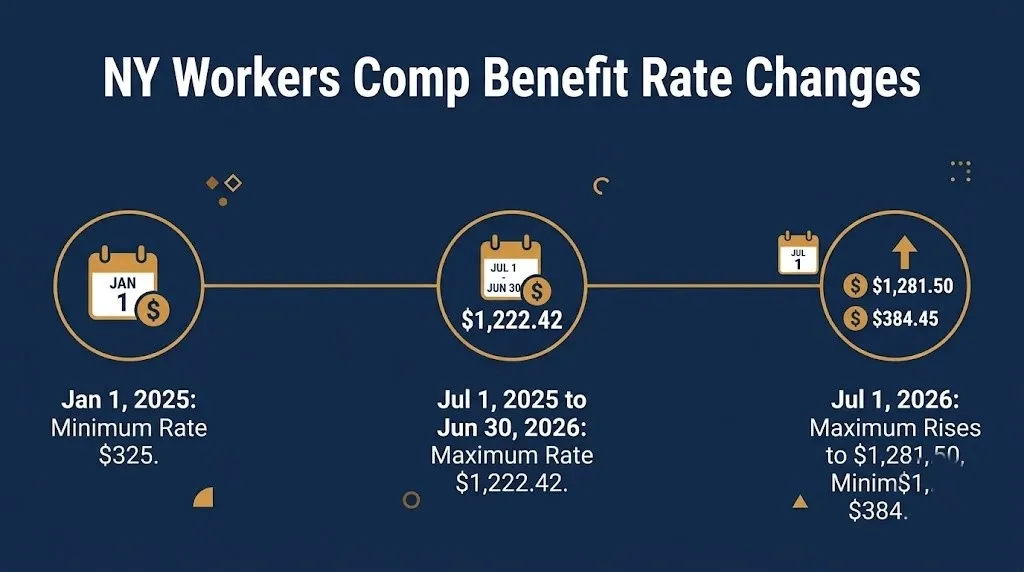
- 2024: Maximum weekly benefit rose to $1,222.42 (effective July 1, 2025)
- January 1, 2025: Minimum weekly benefit rose to $325, up from $275 in 2024
- July 1, 2026: Maximum rises to $1,281.50; minimum rises to $384.45
- Starting July 1, 2026, the minimum weekly benefit becomes indexed to the NYSAWW automatically, rather than requiring new legislation each time
Before 2024, the minimum weekly benefit had been frozen at $150 since 2013, a rate injured low-wage workers lived on for over a decade. The 2023 legislation signed by Governor Hochul ended that freeze and put the state on an automatic annual adjustment schedule going forward.
These rates apply based on your date of injury, not the date you file a claim, so a worker hurt in June 2026 uses the lower rate schedule even if their claim isn’t resolved until after July 1.
Key Takeaway: Your maximum possible weekly benefit locks in on your injury date, not your filing date or hearing date.
What Happens If You Don’t Have Workers’ Compensation Insurance in NY?
Operating without required coverage exposes a New York employer to fines, criminal charges, and full financial liability for any workplace injury.
Confirmed penalties for noncompliance:
| Employer Size | Penalty |
|---|---|
| 5 or fewer employees | $1,000 to $5,000 fine, charged as a misdemeanor |
| More than 5 employees | $5,000 to $50,000 fine, charged as a Class E felony |
| Any uninsured employer | $2,000 civil penalty per 10-day period without coverage, accruing until insured |
Beyond fines, the WCB can issue a Stop-Work Order halting business operations entirely. Uninsured employers also remain liable for the injured employee’s full wage benefits and medical costs out of pocket, and the injured worker may be permitted to file a separate civil lawsuit, something insured employers are generally protected from.
Who Is Considered an Employee Under NY Workers’ Compensation Law?
New York defines an employee broadly as anyone performing work under your supervision, direction, and control, regardless of hours or job title.
That definition covers full-time, part-time, temporary, seasonal, leased, and borrowed workers. It’s a bit like how overtime rules work: the label on someone’s job doesn’t decide coverage, the actual working relationship does.
Confirmed categories generally treated as employees:
- Part-time and temporary staff
- Seasonal and day laborers
- Household workers, gardeners, nannies, and care workers hired directly
- Corporate officers, unless the corporation has only one or two owners holding all its stock
Independent contractor status is scrutinized closely. Workers classified as 1099 contractors are often still deemed employees for workers’ comp purposes unless they meet strict independent contractor criteria under state guidance.
Who Is Exempt From Workers’ Compensation Insurance in New York?
Exemptions are narrow and tied to business ownership structure, not company size or industry.
Confirmed exempt categories:
- Sole proprietors and partnerships with no employees (coverage remains optional for the owner)
- LLC members, excluded unless they opt into coverage themselves
- One or two-person corporations where the named individuals hold all outstanding stock
Even exempt businesses often still need to prove their exemption status. Government agencies issuing permits, licenses, or contracts require a Certificate of Attestation of Exemption (CE-200) to confirm the business legitimately qualifies, since the form cannot be used to prove exemption to another private business or its insurer.
Sole proprietors in higher-risk trades, such as construction or roofing, sometimes buy coverage anyway even when exempt, since many general contractors won’t hire uninsured subcontractors regardless of the legal exemption.
What Does Workers’ Compensation Insurance Cover in New York?
Coverage pays for medical treatment and partial wage replacement tied to a job-related injury or illness, along with legal defense for the employer against most related lawsuits.
Confirmed benefits under a New York workers’ comp policy:
- Medical, dental, and surgical treatment
- Prescription medications and assistive devices
- Travel costs connected to treatment
- Temporary wage replacement (after the 7-day waiting period)
- Payments for permanent effects of an injury, including Schedule Loss of Use awards
- Death benefits for survivors in fatal workplace incidents
- Legal representation for the employer, provided by the insurance carrier
New York also bundles disability benefits insurance into the same coverage requirement, a structure most other states don’t mandate. That policy piece additionally supports New York’s Paid Family Leave program, which the WCB also administers.
What Happens Next
July 1, 2026: New maximum ($1,281.50) and minimum ($384.45) weekly benefit rates take effect for new injury claims.
Expected ongoing through 2026: The WCB continues its multi-year Business Process Re-Engineering project and OnBoard system rollout, funded in part by a $232 million FY2026 budget appropriation.
Expected ongoing through 2026: New anti-fraud units within district attorneys’ offices, tied to recently expanded state law, begin operating alongside the Board’s existing compliance efforts.
Annually each July 1: Benefit rates continue adjusting automatically based on the prior year’s New York State Average Weekly Wage.
Frequently Asked Questions
What is workers’ compensation insurance?
It’s no-fault insurance that pays medical costs and partial lost wages for employees hurt or sickened on the job.
Employees don’t need to prove employer fault to receive benefits.
In exchange, employees generally give up the right to sue their employer directly over the injury.
How do I get workers’ compensation insurance in New York?
You can buy it from a licensed private carrier, a broker, or directly through the New York State Insurance Fund.
NYSIF must insure any employer that applies, regardless of industry or safety record.
Self-insurance is also an option for qualifying businesses that can meet security deposit requirements.
Is workers’ compensation insurance required in New York?
Yes, virtually all employers with one or more employees must carry it under Workers’ Compensation Law Sections 2 and 3.
This includes part-time and family employees.
Narrow exemptions exist for sole proprietors, partnerships, and certain small corporations.
What is the cheapest workers’ compensation insurance in New York?
There’s no single confirmed cheapest option, since pricing depends on your class code, payroll, and claims history.
Comparing quotes from multiple private carriers plus NYSIF is the confirmed way to find your lowest rate.
Premium credit programs like Code Rule 60 can also lower cost for qualifying employers.
How much does a workers’ compensation claim pay in NY?
Wage benefits are generally two-thirds of your average weekly wage, capped at the state maximum.
That maximum is $1,222.42 through June 30, 2026, rising to $1,281.50 starting July 1, 2026.
Your exact payment depends on your wages and disability percentage.
What happens if my employer doesn’t have workers’ compensation insurance?
The employer can face fines from $1,000 up to $50,000, criminal charges, and a Stop-Work Order.
You may still be entitled to full wage and medical benefits, pursued against the uninsured employer directly.
You may also be permitted to file a separate civil lawsuit in that situation.
How do I find my workers’ compensation claim number in New York?
Check the notice mailed by your employer’s insurer or the WCB after your claim is entered into the system.
It also appears on hearing notices and Board decision letters.
You can contact the WCB directly if you can’t locate a notice listing it.
Who is exempt from workers’ compensation insurance in New York?
Sole proprietors and partnerships with no employees, LLC members who don’t opt in, and one or two-person corporations owning all their own stock.
Exempt businesses generally still need a Certificate of Attestation of Exemption (CE-200) for permits and contracts.
Whether you’re an employer shopping for coverage or a worker filing a claim, the numbers that matter are dated and public. Confirm your business’s class code and quote directly with a licensed carrier or NYSIF, and if you’re filing a claim, report your injury in writing within 30 days of the incident, well before that July 1, 2026 rate change takes effect.