North Carolina Workers Compensation Attorney: 2026 Guide to Claims, Payouts, and Deadlines
Quick Answer:
- North Carolina workers compensation is real and mandatory for most employers, but claims are often disputed.
- Benefits replace two-thirds of your average weekly wage, subject to state maximums that change annually.
- The most important deadline is 30 days to report your injury, though you have up to two years to file.
A North Carolina workers compensation attorney handles claims for workers injured on the job. The system pays medical bills and partial wage replacement, but the process is not automatic or friendly.
If you got hurt at work in North Carolina, the clock started the day of your injury. You have 30 days to report it to your employer, but the formal claim deadline extends to two years in most cases.
This article explains how North Carolina workers compensation works, what a lawyer actually does, what benefits pay, and the deadlines that can kill your claim if you miss them. One verified fact most people do not know: North Carolina caps total disability payments at 500 weeks unless you qualify for specific exceptions.
The Facts
| Item | Detail |
|---|---|
| System | North Carolina Workers Compensation Act |
| Administrator | North Carolina Industrial Commission |
| Status | Active, claims processed daily |
| Wage Replacement | Two-thirds of average weekly wage, capped |
| Report Deadline | 30 days from injury, best practice |
| Filing Deadline | Generally 2 years from injury |
| Attorney Fee | Typically 25 percent of recovery, capped |
Is the North Carolina Workers Compensation System Legit?
Yes, North Carolina’s workers compensation system is a real, state-run process. It is not a scam and not optional for most employers.
The North Carolina Industrial Commission oversees the system. It handles disputes, approves settlements, and sets the rules for how claims are paid. The process is codified in the North Carolina Workers Compensation Act.
The system is designed to be a no-fault process. You do not have to prove your employer was negligent. You only have to prove the injury happened at work and was related to your job.
Key Takeaway: The system is real, but employers and insurers dispute claims every day. That is where an attorney matters.
What Does a North Carolina Workers Compensation Attorney Do?
A North Carolina workers compensation attorney handles the legal side of your work injury claim. That means filing forms, negotiating with the insurer, and representing you at hearings if your claim is denied.
The attorney also protects you from mistakes that can sink a claim. Missing a deadline, saying the wrong thing to an adjuster, or accepting a low settlement without understanding the consequences are common errors.
Most workers compensation attorneys work on contingency. You pay nothing upfront. The fee comes out of your recovery, typically 25 percent of the settlement or award.
- Evaluate your case and explain your rights.
- File the necessary forms with the Industrial Commission.
- Gather medical records and evidence of your injury.
- Negotiate with the workers compensation insurance carrier.
- Represent you at mediation or a hearing if needed.
- Review any settlement offer before you sign.
- Protect your claim from procedural errors.
How Much Does a North Carolina Workers Compensation Attorney Cost?
A North Carolina workers compensation attorney typically charges a contingency fee of 25 percent of your recovery. That fee is set by state law and approved by the Industrial Commission.
You do not pay an hourly rate or a retainer. If you recover nothing, you owe no attorney fee. Some costs, like medical record fees or expert witness fees, may be your responsibility, but your attorney should explain these before incurring them.
For example, if your settlement is $40,000, the attorney fee is $10,000, leaving you $30,000. That is the standard arrangement, not a negotiation point.
Reality Check: Any attorney who asks for money upfront for a workers compensation case is not following the standard North Carolina model. Legitimate workers compensation attorneys take their fee from the recovery, not your pocket.
What Is the Average Workers Compensation Settlement in North Carolina?
The average workers compensation settlement in North Carolina varies widely by injury type and severity. There is no single published average, but most settlements fall between $20,000 and $100,000 for serious injuries.
Minor injuries may settle for less than $10,000. Permanent partial disability, which is a partial impairment rating, often settles for more. Total disability cases, where you cannot return to any work, may exceed $100,000.
The settlement amount depends on your average weekly wage, the severity of your injury, whether you need future medical care, and whether you can return to work.
| Injury Type | Typical Settlement Range |
|---|---|
| Minor strain or sprain | $5,000 to $15,000 |
| Surgery required | $20,000 to $60,000 |
| Permanent partial disability | $30,000 to $100,000 |
| Total disability | $100,000 to $300,000+ |
Key Takeaway: Your settlement is not a lottery ticket. It is a calculation based on your wage, your impairment, and your future medical needs.
How Are North Carolina Workers Compensation Benefits Calculated?
North Carolina workers compensation benefits replace two-thirds of your average weekly wage. That is the core formula under state law.
The average weekly wage is based on your earnings in the 52 weeks before your injury. Overtime and bonuses may be included in certain cases. The state sets a maximum weekly benefit each year, so high earners may be capped.
You receive the wage replacement benefit while you are out of work and unable to earn your full income. The benefit continues until you return to work or reach the 500-week cap for total disability, with limited exceptions.
- Determine your average weekly wage from the 52 weeks before injury.
- Calculate two-thirds of that amount.
- Compare to the current state maximum weekly benefit.
- Receive the lower of the two figures.
- Continue receiving benefits until you return to work or hit the cap.
What Is the Deadline to File a Workers Compensation Claim in North Carolina?
You have 30 days to report your injury to your employer. You have up to two years from the injury date to file a formal claim with the North Carolina Industrial Commission.
The 30-day rule is not a hard filing deadline, but failing to report promptly can hurt your credibility and make your claim harder to prove. The two-year deadline is absolute in most cases.
For occupational diseases, the deadline may run from the date you discovered the condition, not the date of exposure. That rule matters for repetitive motion injuries or toxic exposure cases.
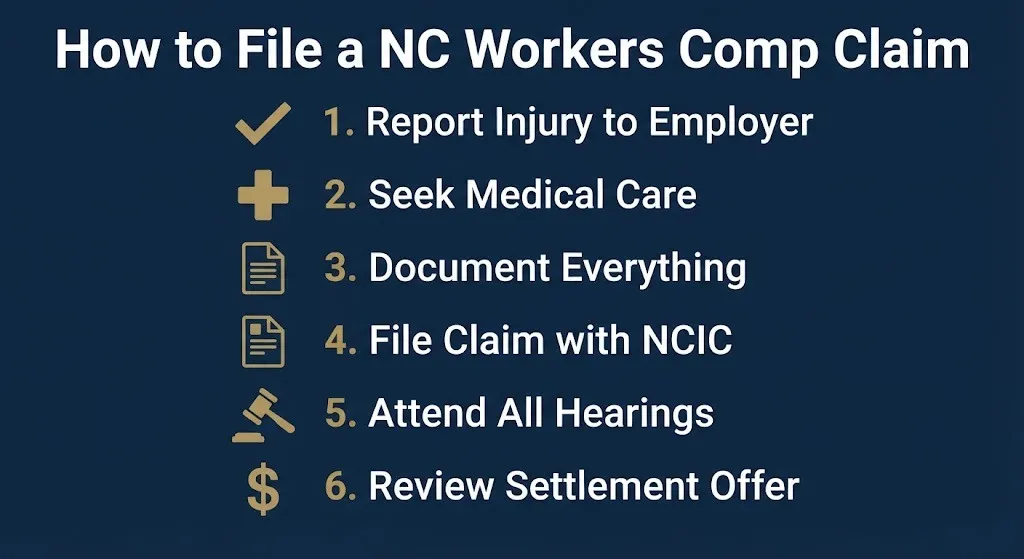
- Report any injury to your employer immediately, ideally the same day.
- Seek medical attention and document your symptoms.
- File a written report with your employer within 30 days.
- File a formal claim with the Industrial Commission within two years.
- Do not wait if your claim is denied. Denials have their own appeal deadlines.
What Are the Most Common Workers Compensation Injuries in North Carolina?
The most common North Carolina workers compensation injuries include back injuries, repetitive motion injuries, falls, machinery accidents, and occupational illnesses.
Construction, manufacturing, healthcare, and transportation workers file the most claims. Back injuries are the single most common injury type, often resulting from lifting, pulling, or repetitive strain.
Repetitive motion injuries, like carpal tunnel syndrome, are harder to prove because there is no single accident. You need medical evidence linking the condition to your job duties.
| Injury Type | Common Cause |
|---|---|
| Back injury | Lifting, pulling, repetitive strain |
| Shoulder injury | Overhead work, repetitive motion |
| Knee injury | Falls, kneeling, twisting |
| Carpal tunnel | Repetitive hand movements |
| Occupational illness | Chemical exposure, toxic substances |
What Is the Role of the North Carolina Industrial Commission?
The North Carolina Industrial Commission is the state agency that administers workers compensation claims. It handles disputes, approves settlements, and sets procedural rules.
If your claim is denied, you can request a hearing before the Commission. A deputy commissioner hears the case and issues a decision. You can appeal to the full Commission and then to state court.
The Commission also approves attorney fees and monitors compliance with the Workers Compensation Act. Its forms and deadlines control the process.
Think of it like a store return without a receipt. The store has a process, a manager to appeal to, and rules you must follow. The Industrial Commission is the manager for workers compensation.
What Happens If My Workers Compensation Claim Is Denied in North Carolina?
If your claim is denied, you have the right to appeal. The denial letter should explain the reason and your appeal deadline.
Common denial reasons include the employer disputing that the injury happened at work, a pre-existing condition defense, or a missed deadline. Each reason requires a different response.
An attorney can request a hearing, gather additional evidence, and present your case to a deputy commissioner. The appeal process takes time, but many denials are reversed.
- Read the denial letter carefully.
- Note the appeal deadline.
- Gather additional medical records and witness statements.
- Request a hearing before the Industrial Commission.
- Present your evidence to the deputy commissioner.
- Appeal to the full Commission if necessary.
Key Takeaway: A denial is not the end of your claim. It is the start of a formal dispute process.
What Is a North Carolina Workers Compensation Settlement?
A North Carolina workers compensation settlement is a lump sum payment that closes your claim. It may also be a structured settlement that pays over time.
The settlement typically covers your past and future disability benefits plus medical care. You sign a release that ends your right to seek further benefits for that injury.
You should never accept a settlement without understanding what you are giving up. An attorney can review the offer and explain whether it is fair.
- Review the full settlement agreement.
- Understand what the lump sum includes and excludes.
- Confirm whether future medical care is covered.
- Ask your attorney whether the amount matches your impairment and wage loss.
- Sign only after you understand the release.
What Is the 500-Week Cap on North Carolina Workers Compensation?
North Carolina caps total disability benefits at 500 weeks. That is just under ten years of payments.
After 500 weeks, your wage replacement benefits end unless you qualify for an exception. The most common exception is permanent and total disability from certain catastrophic injuries, such as severe brain injury, paralysis, or loss of multiple limbs.
The cap does not apply to medical benefits. Your medical care for the work injury continues for life, even after wage payments stop.
What Is the Difference Between Temporary and Permanent Disability in North Carolina?
Temporary disability means you are expected to recover and return to work. Permanent disability means your injury will not fully heal.
Temporary total disability pays two-thirds of your wage while you cannot work at all. Temporary partial disability pays when you can work but earn less due to your injury.
Permanent partial disability is a scheduled benefit based on your impairment rating. Permanent total disability pays the full benefit rate until the 500-week cap, with exceptions.
| Disability Type | What It Means |
|---|---|
| Temporary total | Cannot work at all, expected to recover |
| Temporary partial | Can work but earn less, expected to recover |
| Permanent partial | Permanent impairment, scheduled benefit |
| Permanent total | Cannot work at all, long-term benefit |
What Should You Look for in a North Carolina Workers Compensation Attorney?
Look for an attorney who focuses on workers compensation, not a general practice attorney who handles everything. Experience with the Industrial Commission matters.
Ask about the attorney’s case volume, success rate, and familiarity with your type of injury. A lawyer who has handled many back injury claims knows the medical issues and the typical settlement range.
Avoid attorneys who promise a specific outcome. No ethical attorney guarantees a settlement amount before reviewing your records.
- Confirm the attorney focuses on workers compensation.
- Ask about experience with the Industrial Commission.
- Request examples of similar cases and outcomes.
- Verify the contingency fee structure.
- Ask who will handle your case day to day.
- Read reviews from past clients.
- Trust your gut after the consultation.
Reality Check: A workers compensation attorney is not a magic wand. A good attorney protects your rights and maximizes your recovery. A bad attorney misses deadlines and loses cases.
What Happens Next With Your North Carolina Workers Compensation Claim?
First 30 days: Report your injury and seek medical care. Your claim begins.
Next 90 days: The insurer accepts or denies your claim. Denials trigger your appeal rights.
Next 6 to 12 months: Medical treatment continues. If you cannot return to work, wage benefits continue.
Next 12 to 24 months: Settlement negotiations or a hearing before the Industrial Commission.
Beyond: Appeals, if any, resolve and final payments issue.
These timelines are typical, not guaranteed. Your case may move faster or slower.
Frequently Asked Questions
Is North Carolina workers compensation mandatory for employers?
Yes, most employers with three or more employees must carry workers compensation insurance.
How much does a North Carolina workers compensation attorney charge?
The standard fee is 25 percent of your recovery, paid only if you win.
What is the deadline to report a work injury in North Carolina?
You should report the injury within 30 days. The formal filing deadline is generally two years.
Can I choose my own doctor for a workers compensation claim?
North Carolina law gives the employer the right to direct medical care initially.
What if my workers compensation claim is denied?
You have the right to appeal through the North Carolina Industrial Commission.
How long do workers compensation benefits last in North Carolina?
Wage benefits are capped at 500 weeks for total disability, with limited exceptions.
Is a workers compensation settlement taxable?
Most workers compensation settlements are not taxable as income.
Do I need a lawyer for a workers compensation claim?
Not for simple claims, but a lawyer is strongly recommended for denials, serious injuries, or settlement offers.
North Carolina workers compensation is a system with strict rules and real money at stake. The deadlines are unforgiving, and the insurers are not on your side.
The single most important step is reporting your injury immediately and seeking legal help before you make a mistake that costs you your claim.