Florida Workers Compensation Law 2026: Benefits, Deadlines, and What Changed This Year
Quick Answer
- Florida workers’ comp covers medical care, wage replacement, and disability benefits for work-related injuries.
- Maximum weekly benefit is $1,358 in 2026. Temporary benefits can last up to 260 weeks.
- You must report your injury to your employer within 30 days or risk losing your claim .
Florida workers’ compensation law is a no-fault system. You do not have to prove your employer did anything wrong to get benefits. You just have to show the injury happened at work.
That simplicity is the point. The trade-off is that you give up the right to sue your employer for pain and suffering in most cases. What you get instead is guaranteed medical care and wage replacement, even if the accident was your own fault.
But the system has deadlines and rules that trip people up every year. Miss the 30-day reporting window and you may lose everything. Fail to attend a doctor’s appointment and your benefits can be cut off. This article explains how the system works in 2026, what you may qualify for, and what changed this year.
The Facts
| Item | Details |
|---|---|
| Governing Law | Chapter 440, Florida Statutes |
| Maximum Weekly Benefit (2026) | $1,358 |
| Statewide Average Weekly Wage | $1,357.95 |
| Reporting Deadline | 30 days from injury or diagnosis |
| Temporary Disability Max | 260 weeks |
| Attorney Fee Structure | Statutory tiered percentages under § 440.34 |
| Mental Injury Coverage | Requires accompanying physical injury in most cases |
| Key 2026 Change | Maximum rate increased from 2025 levels |
What Does Florida Workers’ Compensation Cover?
Florida workers’ compensation covers medically necessary treatment, wage replacement while you recover, and permanent disability benefits if your injury leaves lasting impairment.

The system is designed to be self-executing. When you report an injury, your employer notifies its insurance carrier, and the carrier should begin paying benefits without you having to file a lawsuit.
Here is what you may qualify for:
- Medical care. Doctor visits, hospital stays, surgery, prescriptions, physical therapy, and medical equipment.
- Temporary Total Disability (TTD). Wage replacement if you cannot work at all while recovering.
- Temporary Partial Disability (TPD). Partial wage replacement if you can work with restrictions but earn less than before.
- Impairment Income Benefits. Payments based on a permanent impairment rating once you reach maximum medical improvement.
- Permanent Total Disability. Long-term benefits if you can never return to gainful employment.
The wage replacement rate is typically about two-thirds of your average weekly wage, subject to the statutory maximum . In 2026, that maximum is $1,358 per week .
How Much Are Florida Workers’ Compensation Benefits in 2026?
The maximum weekly workers’ compensation benefit in Florida is $1,358 for injuries occurring on or after January 1, 2026, up from the 2025 rate.
The Florida Department of Financial Services sets this figure each year. It equals 100 percent of the statewide average weekly wage, rounded to the nearest dollar .
For 2026, the average weekly wage was determined to be $1,357.95 . That means the maximum rate rose slightly from 2025.
Key benefit rates for 2026:
| Benefit Type | Rate |
|---|---|
| Maximum Weekly Compensation | $1,358 |
| Minimum Weekly Payment | $20 |
| TTD/TPD Payment Rate | ~66⅔% of average weekly wage |
| TPD Maximum Duration | 260 weeks |
| Impairment Benefits | 50% of TTD rate, capped at maximum |
Your actual benefit depends on your pre-injury earnings. If you earned more than the statewide average, your benefit is capped at $1,358. If you earned less, your benefit is calculated as a percentage of your actual wage.
Key Takeaway: The 2026 maximum weekly benefit is $1,358. Higher earners may hit the cap, while lower earners receive a percentage of their actual wage.
How Long Do You Have to Report a Florida Work Injury?
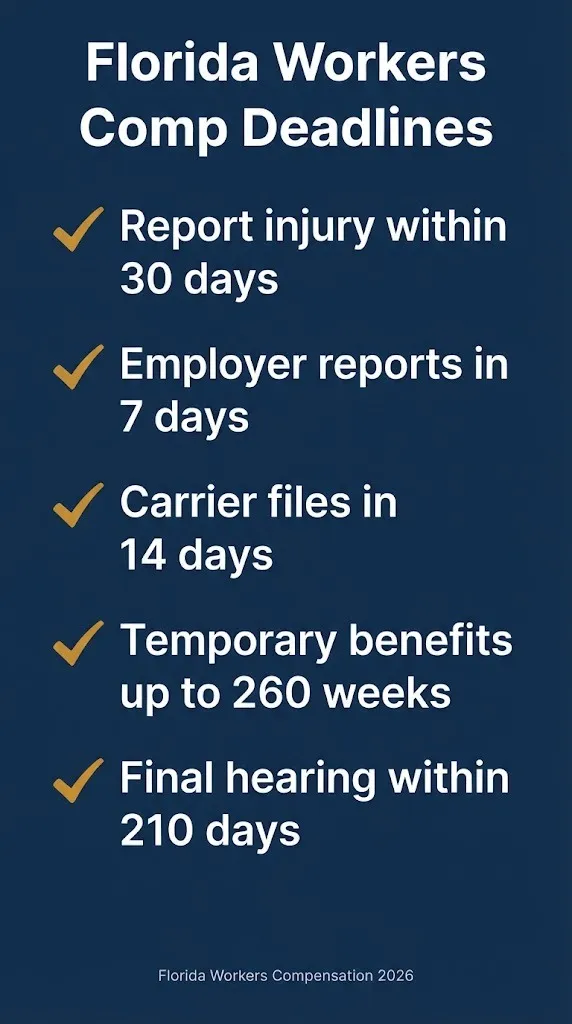
You must report a work injury to your employer within 30 days of the accident or within 30 days of learning from a doctor that your condition is work-related .
This deadline is strict. Florida law says failure to report within 30 days “shall bar a petition” for benefits unless one of four exceptions applies .
The exceptions:
- Your employer had actual knowledge of the injury.
- The cause could not be identified without a medical opinion, and you reported within 30 days of getting that opinion.
- Your employer did not post the required notice about reporting requirements.
- Exceptional circumstances justify the delay.
Do not rely on exceptions. Report your injury immediately, even if you are not sure how serious it is. A delayed report gives the insurance carrier an easy reason to deny your claim.
The employer then has 7 days to report the injury to its carrier . The carrier has 14 days to file the report with the state .
What Are Temporary Disability Benefits in Florida?
Temporary disability benefits replace part of your lost wages while you are recovering and cannot return to your regular job.
There are two types:
Temporary Total Disability (TTD). You cannot work at all. You receive wage replacement, typically about two-thirds of your average weekly wage, up to the statutory maximum.
Temporary Partial Disability (TPD). You can work with restrictions but earn less than before. You receive 80 percent of the difference between your pre-injury and post-injury earnings .
Both types can last up to 260 weeks under current law . That is five years, though most claims resolve well before that.
A mental or nervous injury that accompanies a physical injury is subject to different limits. Temporary benefits for the mental injury portion are capped at six months after you reach maximum medical improvement for the physical injury .
What Is Maximum Medical Improvement in Florida Workers’ Comp?
Maximum Medical Improvement (MMI) is the point when your condition has stabilized and further treatment is not expected to improve it significantly.
Once you reach MMI, your doctor assigns an impairment rating. That rating determines whether you qualify for permanent impairment benefits.
The impairment rating is based on a schedule adopted by the state. Only certain licensed physicians can assign it: medical doctors, osteopathic doctors, chiropractors, podiatrists, optometrists, and dentists .
If you have an impairment rating, you may receive impairment income benefits paid weekly. The rate is 50 percent of your temporary total disability rate, and the duration is calculated at 3 weeks for each percentage point of impairment .
If you disagree with the impairment rating, you can challenge it. But the rating comes from your treating doctor or an independent medical examiner, and the judge of compensation claims gives it weight.
How Much Do Florida Workers’ Comp Lawyers Cost?
Florida workers’ compensation attorneys work on contingency, and the fees they can charge are set by statute and approved by a judge of compensation claims.
Under Florida Statutes § 440.34, the fee schedule is :
- 20% of the first $5,000 of benefits secured
- 15% of the next $5,000
- 10% of remaining benefits secured during the first 10 years after the claim is filed
- 5% of benefits secured after 10 years
You pay nothing up front in most cases. The fee comes out of the benefits recovered, and the judge must approve it as reasonable .
If your case is a medical-only claim and you do not recover disability benefits, the attorney fee may be limited. The statute allows an alternative fee in some medical-only cases, capped at $1,500 based on a $150 hourly rate .
Reality Check: No one should charge you an upfront fee to file a workers’ comp claim. The system is designed so that attorneys get paid only if they secure benefits for you. If someone asks for a retainer before doing anything, walk away.
Can You Choose Your Own Doctor in Florida Workers’ Comp?
No, you generally cannot choose your own doctor in Florida workers’ compensation. Your employer or its insurance carrier has the right to direct your medical care to a provider within its network.
This is one of the biggest frustrations for injured workers. You may want to see your family doctor, but the carrier can require you to see a doctor it selects.
The carrier must provide medically necessary treatment, but it controls who provides it. If you see an unauthorized doctor, the carrier may refuse to pay for that treatment.
There is an exception for emergency care. If you need immediate treatment after an accident, go to the emergency room. The carrier should cover that.
For ongoing care, you can request a one-time change of physician under Florida law. The carrier must authorize the change if you make the request properly. If the carrier denies necessary treatment, you can file a petition for benefits and let a judge decide.
What Happens If Your Florida Workers’ Comp Claim Is Denied?
If your claim is denied, you can file a Petition for Benefits with the Office of the Judges of Compensation Claims and request a hearing.
The denial may be total or partial. The carrier might deny that the injury is work-related, deny a specific treatment, or deny that you are disabled.
Steps to challenge a denial:
- Get the denial in writing. The carrier must state its reasons.
- Contact the Employee Assistance and Ombudsman Office. This state office helps injured workers understand their rights .
- Hire an attorney. Most workers’ comp attorneys offer free consultations.
- File a Petition for Benefits. Your attorney typically handles this.
- Attend mediation. Many disputes settle at mediation before a hearing.
- Prepare for the final hearing. The judge of compensation claims decides disputed issues.
The final hearing must be held within 210 days after the petition is filed in most cases . That is the statutory goal, though delays happen.
What Happens Next in a Florida Workers’ Comp Case?
Day 1-30: Report the injury to your employer. Seek medical care.
Day 7: Employer must report the injury to its carrier .
Day 14: Carrier must file the report with the state .
Weeks 1-12: Carrier authorizes treatment and begins paying temporary benefits if you are disabled.
Months 3-12: You reach maximum medical improvement. Doctor assigns an impairment rating.
If Disputed: File a Petition for Benefits. Mediation typically occurs within 90 days.
If Settled: Lump-sum settlements are common. A judge must approve the settlement in most cases.
Ongoing: If you have permanent impairment, you may receive impairment income benefits for weeks or months after MMI.
Frequently Asked Questions
How long do I have to report a work injury in Florida?
You must report the injury to your employer within 30 days. Failure to report can bar your claim unless an exception applies .
What is the maximum workers’ comp rate in Florida for 2026?
The maximum weekly compensation rate is $1,358 for injuries occurring on or after January 1, 2026 .
How long can I receive temporary disability benefits in Florida?
Temporary total and temporary partial disability benefits can last up to 260 weeks .
Can I sue my employer for a work injury in Florida?
Generally, no. Workers’ compensation is the exclusive remedy for most work injuries. You give up the right to sue in exchange for no-fault benefits.
Do I need a lawyer for a Florida workers’ comp claim?
Not always, but an attorney can help if your claim is denied or if you face a complex dispute. Most work on contingency with no upfront cost .
What happens if I miss a doctor’s appointment in workers’ comp?
The carrier may suspend your benefits. Always attend authorized appointments and follow your doctor’s instructions.
Can I get workers’ comp for mental stress in Florida?
Only if the mental injury is accompanied by a physical injury that requires medical treatment. Mental injuries from stress alone are generally not compensable .
How much does a workers’ comp lawyer cost in Florida?
Attorney fees are set by statute and must be approved by a judge. You typically pay nothing up front, and the fee comes out of benefits recovered .
The most important deadline in any Florida workers’ comp case is the 30-day reporting rule. Report your injury immediately, even if you think it is minor. Document everything. And if your claim is denied, remember that the system gives you a path to challenge it. The 2026 maximum weekly benefit is $1,358, and that number is your benchmark for what the system can provide.