Is the Georgia workers’ comp settlement chart a real thing
Quick Answer
- The Georgia settlement chart is real: it’s the state’s official schedule of weeks owed per body part under O.C.G.A. § 34-9-263.
- Settlement amounts vary by wage, body part, and impairment rating. There’s no fixed statewide average, so treat any single number you see as an estimate.
- There’s no universal claim deadline. Georgia generally requires reporting within 1 year of an accident, or 2 years from your last income benefit payment.
Georgia’s workers’ comp settlement chart is a real, state-published schedule that assigns a set number of weeks of benefits to specific body parts. It comes from the Georgia State Board of Workers’ Compensation, not from a law firm marketing page, though plenty of firms republish it.
This matters most for anyone with a permanent impairment rating after a workplace injury. The single number that drives everything else is Georgia’s $800 weekly benefit cap, unchanged since July 1, 2023, and confirmed as still current through 2026.
This article breaks down the actual chart, how the math works, what you can expect at each stage, and where the deadlines really sit. One detail most competitors skip: Georgia’s own summary document shows no benefit rate increase happened in 2024 or 2025, so the numbers you’ll see below are still the live ones.
The Facts
| Governing Law | O.C.G.A. Title 34, Chapter 9 (Georgia Workers’ Compensation Act) |
| Administering Agency | Georgia State Board of Workers’ Compensation (SBWC) |
| Max Weekly TTD/PPD Benefit | $800 per week (effective for injuries on or after July 1, 2023) |
| Max Weekly TPD Benefit | $533 per week |
| Benefit Rate | 66 2/3% of average weekly wage |
| Max TTD Duration | 400 weeks (unlimited for catastrophic injuries) |
| Typical Reported Settlement Range | Roughly $20,000 to $40,000 for non-catastrophic claims, per attorney-reported data. Not an official state average |
| Filing Deadline | 1 year from accident date, or 2 years from last income benefit paid |
Is the Georgia workers’ comp settlement chart a real thing
Yes, the settlement chart is a real, state-issued schedule, not a marketing invention. It comes directly from O.C.G.A. § 34-9-263, Georgia’s permanent partial disability statute.
The chart assigns a fixed number of weeks of compensation to specific body parts, called “scheduled members.” A lost or fully impaired thumb, for example, carries a different week value than a lost arm.

What’s often mislabeled online is the idea that the chart hands you a dollar figure. It doesn’t. The chart sets the number of weeks, not the payout. Your actual dollar amount depends on your weekly wage and your impairment rating, both of which come after your injury, not before.
The Georgia State Board of Workers’ Compensation republishes this schedule in its official “Summary of Workers’ Compensation Provisions,” last revised July 1, 2025, confirming no rate changes for 2024 or 2025.
How much is the average workers’ comp settlement in Georgia
Not officially tracked. Georgia’s State Board does not publish a statewide average settlement figure, so any specific number you see online is an estimate, not government data.
Attorney-reported ranges commonly cited across multiple Georgia firms put typical non-catastrophic settlements between $20,000 and $40,000. That range covers claims involving moderate injuries with a defined recovery and impairment rating.
Catastrophic injuries fall well outside that range:
- Spinal cord injuries with lasting neurological damage
- Amputations
- Severe traumatic brain injuries
- Total or near-total blindness
- Severe burns
These can settle well into six figures, and some go beyond, because they often qualify for benefits without the standard 400-week cap.
Reality Check: No insurer, adjuster, or “claim specialist” will text or email you an unsolicited settlement number before you’ve reached maximum medical improvement. Filing a workers’ comp claim in Georgia is free. Anyone charging an upfront fee to “unlock” your settlement chart or file paperwork for you is not part of the official state process.
What is the Georgia workers’ comp settlement chart by body part
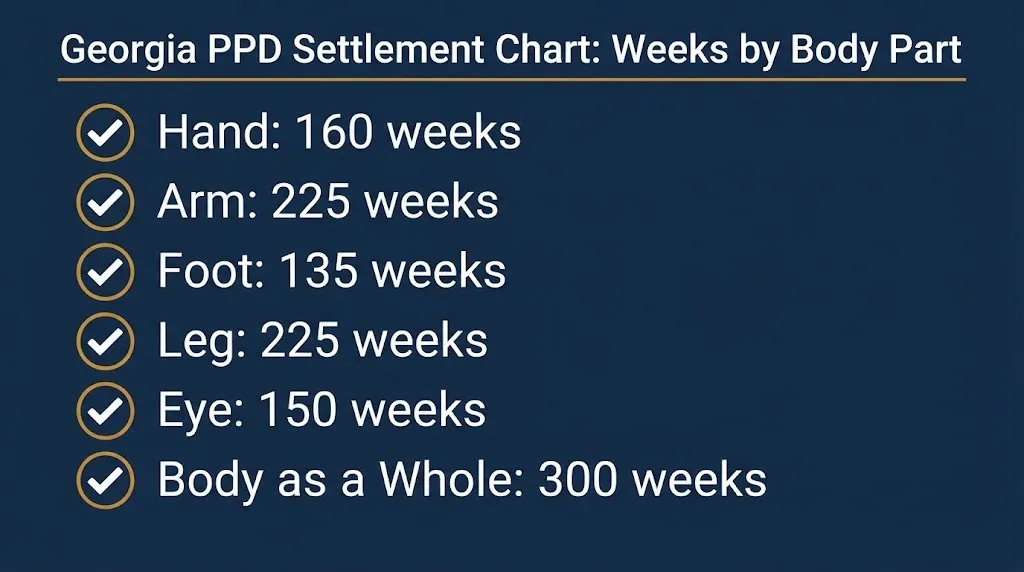
The chart lists a fixed number of compensable weeks for each scheduled body part, unchanged regardless of your wage. Here is the current official schedule under O.C.G.A. § 34-9-263.
| Body Part | Scheduled Weeks |
|---|---|
| Thumb | 60 |
| Index finger | 40 |
| Middle finger | 35 |
| Ring finger | 30 |
| Little finger | 25 |
| Great toe | 30 |
| Other toes | 20 |
| Hand | 160 |
| Foot | 135 |
| Arm | 225 |
| Leg | 225 |
| Eye | 150 |
| Hearing loss, one ear | 75 |
| Hearing loss, both ears | 150 |
| Body as a whole (back, neck, internal organs) | 300 |
These weeks don’t pay out automatically at full value. Your doctor’s impairment rating, expressed as a percentage, multiplies against the scheduled weeks to set your actual benefit period.
Key Takeaway: Georgia’s settlement chart fixes the number of weeks per body part by law, but your wage and impairment percentage still determine the real dollar amount.
How is a workers’ comp settlement calculated in Georgia
A Georgia PPD settlement is calculated by multiplying your impairment rating, the scheduled weeks for your body part, and your weekly compensation rate. The formula looks like this:
Impairment % × Scheduled Weeks × Weekly Rate = PPD Value
Here’s how that plays out with a real example, using confirmed 2026 figures:
- A worker receives a 20% impairment rating to a hand.
- The hand carries 160 scheduled weeks under the chart.
- 20% of 160 weeks equals 32 weeks of PPD benefits.
- At the maximum weekly PPD rate of $800, that’s $25,600.
- At a lower weekly rate, say $500, the same 32 weeks equals $16,000.
This is why two workers with identical injuries can receive very different totals. The wage determines the rate, and the rate is capped at $800 regardless of how high your actual paycheck was.
What is the maximum weekly workers’ comp benefit in Georgia in 2026
The maximum weekly benefit in Georgia is $800, a rate that has applied to injuries occurring on or after July 1, 2023, and remains unchanged through 2026. This applies to temporary total disability (TTD) and permanent partial disability (PPD) alike.
Temporary partial disability (TPD), which covers workers who return to lighter duty at reduced pay, caps lower, at $533 per week.
| Benefit Type | Weekly Maximum | Duration Cap |
|---|---|---|
| TTD (Temporary Total) | $800 | 400 weeks |
| TPD (Temporary Partial) | $533 | 350 weeks |
| PPD (Permanent Partial) | $800 | Set by scheduled weeks |
| Minimum benefit (TTD) | $50 | Same as above |
You’ll sometimes see other numbers online, like $675, $725, or $875. Those are either outdated rates from earlier years, or figures pulled from national averages that don’t apply to Georgia specifically. The official Board document confirms $800 is current, with no increase for 2024 or 2025.
How do you file a workers’ comp claim in Georgia
You file by reporting the injury to your employer, getting treatment from an authorized panel physician, and, if needed, submitting a claim form to the State Board of Workers’ Compensation. Here’s the general sequence:
- Report the injury to your employer immediately, ideally in writing.
- Get treatment from a doctor on your employer’s official WC-P1 panel, unless it’s an emergency.
- Follow all treatment recommendations and attend every scheduled appointment.
- Keep copies of medical records, pay stubs, and correspondence with the insurer.
- If benefits are denied or disputed, file a WC-14 form with the SBWC to request a hearing.
- Reach maximum medical improvement (MMI) before settlement talks typically begin.
- Get an impairment rating from your doctor once you hit MMI, if you have lasting effects.
Key Takeaway: The claims process in Georgia runs on a strict sequence, and skipping the authorized panel physician step is one of the most common reasons benefits get delayed or denied.
How do you negotiate a workers’ comp settlement in Georgia
Negotiation generally opens once you’ve reached maximum medical improvement and received a formal impairment rating. Before that point, most insurers won’t discuss a lump sum because the full extent of your injury isn’t finalized.
Two settlement structures show up most often in Georgia claims:
- Liability settlements: the insurer has accepted the claim and negotiates a payout based on the impairment rating and remaining benefit weeks.
- No-liability settlements: the insurer disputes the claim but offers a lump sum to close it out, often used when causation is contested.
Both structures require the settlement to go through the State Board for approval before it becomes final. That review step exists specifically to check that the deal is fair given your rating and wage history.
What is the deadline to file a workers’ comp claim in Georgia
Georgia generally requires you to report a workplace injury within 1 year of the accident date, or 2 years from the date your last income benefit was paid, whichever applies to your situation. This comes from O.C.G.A. § 34-9-82.
That two-track deadline confuses a lot of injured workers, so here’s the distinction:
- If you never received any income benefits, the clock is 1 year from the date of injury.
- If you did receive benefits at some point, the clock resets to 2 years from your last payment.
Missing either window can bar you from ever filing, regardless of how strong the underlying injury claim is. There’s a useful comparison here: it works a bit like a store return policy with two different clocks depending on whether you kept the receipt.
How long does a Georgia workers’ comp settlement take
There’s no fixed statewide timeline, and settlement pace depends heavily on how quickly you reach maximum medical improvement. Simple claims with clear liability can resolve in a few months. Disputed or catastrophic claims often stretch well past a year.
The general pattern looks like this:
| Stage | Typical Timing |
|---|---|
| Injury reported, treatment begins | Immediate |
| Temporary benefits (TTD/TPD) paid | Weekly, while disabled |
| Maximum medical improvement reached | Varies by injury, often months to over a year |
| Impairment rating assigned | Shortly after MMI |
| Settlement negotiations open | After rating is finalized |
| Board approval of settlement | Weeks after agreement, not automatic |
Key Takeaway: Settlements in Georgia can’t be rushed ahead of maximum medical improvement, because the impairment rating that drives the payout doesn’t exist until that point.
What happens after maximum medical improvement in Georgia
Once you reach maximum medical improvement (MMI), your treating doctor assigns a permanent impairment rating if lasting effects remain. That rating becomes the basis for any PPD settlement.
MMI doesn’t mean you’re fully healed. It means your condition has stabilized to the point where further treatment isn’t expected to improve it significantly. From there, temporary benefits typically wind down, and permanent benefits, if applicable, take over.
This is also the point where most settlement conversations begin in earnest. Insurers are generally reluctant to negotiate a final number before MMI, since the impairment rating hasn’t been locked in yet.
What counts as a catastrophic injury in Georgia workers’ comp
A catastrophic injury under Georgia law removes the standard 400-week benefit cap and can qualify a worker for lifetime income and medical benefits. This designation comes from O.C.G.A. § 34-9-200.1.
Categories that commonly qualify include:
- Spinal cord injuries involving severe paralysis
- Amputations of a hand, arm, foot, or leg
- Severe traumatic brain injuries
- Total or near-total blindness in both eyes
- Severe, disfiguring burns
Getting this designation isn’t automatic. It typically requires medical documentation and, often, a formal determination through the Board. Workers who believe their injury may qualify should raise the issue directly with their treating physician and document it clearly in medical records.
What is the difference between TTD and PPD in Georgia
Temporary Total Disability (TTD) covers wage replacement while you’re completely unable to work and still recovering. Permanent Partial Disability (PPD) covers lasting impairment after you’ve reached maximum medical improvement.
| TTD | PPD | |
|---|---|---|
| When it applies | While unable to work, still healing | After MMI, with a lasting rating |
| Weekly cap | $800 | $800 |
| Duration | Up to 400 weeks | Set by scheduled weeks × rating |
| Requires impairment rating | No | Yes |
TPD sits between the two, covering workers who’ve returned to lighter duty at reduced pay, capped separately at $533 per week.
Do all Georgia workers’ comp claims end in a settlement
No, not every claim ends in a lump-sum settlement. Some claims simply run their course through weekly benefit payments until the worker returns to full duty or benefits expire.
Settlement becomes relevant mainly in two situations: when a worker has a permanent impairment rating worth resolving in one payment, or when there’s a dispute the insurer wants to close out with a lump sum rather than continued litigation. Straightforward claims with full recovery and no lasting impairment often close without any settlement negotiation at all.
What if your employer or insurer disputes your Georgia workers’ comp claim
If your claim is disputed, you can request a hearing before the State Board of Workers’ Compensation by filing a WC-14 form. This starts the formal dispute resolution process, separate from ordinary claim processing.
Common dispute triggers include the insurer questioning whether the injury is work-related, disagreeing with the assigned impairment rating, or contesting the average weekly wage calculation used to set your benefit rate. Appeals within the system run on tight clocks: 20 days to appeal to the Board’s Appellate Division, another 20 days for Superior Court appeal, and 30 days for a discretionary appeal to the Georgia Court of Appeals.
What happens next
Injury occurs: Report to your employer immediately and begin treatment through the authorized panel.
Weekly benefits phase: TTD or TPD payments continue while you’re unable to work at full capacity.
Maximum medical improvement: Your doctor determines your condition has stabilized and assigns an impairment rating if applicable.
Settlement discussion (if applicable): Negotiations open based on the rating, scheduled weeks, and your weekly wage.
Board review: Any settlement must be approved by the State Board of Workers’ Compensation before it becomes final.
Frequently Asked Questions
Is the Georgia workers’ comp settlement chart official?
Yes, it comes directly from O.C.G.A. § 34-9-263 and the State Board of Workers’ Compensation.
It sets scheduled weeks per body part, not a fixed dollar payout.
What is the maximum weekly workers’ comp benefit in Georgia right now?
The maximum is $800 per week for TTD and PPD, effective for injuries since July 1, 2023.
This rate has not increased in 2024, 2025, or 2026.
How much can I get for a hand injury in Georgia workers’ comp?
A hand carries 160 scheduled weeks under the chart.
Your actual amount depends on your impairment rating and your weekly compensation rate, up to $800 per week.
How long do I have to file a workers’ comp claim in Georgia?
Generally 1 year from the date of injury, or 2 years from your last income benefit payment.
Missing this window can bar your claim entirely.
Does Georgia workers’ comp cover lifetime benefits?
Only for injuries classified as catastrophic under O.C.G.A. § 34-9-200.1.
Standard claims cap at 400 weeks for income benefits.
What is the difference between scheduled and non-scheduled injuries in Georgia?
Scheduled injuries, like a hand or arm, have a fixed number of weeks under the chart.
Non-scheduled injuries, like the back or internal organs, use the “body as a whole” category at 300 weeks.
Do I need a lawyer to get a fair workers’ comp settlement in Georgia?
Not legally required, but many workers involve an attorney once a dispute or impairment rating is involved.
Filing itself is always free, regardless of whether you hire representation.
If you’re evaluating a Georgia workers’ comp injury, the number to anchor on is the $800 weekly cap, since it drives every PPD calculation on the chart. Confirm your own impairment rating and average weekly wage directly with your treating physician and the claims adjuster before assuming any total.