Illinois Workers’ Comp Settlement Chart 2026: What Your Injury Is Actually Worth
Quick Answer
- The Illinois workers’ comp settlement chart assigns a fixed number of weeks to each body part, then multiplies by your impairment rating and wage.
- A 10% hand injury at $1,000/week pays roughly $12,300 in PPD benefits alone.
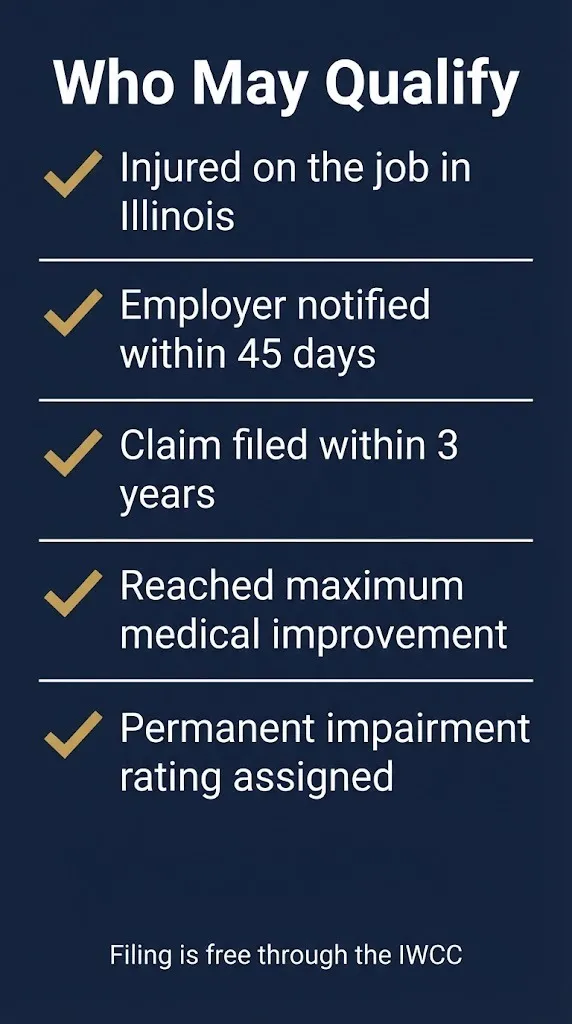
- You must report a work injury to your employer within 45 days, but you have up to 3 years to file a formal claim with the IWCC.
If you’re searching for an Illinois workers’ comp settlement chart, you want to know what your injury is actually worth. The chart is real, it’s public law, and the numbers are fixed by statute.
But here’s what most law firm pages won’t tell you upfront: the chart is a starting point, not a final answer. Your actual settlement depends on three inputs, and one of them (your impairment rating) is negotiable.
The body part chart matters because it sets the maximum weeks of compensation. A hand is worth 205 weeks. An arm is 253. A back is 500 weeks as a “person as a whole.” Your weekly rate is 60% of your average weekly wage, capped at the state maximum.
This article breaks down the 2026 chart, shows the exact formula, and explains what pushes settlements above the baseline.
The Facts
| Governing Law | Illinois Workers’ Compensation Act, Section 8(e) |
| Administering Agency | Illinois Workers’ Compensation Commission (IWCC) |
| Current PPD Maximum Rate | $1,084.66 per week (July 1, 2025 to June 30, 2026) |
| TTD Maximum Rate | $2,008.60 per week (January 15, 2026 to July 14, 2026) |
| Statewide Average Weekly Wage | $1,506.49 |
| Filing Deadline | 3 years from accident or 2 years from last benefit payment |
| Employer Notice Deadline | 45 days from injury |
| Filing Fee | None |
Is the Illinois workers’ comp settlement chart real or just a lawyer sales tool?
The settlement chart is real law, not a marketing gimmick. Section 8(e) of the Illinois Workers’ Compensation Act assigns a specific number of weeks to each scheduled body part .
When you see a law firm publish an “Illinois workers’ comp settlement chart,” they are quoting the statute. The weeks don’t change based on who’s asking. What changes is how those weeks apply to your specific injury.
The chart works like a price list at a hardware store. The shelf price for a hand is 205 weeks. But you don’t pay full price unless you lose the entire hand. Most injuries involve partial loss, so you multiply the weeks by your impairment percentage.
That’s where the negotiation happens. The insurance company’s doctor will rate your impairment low. Your doctor will rate it higher. The arbitrator decides which rating holds up.
Key Takeaway: The chart is fixed by law, but your impairment rating is not. That’s the number that moves your settlement up or down.
How do you calculate an Illinois workers’ comp settlement?
You calculate an Illinois PPD settlement by multiplying three numbers: the scheduled weeks for your body part, your impairment rating as a percentage, and 60% of your average weekly wage .
The formula is straightforward:
Scheduled weeks × Loss-of-use percentage × PPD weekly rate = PPD award
Your PPD weekly rate is 60% of your average weekly wage. That rate is subject to two guardrails: it cannot exceed the state maximum ($1,084.66 for the current period), and it cannot fall below the state minimum .
Here’s a worked example. A warehouse worker earning $1,000 per week suffers a hand injury with a 10% loss-of-use rating:
- Hand scheduled weeks: 205
- Loss-of-use percentage: 10%
- Effective weeks: 205 × 0.10 = 20.5 weeks
- PPD rate: 60% of $1,000 = $600
- PPD award: 20.5 × $600 = $12,300
That $12,300 is just the PPD piece. Your total recovery includes paid medical bills, temporary disability checks while you were off work, and potentially wage differential benefits if you can’t return to your old job at the same pay .
Illinois workers’ comp settlement chart by body part for 2026
The 2026 settlement chart shows maximum values for total loss of each body part at the current PPD rate of $1,084.66 per week. Most injuries involve partial loss, so real awards are a percentage of these figures .
| Body Part | Scheduled Weeks | Maximum Value (100% Loss) |
|---|---|---|
| Arm | 253 | $274,419 |
| Leg | 215 | $233,202 |
| Hearing, both ears | 215 | $233,202 |
| Hand | 205 | $222,355 |
| Foot | 167 | $181,138 |
| Eye | 162 | $175,715 |
| Both testicles | 162 | $175,715 |
| Thumb | 76 | $82,434 |
| Hearing, one ear | 54 | $58,572 |
| Index finger | 43 | $46,640 |
| Middle finger | 38 | $41,217 |
| Great toe | 38 | $41,217 |
| Ring finger | 27 | $29,286 |
| Little finger | 22 | $23,863 |
| Person as a whole (back, neck, shoulder) | 500 | $542,330 |
Carpal tunnel from repetitive trauma is capped separately. The hand is valued at 190 weeks, and PPD generally cannot exceed 15% loss of use unless you prove a higher rating by clear and convincing evidence .
Reality Check: No one calls you first and offers settlement money. Filing a claim with the IWCC costs nothing. Third-party “claim processing” services that charge upfront fees are unnecessary. If someone demands payment to “unlock” your workers’ comp benefits, that’s a scam.
How much can you really get for a back or neck injury in Illinois?
Back and neck injuries are valued as a percentage of the “person as a whole,” which Illinois sets at 500 weeks . There is no fixed schedule for the spine because the impact varies so widely.
A moderate back injury with a 20% whole-person impairment and a $1,000 weekly wage would calculate as: 500 weeks × 0.20 × $600 = $60,000 in PPD benefits.
But that’s just the schedule math. Real back injury settlements often land higher because of wage differential claims. If you can’t return to heavy lifting and take a lower-paying job, you can recover two-thirds of the difference in wages for up to 500 weeks .
Here’s what actual Illinois settlements look like for spinal injuries, based on reported case outcomes:
| Injury Type | Settlement Range |
|---|---|
| Herniated disc, no surgery | $20,000 to $65,000 |
| Lumbar fusion | $90,000 to $315,000 |
| Multi-level spinal with surgeries | $100,000 to $350,000 |
| Spinal fracture | $60,000 to $270,000 |
These ranges come from actual case examples and reflect the combined value of PPD, wage differential, and future medical considerations .
What is your average weekly wage and why does it matter?
Your average weekly wage (AWW) is the foundation of every workers’ comp calculation in Illinois. It’s based on your earnings for the 52 weeks before your injury .
The Illinois Workers’ Compensation Act defines AWW in Section 10. Full-time workers divide their total year wages by 52. Part-time and seasonal workers use a different method, sometimes based on what a comparable full-time employee earns .
Overtime pay is excluded from the calculation. Only your regular hourly rate and standard earnings count .
If you worked multiple jobs at the time of your injury, you can combine wages from all employers to raise your AWW. But you bear the burden of proving those wages .
The insurance company has a financial incentive to undercalculate your AWW. A $50 error in your weekly rate compounds over hundreds of weeks. Check the math carefully, or have someone check it for you.
Key Takeaway: Your average weekly wage determines your weekly benefit rate. A small error in the wage calculation can cost you thousands over the life of your claim.
How to file an Illinois workers’ comp claim in 2026
Filing an Illinois workers’ comp claim means submitting an Application for Adjustment of Claim through the IWCC’s CompFile system. There is no filing fee .
Here are the steps:
- Report your injury to your employer within 45 days. Written notice is best. Oral notice works, but written creates a record .
- Get medical treatment immediately. Your doctor’s records become evidence. Tell them it’s a work injury .
- Register for CompFile at the IWCC website. Choose “pro se” if you don’t have an attorney .
- File your Appearance form. Mail requires notarization. In-person requires photo ID .
- Complete the Application for Adjustment of Claim. Describe the injury, date, and benefits sought .
- Submit through CompFile. You’ll receive a Notice of Case Filed with your arbitrator assignment .
- Attend status calls as scheduled. After three years, you must appear at each one .
The deadline to file is three years from the accident date, or two years from the last benefit payment, whichever is later .
How long does it take to get your settlement check in Illinois?
You can expect your workers’ comp settlement check within 2 to 4 weeks after an IWCC arbitrator approves the contract . The clock starts on approval, not on signing.
Here’s the realistic timeline:
| Stage | Timeframe |
|---|---|
| Signed contract sent to arbitrator | 1 to 3 days |
| Arbitrator reviews and approves | Varies by docket |
| Insurance company processes payment | 7 to 14 days after approval |
| Check mailed or delivered | 3 to 7 days |
| Funds available after deposit | 5 to 10 business days |
Most workers see their money within one to four weeks after the judge approves the settlement . If more than 30 days pass without payment, your attorney can pursue penalties and interest against the insurance carrier .
Medical liens can delay your net recovery. If Medicare, Medicaid, or a health insurer paid bills related to your injury, those liens must be resolved before you receive your portion .
What happens next in your Illinois workers’ comp case?
Immediately: Report your injury, get medical treatment, and document everything.
Within 45 days: Provide written notice to your employer.
Before 3 years: File your Application for Adjustment of Claim through CompFile.
At maximum medical improvement: Your doctor assigns an impairment rating and determines permanent restrictions.
Settlement negotiation: Both sides exchange demands and offers based on the chart, your rating, and your wage.
Arbitrator approval: The IWCC reviews the contract for fairness and math errors.
Payment: Check issued within 2 to 4 weeks of approval.
Frequently Asked Questions
What is the average Illinois workers’ comp settlement?
There is no published average because every case depends on wages, impairment rating, and injury type. Ranges span from a few thousand dollars for minor finger injuries to over $300,000 for spinal fusion cases.
How much is a 10% disability worth in Illinois?
It depends on the body part and your wage. A 10% hand injury at a $1,000 weekly wage pays about $12,300. A 10% back injury at the same wage pays about $30,000 because the whole-person schedule is 500 weeks.
Can I get workers’ comp without a lawyer in Illinois?
Yes. The IWCC allows pro se filing through CompFile, and there is no filing fee. However, insurance companies have attorneys and you will be negotiating against them.
What if my employer denies my workers’ comp claim?
You can file a formal claim with the IWCC to resolve the dispute. The Commission is the administrative court system for workers’ comp disagreements .
How long do I have to report a work injury in Illinois?
You must notify your employer within 45 days of the accident. Failing to do so can cost you all benefits .
What is maximum medical improvement in workers’ comp?
MMI is the point when your condition has improved as much as it is going to with treatment. Your impairment rating and permanent restrictions are determined at MMI .
Are workers’ comp settlements taxable in Illinois?
No. Workers’ compensation benefits are not taxable under Illinois or federal law .
The chart is your starting point, not your ceiling. Gather your medical records, verify your average weekly wage calculation, and file within three years of your accident date. The 45-day notice deadline is the one that catches people off guard.