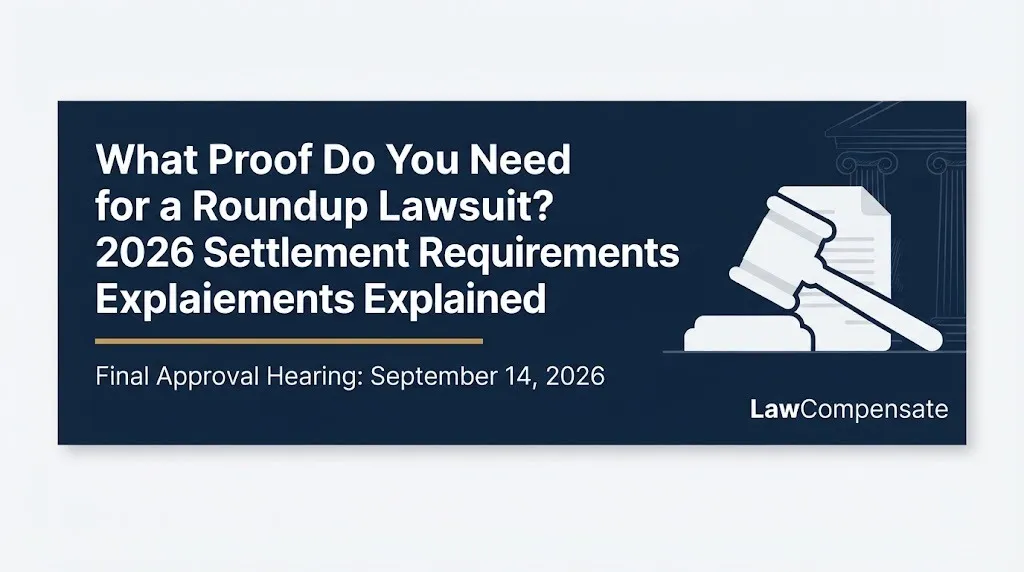
What Proof Do You Need for a Roundup Lawsuit? 2026 Settlement Requirements Explained
Quick Answer
- The Roundup settlement requires proof of NHL diagnosis plus evidence of Roundup exposure, such as receipts, photos, or work records.
- Awards range from $6,000 to over $165,000 based on tier, diagnosis type, and proof strength.
- The opt-out deadline was June 4, 2026; registration for initial claimants opens within 180 days of final approval.
If you’re wondering what proof you need for a Roundup lawsuit, the answer is straightforward: you must document both your non-Hodgkin lymphoma diagnosis and your exposure to Roundup products. The stronger your evidence, the higher your potential award under the 2026 settlement structure.
This matters because Monsanto’s $7.25 billion settlement fund isn’t paid out equally. A scoring system compares your claim against others in your tier, and documentation is one of five factors that determines your final amount.
The most important deadline already passed for opting out, but registration for compensation remains open for eligible claimants. Here’s exactly what proof you need, how the scoring works, and what to do if your records are thin.
The Facts
| Case | Randall King, et al. v. Monsanto Company, No. 2622-CC00325 |
| Status | Preliminary approval March 4, 2026; final fairness hearing rescheduled to September 14, 2026 |
| Fund Size | Up to $7.25 billion |
| Est. Per Person | $6,000 to over $165,000 (tier-based) |
| Claim Deadline | Registration opens within 180 days of final approval for Subclass 1; varies for others |
| Administrator | Not yet confirmed in available records |
| Proof Needed | NHL diagnosis records plus exposure evidence |
Is the Roundup lawsuit settlement real or a scam?
The Roundup settlement is real and court-supervised. A Missouri state judge granted preliminary approval on March 4, 2026, in the Circuit Court of the City of St. Louis.
Monsanto agreed to fund the class through declining annual payments over up to 21 years, totaling $7.25 billion. This is not a television commercial promise. It’s a structured settlement filed in court, with a fairness hearing where the judge decides if the terms are adequate.
The settlement covers current and future claims alleging that Roundup caused non-Hodgkin lymphoma. Bayer, Monsanto’s parent company, explicitly states the agreement contains no admission of liability.
What makes it legitimate is the court oversight. You don’t pay to file. The claims process runs through an official administrator, not third-party “helpers” who call you first. If someone contacts you demanding payment to “process” your Roundup claim, that’s a red flag.
How much money can you get from the Roundup settlement?
Awards range from $6,000 to over $165,000, depending on your tier and claim score. There is no single payout amount because the settlement uses a nine-tier system.
Your tier assignment depends on three factors: whether you’re an occupational or residential claimant, your age at diagnosis, and whether your NHL subtype is aggressive or indolent.
| Factor | Higher Award Impact | Lower Award Impact |
|---|---|---|
| Exposure Type | Occupational (farmer, landscaper) | Residential (home use) |
| Age at Diagnosis | Younger | 78 or older (always Tier 9) |
| NHL Subtype | Aggressive (DLBCL, Burkitt) | Indolent (Follicular, CLL) |
| Treatment | Chemotherapy, radiation, transplant | Less invasive treatment |
| Proof Strength | Receipts, photos, work records | Personal statement only |
Within your tier, your actual award can range from 80% to 120% of the tier average, based on your individual Claim Score.
Key Takeaway: The single biggest lever you control is proof strength. Receipts and photos push your score up. A bare personal statement leaves money on the table.
What medical proof do you need for a Roundup lawsuit?
You need oncology records and pathology reports that confirm a non-Hodgkin lymphoma diagnosis. The settlement defines qualifying NHL broadly, but the specific subtype matters for tier placement.
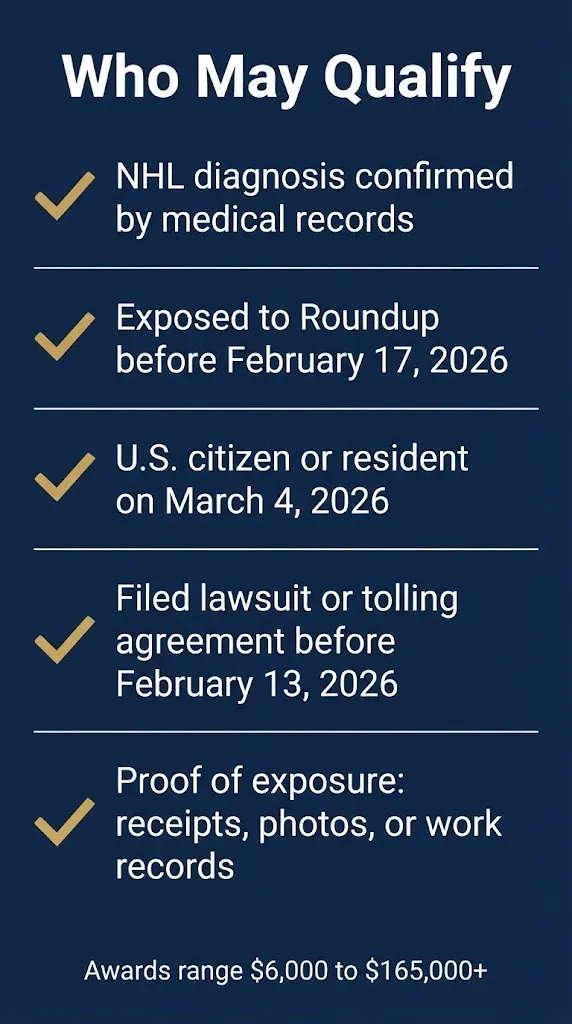
Your medical documentation should include the pathology report identifying the exact lymphoma subtype, treatment records showing what therapies you received, and dates of diagnosis. The settlement class includes anyone diagnosed with NHL as of March 4, 2026, who also meets exposure requirements.
For aggressive NHL subtypes, the settlement lists Diffuse Large B-Cell Lymphoma, Burkitt Lymphoma, and Mantle Cell Lymphoma. Indolent subtypes include Follicular Lymphoma, Chronic Lymphocytic Leukemia, and Hairy Cell Leukemia.
If you were diagnosed after March 4, 2026, you may still qualify under future claimant provisions. The settlement covers diagnoses occurring before the end of a 16-year period following the effective date.
Reality Check: No one texts you settlement money first. Filing a claim is always free through the official process. Third-party “claim preparation” services charging upfront fees are unnecessary. The court-supervised process does not require you to pay anyone to submit your information.
What proof of Roundup exposure is strongest?
Documentary evidence beats memory every time. Receipts, invoices, product photos, and employment records rank highest. Personal statements alone score lowest.
The settlement’s scoring system explicitly states that “photos or receipts count for more than just a personal statement”. If you used Roundup at work, employment records showing your job duties and duration help. If you purchased it for home use, old receipts or credit card statements create a paper trail.
Witness statements from family members or coworkers can fill gaps when paperwork is thin. But they carry less weight than documents.
The minimum exposure threshold for a full award is at least 16 hours or 10 lifetime days total. If you can prove exposure but not the minimum time, you may receive a $150 Limited Proof Award.
How do you prove you used Roundup if you don’t have receipts?
You build a circumstantial case using multiple sources. Employment records, witness statements, product photos, and purchase history from retailers can all support your exposure claim.
Start with where you worked. If your job involved landscaping, farming, groundskeeping, or nursery work, your employment file may document your duties and the chemicals you handled. Coworkers who sprayed alongside you can provide statements.
For home use, check old photos of your garage or garden shed. Look for credit card statements showing purchases at hardware stores. Family members who remember you spraying can provide witness statements.
The settlement doesn’t require a receipt for every application. It requires credible evidence that you were exposed. A combination of work records and witness testimony can meet that bar.
Key Takeaway: Receipts are the gold standard, but they aren’t the only standard. Employment records and witness statements can prove exposure when purchase documentation is gone.
How to join the Roundup lawsuit settlement
Joining means filing a claim through the official process, not hiring a lawyer to “sign you up.” Here are the steps:
- Confirm you meet the exposure and diagnosis requirements.
- Gather your medical records, especially pathology and treatment reports.
- Collect any exposure evidence: receipts, photos, work records, witness names.
- Wait for the registration window to open after final approval.
- Register at the official settlement website when it becomes active.
- Submit your Claim Package within the required timeframe.
- Keep copies of everything you file.
The registration deadline for Subclass 1 claimants (those who filed a lawsuit or tolling agreement before February 13, 2026) is within 180 days of final court approval. If you didn’t file before that date, you generally cannot receive compensation unless you can prove your state’s deadline to sue hasn’t passed.
The opt-out deadline was June 4, 2026. If you didn’t opt out, you’re bound by the settlement terms.
Key Takeaway: The registration window opens only after final approval, which was still pending as of September 2026. Watch the official settlement website for the exact date.
What happens if you have no proof of Roundup exposure?
You can still file, but your award will be limited. The settlement provides a $150 award if you can prove exposure occurred but cannot meet the minimum time threshold.
This is called a Limited Proof Award. It requires showing you were exposed to Roundup products, just not for the required 16 hours or 10 lifetime days.
If you cannot prove any exposure, you remain part of the Settlement Class but receive no money. The class definition includes people who “had reason to know of their Exposure,” so being technically included doesn’t guarantee payment.
The exception: if you can prove your state’s statute of limitations hasn’t expired, you may still apply for a full award even without prior legal action. This depends on where you were exposed and where you lived when diagnosed.
When will Roundup settlement payments go out?
Payments will not go out until the settlement receives final approval and any appeals are resolved. The final fairness hearing was rescheduled to September 14, 2026.
Even after final approval, appeals could delay payment by years. Bayer’s own financial filing states the settlement “does not become final and effective until all appeal procedures have been concluded, which could take several years”.
The settlement structure involves annual payments over up to 21 years, not a single lump sum distribution. Claims are processed annually, and Quick-Pay Awards for eligible tiers are processed on a first-in, first-out basis.
Don’t expect a check in 2026. Realistic timelines point to 2027 at the earliest for initial payments, assuming no major appellate delays.
What happens next in the Roundup settlement?
September 14, 2026: Final approval hearing in St. Louis.
Expected late 2026: If approved, registration window opens for Subclass 1 claimants.
Expected 2027: Appeals process begins; payments cannot start until appeals conclude.
Expected 2027-2028: First claim processing and payment cycle, if no appeals.
Ongoing: Annual payment cycles continue for up to 21 years.
Frequently Asked Questions
What proof do you need for a Roundup lawsuit?
You need a non-Hodgkin lymphoma diagnosis confirmed by medical records, plus evidence of Roundup exposure such as receipts, photos, or work records. Stronger proof of exposure increases your award amount.
Can I file a Roundup claim without receipts?
Yes, but your award may be lower. The settlement accepts witness statements, employment records, and product photos as proof. A $150 Limited Proof Award applies if you can prove exposure but not the minimum time threshold.
How much is the Roundup settlement per person?
Awards range from $6,000 to over $165,000. Your exact amount depends on your tier and claim score. The settlement uses nine tiers based on exposure type, age, and NHL subtype.
Is the Roundup settlement still open for claims?
Registration hasn’t opened yet. The final approval hearing was rescheduled to September 14, 2026. Once approved, the registration window opens within 180 days for eligible claimants.
Do I need a lawyer to file a Roundup claim?
No. The settlement process allows you to file directly. Hiring a lawyer is optional and may reduce your award if they take a percentage. The official process is designed to be accessible without legal representation.
What happens if I miss the opt-out deadline?
If you didn’t opt out by June 4, 2026, you’re bound by the settlement terms. You cannot sue Monsanto separately for the same claims. Your only path is through the settlement claims process.
Can family members file a Roundup claim for someone who died?
Yes. Wrongful death claims can be filed by the estate or close family members. You’ll need the deceased person’s medical records, death certificate, and proof of Roundup exposure.
The registration window hasn’t opened yet, but the paperwork you gather now determines what you collect later. Medical records and exposure evidence take weeks to assemble. Start now, and when the official site goes live, you’ll be ready. September 14, 2026, is the date to watch for final approval.