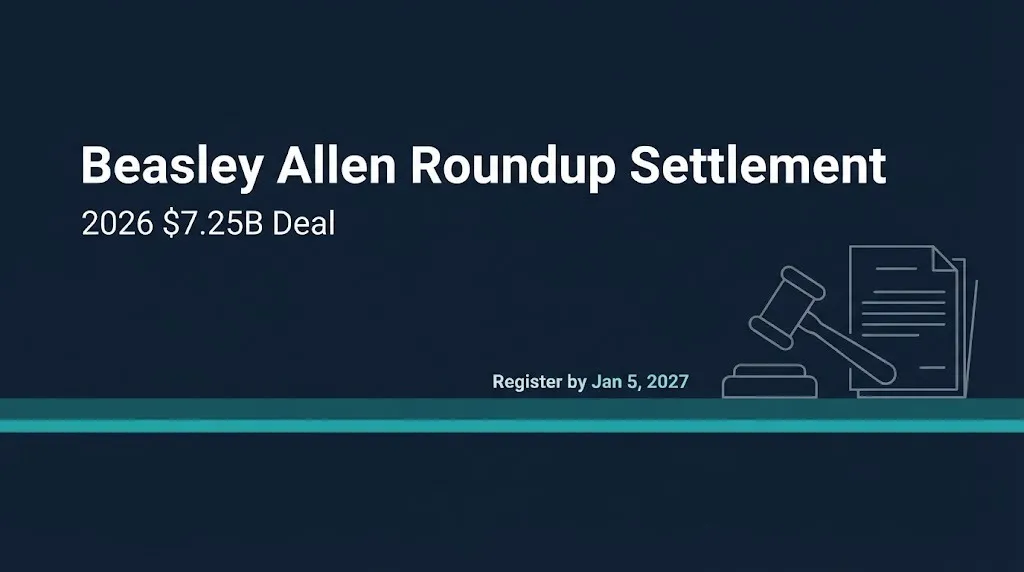
Beasley Allen Roundup Settlement 2026: $7.25 Billion Deal, Payout Tiers, and Claim Status
Quick Answer
- Bayer agreed to pay up to $7.25 billion over 21 years to resolve current and future non-Hodgkin lymphoma claims from Roundup exposure.
- Payout tiers range from a $150 limited-proof award to an average of $165,000 for Tier 1 claimants, with actual awards ranging from 80% to 120% of tier averages.
- The claim registration deadline is January 5, 2027, or 180 days after final approval, whichever is later.
Introduction to the Beasley Allen Roundup Settlement
The Beasley Allen Roundup settlement is part of a $7.25 billion nationwide class action resolution that Bayer’s Monsanto unit agreed to in February 2026. The deal covers people exposed to Roundup weedkiller before February 17, 2026, who have been diagnosed with non-Hodgkin lymphoma (NHL).
If you used Roundup on your farm, in your garden, or as part of your job, and later developed NHL, you may be part of this settlement class. The settlement establishes a long-term claims program that will pay awards over up to 21 years.
This article explains the payout tiers, who qualifies, how to file a claim, and what the recent Supreme Court ruling means for your rights. One critical detail: the settlement is not yet final because appeals are expected, and no money will be distributed until all appeals are resolved .
The Facts
| Item | Detail |
|---|---|
| Case Name | King v. Monsanto (Missouri State Court class action) and In re: Roundup Products Liability Litigation (MDL 2741) |
| Court | Circuit Court of the City of St. Louis, Missouri |
| Case Number | 2622-CC00325 |
| Status | Final approval granted September 14, 2026. Subject to appeals. |
| Settlement Fund | Up to $7.25 billion over 21 years |
| Est. Per Person | $150 (limited proof) to $165,000 average (Tier 1), with actual awards 80% to 120% of tier averages |
| Claim Deadline | Register by January 5, 2027, or 180 days after final approval, whichever is later |
| Exclusion Deadline | June 4, 2026 (PASSED) |
| Final Approval Hearing | September 14, 2026 (COMPLETED) |
| Administrator | BrownGreer PLC |
| Proof Needed | Medical diagnosis of NHL, exposure evidence, and treatment records |
Is the Beasley Allen Roundup Settlement Legitimate?
Yes, the Beasley Allen Roundup settlement is legitimate and received final approval from a Missouri state court on September 14, 2026. Beasley Allen is one of the leading plaintiff firms representing claimants in the Roundup litigation .
The settlement resolves claims that Roundup exposure caused non-Hodgkin lymphoma. Bayer continues to deny that glyphosate causes cancer, stating the settlement “does not contain any admission of liability or wrongdoing” .
The deal structure spreads payments over 21 years to protect Bayer’s financial stability. The company increased its litigation provisions from 7.8 billion euros to 11.8 billion euros to cover the settlement and related costs .
For context on how to read that: a company that sets aside billions in reserves while denying wrongdoing is like a landlord who fixes the plumbing only after the city cites the building. The fix is real, but the timing tells you something about the motivation.
Key Takeaway: The settlement is legitimate and court-approved, but Bayer admits no wrongdoing, and the 21-year payment structure means claimants will wait years for full compensation.
How Much Can You Get from the Roundup Settlement?
Payout amounts depend on your tier assignment and claim score. The settlement creates nine tiers based on exposure type, age at diagnosis, and NHL subtype .
| Tier Factor | Impact on Award |
|---|---|
| Occupational vs. Residential | Occupational claims generally score higher |
| Age at Diagnosis | Younger claimants receive higher awards |
| Aggressive vs. Indolent NHL | Aggressive (fast-growing) subtypes pay more |
| Treatment Intensity | Chemotherapy, radiation, and invasive treatments increase scores |
| Proof Strength | Receipts, photos, and documentation score higher than personal statements |
| Exposure Duration | Longer and more frequent exposure increases awards |
Tier 1 (younger, occupational, aggressive NHL) has the highest average award. Tier 9 (claimants over age 78) has the lowest .
Actual awards range from 80% to 120% of the tier average depending on your individual claim score. The court filing notes that average awards could range from $10,000 to $165,000, though the full range includes higher amounts for top-tier claimants .
A $150 limited-proof award is available if you cannot prove minimum exposure (at least 16 hours or 10 lifetime days) but can still show you were exposed to Roundup .
Reality Check
The $7.25 billion figure is not a per-person payout. It is the maximum funding for the entire class, paid over 21 years. No money will be distributed until all appeals are resolved, which could take several years . Filing a claim is free. Anyone charging you a fee to register or apply for a Roundup settlement award is not legitimate.
Who Qualifies for the Roundup Settlement?
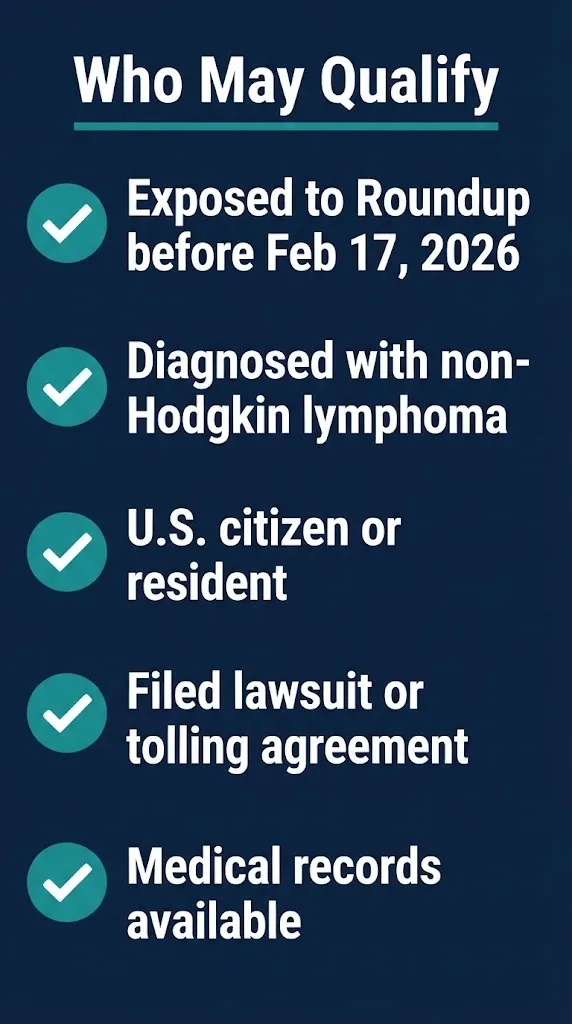
You may qualify if you were exposed to Roundup in the United States before February 17, 2026, and have been diagnosed with non-Hodgkin lymphoma. The class includes both current NHL patients and people who may be diagnosed in the future within a 16-year period .
The core eligibility requirements are:
- Exposure: You used or were exposed to Roundup products in the U.S. before February 17, 2026
- Diagnosis: You have a qualifying NHL diagnosis as of March 4, 2026, or receive one later
- Residency: You are a U.S. citizen or were living in the U.S. on March 4, 2026
A critical distinction exists for people diagnosed before 2020. If you filed a lawsuit or signed a tolling agreement before February 13, 2026, you can apply for compensation. If you did not, you generally cannot receive money unless you can prove your state’s deadline to sue has not passed .
Tolling agreements pause the clock on your deadline to sue. If you signed one, you preserved your rights.
How Do You File a Roundup Settlement Claim?
Filing a claim requires registering with the settlement administrator and submitting a Claim Package. The registration deadline is January 5, 2027, or 180 days after the settlement becomes final, whichever is later .
Here are the steps:
- Register on the official settlement website within the deadline.
- Gather medical records confirming your NHL diagnosis and treatment.
- Document your Roundup exposure with receipts, photos, or employment records.
- Complete the Claim Package with all required information.
- Submit before the deadline and respond to any administrator requests.
- Receive tier assignment based on exposure, age, and NHL subtype.
- Claim scoring determines your actual award within the tier range.
- Payment is made annually after appeals are resolved.
The settlement administrator is BrownGreer PLC . Claims will be processed annually, not all at once.
What Does the Supreme Court Durnell Decision Mean?
The Supreme Court decided Durnell on June 25, 2026, holding that federal pesticide law preempts state-law failure-to-warn claims for Roundup. The ruling significantly changed the legal landscape .
The decision means plaintiffs cannot argue that Roundup’s label failed to warn about cancer risks because the EPA has concluded no warning is required. This theory drove most of the large jury verdicts against Bayer .
However, the ruling was limited to failure-to-warn claims. Design defect and negligence claims may still proceed in state courts .
After the Durnell decision, some people who opted out of the settlement sought to opt back in, believing their individual claims were now weaker. The court granted a three-week extension of the final approval hearing to process these requests .
What Is the Status of the Federal MDL?
The federal Roundup MDL (In re: Roundup Products Liability Litigation, No. 16-md-02741) remains active with nearly 4,000 lawsuits. Bayer asked Judge Vince Chhabria to dismantle the MDL after the Durnell ruling, arguing the claims have “no reason to exist” .
Plaintiffs countered that the Durnell ruling was limited to the label and does not affect design defect or negligence claims. Judge Chhabria said both sides submitted “unsatisfying” responses and told them to “plow ahead” on complex legal questions .
The MDL plaintiffs are excluded from the class settlement unless they request inclusion and dismiss their pending claims .
What Happens Next with the Roundup Settlement?
The settlement is approved but not final. Here is the expected timeline:
September 14, 2026: Final approval hearing held .
Expected late 2026: Appeals filed by objectors. The Eighth Circuit dismissed one objector appeal in August 2026, but more may follow .
Expected 2027: If appeals are resolved, registration opens and claims processing begins.
Expected 2027-2043: Annual payments distributed over up to 21 years.
Ongoing: The federal MDL continues, with Judge Chhabria overseeing nearly 4,000 cases .
No payments will be made until all appeals are exhausted. The settlement agreement states it “does not become final and effective until all appeal procedures have been concluded” .
Frequently Asked Questions
Is the Roundup settlement final?
The settlement received final approval on September 14, 2026, but it is not effective until all appeals are resolved. That could take several years.
How much will I receive from the Roundup settlement?
Awards range from $150 for limited proof to an average of $165,000 for Tier 1 claimants. Actual amounts depend on your tier and claim score.
What is the deadline to file a Roundup settlement claim?
You must register by January 5, 2027, or 180 days after final approval, whichever is later. Claim Packages are due within 180 days of the settlement becoming final.
Do I need proof of Roundup use?
Yes. Stronger proof (receipts, photos, employment records) increases your claim score. A $150 limited-proof award is available if you can show exposure but not minimum duration.
What if I was diagnosed with NHL before 2020?
If you filed a lawsuit or signed a tolling agreement before February 13, 2026, you can apply. If not, you generally cannot receive money unless your state’s deadline to sue has not passed.
What does the Durnell Supreme Court decision mean for my claim?
The ruling eliminated failure-to-warn claims but did not affect design defect or negligence claims. The class settlement covers NHL claims regardless of legal theory.
Can I still sue Monsanto individually?
Only if you opted out by June 4, 2026. If you did not opt out, you are bound by the settlement. Future claimants have a “back-end” opt-out after diagnosis but must go through the claims process first.
Who is the settlement administrator?
BrownGreer PLC is the settlement administrator. The official settlement website is WeedKillerClass.com.