Settlement House Movement in 2026: Definition, History, and Modern Impact
Quick Answer
- The settlement house movement is a social reform effort that began in the 1880s, placing volunteers in poor urban neighborhoods to provide education, healthcare, and community services.
- It is not a lawsuit or settlement payout program; it is a historical and ongoing social movement with no claim deadlines or financial compensation.
- Modern settlement houses continue operating worldwide, with the International Federation of Settlements connecting organizations across 30 countries in 2026.
What Is the Settlement House Movement?
The settlement house movement is a reformist social movement that began in the 1880s and peaked around the 1920s in England and the United States. Its goal was to bring rich and poor together in interdependent communities by establishing “settlement houses” in poor urban areas where volunteer middle-class workers would live alongside their low-income neighbors.
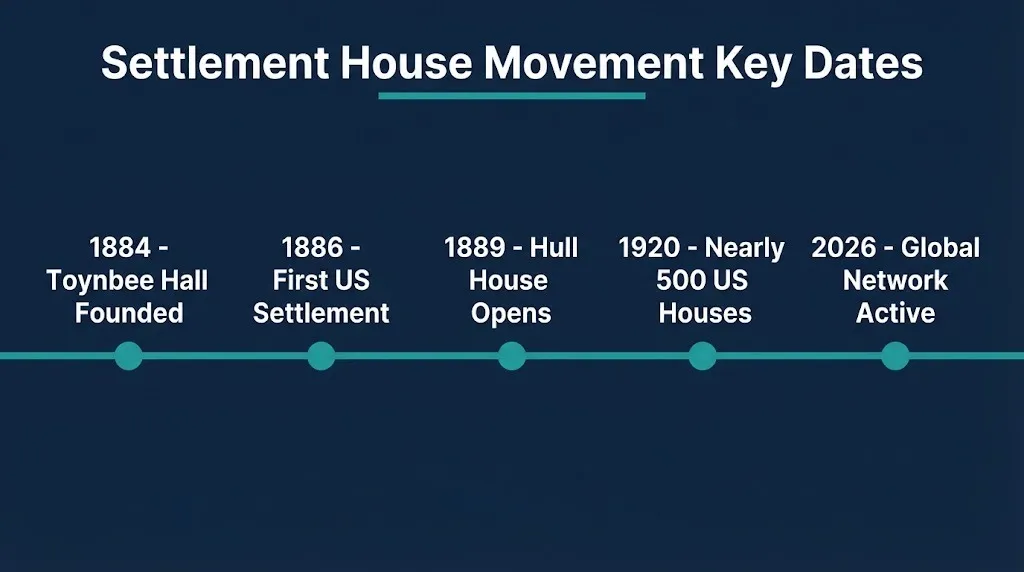
The movement started with the founding of Toynbee Hall in Whitechapel, in London’s East End, in 1884. Victorian England, increasingly concerned with poverty, gave rise to a model where university students settled in slum areas to live and work alongside local people.
These houses offered food, shelter, basic and higher education, savings programs, sports, and arts. The approach differed from traditional charity because settlement workers focused on societal causes of poverty, especially those tied to industrialization, rather than personal failings.
The movement spread to the United States in 1886 when Stanton Coit founded the Neighborhood Guild on Manhattan’s Lower East Side. Jane Addams then established Hull House in Chicago in 1889, which became the most famous American settlement house.
Key Takeaway: The settlement house movement is a historical and ongoing social reform effort, not a legal settlement program. There is no claim form, payout, or deadline associated with it.
Is the Settlement House Movement Still Active in 2026?
Yes, the settlement house movement remains active in 2026 through a global network of community organizations. The International Federation of Settlements and Neighborhood Centers (IFS) connects locally rooted organizations across six continents and 30 countries.
In June 2026, community, neighborhood, child, and youth sector leaders from Australia, Canada, the United States, and Germany came together for the Berlin International Exchange. The IFS also announced a Regional Mental Health Conference scheduled for September 29 to 30, 2026, in Kisumu, Kenya.
IFS members use different names that reflect their local histories and contexts, including settlement houses, neighborhood houses, neighborhood centers, and community centers. They share a commitment to community participation, inclusion, social justice, and locally led action.
University Settlement, America’s first settlement house, celebrated its 140th birthday in April 2026 with a record-breaking gala that raised more than $1.3 million. The organization supports programs that more than 40,000 New Yorkers count on every year.
The movement’s modern legacy includes the Poor Man’s Lawyer service, which began when a barrister volunteered his time and encouraged his friends to do the same. Settlement houses have been described as “a foundation for social work practice” in the United Kingdom.
How Did the Settlement House Movement Start?
The settlement house movement started in 1884 with the founding of Toynbee Hall in London’s East End by Samuel Barnett. It was a response to severe poverty, homelessness, and the failings of traditional charity during the Industrial Revolution.
Settlement leaders were concerned that welfare could reinforce a division between the “helper” and the “helpless.” They focused instead on relationships, participation, reciprocity, social reform, and addressing the structural causes of poverty.
The movement’s approach was radically different from the charity organization societies that preceded it. Settlement workers did not just distribute aid; they moved into the neighborhood and lived alongside the people they served.
The Women’s University Settlement, now Blackfriars Settlement, was founded in 1887 by women from Cambridge and Oxford colleges. As higher education opened to women, young female graduates became a significant force in the movement.
The movement spread internationally. In 1905, Stanislav Shatsky and Alexander Zelenko established a network of educational and social institutions in northern Moscow, naming it “Settlement.” The Russian government closed it in 1908 due to alleged socialist activities.
What Was Hull House and Why Did It Matter?
Hull House was the most famous settlement house in the United States, founded in Chicago in 1889 by Jane Addams and Ellen Gates Starr. It became the standard bearer for the American settlement movement after they visited Toynbee Hall in 1888.
Unlike the charity and welfare efforts that preceded it, Hull House was not a religious-based organization. Addams grounded the settlement on democratic ideals rather than Christian ethics. It focused on providing education and recreational facilities for European immigrant women and children.
Hull House grew from one building to 13 by 1911, with a summer camp added in 1912. It held classes in literature, history, art, sewing, and other subjects. Free concerts, lectures, and clubs for children and adults were regular features.
Addams published her thoughts on what she called the “three R’s” of the settlement house movement: residence, research, and reform. Hull House residents conducted careful studies of the surrounding community, gathering data that informed their advocacy.
By 1920, there were nearly 500 settlement houses nationally. The movement had grown from 74 settlements in 1897 to 413 by 1911 across 32 states. Hull House set the model that many others followed.
Who Were the Key Figures in the Settlement House Movement?
The settlement house movement was shaped by a network of reformers in the United Kingdom and the United States. Here are the most significant figures:
| Name | Contribution | Location |
|---|---|---|
| Samuel Barnett | Founded Toynbee Hall in 1884 | London, England |
| Jane Addams | Co-founded Hull House in 1889 | Chicago, Illinois |
| Ellen Gates Starr | Co-founded Hull House with Addams | Chicago, Illinois |
| Stanton Coit | Founded Neighborhood Guild in 1886 | New York City |
| Mary K. Simkhovitch | Founded Greenwich House in 1902 | New York City |
| Lillian Wald | Directed Henry Street Settlement from 1893 | New York City |
| Robert Archey Woods | Led South End House | Boston, Massachusetts |
Mary Kingsbury Simkhovitch became a tireless advocate of public housing and has been called “the mother of public housing.” She played a central role in designing and administering the first public housing projects in America during the New Deal.
The National Housing Conference, which Simkhovitch founded in 1931, continues to operate as a prominent advocate for safe, affordable housing. She co-wrote the National House Act of 1937, the first legislation establishing the federal government’s responsibility to help provide low-income families with housing.
A new biography of Simkhovitch, “A Slumless America,” was published by Oxford University Press in 2026.
How Did the Settlement House Movement Spread Internationally?
The settlement house movement spread from England to the United States, then to Russia, Australia, and other countries. Each adaptation reflected local conditions while keeping the core commitment to community-based social reform.
In the United States, the movement was introduced by Jane Addams after she traveled to Europe and learned about the English system. The movement became popular due to the socio-economic situation between 1890 and 1910, when more than 12 million European immigrants arrived in the country.
In Australia, the movement began at the University of Sydney through its Women’s Society. Helen Plummer Phillips brought the model back after visiting Cambridge and Oxford. The Settlement eventually served Aboriginal and migrant families and is now known as The Settlement Neighbourhood Centre in Darlington, Sydney.
Jewish communities played an active role in the settlement movement as donors, administrators, resident staff, and clients. Lillian Wald directed the Henry Street Settlement from 1893 to 1933, with funding largely from Jewish philanthropists.
The Educational Alliance, founded in Manhattan in 1889, was the most prominent Jewish settlement in the United States. While all settlement houses tried to “make Americans” out of immigrants, the Alliance tried to “make” American Jews in line with Reform Judaism.
What Services Did Settlement Houses Provide?
Settlement houses provided a wide range of services designed to improve the lives of poor urban residents. The services evolved based on community needs and the settlement’s specific location.
At Houchen Settlement House in El Paso, Texas, the Woman’s Home Missionary Society provided medical and social services from the settlement house’s bathroom. They offered basic health care at affordable costs and classes in hygiene and nutrition.
Houchen’s Freeman Clinic opened in 1921, representing the first separation of medical and settlement work. The Newark Methodist Maternity Hospital opened in 1937, further expanding infant services, prenatal care, and delivery. Mexican American women became nurses at the hospital, creating a trusted environment.
Settlement houses typically offered:
- Education: English classes, kindergarten, literacy programs, and citizenship preparation
- Healthcare: Clinics, maternal care, infant care, and health education
- Recreation: Playgrounds, clubs, sports, and arts programs
- Social services: Employment assistance, savings programs, and legal aid
Today, settlements provide early education, youth guidance, crime intervention, senior programs, and specialized programs for young people who have aged out of foster care.
What Is the Legacy of the Settlement House Movement?
The legacy of the settlement house movement includes major contributions to social work, housing reform, and the modern social safety net. Settlement houses influenced urban design and architecture in the twentieth century.
The movement gave rise to many social policy initiatives and innovative ways of working with excluded populations. The Poor Man’s Lawyer service came about because a barrister volunteered his time and encouraged his friends to do the same.
Settlement houses were incubators of progressive ideas, civic action, and policy change. They shaped public housing reform, strengthened local communities, and helped lay the groundwork for today’s social safety net.
James Rossant of Conklin + Rossant agreed with Robert E. Simon’s social vision and consciously sought to mix economic backgrounds when drawing up the master plan for Reston, Virginia. The New Monastic movement has a similar goal and model.
The movement also influenced the Arts and Crafts movement. African American industrial education shared purposes with Arts and Crafts ideals, including moral uplift, social change, and service to others.
By 1993, the estimated number of settlement houses dropped to 300 in 80 cities. But the movement continued to evolve, with new houses like Boulevard House established in Southwest Detroit in 2012.
What Does the Settlement House Movement Look Like Today?
Modern settlement houses are community-focused organizations that provide a range of services without requiring employees to live alongside those they serve. They are staffed by professional employees and students.
The International Federation of Settlements and Neighborhood Centers connects organizations across 30 countries. IFS creates opportunities for members to build relationships across borders, exchange knowledge, and strengthen practice.
In 2026, the IFS continues to address contemporary challenges. A September 2026 reflection piece asked a question the settlement movement “rarely asks out loud”: when international belonging is invisible.
The tension between emergency relief and community building remains relevant. During the current cost-of-living crisis, community organizations face the same question settlement leaders debated over a century ago: does the relationship end with handing out a food parcel, or does it lead to connection, participation, and collective action?
University Settlement’s 2026 gala honored the Schall family’s 60 years of commitment. Ellen Schall began as a camp counselor in 1966 and later served on the board for 35 years. Four generations of the family, 19 individuals total, have supported the organization.
Frequently Asked Questions
What was the settlement house movement?
The settlement house movement was a reformist social movement that began in the 1880s. It established community centers in poor urban areas where middle-class volunteers lived and provided education, healthcare, and social services.
Is the settlement house movement a lawsuit or settlement program?
No. The settlement house movement is a historical and ongoing social reform effort. It has no claim forms, payouts, deadlines, or financial compensation for individuals.
What was the most famous settlement house?
Hull House in Chicago, founded by Jane Addams and Ellen Gates Starr in 1889, was the most famous American settlement house. It became the standard bearer for the movement that grew to nearly 500 houses by 1920.
Who started the settlement house movement?
The movement started with Toynbee Hall in London in 1884, founded by Samuel Barnett. Jane Addams brought the model to the United States and became the leading figure of the American movement.
Is the settlement house movement still active in 2026?
Yes. The International Federation of Settlements connects organizations across 30 countries. University Settlement celebrated its 140th birthday in 2026, and IFS held a Berlin exchange in June 2026.
What services did settlement houses provide?
Settlement houses provided education, healthcare, recreation, and social services. They offered English classes, kindergarten, clinics, playgrounds, clubs, and legal aid to poor urban residents.
How did the settlement house movement spread internationally?
The movement spread from England to the United States, Russia, Australia, and other countries. Each adaptation reflected local conditions while keeping the commitment to community-based social reform.
What is the legacy of the settlement house movement?
The movement contributed to social work, housing reform, and the modern social safety net. It influenced urban design and inspired the Poor Man’s Lawyer service and other social policy initiatives.