IRS Settlement Programs 2026: Offer in Compromise, Payment Plans, and How to Resolve Federal Tax Debt
Quick Answer
- IRS settlement programs in 2026 include Offer in Compromise, installment agreements, Currently Not Collectible status, and automatic penalty relief.
- Settlement amounts depend on your income, expenses, assets, and ability to pay; the IRS accepts less than owed only if you genuinely cannot pay in full.
- The OIC application requires a $205 fee and an initial payment, with fee waivers available for qualifying low-income taxpayers.
If you owe back taxes and cannot pay the full amount, the IRS has several settlement programs that may reduce what you owe or give you more time. The most powerful is the Offer in Compromise, which lets you settle a tax debt for less than the total balance.
This matters to millions of Americans carrying federal tax debt. The IRS reported that as of 2026, its collection alternatives remain open to eligible taxpayers, but the application process has specific requirements that trip up unprepared filers.
This article breaks down every verified IRS settlement program available in 2026, the exact fees and eligibility rules, how to protect yourself from predatory tax relief companies, and the realistic timelines you should expect before any deal is approved.
The Facts
| Program | IRS Offer in Compromise (OIC), installment agreements, Currently Not Collectible, automatic penalty relief |
| Status | Active; IRS accepting applications |
| Application Fee | $205 for OIC; waivable for qualifying low-income taxpayers |
| Est. Per Person | Varies widely based on income, expenses, assets, and ability to pay |
| Claim Deadline | No deadline; applications accepted year-round |
| Administrator | Internal Revenue Service |
| Proof Needed | Form 656-B, Form 433-A or 433-B, financial documentation |
Is the IRS Offer in Compromise Real or a Scam?
The Offer in Compromise is completely real and authorized by federal law. It is an agreement between you and the IRS that settles a tax debt for less than the full amount you owe.
The IRS states clearly that factors like income, expenses, asset equity, and ability to pay are considered when evaluating your application. This is not a program where you simply ask for a discount and receive one.
The confusion comes from aggressive marketing by tax relief companies. The IRS placed “OIC mills” on its 2026 Dirty Dozen list of tax scams. These operations overpromise results and charge high fees to taxpayers who do not qualify.
The key distinction: the OIC program is legitimate and free to apply for directly through the IRS. What is not legitimate is any company guaranteeing you will qualify or receive a specific settlement amount before reviewing your financials.
How Much Can You Settle Your IRS Debt For in 2026?
Your settlement amount is not a fixed percentage. The IRS calculates what it believes you can afford to pay based on your specific financial situation.
The agency considers your income, monthly living expenses, asset equity, and future earning potential. If your assets and income suggest you could pay $10,000 over time, the IRS will generally expect at least that amount.
The $205 application fee applies unless you qualify for the low-income exception. An initial payment is also required with your offer, though low-income taxpayers can have this waived as well.
There is no published table of settlement tiers because every case is different. A taxpayer with no assets and minimal income might settle a $50,000 debt for a few thousand dollars. A taxpayer with equity in a home and steady employment will face a much higher required offer.
Not yet determined is the honest answer for any specific case until the IRS reviews your Form 433-A or 433-B and calculates your reasonable collection potential.
Key Takeaway: The IRS does not publish settlement percentages; your offer must be based on documented ability to pay, and the $205 fee is waivable for qualifying low-income taxpayers.
How to Apply for an IRS Offer in Compromise
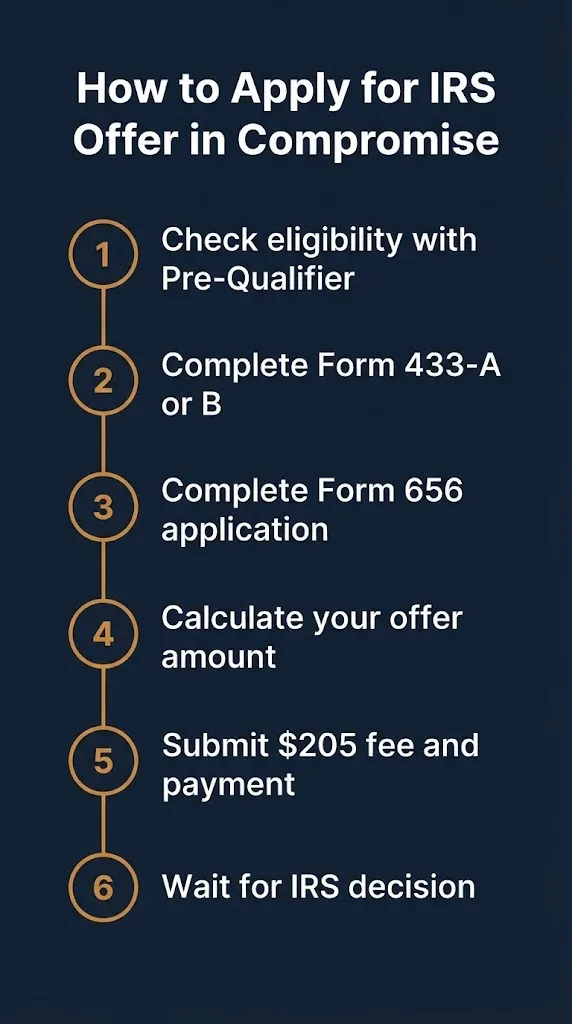
You can apply for an Offer in Compromise online or by mail using the forms in the current Form 656-B booklet. Here are the steps:
- Use the OIC Pre-Qualifier Tool on IRS.gov to check basic eligibility.
- Complete Form 433-A (individuals) or Form 433-B (businesses) with your financial details.
- Complete Form 656, the Offer in Compromise application.
- Calculate your offer amount using the formulas in the booklet.
- Include the $205 application fee and required initial payment, unless waived.
- Submit your package online through your IRS Individual Online Account or by mail.
- Wait for IRS review, which can take several months.
- Respond promptly to any requests for additional information.
The IRS warns that using an outdated version of Form 656-B can cause processing delays. Always download the current booklet.
What Are the Other IRS Tax Debt Settlement Programs?
The Offer in Compromise is not your only option. The IRS offers several programs depending on your situation.
| Program | Best For | Key Feature |
|---|---|---|
| Offer in Compromise | Taxpayers who genuinely cannot pay full debt | Settles for less than owed |
| Short-term payment plan | Balances under $100,000 | Up to 180 days to pay in full |
| Long-term payment plan | Balances under $50,000 | Up to 10 years to pay |
| Currently Not Collectible | Financial hardship cases | Pauses most collection activity |
| Automatic penalty relief | Taxpayers with clean compliance history | Penalties removed automatically |
The short-term plan is for balances under $100,000 in combined tax, penalties, and interest. You get up to 180 days to pay in full.
The long-term plan, also called an installment agreement, is available to individual taxpayers who owe $50,000 or less. Most taxpayers can stretch payments up to 10 years, though interest and penalties keep accruing.
What Is Currently Not Collectible Status in 2026?
Currently Not Collectible status, often called CNC, temporarily pauses most IRS collection activities when you cannot pay due to financial hardship.
This is not a settlement. Your full tax debt remains, and penalties and interest continue to accrue. The IRS may also file a Notice of Federal Tax Lien and apply future refunds to your balance.
To qualify, you typically need to provide financial information showing that paying anything would prevent you from covering basic living expenses. The IRS may ask for documentation of income, monthly expenses, bank accounts, and property.
CNC status has no fixed time limit. The IRS may review your financial condition periodically and resume collection if your ability to pay improves.
One common misconception: CNC does not eliminate your debt. It is a temporary delay, not a settlement. The balance may actually grow while you are in this status because penalties and interest keep running.
How Does Automatic Penalty Relief Work in 2026?
The IRS introduced a new automatic process in 2026 called Automatic Exemption from Penalty, or AEP, which replaces the old First Time Abate procedure.
Under AEP, penalties are not assessed during processing if you have a history of filing on time and paying any tax due in the previous 3 years (or 12 consecutive quarters for quarterly returns). This applies to eligible original returns starting with tax year 2025.
You do not need to request this relief. If you qualify, the IRS applies it automatically and sends you a notice.
AEP covers failure to file, failure to pay, and failure to deposit penalties for eligible returns. Returns filed only in response to specific transactions, like estate or gift tax returns, generally do not qualify.
If you do not qualify for AEP, you can still request penalty relief based on reasonable cause.
Reality Check: The IRS will never call you demanding immediate payment or threatening arrest. The agency’s first contact is always by mail. If someone calls claiming you owe back taxes and must pay right now, it is a scam.
How to Avoid IRS Tax Debt Relief Scams
The FTC and state attorneys general have issued repeated warnings about predatory tax debt settlement companies in 2026.
These companies use official-sounding names like “Tax Resolution Oversight Department” or “Tax Mediation and Resolution Agency”. They promise to settle your debt for pennies on the dollar, then charge high upfront fees and deliver nothing.
Virginia Attorney General Jay Jones warned in April 2026 that these companies “exploit vulnerable people’s desperation and fear of the IRS while offering reassurances they are in no position to make”.
The FTC reached a settlement of nearly $10 million with the owners of American Tax Service for sending mailers impersonating the government and making false promises about tax debt resolution.
Red flags that should end the conversation immediately:
- They guarantee a specific settlement amount or percentage before reviewing your finances
- They promise a timeline for results, like “six months or less”
- They claim you qualify for a program without examining your income, expenses, and assets
- They demand full payment of fees upfront
- They use high-pressure sales tactics or claim this is your “last chance”
Legitimate tax professionals do not guarantee outcomes. Only the IRS can decide what settlement it will accept.
When Should You Hire Professional Help for IRS Debt?
You can apply for every IRS settlement program yourself for free. The question is whether your situation is complex enough to justify paying someone.
Hiring representation tends to make financial sense when:
- You owe more than roughly $10,000 to the IRS
- You have multiple years of unfiled returns
- You are facing a wage garnishment, bank levy, or active collection action
- You are under audit or received a notice of deficiency
- Your situation involves payroll tax debt or trust fund recovery penalties
- You simply do not have the time or willingness to deal with the IRS directly
For simpler situations, do it yourself. If you owe under $10,000 and just need a payment plan, you can set one up online in about 15 minutes through the IRS Online Payment Agreement tool.
If you do hire help, verify the credentials of the person actually doing the work. Enrolled agents, CPAs, and tax attorneys have unlimited practice rights before the IRS. Salespeople do not.
Key Takeaway: Every IRS settlement program is free to apply for directly, and paid help makes sense mainly for complex cases involving levies, payroll taxes, or multiple unfiled years.
What Happens Next
Ongoing: IRS continues accepting OIC applications and payment plan requests year-round through IRS.gov.
January 1, 2027: AEP fully replaces First Time Abate for eligible returns with original due dates on or after this date.
Expected 2027: IRS continues reviewing pending OIC applications; processing times vary by case complexity.
Ongoing: Collection activities resume for taxpayers whose financial situations improve after CNC status.
Frequently Asked Questions
Is the IRS Offer in Compromise program legitimate?
Yes, it is authorized by federal law and administered directly by the IRS. The program settles tax debt for less than owed if you demonstrate genuine inability to pay.
How much does it cost to apply for an IRS settlement?
The Offer in Compromise application fee is $205, plus an initial payment. Low-income taxpayers may qualify to have both waived.
How long does an IRS Offer in Compromise take to process?
Processing typically takes several months to over a year. The IRS reviews your financial information carefully before deciding whether to accept, reject, or counter your offer.
Can I settle my IRS debt for pennies on the dollar?
No company can guarantee that, and most taxpayers do not qualify for such steep reductions. Your settlement is based on documented ability to pay, not a fixed percentage.
What happens if I cannot pay my taxes at all?
You may qualify for Currently Not Collectible status, which pauses most collection activities. Your debt does not disappear, and penalties and interest continue to accrue.
Will the IRS accept less than what I owe?
The IRS may accept an Offer in Compromise if it determines collecting the full amount is not feasible and the offered amount represents your true ability to pay.
How do I know if I qualify for an Offer in Compromise?
Use the free OIC Pre-Qualifier Tool on IRS.gov. It provides a preliminary assessment before you invest time in the full application.
Are tax relief companies worth the money?
Sometimes, but only for complex cases. For simple payment plans or penalty abatement, you can handle it yourself for free. Never pay a company that guarantees results.