WhatsApp Lawsuit and Class Action Litigation in 2026: Privacy Claims, Regulatory Actions, and What Users Should Know
Quick Answer
- WhatsApp lawsuits in 2026 include privacy class actions, data protection fines, and consumer claims across multiple countries.
- No global class action settlement or claims administrator exists that covers all WhatsApp users.
- Some regulatory fines and settlements have been finalized, but individual user payouts are rare and case-specific.
If you searched “WhatsApp lawsuit” or “WhatsApp class action lawsuit,” you probably saw a headline about Meta, privacy, data sharing, or a settlement and want to know whether you can claim money. This article gives you the verified picture across the major cases, which ones actually affect users, and which are regulatory fines that do not pay individuals.
WhatsApp is owned by Meta Platforms, the same company that owns Facebook and Instagram. The legal troubles around WhatsApp cluster around one issue: what the app does with your data and whether you were told the truth about it.
The surprising verified detail: the largest WhatsApp-related penalties in recent years were regulatory fines paid to governments, not settlement funds distributed to users. That distinction is where most online confusion starts.
The Facts
| Fact | Detail |
|---|---|
| Parent company | Meta Platforms, Inc. |
| Primary legal issue | Data privacy, data sharing with Facebook, GDPR and consumer protection violations |
| Active jurisdictions | European Union, United States, India, Brazil, and others |
| Regulatory fines | Multiple, totaling hundreds of millions of euros globally |
| User class actions | Limited; no global settlement |
| Claims administrator | None for a global user payout |
| Individual user payout | Not available in most cases |
Is There a WhatsApp Class Action Lawsuit That Pays Users in 2026?
There is no global WhatsApp class action settlement that pays all users in 2026. Some class actions exist in specific countries, but none has produced a broad claims process available to every WhatsApp user.
In the United States, privacy class actions against Meta and WhatsApp have been filed over the years. Some settled. Some were dismissed. None in 2026 offers a simple online claim form for every American user.
In Europe, collective redress actions exist under national laws, but again, no single settlement covers all users.
If you see a post or ad claiming you can sign up for the “WhatsApp settlement” and get paid, treat it as unverified. Check the official court docket or a legitimate settlement administrator before giving out your information.
Key Takeaway: No global WhatsApp class action settlement exists in 2026. Any ad promising a payout to all users is misleading.
What Are the Main WhatsApp Lawsuits and Regulatory Actions in 2026?
The legal actions against WhatsApp fall into four categories. Each has different stakes and different outcomes for users.
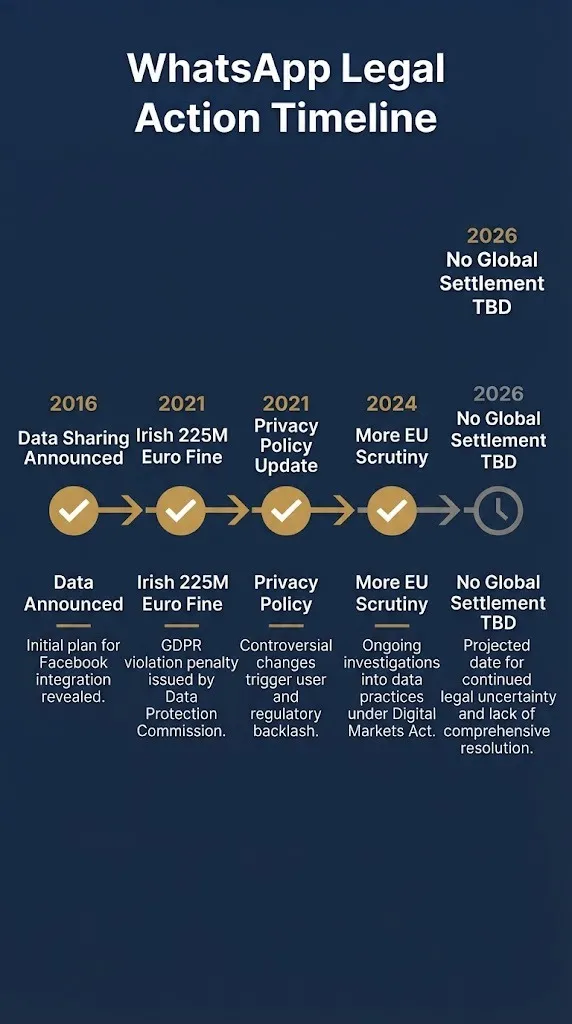
First, the European Union data protection actions. Ireland’s Data Protection Commission, which oversees WhatsApp because Meta’s European headquarters is in Dublin, has fined WhatsApp repeatedly under the General Data Protection Regulation. In 2021, the DPC fined WhatsApp 225 million euros for transparency violations. Additional scrutiny has continued through 2025 and 2026.
Second, consumer protection actions in the United States and elsewhere. The Federal Trade Commission has investigated Meta’s data practices for years. Some of those investigations touched WhatsApp data sharing.
Third, individual privacy class actions. These cases allege that WhatsApp violated wiretap laws, state privacy statutes, or consumer protection laws. Outcomes vary widely.
Fourth, content and moderation lawsuits. These cases involve claims about WhatsApp’s role in spreading harmful content or failing to moderate certain material. They rarely affect user payouts.
Key Takeaway: Most WhatsApp legal action is regulatory, not compensatory. Fines go to governments, not users.
Did the WhatsApp Privacy Fine in Europe Pay Users?
The WhatsApp privacy fines in Europe did not pay users directly. The Irish Data Protection Commission fine of 225 million euros went to the Irish government, not to individual WhatsApp users.
This is the single most misunderstood point in the WhatsApp legal conversation. A regulatory fine is a penalty paid to a government agency. It is not a settlement fund distributed to consumers.
In the United States, the same confusion surrounds FTC settlements. When the FTC settles with a company, the money may go to the U.S. Treasury or, in some cases, to a redress fund for consumers. The FTC has not created a broad WhatsApp user redress fund in 2026.
If you want to know whether any given WhatsApp legal action pays users, look for the words “claims administrator,” “claim deadline,” or “redress fund.” If those words are absent, users are not getting paid.
Reality Check: A regulatory fine against WhatsApp is not the same as a class action settlement. Fines go to governments. Settlements with a claims process go to users. Confusing the two is how scam ads trick people into handing over personal data.
What Was the WhatsApp Data Sharing Controversy?
The data sharing controversy started in 2016, when WhatsApp announced it would begin sharing user data with Facebook for advertising and product purposes. Before that, WhatsApp had promised users it would not share data with Facebook.
European regulators opened investigations. The Irish Data Protection Commission eventually found that WhatsApp violated GDPR transparency rules. The 225 million euro fine in 2021 was one result.
The data sharing practices changed over time. WhatsApp updated its privacy policy in 2021 to clarify how it shares data with Meta. That update triggered another wave of lawsuits and regulatory complaints, especially in India and Brazil.
The core allegation is consistent: WhatsApp said one thing about privacy and then did something else. Whether that rises to legal liability depends on the jurisdiction and the specific claim.
Key Takeaway: The data sharing controversy is about whether WhatsApp broke its privacy promises. Regulators said yes in Europe. User payouts still did not follow.
Are There Any WhatsApp Lawsuits That Actually Pay Users?
Some WhatsApp class actions have produced user payouts, but they are limited and case-specific. None has been a global settlement.
In the United States, a class action over WhatsApp’s use of facial recognition or biometric data could produce a settlement in the future, but none is confirmed in 2026. Illinois’ Biometric Information Privacy Act has produced large settlements against tech companies in other contexts, but no WhatsApp BIPA settlement has been finalized.
In Germany, consumer organizations have brought collective actions under the new German collective redress law. One case involving WhatsApp’s data practices is pending, but no payout has been approved.
In India, individual claims against WhatsApp over privacy have faced jurisdictional hurdles. Most have not resulted in user compensation.
The honest answer is that most WhatsApp legal actions do not pay individual users. They change corporate behavior or produce government fines. User compensation is the exception, not the rule.
Key Takeaway: User payouts from WhatsApp lawsuits are rare and limited. Do not assume a fine means money is coming to you.
How Do I Know If a WhatsApp Settlement Notice Is Real?
A real WhatsApp settlement notice names the court, the case number, the claims administrator, and the official settlement website. It explains the class definition, the claim deadline, and what proof you need to file.
A fake notice often lacks those details. It uses vague language like “eligible users may claim up to $500.” It asks for personal information upfront or charges a filing fee. It creates urgency without dates.
To verify a notice, search the case name in the court’s public docket. Check the claims administrator’s website independently. Do not click links in the notice itself.
Legitimate settlement notices do not ask for your password, your bank account password, or payment to file. Filing is always free.
What Is the Status of WhatsApp Privacy Class Actions in the United States?
Privacy class actions against WhatsApp in the United States have had mixed results. Some were dismissed for lack of standing or failure to state a claim. Others settled for injunctive relief, meaning WhatsApp changed its practices but did not pay users.
A notable case involved WhatsApp’s use of user phone numbers and contact lists. That case, filed in federal court in California, was dismissed in part and settled in part. The settlement did not create a broad user payout.
Another case alleging violations of state wiretap laws was dismissed. Appeals followed, but no final user compensation has been approved.
The U.S. legal landscape for privacy class actions is difficult for plaintiffs. Courts often require a showing of concrete harm, which is hard to prove in data sharing cases.
Key Takeaway: U.S. privacy class actions against WhatsApp have not produced a broad user payout in 2026. Most have been dismissed or settled for non-monetary relief.
What Is the Status of WhatsApp Legal Actions in India?
India is one of WhatsApp’s largest markets, and the legal pressure there is significant. The Indian government has pushed for message traceability, which WhatsApp has resisted. That dispute is about law enforcement access, not user payouts.
India’s antitrust regulator, the Competition Commission of India, has scrutinized WhatsApp’s data sharing and tied services. That action could result in fines, but those fines would go to the Indian government, not users.
Individual privacy claims in Indian courts have faced procedural challenges. India does not yet have a comprehensive data protection law in full force, though the Digital Personal Data Protection Act is being implemented in phases.
No Indian WhatsApp class action has produced a user payout as of September 2026.
Key Takeaway: India’s legal actions against WhatsApp are about regulatory power and market competition, not user compensation.
Could the FTC Ever Create a WhatsApp User Redress Fund?
The FTC has the authority to create consumer redress funds when it settles enforcement actions. Whether it will do so in a WhatsApp case depends on the facts and the settlement terms.
In other tech cases, the FTC has created redress funds. For example, the FTC’s settlement with Epic Games over Fortnite included refunds to affected users. A similar structure could theoretically apply to a WhatsApp case if the FTC proved consumer harm.
But no such FTC redress fund exists for WhatsApp users in 2026. The FTC’s cases against Meta have focused on other products and other harms, not primarily WhatsApp.
If the FTC ever announces a WhatsApp redress fund, it will appear on the FTC’s official website with a claims administrator, a deadline, and a claim form. Until then, any “FTC WhatsApp settlement” ad is false.
Key Takeaway: The FTC could create a WhatsApp redress fund someday, but none exists now. Check the FTC’s official site before believing any ad.
What Should I Do If I See a WhatsApp Settlement Ad?
Treat every WhatsApp settlement ad as unverified until you confirm it on a court docket or official administrator website. Do not click the ad. Do not enter your phone number, email, or any personal information.
Search the case name plus the word “court” or “docket.” Look for the claims administrator’s website. Check the FTC’s consumer alert page for known scams.
If the ad asks for money, it is a scam. If the ad promises a specific dollar amount, it is probably a scam. If the ad creates fake urgency, it is a scam.
The safest move is to ignore the ad and do your own research from official sources.
Key Takeaway: WhatsApp settlement ads are more likely to be scams than real opportunities. Verify before you act.
What Are the Most Common WhatsApp Scam Lawsuit Ads?
Scammers exploit the WhatsApp name because it is globally recognized. The most common fake ads promise a “WhatsApp class action settlement” of $500 or more per user.
Some fake ads use real case names but false claim links. Others invent cases that do not exist. They often use Meta’s logo or a fake court seal to look official.
The goal is usually identity theft or phishing. The fake claim form asks for your name, address, date of birth, phone number, and sometimes your bank account details or Social Security number.
No legitimate settlement asks for your Social Security number unless it is a tax reporting requirement, and even then, it is handled securely through the claims administrator, not an ad.
Key Takeaway: Fake WhatsApp settlement ads are phishing operations. They want your data or your money, not to give you money.
What Happens Next in WhatsApp Litigation?
The next stages in WhatsApp litigation are predictable in shape. More regulatory fines are likely in Europe as the Irish Data Protection Commission and other EU regulators continue their scrutiny.
In the United States, privacy class actions will continue to face standing challenges. Some may settle for injunctive relief. A user payout is possible but not confirmed.
In India, the data protection law rollout will create new legal obligations and likely new enforcement actions.
For users, the practical next step is to watch official sources. If a real settlement ever opens, it will be announced on court dockets and official administrator websites, not in social media ads.
Frequently Asked Questions
Is there a WhatsApp class action lawsuit in 2026?
Yes, but no global class action covers all users, and no broad user settlement exists.
Does the WhatsApp privacy fine pay users?
No. Regulatory fines like the 225 million euro Irish fine go to governments, not users.
Can I get money from a WhatsApp lawsuit?
Only if you are a member of a specific class action that settles with a user payout. None is confirmed in 2026.
Are WhatsApp settlement ads real?
Most are scams. Verify any ad on a court docket or official claims administrator website before acting.
What was the WhatsApp data sharing controversy about?
WhatsApp said it would not share data with Facebook, then changed its policy and began sharing data.
Has the FTC fined WhatsApp?
The FTC has investigated Meta broadly, but no WhatsApp-specific user redress fund exists in 2026.
What is the Irish Data Protection Commission fine?
Ireland fined WhatsApp 225 million euros in 2021 for GDPR transparency violations.
How do I report a fake WhatsApp settlement ad?
Report it to the FTC at its official complaint portal and to your state attorney general.
The single most important fact about WhatsApp lawsuits in 2026 is that most of them are regulatory actions, not user compensation cases. Fines go to governments. Settlements with payouts are rare and case-specific.
If you want to protect yourself, do not click settlement ads. Do not enter personal information on unverified websites. Check official sources before believing anything. The only legitimate payouts are announced on court dockets and official administrator websites, never in a social media ad.