California Victim Compensation Board 2026: How to Apply, What It Pays, and How Much You Can Get
Quick Answer
- CalVCB is a real state program that reimburses crime victims for expenses insurance does not cover, up to $70,000.
- The maximum you may qualify for is $70,000, but actual payment depends on your verified losses and other reimbursement sources.
- Victims generally have seven years from the crime date to file, but deadlines vary by incident and victim age.
What Is the California Victim Compensation Board?
The California Victim Compensation Board is a state agency that reimburses eligible crime victims for expenses directly related to a qualifying crime. It is not a lawsuit, not a settlement, and not a payout for pain and suffering. It is a government reimbursement program funded by state appropriations, criminal fines, and federal grants.
CalVCB pays for things like medical bills, mental health counseling, lost wages, funeral expenses, and relocation costs when those costs are not covered by insurance, workers’ compensation, or other sources. The program operates as the payer of last resort, meaning it fills gaps left by other coverage.
The agency is overseen by a board and operates under California Government Code sections 13920 and 13974. It processes thousands of claims each year and has specific rules about who qualifies, what gets reimbursed, and how long victims have to apply.
You can reach CalVCB by phone at 800-777-9229 or by email at [email protected]. Paper applications are available in 18 languages, including Arabic, Farsi, and Kurdish. The online application is available in English and Spanish.
How Much Can You Get from the California Victim Compensation Board?
The maximum CalVCB benefit is $70,000 per claim for most eligible expenses, but actual payment depends entirely on your verified losses. There is no standard payout. You get reimbursed for specific, documented expenses, up to the program limits.
CalVCB does not pay a lump sum. It pays bills and losses as they are verified and approved. Some categories have their own caps within the $70,000 total.
| Benefit Category | Maximum Amount |
|---|---|
| Total claim limit | $70,000 |
| Mental health counseling (general) | Depends on treatment plan and rates |
| Mental health counseling (sexual assault) | Up to $50,000 |
| Funeral and burial | Up to $12,818 |
| Relocation expenses | Up to $3,418 |
| Home security upgrades | Up to $1,000 |
| Crime scene cleanup | Up to $1,709 |
| Service dog veterinary or replacement | Up to $10,000 |
| Job retraining | Varies, within $70,000 total |
The limits above come from CalVCB’s published benefit tables and FAQ documents. Some caps are adjusted periodically for inflation. The $70,000 total is the hard ceiling for a single claim.
Not yet determined: Individual payout amounts vary so widely that no single average is meaningful. A victim with no insurance and significant medical bills may receive far more than a victim with full coverage. The program reimburses what other sources do not pay.
Who Qualifies for California Victim Compensation Board Benefits?
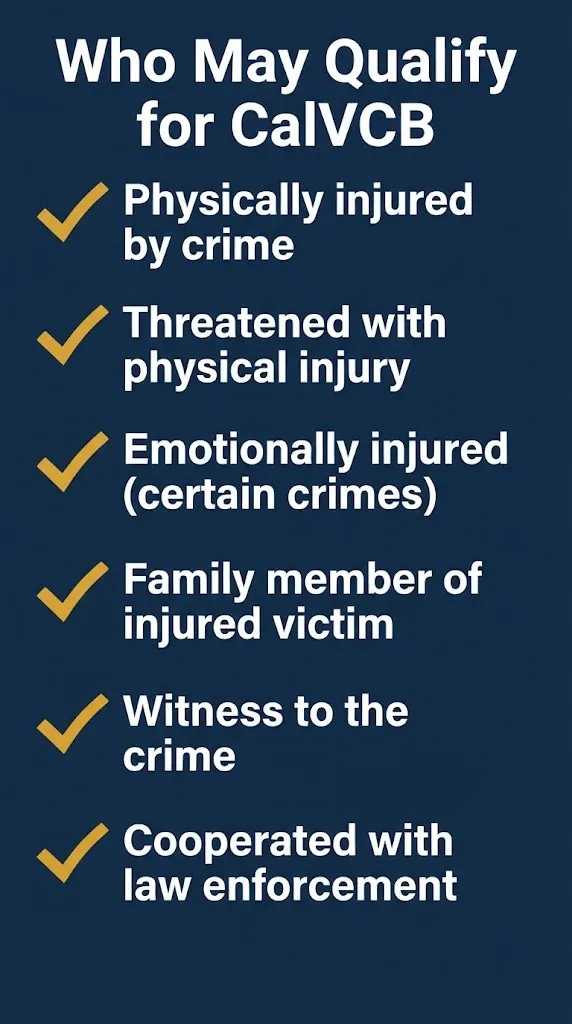
You may qualify if you were physically injured, threatened with physical injury, or emotionally injured by a qualifying crime in California. You must also cooperate with law enforcement and CalVCB, and you cannot have been involved in the events that led to the crime.
CalVCB’s eligibility rules are specific. The crime must have occurred in California, or the victim must be a California resident victimized elsewhere. The victim must report the crime to police, though exceptions exist for domestic violence, human trafficking, and sexual assault.
Direct victims qualify if they suffered physical injury, threat of physical injury, or death. Derivative victims also qualify, including spouses, registered domestic partners, children, parents, siblings, grandparents, and roommates. A person who voluntarily pays medical or funeral expenses for a deceased victim can also seek reimbursement.
There are disqualifying factors. You cannot receive payment while incarcerated, on parole or probation for a violent felony, or required to register as a sex offender. These restrictions pause payment during those periods but do not permanently bar eligibility.
Undocumented immigrants can apply. Immigration status does not affect CalVCB eligibility. A victim who was 21 or younger at the time of the crime has until their 28th birthday to file.
Key Takeaway: CalVCB eligibility hinges on cooperating with police, having a qualifying crime, and exhausting other reimbursement sources first.
How Do You Apply for California Victim Compensation Board Benefits?
You can apply online at CalVCB’s official application portal, by mail, or with help from a local Victim Witness Assistance Center. Filing is free. You do not need a lawyer to apply.
Here are the steps:
- Report the crime to law enforcement. Get a police report number if possible.
- Gather documentation. Police reports, medical bills, insurance explanation of benefits, and proof of lost wages.
- Fill out the application. Use the online portal or a paper form in one of 18 languages.
- Submit supporting documents. Attach bills, receipts, and verification of other payments.
- Cooperate with CalVCB. Respond to requests for more information promptly.
- Wait for a decision. CalVCB must act within 45 days unless the claim is complex or extended by agreement.
- Appeal if denied. You can request reconsideration or a hearing if the claim is rejected.
The application asks about the crime, your injuries, your expenses, and any other payments you have received or expect to receive. You must disclose insurance, workers’ compensation, civil settlements, and GoFundMe campaigns. CalVCB cannot pay for expenses already covered by another source.
If your claim is not acted on within 45 days, it is automatically deemed rejected under California Code of Regulations section 632.10. You can agree in writing to extend that deadline.
What Does the California Victim Compensation Board Cover?
CalVCB reimburses medical, dental, mental health, income loss, funeral, relocation, and other crime-related expenses that other sources do not cover. It does not pay for pain and suffering, property damage, or attorney fees.
Covered expenses include:
- Medical and hospital bills at CalVCB’s established rates
- Dental services, generally at 75% of billed charges
- Mental health counseling, with session limits set by treatment guidelines
- Income loss for victims disabled by the crime, up to five years in most cases
- Support loss for dependents who lost financial support due to the crime
- Funeral and burial costs, including culturally specific expenses like burial clothes and headstones
- Relocation costs for victims who must move for safety
- Home security upgrades like locks, alarms, and window repairs
- Crime scene cleanup for homes or vehicles
- Vocational retraining if the crime affected your ability to work
- Service dog veterinary care or replacement
- Human trafficking wage compensation, up to $10,000 per year of trafficking
What CalVCB does not cover:
- Pain and suffering
- Property damage or theft
- Court costs and attorney fees
- Expenses already paid by insurance, workers’ comp, or civil settlement
- Expenses incurred more than seven years ago, with some exceptions
- Costs while incarcerated or on parole for a violent felony
CalVCB is the payer of last resort. If you have health insurance, you must submit bills to your insurer first. CalVCB reimburses copays, deductibles, and uncovered amounts. If you later receive a civil settlement or insurance payment for expenses CalVCB already paid, you must repay CalVCB.
Reality Check: CalVCB does not send unsolicited emails or texts offering money. Scammers impersonate government agencies and quote specific award amounts or reference codes. CalVCB will never ask for your personal information over email. If you get a message like that, it is a phishing scam.
How Long Does the California Victim Compensation Board Take to Pay?
CalVCB must act on a claim within 45 days of submission, but complex claims can take longer. Payment timing after approval depends on the type of expense and whether providers bill directly.
The 45-day rule comes from California Code of Regulations section 632.10. If the board does not act in that window, the claim is automatically rejected unless you and the board agree in writing to an extension.
In practice, claims with complete documentation move faster. Claims missing police reports, bills, or insurance explanations of benefits get delayed. You can help by submitting everything at once.
Mental health providers and medical providers can bill CalVCB directly if they are registered with the program. That means you may not have to pay upfront and wait for reimbursement. Ask your provider if they bill CalVCB directly.
If you receive a civil settlement or insurance payout after CalVCB pays your bills, you must notify CalVCB and repay the overlapping amounts. This is not optional. CalVCB will seek reimbursement from any later recovery.
What Is the Deadline to File a California Victim Compensation Board Claim?
Most victims have seven years from the date of the crime to file an application. Victims who were 21 or younger at the time of the crime have until their 28th birthday. Some crimes and circumstances have different deadlines.
The seven-year rule applies from the crime date, or from the date the victim knew or should have known that an injury or death resulted from the crime. For the Islamic Center of San Diego shooting, victims have until May 18, 2033, because the incident occurred in 2026 and the seven-year window runs from that date.
Applications for expenses incurred more than seven years ago are generally denied. There are exceptions, but they are narrow.
If the crime occurred outside California but you are a California resident, you must apply in the state where the crime happened first. If that state’s program does not cover your expenses, CalVCB may help. You still need to file with CalVCB and provide documentation from the other state’s program.
Filing late is the most common reason claims get denied. Do not wait to gather every document before starting your application. You can amend it later.
What Happens Next: CalVCB Program Timeline
Ongoing through 2026: CalVCB continues processing claims and paying approved benefits. New applications are accepted daily.
July 1, 2026: The 2026-27 Trauma Recovery Center grant cycle began, funded by a $12.5 million General Fund appropriation. Grants run through June 30, 2028.
Expected late 2026: CalVCB may adopt proposed regulations on mental health benefits and direct payments to providers, which could affect future claim processing.
Pending legislation: Assembly Bill 2297 would require courts to order restitution when defendants participate in diversion programs. Assembly Bill 2247 would create a youth trauma pilot program in four counties. Both bills are moving through the Legislature.
No sunset date: CalVCB is a permanent state program. It does not expire.
Frequently Asked Questions
Is the California Victim Compensation Board legitimate?
Yes. CalVCB is a real California state agency funded by the government. It has processed victim compensation claims for decades. You can verify it through the official state website and by calling 800-777-9229.
How much money can I get from CalVCB?
The maximum is $70,000 per claim for most expenses. Mental health counseling for sexual assault victims can reach $50,000. Actual payment depends on your verified losses and what other sources cover.
Do I need a lawyer to apply for CalVCB?
No. Filing is free, and you can complete the application yourself. Victim Witness Assistance Centers can help you fill out forms at no cost. A lawyer is only useful if you are also pursuing a civil claim against the perpetrator.
Can I get CalVCB money and a civil settlement?
Yes, but CalVCB is the payer of last resort. If you receive a civil settlement later, you must repay CalVCB for any expenses it covered that the settlement also compensates. You cannot double-recover.
What crimes qualify for CalVCB?
Qualifying crimes include physical assault, domestic violence, sexual assault, homicide, robbery, human trafficking, child abuse, and any crime that results in physical injury or threat of physical injury. Emotional injury qualifies for certain crimes.
How long does it take to get paid?
CalVCB must act on your claim within 45 days. Payment after approval depends on the expense type. Providers who bill directly may get paid faster. Reimbursement checks to victims typically arrive within weeks of approval.
Can undocumented immigrants apply for CalVCB?
Yes. Immigration status does not affect eligibility. CalVCB does not report applicants to immigration authorities.
What if my CalVCB claim is denied?
You can request reconsideration or appeal. The denial notice explains your options. You can also contact the CalVCB Ombudsperson if you believe the agency did not follow its own rules.
The most important thing is to apply within seven years of the crime and to document every expense. Gather your police report, bills, and insurance statements. Submit the application before the deadline passes. If you are unsure whether you qualify, call CalVCB at 800-777-9229 and ask.