Is the Tea App Lawsuit Real?
Quick Answer
- The Tea app lawsuit is real: a consolidated federal case (No. 3:25-cv-06321) is active in the Northern District of California.
- Payout amounts are not yet determined; no settlement fund or administrator exists as of this writing.
- No claim deadline exists yet because there is no settlement; the court was weighing a motion to dismiss with briefing due July 1, 2026.
If you downloaded Tea, uploaded a selfie or ID, or sent messages on the app before the summer of 2025, you’ve probably seen the headlines and wondered if you’re owed anything. Right now, the honest answer is: maybe, eventually, but not yet. This article breaks down exactly what’s confirmed in court records, what’s still speculation floating around other sites, and what to actually do while you wait.
The Facts
| Case | In Re: Tea Dating Advice Data Breach Litigation |
| Court | U.S. District Court, Northern District of California |
| Case Number | 3:25-cv-06321 |
| Status | Pretrial, motion to dismiss pending, no class certified |
| Fund Size | Not yet confirmed |
| Est. Per Person | Not yet determined |
| Claim Deadline | None yet, no settlement exists |
| Administrator | Not yet appointed |
| Proof Needed | Not yet applicable, check the official court docket for updates |
Tea is a women-only dating safety app that launched in 2023 and lets verified users anonymously post about men they’ve dated, including background check results and warnings. It went viral in July 2025, briefly topping the Apple App Store charts. Within days, that popularity turned into a security disaster, and the lawsuits followed almost immediately.
Is the Tea App Lawsuit Real?
Yes, the Tea app lawsuit is a real, active federal case, not internet rumor. Plaintiffs first sued in late July 2025, and the litigation is still moving through the courts in 2026.
The lead case, filed by plaintiff Griselda Reyes, landed in the Northern District of California on July 28, 2025. Within about two weeks, at least ten separate class actions had been filed in federal and state courts around the country.
Courts later folded the federal cases together into one consolidated docket. That consolidated case, formally titled In Re: Tea Dating Advice Data Breach Litigation, carries case number 3:25-cv-06321 and is assigned to U.S. District Judge William H. Orrick.
Key Takeaway: The Tea app lawsuit is a confirmed, court-verified case, but it has not reached a settlement, so any site quoting a specific payout figure right now is guessing.
Is Tea Dating Advice Being Sued Right Now?
Tea Dating Advice, Inc. is currently a defendant in active federal litigation, along with several related companies and individuals. The consolidated complaint names Tea Dating Advice, Inc. itself, plus entities including Super Unlimited Inc., K Investment Management Co LLC, WC Investor Three Holdings LLC, an individual identified as Benjamin Perlmutter, and X Corp (the company formerly known as Twitter).
Twenty-one anonymous plaintiffs, filed under Jane Doe pseudonyms to protect their identity given the sensitive nature of the leaked data, joined Griselda Reyes in a consolidated class action complaint filed December 23, 2025.
Separately, individual men who were the subject of posts on Tea have filed their own defamation-style suits against the company. Those are different cases with different legal theories, and they are not part of the data breach class action covered here.
How Much Money Could Tea App Users Get?
Not yet determined. No settlement fund exists, so there is no confirmed per-person payout figure for the Tea app lawsuit as of August 2026.
Any number you see elsewhere quoting a specific dollar figure, a total fund size, or a “typical payout” for this case is not sourced to a court filing or settlement notice. It’s a projection, and projections are not money.
That said, data breach class actions of this size do have comparable outcomes worth understanding:
| Comparable Data Breach Case | Outcome |
|---|---|
| T-Mobile 2022 breach (MDL 3073) | Settled for hundreds of millions after years of litigation |
| Change Healthcare breach (MDL 3108) | Still in litigation, no final payout figures yet |
| Various regional data breach suits | Typical per-claimant range has spanned roughly $25 to a few hundred dollars for basic claims, more for documented identity theft losses |
Those figures come from other, unrelated cases and are shown only for context. They tell you nothing about what Tea plaintiffs will eventually receive, if anything.
Is There a Tea App Settlement Amount Yet?
No. As of the most recent public docket activity, the case has not reached a settlement, so there is no fund size, no payout tier, and no settlement website taking claims.
The company has instead moved to dismiss the case. In a motion filed around January 30, 2026, Tea’s lawyers argued that plaintiffs relied on “speculative future harms” that don’t count as concrete legal injury, and separately contested whether an exposed driver’s license number even qualifies as a protected “motor vehicle record” under federal privacy law.
Judge Orrick has since reset the briefing schedule on that motion more than once. The most recent order on record set a deadline of July 1, 2026 for plaintiffs to respond or seek leave to amend their complaint. Until that motion is resolved, there is no path to a settlement, a class certification, or a payout.
Reality Check: No one texts you first about Tea app settlement money, because no settlement exists yet. Filing a claim in any real class action is always free, and anyone charging you an upfront fee to “register” you for this case is not a legitimate settlement administrator.
Who Qualifies for the Tea App Lawsuit?
You may be part of the affected group if you created a Tea account and your information was caught in one of the 2025 breaches, though a formal certified class does not exist yet. The company has said the exposed dataset primarily involved users who signed up before February 2024.
Based on the consolidated complaint and breach investigations, here’s who court filings and security researchers say was affected:
- Users who submitted a selfie or government-issued ID during Tea’s identity verification process before February 2024
- Users whose direct messages were part of the roughly 72,000 images and more than a million private messages exposed in the breaches
- Users who received a direct breach notification email from Tea
- Illinois residents whose biometric data (used for identity verification) was collected without the written consent required under state law
Key Takeaway: Being a Tea user before the breach doesn’t automatically make you a class member with a payout coming; it makes you a potential class member in a case that hasn’t reached that stage yet.
How Do I Join the Tea App Lawsuit?
Right now, there is no claim form to fill out, because there is no settlement. What you can do instead is protect your position and stay informed for when that changes.
- Check whether you received a direct breach notification email from Tea.
- Save any evidence you signed up before February 2024, such as account confirmation emails.
- Document any actual harm, including identity theft attempts, phishing, or harassment tied to leaked data.
- Consider a free consultation with a consumer privacy attorney if you want individual legal advice.
- Watch official court dockets and reputable legal news outlets rather than social media rumors.
- Do not pay any company or individual claiming they can “register” you for compensation right now.
A useful comparison: this stage is a lot like waiting on an insurance claim before the adjuster has even inspected the damage. There’s a real process underway, but nobody can hand you a check until it runs its course.
Do I Need a Lawyer to File a Claim?
You do not need your own lawyer to eventually be included in a class action settlement, if and when one happens. Class members are typically represented automatically by the plaintiffs’ attorneys already litigating the case, unless they choose to opt out.
If your personal losses from the breach are unusually severe, such as documented identity theft or financial fraud tied directly to the leaked Tea data, an individual consultation with a privacy attorney can help you understand whether pursuing your own claim, separate from the class, makes more sense. That’s a personal decision with tradeoffs on both sides, not something this article can tell you to do.
What Is the Current Status of the Tea App Case?
The case is in the pretrial motion phase, with Tea Dating Advice’s motion to dismiss still pending as of the latest available court record. No class has been certified, and no trial date has been set.
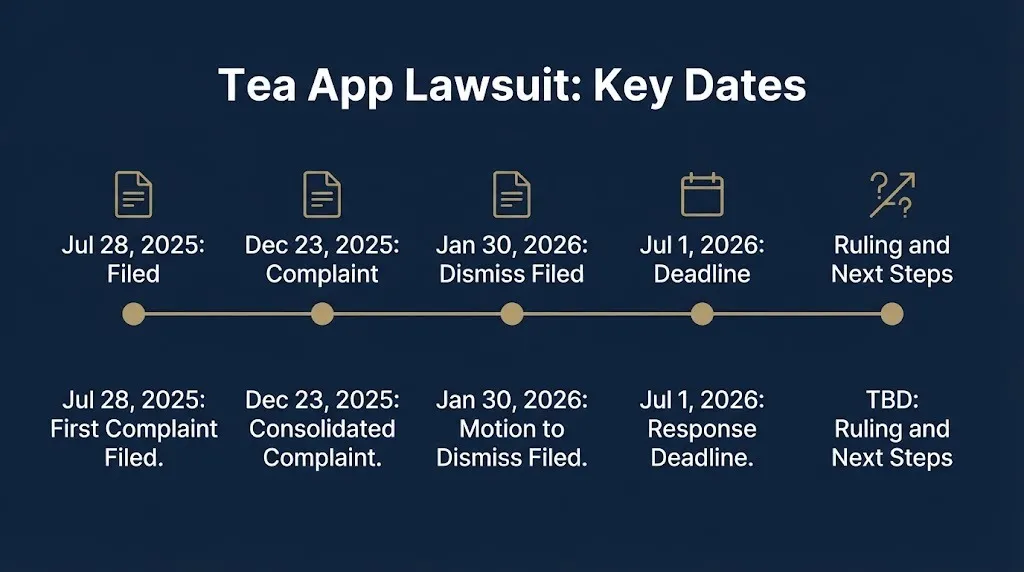
Here’s the confirmed procedural timeline based on the federal docket:
| Date | Event |
|---|---|
| July 28, 2025 | Griselda Reyes files the first federal complaint |
| August 7, 2025 | Ten class action lawsuits filed nationwide |
| December 23, 2025 | Consolidated class action complaint filed with 21 additional Jane Doe plaintiffs |
| January 30, 2026 | Tea Dating Advice files motion to dismiss |
| February 6, 2026 | Judge Orrick signs stipulated protective order |
| June 1, 2026 | Court resets deadline, response to motion to dismiss due July 1, 2026 |
Key Takeaway: As of mid-2026, the case is still fighting over whether it survives a motion to dismiss, a step that comes well before any class certification or settlement talks.
When Will the Tea App Lawsuit Settle?
There is no confirmed settlement timeline, and any specific prediction you read elsewhere is speculation, not fact. Data breach class actions of this size and complexity, involving multiple corporate defendants and overlapping breach incidents, commonly take one to three years or longer to reach a settlement after the motion to dismiss stage.
Given that the motion to dismiss was still being briefed into the second half of 2026, a resolution before late 2026 or into 2027 looks unlikely, though the court could move faster or slower depending on the ruling. Watch for a ruling on the motion to dismiss as the next real signal of where this case is headed.
What Happened in the Tea App Data Breach?
The Tea app suffered at least two distinct security failures in July and August 2025 that exposed sensitive user data to the public internet. The first involved an unsecured “legacy” database that hackers, reportedly organized through the imageboard 4chan, discovered and began publicly dumping.
That initial breach exposed roughly 72,000 images, including selfies and government ID photos submitted for identity verification, plus additional images pulled from user posts, comments, and direct messages. A second, separate vulnerability, tied to a lack of database encryption, reportedly exposed more than 1 million private messages between users.
Plaintiffs allege Tea had promised to delete verification ID images immediately after processing them, a claim the breach appeared to contradict. The consolidated complaint raises claims of negligence, breach of implied contract, failure to secure user data, and violations of the California Consumer Privacy Act, which allows for statutory damages without proof of individualized harm.
In October 2025, Apple removed Tea from the App Store, citing complaints and privacy standard failures, including concerns about exposed minors’ data.
Who Is Being Sued in the Tea App Lawsuit?
Beyond Tea Dating Advice, Inc. itself, the consolidated complaint names several related companies and one named individual as defendants. That includes Super Unlimited Inc., K Investment Management Co LLC, WC Investor Three Holdings LLC, Benjamin Perlmutter, and X Corp.
The inclusion of multiple corporate entities points to questions about Tea’s ownership and investment structure, and whether any of those related companies bear responsibility for security decisions. X Corp’s presence in the case stems from separate claims tied to how leaked content spread on that platform after the breach.
What Is the Illinois Biometric Lawsuit Against Tea?
A separate set of lawsuits filed in Illinois accuses Tea of violating the state’s Biometric Information Privacy Act (BIPA) by collecting facial verification data without the written consent and public retention policy the law requires. This case runs on a different legal track from the California federal consolidation.
BIPA is one of the strictest biometric privacy laws in the country and allows for statutory damages per violation, which is part of why Illinois biometric cases against major tech platforms have historically produced some of the largest privacy settlements in the country. No ruling or settlement has been confirmed in the Illinois Tea litigation as of this writing.
Are There Lawsuits From Men Featured on Tea?
Yes, separately from the data breach case, individual men who were the subject of posts on Tea have filed their own lawsuits, generally alleging defamation rather than a privacy breach. These cases are not part of the consolidated data breach class action.
One example: a North Carolina man sued after posts on Tea accused him of coercing women into sex trafficking, which he denies. A trial court dismissed that case in November 2025, citing Communications Decency Act immunity, which generally protects platforms from liability for user-posted content. That dismissal was scheduled for an appeal hearing before the North Carolina Court of Appeals in August 2026.
Key Takeaway: The Tea app is facing two very different kinds of lawsuits at once: data breach claims from users whose information leaked, and defamation claims from men who say posts about them were false.
What Happens Next
July 1, 2026: Deadline for plaintiffs to respond to Tea’s motion to dismiss or seek leave to amend their complaint, per the court’s most recent scheduling order.
Expected, following that filing: Judge Orrick rules on the motion to dismiss, which determines whether the case proceeds to discovery or gets narrowed.
Expected, if the case survives dismissal: Discovery phase, followed by a motion for class certification, a step that typically takes many months in cases this size.
Expected, only if a settlement is reached: Announcement of a settlement fund, appointment of a claims administrator, and a public claim filing period with a real deadline.
TBD: Resolution of the separate Illinois BIPA litigation and the North Carolina defamation appeal, both running on independent timelines.
Frequently Asked Questions
Is the Tea app lawsuit a scam?
No, the underlying federal case is real and verifiable through public court records.
Scam risk mostly comes from third parties falsely claiming to process claims or charging fees before any settlement exists.
Has Tea Dating Advice admitted fault?
No formal admission of fault has been confirmed in court filings reviewed for this article.
The company has instead moved to dismiss the case, arguing plaintiffs’ claimed harms are too speculative.
How many people were affected by the Tea app breach?
Reports describe roughly 72,000 images and more than 1 million private messages exposed across two separate incidents.
An exact confirmed count of affected individual users has not been established in the public docket.
Is Tea app still available to download?
Apple removed Tea from its App Store in October 2025.
Other download sources and availability may vary and are not confirmed here.
Will everyone who used Tea get money?
Not necessarily, and only if the case reaches a settlement or a favorable trial verdict.
Even then, eligibility criteria and proof requirements will be set by the eventual settlement terms, not guaranteed for every past user.
What’s the difference between the data breach case and the defamation lawsuits?
The data breach case is about Tea’s security failures exposing user data.
The defamation lawsuits are separate, individual cases from men who say posts about them on the app were false.
Where can I check for real updates on this case?
The federal court’s public docket for case 3:25-cv-06321 in the Northern District of California is the authoritative source.
Established legal news outlets that cite specific court filings are a reliable secondary source.
Do I need to do anything right now?
There is nothing to file yet, since no settlement or claims process exists.
Saving your account records and any evidence of harm now will help if a settlement process opens later.
The single most useful thing you can do right now is keep records, not chase rumors. Bookmark the federal docket for case 3:25-cv-06321 and check back after the July 1, 2026 filing deadline passes.
No claim form exists yet, and the next real milestone is a court ruling on the motion to dismiss, not a payout.