Harvard Lawsuit 2026: Every Active Case Against and By the University, Explained
Quick Answer
- This is real, ongoing federal litigation, not a consumer settlement: Harvard sued the Trump administration and the administration sued back on separate fronts.
- There is no individual payout tied to these government cases; the only cash settlement in Harvard’s 2026 legal news is a separate $53 million class action over stolen body parts at Harvard Medical School.
- The most consequential date to watch is the First Circuit Court of Appeals ruling on the $2.7 billion funding freeze case, still pending as of early September 2026.
You will not find a claim form for “the Harvard lawsuit.” That phrase actually covers several separate federal cases running in parallel since 2025.
The one with the most money at stake is Harvard’s suit against the federal government over frozen research funding. A judge already ruled for Harvard once. The government appealed, and that appeal is still open.
This article breaks down each active case, what has been decided, what has not, and the dates that actually matter if you are a student, employee, researcher, or just trying to follow the story accurately. One surprising fact most coverage buries: a federal judge already threw out one of the government’s own lawsuits against Harvard, and the Justice Department is now appealing that dismissal too.
The Facts
| Case | Harvard v. U.S. Dept. of Health and Human Services (funding freeze); separately, U.S. v. Harvard (Title VI antisemitism suit, dismissed); separately, Harvard v. DHS (SEVP/international students, resolved by injunction) |
| Status | Funding case on appeal at the First Circuit; antisemitism case dismissed August 13, 2026, now on appeal; SEVP case resolved through court-ordered injunctions in 2025 |
| Fund Size | Not applicable, these are not class settlements. Roughly $2.7 billion in research funding is the amount at stake in the main funding case |
| Est. Per Person | Not applicable, no individual claims process exists in these government cases |
| Claim Deadline | Not applicable. Separately, the unrelated $53 million Harvard body parts theft settlement has a claims process moving through court, with deadlines not yet confirmed for the general public |
| Administrator | Not applicable to the government cases |
| Proof Needed | Not applicable, no personal claim to file |
Is the Harvard lawsuit real, or a scam text?
It’s real, and it’s federal court litigation, not a text message scam. There is no “Harvard lawsuit payout” text that would ever be legitimate, because these are institutional disputes between Harvard and federal agencies.
If you got a text or email claiming you’re owed money from “the Harvard lawsuit,” it almost certainly is not describing this case. Real class settlements come from official case administrator sites, never a random text asking you to click a link.
The only Harvard-related matter in 2026 involving individual payouts is the Harvard Medical School morgue body parts theft settlement, a $53 million class action tied to a 2023 criminal case, and even that has its own separate, verified claims process.
Key Takeaway: The “Harvard lawsuit” people search for in 2026 is a set of government-versus-university cases, not a consumer class action, so there is no personal claim form to fill out.
What is the Harvard lawsuit actually about?
The core dispute is the Trump administration’s decision to freeze roughly $2.2 to $2.7 billion in federal research funding to Harvard starting in April 2025. The administration said it acted over concerns about campus antisemitism and diversity practices. Harvard sued, calling the freeze retaliation for refusing a list of government demands.
Those demands, sent to Harvard in April 2025, asked the university to change academic departments, alter hiring practices, adopt an outside “viewpoint audit,” and eliminate diversity, equity, and inclusion programs. Harvard refused. Days later, the funding freeze followed.
A second, separate track involves international students. In May 2025, the Department of Homeland Security revoked Harvard’s certification to host foreign students under the Student and Exchange Visitor Program. Harvard sued immediately and won emergency court protection the same day.
A third track is the government’s own Title VI lawsuit against Harvard, filed in March 2026, alleging the university failed to protect Jewish students. That case was dismissed in August 2026 and is now being appealed by the Justice Department.
Who is affected by the Harvard funding freeze case?
Harvard researchers, graduate students, and staff whose work depends on federal grants are the ones most directly affected. More than 6,800 international students, about 27 percent of Harvard’s total enrollment, were also caught up in the separate SEVP fight.
Who is impacted, by category:
| Group | How they were affected |
|---|---|
| Federally funded researchers | Grants were terminated starting April 2025, later reinstated after Harvard’s September 2025 court win |
| International students | Faced possible loss of legal status when SEVP certification was revoked in May 2025 |
| Faculty and administrators | Targeted by the administration’s list of governance and hiring demands |
| Jewish and Israeli students | Central to the now-dismissed Title VI antisemitism lawsuit |
Amicus briefs filed in the appeal show how far this reaches beyond Harvard. More than 30 universities, including Stanford, MIT, Yale, and the University of Chicago, filed briefs backing Harvard’s position at the First Circuit.
How much money is at stake in the Harvard lawsuit?
Not yet determined in the sense of a final number, because the case is still on appeal. The figure most consistently cited across court filings and news coverage is roughly $2.7 billion in federal research funding that was frozen, then restored by a district court, and is now the subject of the government’s appeal.
There is no per-person payout in this case. It is institutional funding, not consumer compensation.
Amounts by case, as verified:
| Case | Dollar figure | Status |
|---|---|---|
| Research funding freeze | Approximately $2.7 billion | Restored by district court in October 2025; funding freeze appeal pending |
| Title VI antisemitism suit | Nearly $1 billion in funding the government sought to claw back | Dismissed August 13, 2026; now on appeal by DOJ |
| Harvard Medical School body parts settlement (separate matter) | $53 million | Agreed August 2026, pending court approval |
Reality Check: No one texts you to say you’re owed part of a university funding settlement, and there is no fee-based “claim helper” that can get you a payout here, because there is no individual claims process tied to the Harvard-versus-government funding case. If anyone asks you for money to file a claim in “the Harvard lawsuit,” it’s not connected to any of the real litigation described in this article.
What did the judge rule in the Harvard funding case?
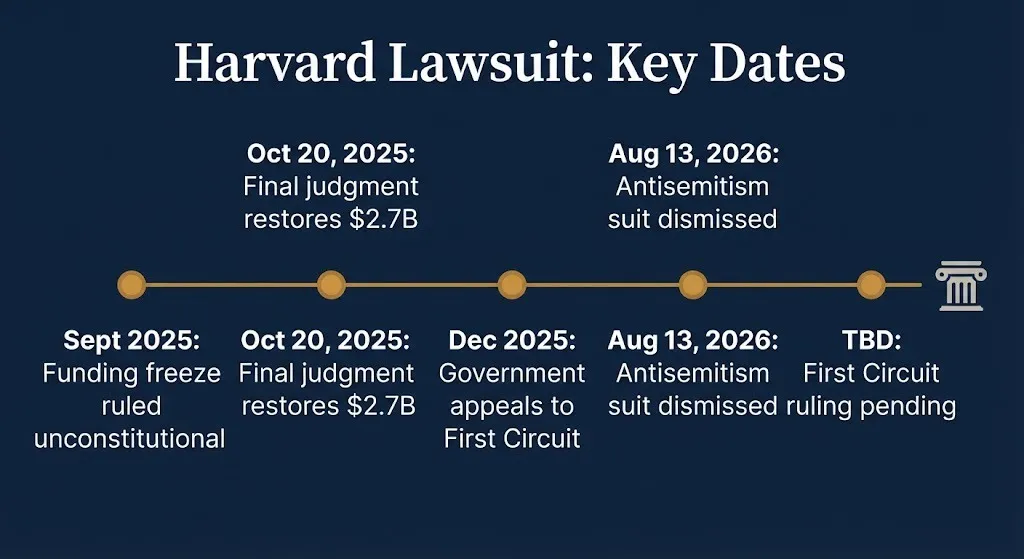
U.S. District Judge Allison Burroughs ruled for Harvard in September 2025, finding the funding freeze unconstitutional. She issued her final judgment on October 20, 2025, permanently blocking the government from enforcing the freeze orders.
Burroughs found the cuts were retaliatory, aimed at punishing Harvard for exercising First Amendment rights, and that the administration bypassed the formal process Title VI requires before pulling federal funds over discrimination claims.
The administration reinstated most of the frozen grants after the ruling. It then filed a notice of appeal in December 2025, right before its 60-day deadline expired.
Key Takeaway: Harvard already won the funding fight once at the district court level, and the money was restored, but the government’s appeal means the final legal outcome is still unresolved as of September 2026.
What is the Harvard antisemitism lawsuit and why was it dismissed?
The Justice Department’s Title VI lawsuit against Harvard, filed in March 2026, alleged the university failed to protect Jewish and Israeli students from discrimination after the October 7, 2023 Hamas attack triggered a wave of campus protests.
U.S. District Judge Richard G. Stearns dismissed the case on August 13, 2026. He found the incidents the government cited were, in his words, “too isolated and episodic” to prove Harvard was continuously violating civil rights law.
Stearns also found the government failed to show Harvard violated the law after it received formal notice of the allegations in June 2025, which Title VI requires before that kind of enforcement action.
The Justice Department appealed the dismissal on August 27, 2026, asking the First Circuit to revive the case. That appeal is separate from, but related to, the larger funding freeze appeal moving through the same court.
What happened with Harvard’s international students and the SEVP case?
Harvard’s ability to host international students is currently protected by federal court injunctions issued in 2025, and no ruling has reversed that protection as of September 2026.
The Department of Homeland Security revoked Harvard’s SEVP certification on May 22, 2025, citing the university’s handling of campus antisemitism and its response to DHS records requests. Harvard sued the next day.
A federal judge issued a temporary restraining order within hours, then a longer injunction blocking the revocation. A second injunction in June 2025 blocked a related presidential proclamation that tried to restrict entry for Harvard student visa holders.
Timeline of the SEVP dispute:
- April 16, 2025: DHS requests five years of disciplinary records on international students.
- May 22, 2025: DHS revokes Harvard’s SEVP certification.
- May 23, 2025: Harvard sues; a judge issues an immediate restraining order.
- June 4, 2025: A separate presidential proclamation tries to restrict visa entry for Harvard students.
- June 23, 2025: A judge blocks the proclamation with a preliminary injunction.
- Ongoing: Both injunctions remain in place, and Harvard continues enrolling international students.
Is there a Harvard admissions records lawsuit too?
Yes, and it is separate from the funding and antisemitism cases. The Justice Department sued Harvard on February 13, 2026, accusing the university of withholding admissions data needed to check compliance with the Supreme Court’s 2023 ban on race-conscious admissions.
The lawsuit does not accuse Harvard of discrimination directly. It seeks to compel document production, including years of individual-level applicant data covering race, test scores, and admissions outcomes.
Harvard moved to dismiss the records lawsuit, arguing the request is overly broad and burdensome. That motion was pending as of the middle of 2026, with no ruling confirmed yet.
Is the Harvard body parts settlement connected to these lawsuits?
No. The $53 million Harvard Medical School settlement is a completely separate matter, unrelated to the funding freeze, antisemitism suit, or admissions case.
That settlement, announced in August 2026, resolves a class action tied to the 2023 discovery that a former HMS morgue manager, Cedric Lodge, stole and sold body parts donated for research between 2018 and 2022. Families of donors are the class affected by that case, not the general public or Harvard students.
If you are searching specifically for that case’s claim process, deadlines and payout tiers were not yet confirmed in the sources checked for this article, and readers should watch the official settlement website tied to that specific litigation, separate from anything described above.
Key Takeaway: “Harvard lawsuit” news in 2026 spans at least four unrelated legal fights, and mixing them up is the single most common mistake in search results right now.
What does university autonomy mean in this case?
University autonomy, in this context, means Harvard’s ability to set its own hiring, curriculum, and admissions policies without the federal government using funding threats as leverage.
Judge Burroughs’ September 2025 ruling framed the funding freeze as government overreach into that autonomy, not a legitimate Title VI enforcement action. The government’s appeal argues the opposite: that federal agencies can attach conditions to funding based on shifting priorities, without going through Title VI’s formal process first.
This is the legal question the First Circuit will ultimately decide, and it carries weight far beyond Harvard, since the outcome could set precedent for how the federal government can use research funding as pressure on any university.
How much has this cost Harvard so far?
Exact litigation costs are not yet confirmed in public court filings or verified reporting. What is confirmed: Harvard temporarily lost access to roughly $2.7 billion in research funding for several months in 2025 before the funding was restored following the September ruling.
Harvard also drew on its own reserves and announced budget measures in 2025 to cover research gaps while the freeze was in effect, though specific dollar figures for those internal measures were not independently verified for this article.
What happens next in the Harvard lawsuit?
- Pending, no set date: First Circuit Court of Appeals ruling on the $2.7 billion funding freeze case, following the government’s appeal filed in December 2025 and its comprehensive brief filed in April 2026.
- Pending, no set date: First Circuit review of the Justice Department’s appeal of the dismissed Title VI antisemitism lawsuit, filed August 27, 2026.
- Pending in district court: Harvard’s motion to dismiss the admissions records lawsuit, filed after the case was expanded in May 2026.
- Ongoing: SEVP and student visa injunctions remain in effect, with no confirmed date for a final resolution of that underlying case.
- Separate track, pending court approval: The $53 million Harvard Medical School body parts settlement awaits final court sign-off, following preliminary approval proceedings in August 2026.
Frequently Asked Questions
Is the Harvard lawsuit against Trump or is Trump suing Harvard?
Both are happening at once, in different cases.
Harvard sued the administration over the funding freeze and the SEVP revocation.
The Justice Department separately sued Harvard over antisemitism compliance and over admissions records.
How much money did Harvard get back from the government?
Roughly $2.7 billion in previously frozen research funding was restored after the district court’s September 2025 ruling.
That restoration is not final, because the government’s appeal at the First Circuit is still pending.
Did Harvard win its lawsuit against the Trump administration?
Harvard won at the district court level on the funding freeze in September 2025, and won emergency protection for international students in 2025.
The antisemitism lawsuit brought by the government against Harvard was also dismissed in Harvard’s favor in August 2026.
All three outcomes are being appealed, so nothing is legally final yet.
Can international students still attend Harvard in 2026?
Yes, current court injunctions from 2025 remain in effect, protecting Harvard’s SEVP certification and blocking the related visa entry proclamation.
No ruling as of September 2026 has reversed that protection.
Is there a settlement fund for Harvard students or employees?
No, none of the four government-related lawsuits described here involve an individual claims process or settlement fund for students or employees.
The only cash settlement tied to Harvard right now is the unrelated $53 million body parts theft class action.
When will the First Circuit rule on the Harvard funding case?
Not yet confirmed. No official ruling date has been announced as of early September 2026, and legal observers have suggested a decision could land anywhere from late 2026 into 2027.
Why was the government’s antisemitism lawsuit against Harvard dismissed?
A federal judge found the incidents the government cited were too isolated to prove an ongoing, uncorrected civil rights violation under Title VI.
The judge also found the government failed to show new violations occurred after Harvard received formal legal notice in June 2025.
Who is supporting Harvard in the appeal?
More than 30 universities filed amicus briefs backing Harvard’s position, including Stanford, MIT, Yale, and the University of Chicago.
Some outside groups, including Hillel International, initially filed supporting briefs before internal reviews led at least one organization to withdraw its brief in mid-2026.
If you are following this case because it affects your funding, enrollment, or research position at Harvard or another university, the First Circuit’s eventual ruling is the date to watch. Check official court dockets and Harvard’s own public statements rather than social media summaries for anything claiming a final resolution.