Website Accessibility Lawsuits 2026: What the Data Actually Shows
Quick Answer
- Website accessibility lawsuits are real and growing: 3,117 were filed in federal court in 2025, up 27% from 2024.
- Settlements are individually negotiated, not a shared fund. Demand-letter cases often settle for $5,000 to $25,000.
- There is no single deadline. Each business faces its own demand letter or complaint on its own timeline.
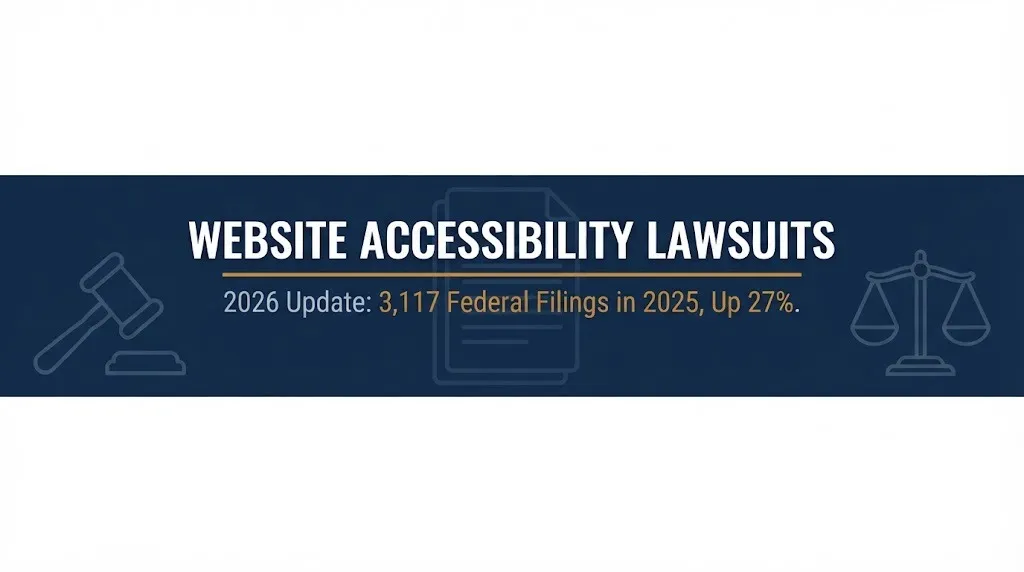
If you got a demand letter or a lawsuit notice about your website, you are not imagining a trend. Website accessibility lawsuits climbed to 3,117 federal filings in 2025, according to law firm Seyfarth Shaw’s annual tracking of court dockets.
That’s a real and measurable jump, not internet noise. Plaintiffs’ firms filed those suits under Title III of the Americans with Disabilities Act, arguing that blind or low-vision users could not use certain websites with screen readers.
This article breaks down the verified filing numbers, what settlements actually cost, and the federal case where the Department of Justice just pushed back on a class settlement it called unfair to the very people it was supposed to help.
The Facts
| Featured Case | Alcazar v. Fashion Nova, Inc., N.D. Cal., plus thousands of individual ADA Title III filings nationwide |
| Status | Active and rising: 3,117 federal website accessibility filings in 2025 |
| Fund Size | Not applicable. There is no shared settlement fund. Cases settle individually |
| Est. Per Case | Demand-letter stage: roughly $5,000 to $25,000. Litigated cases: $25,000 to $75,000 or more |
| Claim Deadline | Not applicable. These are individual demand letters and lawsuits, not a claims-made class settlement |
| Administrator | Not applicable. Each case has its own plaintiff’s firm and defense counsel |
| Proof Needed | A plaintiff generally must show they tried to use the site and were blocked by a disability-related barrier |
Are website accessibility lawsuits real?
Yes. Website accessibility lawsuits are a verified and growing category of federal litigation, not a scam or a myth.
Courts have been hearing these cases since at least 2017. Federal filings totaled 814 that year and climbed to 3,117 by 2025, according to Seyfarth Shaw’s ADA Title III tracking.
Multiple federal courts, including the Ninth Circuit in Robles v. Domino’s Pizza, have ruled that a business’s website can count as a “place of public accommodation” under the ADA if it’s tied to physical goods or services. That’s the legal hook plaintiffs use.
Not every circuit agrees. The Eleventh Circuit ruled differently in Gil v. Winn-Dixie, creating a real split in how courts around the country treat these claims.
Key Takeaway: Website accessibility lawsuits are a documented, growing category of federal litigation built on a real, if legally contested, reading of the ADA.
Is my business actually required to make its website accessible?
There’s no single federal regulation that spells out exact website accessibility rules for private businesses, and that gap is part of why lawsuits keep happening.
The ADA itself never mentions websites. It was written in 1990, years before online shopping existed in its current form. Courts have filled that gap by applying Title III’s public accommodation language to websites connected to brick-and-mortar or e-commerce operations.
Most defense attorneys and plaintiffs’ firms point to the Web Content Accessibility Guidelines (WCAG) 2.1 Level AA as the practical benchmark, even though it isn’t formally adopted as the ADA standard for private businesses.
Government websites are a different story. The Department of Justice issued a formal rule requiring state and local government sites to meet WCAG 2.1 AA, with compliance deadlines that were recently extended (more on that below).
How much does an ADA website lawsuit settle for?
Most website accessibility cases settle privately, and the number depends heavily on when in the process you settle.
Settlements are not standardized, so the ranges below come from industry tracking of reported cases, not a single verified source. Treat them as a realistic range, not a guarantee.
| Stage | Typical Range |
|---|---|
| Demand letter, early response | $5,000 to $15,000 |
| Out-of-court settlement after filing | $25,000 to $50,000 |
| Litigated through discovery or judgment | $60,000 or more |
| California Unruh Act statutory damages | $4,000 per violation, per visit |
California cases carry extra risk. The state’s Unruh Civil Rights Act allows statutory damages layered on top of any ADA claim, which is why California accounts for a large share of filings.
Key Takeaway: There is no fixed settlement figure for website accessibility cases. Amount depends on your revenue, how fast you respond, and whether the claim includes a state statute like California’s Unruh Act.
Reality Check
No government agency or court sends you a text message about a website accessibility settlement check. There is no shared claims fund to sign up for here, unlike a class action payout.
If someone contacts you claiming they can get you compensation for a website accessibility issue and asks for an upfront fee, that is not how these cases work. Genuine demand letters come from a plaintiff’s attorney, addressed to the business being accused, not to consumers.
What to do if you get an ADA website demand letter
A demand letter means someone is alleging your website has accessibility barriers, and it usually gives you a window to respond before a lawsuit gets filed.
Acting fast and documenting your response matters more than panicking. Here’s a general outline reported across defense-side legal guidance:
- Do not ignore the letter or let the response window lapse.
- Forward it to an attorney experienced in ADA Title III defense.
- Do not publicly admit fault or promise a fix before consulting counsel.
- Have your site audited against WCAG 2.1 AA criteria.
- Document every remediation step you take, with dates.
- Negotiate settlement terms through counsel, not directly with the claimant.
- Build a written accessibility policy so you have a record going forward.
Businesses that respond quickly and show good-faith remediation efforts tend to see lower settlement figures, according to attorneys who negotiate these cases regularly. That pattern is not a guarantee, only a reported trend.
How to check if your website is ADA compliant
You can get a reasonable first read on your site’s accessibility without hiring anyone, though a full legal-grade audit usually needs a professional.
Automated scanning tools can flag common issues: missing image descriptions (alt text), unlabeled form fields, low color contrast, and keyboard navigation traps. These are the same issues plaintiffs’ firms typically cite.
- Run an automated WCAG 2.1 AA scan of your homepage and top landing pages.
- Try navigating your own site using only a keyboard, no mouse.
- Check whether every image has meaningful alt text.
- Test checkout or contact forms with a screen reader, if you have access to one.
- Review whether video content has captions.
Automated tools catch a meaningful share of common problems, but they miss things a human tester or screen reader user would catch. Treat a scan as a starting point, not a compliance certificate.
How many website accessibility lawsuits were filed in 2025 and 2026?
Federal courts saw 3,117 website accessibility lawsuits filed in 2025, according to Seyfarth Shaw’s manual review of Courthouse News Service data, current as of its March 2026 report.
That figure was up 27% from 2,452 filings in 2024, reversing two straight years of decline in 2022 and 2023.
Website cases now make up a bigger slice of all ADA Title III litigation. They accounted for 36% of the 8,667 total federal ADA Title III lawsuits filed in 2025, up from 28% the year before.
Filing volume moved unevenly through the year: as low as 219 cases in June 2025 and as high as 319 in July 2025, per the same tracking.
2026 total not yet confirmed. The year isn’t over, and Seyfarth Shaw’s full-year count typically publishes the following March. Some industry sites are already citing 2026 projections in the 5,000-plus range, but those are estimates, not final tallies. Treat any specific 2026 total you see right now as unconfirmed until the year-end count is published.
What’s happening with DOJ and the Fashion Nova class settlement?
The Department of Justice filed a Statement of Interest on February 2, 2026, asking a federal court to reject a proposed class settlement in Alcazar v. Fashion Nova, Inc. (N.D. Cal., case 20-cv-01434).
The DOJ argued the settlement’s injunctive relief was too thin: a single sentence requiring Fashion Nova to fix its site, with no ongoing monitoring, staff training, or third-party audit requirement.
In an unusual twist, DOJ’s own expert found that the settlement website set up for class members to file claims had accessibility barriers for screen reader users.
- The court heard the parties’ Motion for Final Approval on February 12, 2026.
- A final ruling was still pending as of the most recent legal tracking.
- Attorneys following the case expect DOJ’s objection to push more cases toward private, non-class settlements instead of class actions.
Key Takeaway: DOJ’s intervention in the Fashion Nova case signals it will scrutinize proposed class settlements more closely, which could shift more website accessibility disputes into private, individual resolutions.
What’s the latest on the DOJ Title II deadline extension?
The DOJ issued an Interim Final Rule on April 20, 2026, extending the compliance deadline for state and local government websites and mobile apps by one year.
Large public entities, meaning those serving populations of 50,000 or more, now must meet WCAG 2.1 Level AA by April 26, 2027. Smaller public entities have until April 26, 2028.
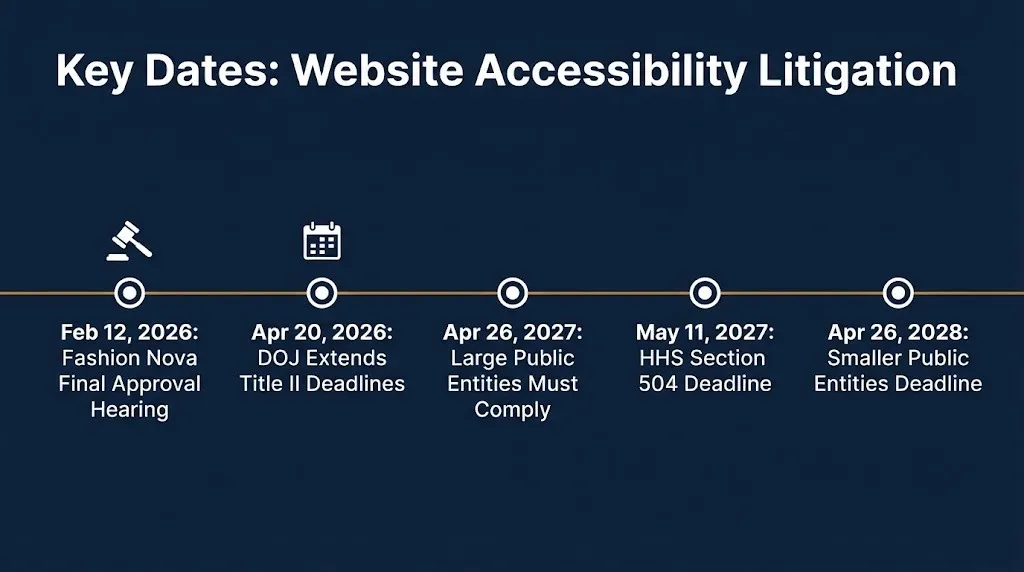
The Department of Health and Human Services separately extended the first Section 504 web accessibility deadline for covered funding recipients to May 11, 2027.
These extensions apply only to government entities and federally funded programs under Title II and Section 504. They do not touch private business obligations under Title III, and they create no safe harbor from the private lawsuits covered throughout this article.
A federal lawsuit filed in May 2026 challenges those DOJ and HHS extensions directly, arguing they leave disabled users without access for longer than lawmakers intended. That case was still pending as of this writing.
Why are website accessibility lawsuits surging?
Three forces are driving the 2025 to 2026 increase, based on the reported data: a rebound after 2023 and 2024’s decline, a wave of pro se filers, and continued e-commerce growth.
Pro se ADA Title III filings, meaning cases filed by individuals without a lawyer, rose 40% in 2025 compared to 2024, according to Seyfarth Shaw’s tracking. Legal commentators point to AI writing tools as one factor making it easier for non-lawyers to draft complaints.
E-commerce remains the single biggest target. Retail and e-commerce sites accounted for a large majority of website accessibility filings, since transactional pages like checkout and account creation make barriers easy to document and prove.
Think of it like a store that only has stairs to its entrance. If a wheelchair user can’t get in the door, that’s a straightforward, provable barrier. A broken “add to cart” button for a screen reader user works the same way in court.
Who is filing these lawsuits?
A small number of law firms file most website accessibility cases. The top 15 plaintiffs’ firms accounted for 86.76% of federal website accessibility filings in 2024, according to Seyfarth Shaw’s data.
This concentration matters because it means the same firms often use similar complaint language and target similar categories of website defects across many different defendants.
Courts have started pushing back on some of these firms’ tactics. Judges in the Southern District of New York have increasingly questioned serial plaintiffs’ standing, ordering evidentiary hearings on whether a plaintiff genuinely intended to use a defendant’s site or was simply testing for lawsuit material.
California courts have taken a different approach: declining to hear state law claims alongside federal ADA claims, which removes the extra monetary damages available under the Unruh Act. Some plaintiffs have responded by filing directly in state court instead of federal court.
Key Takeaway: A concentrated group of firms drives most website accessibility litigation, and courts in New York and California are both, in different ways, applying more scrutiny to how these cases get filed.
Which states and industries get targeted most?
California, New York, and Florida remain the top three states for ADA Title III filings, according to Seyfarth Shaw’s 2024 data, which reported roughly 3,252 filings in California, 2,220 in New York, and 1,627 in Florida.
E-commerce and retail sites make up the largest share of website-specific targets. Reported estimates put e-commerce’s share of website accessibility filings at somewhere between 69% and 77% of the total.
Company size offers little protection. Reported data suggests a majority of 2024 filings targeted businesses with under $25 million in annual revenue, not just large national retailers.
Repeat targeting is also on the rise. Seyfarth Shaw’s tracking found that 46% of federal ADA Title III cases filed in the first half of 2025 named a defendant that had already been sued before.
Do accessibility overlays and widgets stop lawsuits?
Generally, no. Accessibility overlay widgets, the small plug-in tools that claim to auto-fix a site’s accessibility, have not proven to be a reliable legal shield.
Legal trackers have reported lawsuits filed specifically against sites that had overlay tools installed, arguing the underlying code was still broken. Even the overlay companies themselves have faced lawsuits.
The Federal Trade Commission fined one major overlay vendor, accessiBe, $1 million in January 2025 over allegedly false compliance claims made in its marketing.
Defense-side attorneys generally advise that fixing accessibility issues in a site’s actual source code, rather than layering a widget on top, provides more defensible protection if a lawsuit does happen.
What did Robles v. Domino’s Pizza actually establish?
Robles v. Domino’s Pizza is the Ninth Circuit case most often cited as the legal foundation for website accessibility lawsuits, decided in 2019.
The court ruled that the ADA applies to a company’s website and mobile app when they operate as a gateway to a physical place of business, in that case Domino’s restaurants and delivery service.
Domino’s asked the Supreme Court to review the case. The Supreme Court declined, leaving the Ninth Circuit’s ruling in place and effectively setting the standard across a large part of the country.
That ruling doesn’t apply everywhere uniformly. The Eleventh Circuit’s different approach in Gil v. Winn-Dixie means the exact legal standard still depends partly on which federal circuit a case is filed in.
What Happens Next
February 12, 2026: Court heard final approval arguments in Alcazar v. Fashion Nova after DOJ’s objection. Ruling still pending.
April 26, 2027: Deadline for large public entities to meet WCAG 2.1 AA under the DOJ’s extended Title II rule.
May 11, 2027: Extended Section 504 web accessibility deadline for HHS-covered funding recipients.
April 26, 2028: Deadline for smaller public entities under the same extended DOJ rule.
Expected March 2027: Seyfarth Shaw’s next annual tracking report, which will confirm the full 2026 website accessibility filing total.
Frequently Asked Questions
Can I be sued even if I never got a demand letter first?
Yes.
Some plaintiffs’ firms file a lawsuit directly without sending a demand letter first.
A demand letter is common but not legally required before filing.
Does my small business qualify for an exemption?
There is no blanket small business exemption from ADA Title III.
Company size can affect settlement negotiations, but it doesn’t remove legal exposure.
Reported data shows most filings actually target businesses under $25 million in revenue.
Is an accessibility widget enough to protect my site?
Generally, no, according to reported legal outcomes.
Overlay widgets have not reliably prevented lawsuits, and some sites using them have still been sued.
Source code remediation is what defense attorneys typically recommend as more defensible.
Do I need a lawyer if I get a demand letter?
It’s strongly advised, though not a strict legal requirement to receive one.
Businesses that involve ADA Title III defense counsel early tend to see better negotiated outcomes, per reported settlement patterns.
Ignoring the letter carries real legal risk.
Why did filings drop in 2023 and 2024, then jump back up in 2025?
The exact cause isn’t fully confirmed in the public data.
Filings fell 14% in 2023 and 13% in 2024, then rose 27% in 2025, according to Seyfarth Shaw.
Analysts point to pro se filings and AI drafting tools as contributing factors in the 2025 rebound.
Does the DOJ’s 2026 deadline extension protect my business from lawsuits?
No.
The April 2026 extension applies only to state and local government websites under Title II, not private businesses under Title III.
Private ADA website lawsuits can still be filed against your business regardless of that government-only extension.
What’s the difference between ADA Title II and Title III in this context?
Title II covers state and local government entities.
Title III covers private businesses open to the public, including most e-commerce sites.
Website accessibility lawsuits against private companies fall under Title III, which is unaffected by the 2026 Title II deadline extension.
Bottom Line
Website accessibility lawsuits aren’t slowing down. Filings jumped 27% in 2025, and the DOJ’s own recent objection to the Fashion Nova settlement shows even regulators think some resolutions fall short.
If you run a public-facing website, check it against WCAG 2.1 AA now and watch how the Alcazar v. Fashion Nova ruling comes down. It could reshape how future class settlements get structured.