Pennsylvania Workers Compensation Attorney in 2026: Fees, Deadlines, and How to Choose
Quick Answer
- Pennsylvania workers compensation attorneys typically charge 20% of the award, capped by law under Section 442 of the Workers Compensation Act.
- You pay nothing upfront. Attorney fees come out of your benefits only if your case succeeds.
- The most critical deadline is 21 days to report your injury to your employer. Missing 120 days generally bars your claim entirely.
Introduction to Hiring a Pennsylvania Workers Compensation Attorney
A Pennsylvania workers compensation attorney represents injured workers in claims against employers and their insurance carriers under the Pennsylvania Workers Compensation Act. These attorneys work on contingency, meaning you pay nothing unless they recover benefits for you.
If you were hurt on the job in Philadelphia, Allentown, Reading, or anywhere in Pennsylvania, the system has specific rules that can trip you up. There’s a 21-day window to notify your employer, a 90-day restriction on which doctors you can see, and an insurance company that has 21 days to accept or deny your claim .
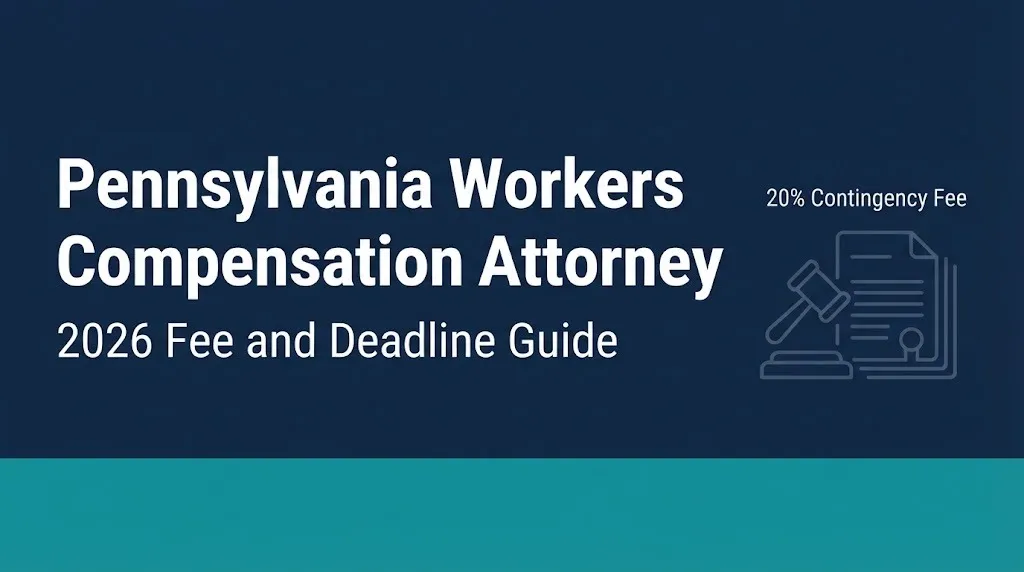
This article explains how attorney fees work, what deadlines apply, how to choose the right lawyer, and what to expect from the claims process. One detail many injured workers miss: if your employer contested your claim without reasonable basis, you may not pay any attorney fees at all because the law shifts those fees to your employer .
The Facts
| Item | Detail |
|---|---|
| Practice Area | Pennsylvania workers compensation law |
| Governing Law | Pennsylvania Workers Compensation Act (Act of June 2, 1915) |
| Attorney Fee Cap | 20% of award under Section 442 (77 P.S. § 998) |
| Fee Structure | Contingency. No upfront costs. |
| Fee-Shifting | Employer pays fees if it contested without reasonable basis |
| Notice Deadline | 21 days for full benefits. 120 days hard deadline. |
| Claim Petition Deadline | 3 years from date of injury |
| 2026 Max Weekly Benefit | $1,394.00 |
| Administrator | Pennsylvania Bureau of Workers Compensation |
How Much Does a Pennsylvania Workers Compensation Attorney Cost?
A Pennsylvania workers compensation attorney typically costs 20% of the wage-loss benefits awarded, with the fee capped by statute and requiring approval from a Workers Compensation Judge .
That 20% figure comes from Section 442 of the Workers Compensation Act, which governs fee agreements between claimants and their attorneys . The rate is essentially uniform across Pennsylvania, so price is not the differentiator when choosing a lawyer.
The fee structure works like this:
| Fee Factor | Detail |
|---|---|
| Percentage | 20% of wage-loss benefits |
| Medical Benefits | Fees typically do not apply to medical benefits |
| Upfront Costs | None. Contingency basis only. |
| Approval Required | Yes. A WCJ must approve the fee agreement. |
| Fee-Shifting | Possible if employer contested without reasonable basis |
Case expenses like medical record costs and expert witness fees are advanced by the firm and only reimbursed from your settlement if your case succeeds .
A 2024 study by the Workers Compensation Research Institute found that workers with attorney representation received benefit increases of between $7,700 and $12,400 compared to those without representation . That gap matters when you’re deciding whether to hire a lawyer.
Reality Check
No attorney can promise you a specific settlement amount at your first meeting. Anyone who does is not being honest with you . Filing a workers compensation claim is free, and you owe nothing unless your attorney recovers benefits for you. If a firm asks for an upfront retainer or hourly fees, walk away.
How Do You Choose a Pennsylvania Workers Compensation Attorney?
You should choose a Pennsylvania workers compensation attorney by verifying certification, confirming they represent injured workers only, and testing their knowledge of procedural deadlines. Pennsylvania has a formal certification for this practice area through the Pennsylvania Bar Association’s Section on Workers Compensation Law .
Here’s what to look for:
- Certification: Check if the attorney is a Certified Workers Compensation Specialist. This requires demonstrated experience, peer review, and testing .
- Claimant-side only: Ask directly if the firm represents employers or insurers. A firm that depends on carrier referrals has a conflict .
- Procedural knowledge: A good attorney will raise the 21-day and 120-day notice deadlines and the 90-day panel physician rule without prompting .
- Fee transparency: Get the fee agreement in writing. Understand whether the 20% applies to medical benefits and who pays case costs .
- Direct access: Ask which attorney will appear at your hearings and whether you can reach that person directly .
- Third-party screening: Ask how they evaluate whether someone other than your employer contributed to your injury. A separate civil claim can be worth far more than workers comp benefits alone .
Red flags include guaranteed settlement figures at the first meeting, pressure to sign immediately, and reluctance to explain how a claim petition proceeds .
What Are the Key Deadlines for Pennsylvania Workers Compensation Claims?
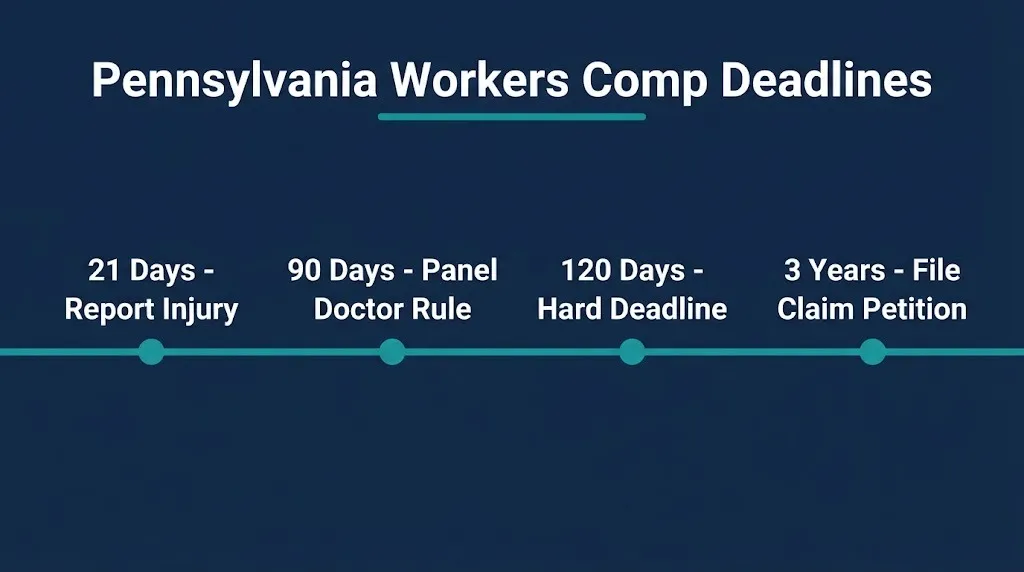
The most important deadline is 21 days to report your injury to your employer to get the full amount of benefits. If you miss that window, you can still report within 120 days, but the delay gives the insurer more room to dispute your claim .
Here’s the full deadline picture:
| Deadline | What It Means |
|---|---|
| 21 days | Report injury to employer for full benefits |
| 120 days | Hard deadline to report. Miss this and your claim is barred. |
| 3 years | File a formal Claim Petition with the Bureau of Workers Compensation |
| 20 days | File an appeal after a WCJ decision |
Gradual injuries and occupational diseases follow different rules. If your condition developed over time, such as a repetitive stress injury or hearing loss from prolonged noise exposure, the clock may start from the date you knew or should have known the condition was work-related .
Report in writing whenever possible. A verbal report is legally sufficient, but written notice creates a record that’s harder to dispute later .
What Is the 90-Day Panel Physician Rule?
Pennsylvania law requires you to treat with a doctor from your employer’s approved provider list for the first 90 days after a workplace injury, as long as that list meets legal requirements .
The panel must include at least six medical providers, at least three of whom must be physicians. Each provider must include contact information and a specialty. The list must be geographically accessible and conspicuously posted at the workplace .
You can choose any doctor on the list. Your employer cannot force you to see a specific physician .
There are exceptions where you can choose your own doctor immediately:
- Your employer did not post a valid, compliant panel list
- The panel does not include the specialist you need
- A panel doctor recommends invasive surgery, allowing a second opinion from a non-panel doctor
- The 90-day period has passed
If you see a non-panel doctor during the first 90 days when a valid panel exists, the insurance carrier may refuse to pay those medical bills .
Key Takeaway: The 90-day panel rule controls your medical treatment early in the claim. If your employer didn’t follow the posting and notice requirements, you may have free choice of doctor from day one.
What Happens After 104 Weeks of Workers Compensation Benefits?
After you receive 104 weeks of total disability benefits, the insurer can request an Impairment Rating Evaluation (IRE) to determine your degree of permanent impairment .
If the rating comes in below 35%, the insurer can attempt to convert your total disability benefits to partial disability benefits, which carry a 500-week cap . That’s a significant change in your benefit status.
Pending legislation in 2026 (Senate Bill 1151 and House Bill 2204) would amend the IRE process by removing the requirement that the evaluating physician be active in clinical practice for at least 20 hours per week . The bills would still require the physician to be licensed in Pennsylvania and certified by an approved board.
The IRE threshold changed after the Protz v. WCAB decision. Prior to 2018, you had to be at least 35% impaired. The threshold is now 50% .
If your rating falls below the threshold, your benefits convert from total to partial disability, and the clock starts ticking toward the 500-week cap.
How Long Does a Pennsylvania Workers Compensation Case Take?
An accepted, undisputed claim can begin paying benefits within the 21-day window after your employer reports the injury . A disputed claim that requires a Claim Petition and hearings before a Workers Compensation Judge commonly takes many months to over a year before a decision is issued .
The timeline depends on several factors:
- Whether the claim is accepted or disputed: Accepted claims proceed smoothly. Disputed claims enter the WCJ hearing process.
- Medical treatment status: Settlement negotiations generally wait until treatment stabilizes enough to estimate future needs .
- Independent Medical Examinations (IMEs): Insurers frequently require an IME, which can extend timelines .
- Appeals: Either side can appeal a WCJ decision to the Workers Compensation Appeal Board, adding substantial time .
A Compromise and Release (C&R) settlement requires a hearing before a WCJ, who must approve it as being in your best interest . Negotiating a C&R can happen at almost any point once a claim is accepted or decided.
What Happens Next with Your Pennsylvania Workers Compensation Claim?
Here are the key stages to expect:
Immediate: Report your injury to your employer within 21 days. Seek medical treatment from a panel provider if required.
Within 21 days of notice: The insurer must accept, deny, or temporarily accept your claim .
If denied: File a Claim Petition with the Bureau of Workers Compensation. The case is assigned to a Workers Compensation Judge.
Discovery and hearings: Both sides present evidence, including medical records and depositions. Hearings are typically scheduled with gaps between them .
Decision: The WCJ issues a decision. Either side can appeal within 20 days .
Settlement: If both sides want finality, negotiate a Compromise and Release requiring WCJ approval .
Frequently Asked Questions
How much does a Pennsylvania workers compensation attorney cost?
Pennsylvania workers compensation attorneys charge 20% of the wage-loss benefits awarded, capped by Section 442 of the Workers Compensation Act. You pay nothing upfront, and the fee requires approval from a Workers Compensation Judge .
Do I need a lawyer for my workers compensation claim?
You don’t legally need one, but studies show workers with attorney representation receive $7,700 to $12,400 more in benefits than those without . If your claim is denied or disputed, an attorney is strongly recommended.
What is the deadline to report a work injury in Pennsylvania?
You have 21 days to report your injury to your employer for full benefits. The hard deadline is 120 days. After that, your claim is generally barred .
Can I choose my own doctor for workers compensation in Pennsylvania?
For the first 90 days, you must treat with a doctor from your employer’s approved panel list, if a valid list exists. After 90 days, you can choose your own doctor. If your employer didn’t post a compliant panel, you may have free choice from the start .
What happens if my workers compensation claim is denied?
You have the right to appeal by filing a Claim Petition with the Bureau of Workers Compensation. The case goes before a Workers Compensation Judge. An attorney can represent you through the appeals process .
How long do I have to file a workers compensation claim petition?
You have three years from the date of injury to file a formal Claim Petition with the Bureau of Workers Compensation .
What is a Compromise and Release settlement?
A C&R is a negotiated lump-sum resolution that closes out some or all of your claim in exchange for a set amount rather than ongoing benefits. It requires approval from a Workers Compensation Judge .
Can my employer fire me for filing a workers compensation claim?
No. It is illegal for an employer to fire or retaliate against you for filing a workers compensation claim. Retaliation can include demotion, reduced hours, or negative performance reviews .