Workers Compensation Attorney Chicago 2026: Costs, Benefits, and How to Find the Right Lawyer
Quick Answer
- Most Chicago workers’ comp lawyers charge no upfront fees and take 20% of your settlement or award, capped by Illinois law.
- Average settlements vary widely. A recent Illinois case awarded $871.73 per week for a 35% leg injury .
- There is no filing deadline to hire an attorney, but waiting can weaken your claim. Free consultations are standard.
How Much Does a Workers Compensation Attorney Cost in Chicago?
A workers’ compensation attorney in Chicago typically costs nothing upfront and takes a contingency fee capped at 20% of your total recovery under Illinois law .
This is different from personal injury cases, which often charge 33% to 40%. Workers’ comp fees are regulated because the system is administrative, not a jury trial system. The Illinois Workers’ Compensation Act sets the rules, and attorneys cannot charge more than the statutory cap.
Here’s what the cost structure actually looks like:
| Fee Type | Amount | When You Pay |
|---|---|---|
| Upfront consultation | $0 | Never |
| Attorney fee | 20% of recovery | Only if you win |
| Case costs (records, filing fees) | Advanced by firm | Deducted from settlement if you win |
| If you lose | $0 | Nothing owed |
One important detail: if you lose your case, you owe nothing. The attorney absorbs the costs. This is how most Chicago workers’ comp firms operate, including Horwitz, Horwitz & Associates, which explicitly states you pay nothing unless they win .
The 20% cap applies to the final settlement or award. If your case settles for $100,000, the attorney gets $20,000, and you keep $80,000, minus any advanced costs like medical record fees or expert evaluations .
What Benefits Can You Receive Through Illinois Workers Compensation?
Illinois workers’ compensation provides five main types of benefits to injured workers, regardless of who was at fault for the accident .
The system is no-fault. You don’t have to prove your employer did anything wrong. You just have to show the injury happened at work and arose out of your employment.
Medical Expenses: All reasonable and necessary medical care related to your work injury is covered. This includes hospital stays, surgeries, physical therapy, medications, and prosthetics .
Temporary Total Disability (TTD): If you cannot work at all during recovery, you receive wage replacement. Under Illinois law, this is 66 2/3% of your average weekly wage . A recent IWCC decision awarded $652.90 per week in TTD benefits for a shoulder and spine injury .
Temporary Partial Disability (TPD): If you can work light duty but earn less than before, TPD makes up part of the difference.
Permanent Partial Disability (PPD): For lasting impairments, you receive a scheduled award based on the body part injured and the percentage of loss. One November 2025 decision awarded $871.73 per week for injuries including 35% loss of use of a leg, 25% loss of a thumb, and 7.5% loss of an eye .
Permanent Total Disability (PTD): For catastrophic injuries that prevent any return to work, you receive lifetime benefits.
Death Benefits: Surviving family members can recover funeral expenses and ongoing financial support.
How Long Do You Have to File a Workers Compensation Claim in Illinois?
Illinois law gives you three years from the date of the accident to file a workers’ compensation claim, or two years from the last date you received benefits, whichever is later.
The clock starts ticking on the date of your injury. For repetitive trauma injuries like carpal tunnel or back strain from repeated lifting, the clock starts when you become aware the injury is work-related and disabling.
Waiting has two costs. First, evidence fades. Witnesses move, memories blur, and surveillance footage gets deleted. Second, insurance companies treat late claims with more suspicion. A claim filed six months after an injury raises questions about whether the injury actually happened at work.
Think of it like a warranty claim on a phone. If you drop it and wait a year to file, the company questions whether the damage was really from that drop. File early, document everything.
The Illinois Workers’ Compensation Commission has a page listing attorney referral services if you need help finding representation. The Commission does not recommend specific attorneys but provides this list as a public service .
Who Are the Top Workers Compensation Attorneys in Chicago?
Chicago has one of the largest concentrations of workers’ compensation attorneys in the country, with over 3,000 listed on Martindale-Hubbell for Illinois alone . Finding the right one means looking past advertising and checking credentials.
Several firms and attorneys stand out based on peer reviews and professional recognition:
Frank A. Sommario of Romanucci & Blandin was named the 2027 Best Lawyers “Lawyer of the Year” for Workers’ Compensation Law – Claimants in Chicago . This is a peer-reviewed honor given to only one attorney per practice area and region.
Anesi Ozmon, Ltd. is an AV-rated plaintiff firm founded in 1955, with attorneys including David Figlioli and John Popelka receiving 5.0 peer ratings in workers’ compensation . The firm handles workers’ comp, personal injury, and construction accidents.
Horwitz, Horwitz & Associates publishes its fee structure openly and states its workers’ comp fees are set by statute at 20%. The firm recovered $1.8 million for a bakery worker in one of Illinois’ largest workers’ comp settlements .
BCM Law, P.C. is on the defense side, representing employers and insurers. The firm handled over 2,500 workers’ compensation claims in 2025 and saved one Fortune 50 client more than $600,000 in claim costs .
The Illinois Workers’ Compensation Lawyers Association (WCLA) maintains a list of attorney members on its website, which is a good starting point for finding claimant-side representation .
Key Takeaway: The top Chicago workers’ comp attorneys are recognized by peer-review organizations like Best Lawyers and Martindale-Hubbell, not just by advertising spend. Check credentials before you hire.
How Do You Choose the Right Workers Compensation Lawyer?
Choosing the right workers’ compensation lawyer means matching your specific injury and situation to an attorney with relevant experience, not just picking the biggest advertiser.
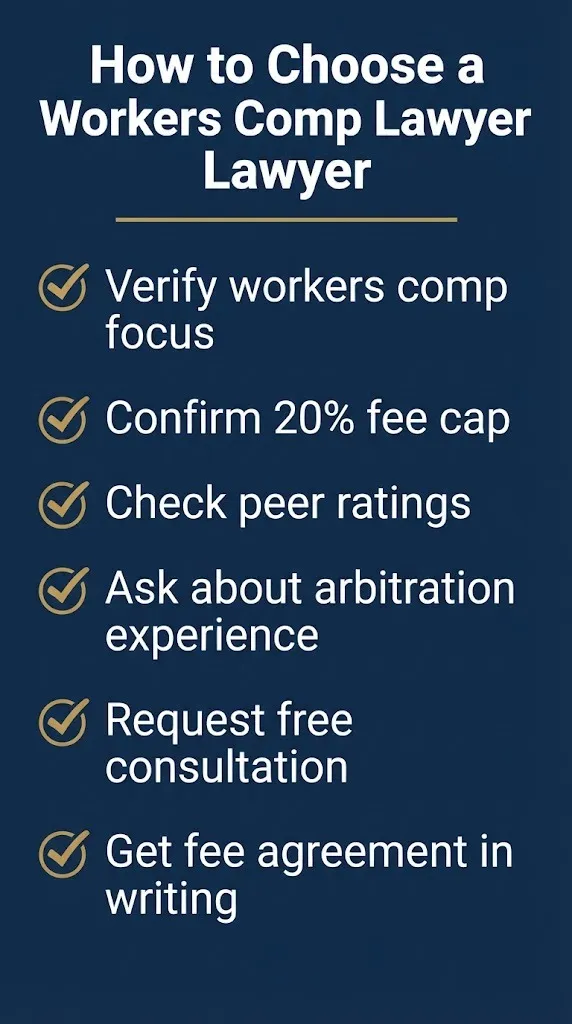
Here’s a practical checklist:
- Verify the attorney’s focus. Workers’ comp is a specialized area. A personal injury lawyer who “also does” workers’ comp may not know the IWCC arbitration process as well.
- Ask about their experience with your injury type. Roofers, nurses, warehouse workers, and office employees face different hazards and different insurers.
- Confirm the fee structure in writing. It should be 20% under Illinois law. If someone quotes higher, walk away.
- Check peer ratings. Martindale-Hubbell and Best Lawyers ratings are based on evaluations by other attorneys and judges .
- Ask who will handle your case. Some firms assign paralegals or junior associates. You want to know who is actually doing the work.
- Request a free consultation. Every reputable Chicago workers’ comp firm offers this .
- Ask about trial and arbitration experience. Most cases settle, but insurers pay more when they know your attorney will fight at arbitration.
If you’re a temporary worker or day laborer, the analysis gets more complicated. Staffing agency workers are generally covered through the agency’s insurance, not the host employer’s . Day laborers hired directly may be classified as independent contractors, which complicates coverage. An experienced attorney can sort this out.
Reality Check
No legitimate workers’ compensation attorney will charge you an upfront fee or ask for a credit card. If someone does, they’re not operating within Illinois law. Free consultations are standard, and the 20% contingency cap is statutory.
What Types of Injuries Qualify for Workers Compensation in Chicago?
Any injury that happens at work or because of work can qualify for workers’ compensation in Illinois, from a single accident to a repetitive strain condition.
Common qualifying injuries include:
- Construction and roofing injuries: Falls, struck-by-object accidents, ladder collapses, and scaffolding failures .
- Healthcare worker injuries: Lifting injuries, needlesticks, and exposure incidents.
- Warehouse and manufacturing injuries: Repetitive motion, machinery accidents, and forklift collisions.
- Retail and hospitality injuries: Slips and falls, burns, and lifting strains.
- Office worker injuries: Carpal tunnel, back strain from sitting, and repetitive stress.
The key legal test is whether the injury “arose out of and in the course of employment.” That means it happened while you were doing your job, at your workplace or while performing work duties.
You do not need to prove your employer was negligent. Even if you made a mistake that caused your own injury, workers’ compensation still covers you. The only exception is if you were intoxicated or intentionally hurt yourself.
Pre-existing conditions do not disqualify you. If a work activity aggravated an old injury or made a condition worse, that aggravation can be compensable. You may need medical testimony connecting the work activity to the worsened condition.
What Happens If Your Employer Doesn’t Have Workers Compensation Insurance?
If your employer did not have workers’ compensation insurance, you may still recover benefits through the Injured Workers’ Benefit Fund (IWBF) .
The IWBF was created in 2005 and is funded by penalties and fines collected from uninsured employers. It pays benefits to injured workers whose uninsured employers failed to pay what they owe .
To qualify for IWBF payments, your case must meet specific criteria:
- Your employer failed to provide workers’ compensation coverage.
- Your employer failed to pay benefits under a final award.
- You filed an Application for Adjustment of Claim with the IWCC.
- You named the State Treasurer as a party respondent.
- You served a copy of the application on the Treasurer.
- You received a final award granting benefits.
- You submitted a Request for Benefits Form (IC 44) within 90 days of the final award.
The IWBF pays claims on a pro rata basis if there isn’t enough money to pay all claims in a given year . It’s a safety net, not a guarantee, but it’s better than nothing.
If your employer is uninsured and the IWBF doesn’t cover your full award, you may also have a personal injury lawsuit against the employer. An attorney can advise whether that option applies to your situation.
Key Takeaway: If your employer is uninsured, the Injured Workers’ Benefit Fund may pay your award, but you must follow strict procedural rules. An attorney familiar with IWBF claims can help you file correctly.
What Happens Next in Your Chicago Workers Compensation Case?
The workers’ compensation process in Illinois follows a defined path. Here’s the timeline you can expect if you file a claim:
| Stage | Timeframe | What Happens |
|---|---|---|
| Injury and report | Immediately | Report the injury to your employer in writing |
| Medical treatment | Within days | See a doctor, document everything |
| Insurance investigation | 2-4 weeks | Adjuster reviews the claim, may accept or deny |
| TTD benefits begin | Within 14 days | If claim accepted, wage replacement starts |
| Attorney hired | Anytime | Most workers hire after a denial or lowball offer |
| Settlement negotiation | 3-12 months | Attorney negotiates with insurer |
| Arbitration (if needed) | 12-24 months | IWCC arbitrator decides disputed issues |
| Appeal (if needed) | 24-36 months | IWCC review or Circuit Court |
Most cases settle. The Illinois Workers’ Compensation Commission reported thousands of arbitration decisions in 2025 and 2026, but those represent a fraction of total claims. The majority resolve through voluntary settlement before a hearing.
If your case goes to arbitration, the arbitrator issues a written decision. Recent decisions have awarded specific weekly amounts for specific injuries, like $871.73 per week for multiple permanent partial disabilities and $587.61 per week for a 25% loss of the person as a whole .
The arbitrator’s decision is binding unless appealed. Either side can appeal to the full Commission, and then to the Circuit Court. Appeals extend the timeline but rarely change the outcome dramatically.
Frequently Asked Questions
How much does a workers comp attorney charge in Chicago?
Illinois law caps workers’ compensation attorney fees at 20% of your recovery. You pay nothing upfront, and if you lose, you owe nothing .
Do I need a lawyer for a workers comp claim in Illinois?
You can file a claim without a lawyer, but having one usually results in a higher settlement. Insurers know which claimants have representation and tend to offer more to avoid arbitration.
How long does a workers comp case take in Chicago?
Most settle within 3 to 12 months. If your case goes to arbitration, expect 12 to 24 months. Appeals can extend it to 24 to 36 months.
What is the average workers comp settlement in Illinois?
There is no single average. Settlements range from a few thousand dollars for minor injuries to $1.8 million for catastrophic cases . Your amount depends on your injury, wages, and medical needs.
Can I get fired for filing a workers comp claim?
No. Illinois law prohibits retaliation against workers who file good-faith workers’ compensation claims. If you are fired after reporting an injury, you may have a separate retaliation claim.
What if my employer denies my workers comp claim?
You can appeal the denial. The IWCC process allows you to request a hearing before an arbitrator. Most workers hire an attorney at this stage because the process is formal and evidence-heavy.
How do I find a good workers comp lawyer in Chicago?
Start with the Illinois Workers’ Compensation Lawyers Association attorney list, check Martindale-Hubbell peer ratings, and ask about experience with your specific injury. Free consultations are standard .
Do I have to pay back my health insurance from a workers comp settlement?
Possibly. If your health insurance paid for treatment that workers’ compensation should have covered, they may have a right of reimbursement. An attorney can negotiate these liens down or eliminate them.
The Bottom Line
Finding the right workers’ compensation attorney in Chicago starts with understanding the cost structure: nothing upfront, 20% at the end, capped by Illinois statute. The system is designed to be accessible, but the process is not simple. Insurers deny valid claims, delay benefits, and pressure workers to return too soon. An experienced attorney evens the odds. Start with a free consultation, verify the attorney’s credentials, and confirm the fee structure in writing before you sign anything. The most important number to remember is 20%, the maximum you should ever pay for workers’ comp representation in Illinois .
Key Takeaway: The 20% statutory fee cap is your protection. No legitimate Chicago workers’ comp attorney charges more, and none should charge you anything upfront.