California Workers Compensation Insurance 2026: Requirements, Costs, and Where to Buy Coverage
Quick Answer
- Workers’ compensation insurance is legally required in California for almost all employers with one or more employees, no exceptions for small businesses.
- Average pricing sits around $1.65 per $100 of payroll under the newly approved September 2026 benchmark rate, though actual quotes vary by industry.
- Operating without coverage can trigger fines up to $100,000, a stop-work order, and misdemeanor criminal charges under Labor Code Section 3700.5.
If you’re searching “workers compensation insurance california” in 2026, you’re probably a business owner trying to get compliant, a contractor facing new licensing rules, or someone comparing quotes before a policy renewal. This isn’t a lawsuit or a settlement, it’s a legal requirement most California employers can’t skip.
The rules just got more expensive and, for some contractors, more complicated. The state’s benchmark pricing for workers’ comp coverage rose to $1.65 per $100 of payroll for policies starting September 1, 2026. Meanwhile, a new law, SB 291, raised minimum penalties for uninsured contractors starting January 1, 2026, to $10,000 for sole owners and $20,000 for others, with no exceptions for ignorance or financial hardship.
This article breaks down who legally needs coverage, what it actually costs in 2026, where to buy it including the state-run option, and what happens if you skip it. One detail that surprises a lot of business owners: California has no minimum employee threshold, hiring just one part-time worker triggers the legal requirement.
The Facts
| Requirement | Mandatory for nearly all California employers with one or more employees |
| Status | Active law; enforcement increasing under new 2026 legislation (SB 291) |
| 2026 Benchmark Rate | $1.65 per $100 of payroll (approved rate, effective September 1, 2026) |
| Prior Benchmark Rate | $1.55 per $100 of payroll (approved September 1, 2025 rate) |
| Penalty Range | Up to $100,000 in civil penalties, plus possible criminal misdemeanor charges |
| Primary Regulator | California Department of Industrial Relations, Division of Workers’ Compensation |
| State-Run Insurer | State Compensation Insurance Fund (State Fund), insurer of last resort |
Is Workers’ Compensation Insurance Required by Law in California?
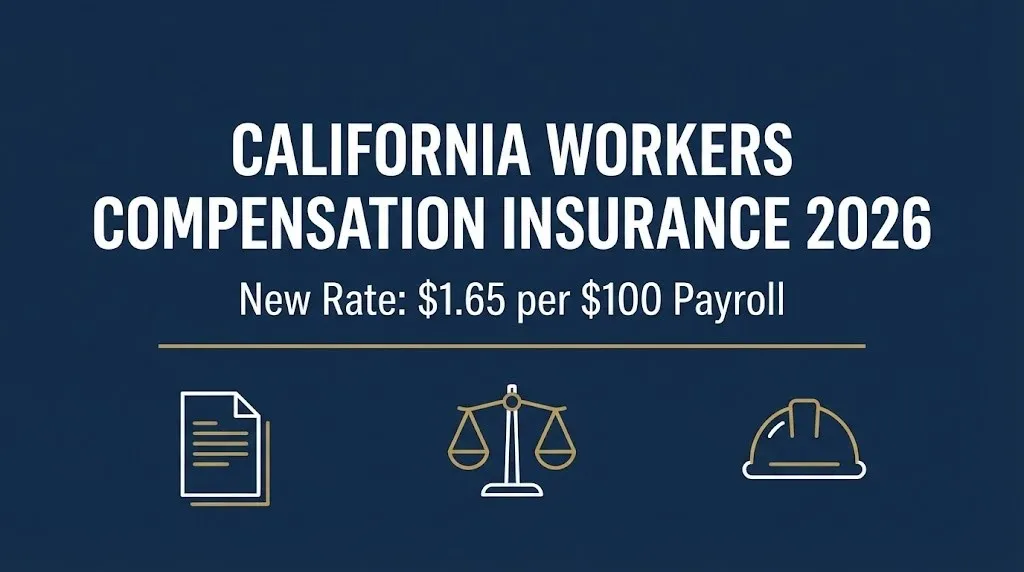
Yes, California law requires nearly every employer with at least one employee, full-time, part-time, or seasonal, to carry workers’ compensation insurance.
There is no minimum employee threshold for most businesses. The moment you hire your first employee, the legal obligation begins, regardless of your company’s size or industry. This applies whether workers are paid hourly, salaried, or on commission.
Who is generally required to carry coverage:
- Any business employing one or more W-2 workers, full-time or part-time.
- Sole proprietors who hire even a single helper or laborer.
- Licensed contractors, under an expanding set of rules described later in this article.
Who is typically exempt:
- True independent contractors who pass California’s ABC Test for worker classification.
- Certain sole proprietors and partners with no employees, outside the new contractor mandate.
Key Takeaway: California workers’ compensation insurance is not optional once you have an employee on payroll, and misclassifying workers as independent contractors to avoid coverage is itself illegal.
California Workers Compensation Insurance: How Much Does It Cost in 2026?
Workers’ comp costs in California are calculated per $100 of payroll, and the state’s newly approved benchmark rate for late 2026 policies is $1.65, up 6.6 percent from the prior year.
On July 10, 2026, California’s Insurance Commissioner approved new advisory pure premium rates for policies incepting on or after September 1, 2026. The Workers’ Compensation Insurance Rating Bureau of California (WCIRB) had originally requested a steeper 10.4 percent increase, citing rising cumulative trauma claim frequency, higher medical costs, and increased loss adjustment expenses. The Commissioner approved a smaller 6.6 percent increase instead.
2026 California workers’ comp benchmark pricing:
| Effective Date | Average Advisory Pure Premium Rate | Change from Prior Year |
|---|---|---|
| September 1, 2025 | Approximately $1.55 per $100 payroll | Baseline |
| September 1, 2026 | $1.65 per $100 payroll | +6.6 percent (approved) |
This is an advisory benchmark, not a mandated price. Insurers are not required to use it, and actual quotes vary significantly based on your industry classification code, claims history, and chosen carrier.
What determines your actual premium:
- Your WCIRB classification code, based on your primary business activity.
- Total payroll broken down by job classification.
- Your experience modification rate (Mod rate), reflecting past claims history.
- Whether you choose annual billing or pay-as-you-go billing tied to actual payroll.
- Which carrier you select, since private insurers price differently than the State Fund.
Where to Buy Workers Compensation Insurance in California
You can buy California workers’ compensation insurance from a private insurance carrier, through an independent agent, or from the State Compensation Insurance Fund, the state’s own workers’ comp insurer.
The State Compensation Insurance Fund, commonly called State Fund, was established by the California legislature in 1913. It’s a public enterprise fund that competes directly with private insurers, is self-supported through premiums and investment income, and receives no financial support from the state general fund. State Fund also serves as the insurer of last resort for employers that private carriers decline to cover.
Steps to get workers’ comp insurance in California:
- Determine your WCIRB classification code based on your primary business activity.
- Gather payroll data broken down by employee job classification.
- Get quotes from multiple private carriers and from State Fund directly.
- Compare pricing, since rates vary significantly between insurers even for identical coverage.
- Choose between annual premium billing and pay-as-you-go billing tied to real payroll.
- Confirm your policy meets California’s minimum statutory coverage requirements before your first employee starts work.
Large, financially stable employers may also qualify to self-insure instead of purchasing a traditional policy, though this option involves separate state approval and is uncommon for small businesses.
Cheap Workers Compensation Insurance California: What to Watch For
There’s no single “cheapest” workers’ comp policy in California, since pricing is tied to your specific payroll, classification code, and claims history rather than a flat rate any provider can guarantee.
Shopping around matters more than chasing an advertised low price. Rates for functionally identical coverage can vary meaningfully between private carriers, and State Fund’s pricing may be more competitive for certain higher-risk classifications where private insurers charge a premium.
Ways to legitimately lower your workers’ comp costs:
- Accurately classify every employee by job type; misclassification leads to audits and back premiums, not real savings.
- Maintain a strong safety record, since your experience modification rate directly affects pricing.
- Compare pay-as-you-go billing against traditional annual premiums if your payroll fluctuates seasonally.
- Get quotes from at least three sources, including State Fund, before committing to a policy.
Reality Check
No legitimate insurance requirement disappears because a business is small, new, or short-staffed, and no online quote tool can legally waive California’s coverage mandate. If you’re offered a workers’ comp policy that seems dramatically cheaper than every other quote you’ve received, verify the carrier is properly licensed in California through the Department of Insurance before paying anything, since unlicensed or fraudulent coverage leaves you just as exposed as having no policy at all.
What Happens If You Don’t Have Workers Compensation Insurance in California?
Operating without required workers’ compensation insurance in California is a criminal misdemeanor, and penalties can reach $100,000 in civil fines alone.
Under Labor Code Section 3700.5, failing to carry required coverage is punishable by a fine of at least $10,000, imprisonment in county jail for up to one year, or both. Separately, the Division of Labor Standards Enforcement (DLSE) can issue civil penalties up to $100,000 depending on business size and the length of the coverage gap.
Consequences of operating uninsured in California:
| Violation | Potential Penalty |
|---|---|
| Operating without required coverage | Criminal misdemeanor, minimum $10,000 fine, up to one year in jail |
| Civil penalty for uninsured operation | Twice the unpaid premium amount, or $1,500 per uninsured employee, whichever is greater, up to $100,000 |
| Failure to observe a stop-work order | Misdemeanor, up to 60 days county jail and/or $10,000 fine |
| Injured worker files a claim while uninsured | Up to $10,000 per employee if the claim is compensable, up to $100,000 total |
| Failure to post required workers’ comp notice | Up to $7,000 per violation |
If the DLSE determines you’re operating uninsured:
- They issue a stop-work order, halting your use of employee labor immediately.
- You must obtain valid coverage before resuming operations.
- Failure to observe the stop order itself becomes a separate misdemeanor.
- You may face additional civil penalties layered on top of criminal charges.
- If an employee is injured during the uninsured period, you become personally liable for medical costs and lost wages without the normal legal protections workers’ comp provides.
Key Takeaway: California’s penalty structure is designed to make noncompliance far more expensive than the insurance itself, and new 2026 rules make that gap even wider for contractors specifically.
California Workers Compensation for Contractors: What Changed in 2026
Licensed contractors face an expanding set of workers’ comp requirements, and a new law, SB 291, sharply increased penalties for uninsured contractors starting January 1, 2026.
Under SB 291, uninsured sole-owner contractors now face a minimum $10,000 penalty, while other uninsured contractors face a minimum $20,000 penalty. These are statutory minimums that apply automatically, regardless of intent, financial hardship, or claimed misunderstanding of the requirement.
Separately, under SB 216, all licensed contractors, even those without employees, were originally set to require workers’ compensation coverage starting January 1, 2026. SB 1455 delayed that broader requirement to January 1, 2028, though contractors in certain license types (such as C-8 Concrete, C-20 HVAC, C-22 Asbestos Abatement, and D-49 Tree Service) were already required to comply starting in 2023.
Contractor timeline to know:
- 2023: First-phase contractor license types required to carry coverage.
- January 1, 2026: SB 291’s increased penalty minimums for uninsured contractors take effect.
- February 1, 2026: New requirement for employers to provide written notice of workers’ comp rights to employees.
- January 1, 2028: SB 1455’s delayed deadline for all remaining licensed contractors to carry coverage, even without employees.
Contractors who wait until the 2028 deadline to plan for compliance risk scrambling for coverage under tighter timelines and potentially higher rates.
Frequently Asked Questions
Is workers’ compensation insurance required by law in California?
Yes, nearly all California employers with at least one employee must carry workers’ compensation insurance.
There is no minimum employee threshold for most businesses, one part-time hire triggers the requirement.
Licensed contractors face additional, separate requirements under SB 216 and SB 1455.
How much does workers’ compensation insurance cost in California in 2026?
The state’s approved benchmark rate is $1.65 per $100 of payroll for policies starting September 1, 2026.
This is a 6.6 percent increase from the prior year’s approved rate.
Your actual premium depends on your industry classification, payroll, and claims history, not just the benchmark.
What is the State Compensation Insurance Fund?
The State Compensation Insurance Fund, or State Fund, is California’s state-established workers’ comp insurer, created in 1913.
It competes with private carriers and serves as the insurer of last resort for employers private insurers decline to cover.
State Fund receives no financial support from California’s general fund and operates on premiums and investment income.
What happens if I don’t have workers’ comp insurance in California?
Operating without required coverage is a criminal misdemeanor under Labor Code Section 3700.5.
Penalties include a minimum $10,000 fine, up to one year in jail, and civil penalties up to $100,000.
The state can also issue a stop-work order, halting your business until you obtain coverage.
Do independent contractors need workers’ compensation insurance?
True independent contractors who meet California’s ABC Test are generally not covered by an employer’s workers’ comp policy.
However, misclassifying employees as independent contractors to avoid coverage is illegal and can trigger significant penalties.
Licensed contractors themselves face a separate, expanding set of requirements under SB 216 and SB 1455.
Where can small businesses get cheap workers’ compensation insurance in California?
There’s no fixed “cheapest” option, since pricing depends on your specific payroll and risk classification.
Comparing quotes from multiple private carriers and from State Fund is the most reliable way to find competitive pricing.
Accurate employee classification and a strong safety record are the most effective ways to keep long-term costs down.
When do new California workers’ comp contractor rules take effect?
SB 291’s increased penalty minimums for uninsured contractors took effect January 1, 2026.
The broader requirement for all licensed contractors to carry coverage, even without employees, is delayed to January 1, 2028 under SB 1455.
Some specific contractor license types were already required to comply starting in 2023.
If you’re a California employer, the most useful next step is confirming your current policy reflects accurate payroll and classification data before rates shift again. If you don’t yet have coverage and have employees on payroll, treat that as urgent, not optional.
The date to watch: California’s new $1.65 per $100 payroll benchmark rate takes effect for policies starting September 1, 2026.