Autism Tylenol Lawsuit 2026: Settlement Status, Eligibility, and What Parents Need to Know
Quick Answer
- The Tylenol autism lawsuit is real, with thousands of cases consolidated in federal multidistrict litigation.
- No settlement has been approved, and no per-person payout amount has been determined.
- No claim deadline exists yet, so no one can file for compensation through a settlement administrator.
If you took acetaminophen during pregnancy and your child later received an autism diagnosis, you have probably seen headlines about the Tylenol autism lawsuit. You are looking for a straight answer about whether this is real, whether you qualify, and whether money is actually coming.
The verified answer is this: the litigation is real. It is consolidated as multidistrict litigation in the U.S. District Court for the Southern District of New York under Judge Denise Cote. But no settlement exists yet. No fund has been created. No claim form exists. Anyone telling you otherwise is ahead of the court record.
The Facts
| Fact | Details |
|---|---|
| Case | In re Acetaminophen ASD/ADHD Products Liability Litigation |
| Status | Active litigation, no settlement |
| Fund Size | Not established |
| Est. Per Person | Not determined |
| Claim Deadline | Not set |
| Administrator | Not appointed |
| Proof Needed | Not yet defined |
Is the Tylenol Autism Lawsuit Real or a Scam?
The Tylenol autism lawsuit is real. It is not a scam. The litigation is formally known as In re Acetaminophen ASD/ADHD Products Liability Litigation, and it is pending in federal court in New York.
Thousands of cases have been consolidated before one federal judge for pretrial proceedings. That consolidation, called multidistrict litigation, is standard for mass torts involving similar claims.
But real litigation is not the same as a settlement. No settlement has been reached. No class has been certified. No claims administrator has been appointed. Any website claiming you can file a Tylenol autism claim today is misrepresenting the current status.
Why Is Tylenol Being Sued Over Autism?
Tylenol is being sued because plaintiffs allege that prenatal acetaminophen exposure increases the risk of autism and ADHD in children. The lawsuits target generic acetaminophen retailers and manufacturers, not just the Tylenol brand.
The legal theory is failure to warn. Plaintiffs argue that manufacturers and retailers knew or should have known about studies linking prenatal acetaminophen use to neurodevelopmental conditions and failed to warn pregnant consumers.
The science is contested. Major medical organizations, including the American College of Obstetricians and Gynecologists, have not changed their position that acetaminophen is generally safe during pregnancy when used as directed. That disagreement is central to the litigation.
Key Takeaway: The lawsuits are about warning labels, not about proving acetaminophen definitely causes autism in every case.
What Is the Status of the Tylenol Autism Lawsuit in 2026?
The status of the Tylenol autism lawsuit in 2026 is active litigation with no settlement. The multidistrict litigation continues to move through pretrial proceedings, including expert testimony battles and bellwether case selection.
No trial date has been set for the first bellwether case as of September 1, 2026. The court has been addressing expert admissibility, which is a critical phase in mass tort litigation.
The outcome of expert rulings will shape settlement pressure. If plaintiffs’ experts survive challenges, defendants face greater risk and may push toward settlement. If experts are excluded, the opposite occurs.
How Many Cases Are in the Tylenol Autism Lawsuit?
Thousands of cases are pending in the Tylenol autism multidistrict litigation. The exact number changes as new cases are filed and others are dismissed.
The Judicial Panel on Multidistrict Litigation consolidated the cases in October 2022. Since then, the docket has grown substantially, making it one of the largest active mass torts in the country.
An exact current case count requires checking the live docket. Legal news reports and the court’s official docket sheet provide periodic updates.
How Much Is the Tylenol Autism Settlement Per Person?
There is no Tylenol autism settlement per person because there is no settlement. Any dollar figure you see online is speculation or fabrication.
In mass tort litigation, per-person payouts depend on multiple factors: injury severity, medical costs, jurisdiction, and the strength of individual evidence. Even after a global settlement, payouts typically vary by tier.
Here is what a typical mass tort settlement structure might look like, based on other pharmaceutical and product liability cases:
| Severity Tier | Possible Compensation Range |
|---|---|
| ADHD only | Lower tier |
| Autism with high support needs | Higher tier |
| Autism with significant medical costs | Highest tier |
These ranges are illustrative, not based on any Tylenol settlement because none exists.
Key Takeaway: No payout amount is confirmed, and any website naming a dollar figure is not citing a court-approved settlement.
Is There a Tylenol Class Action Lawsuit?
No. The Tylenol autism litigation is not a class action. It is a multidistrict litigation, often called a mass tort.
The difference matters. In a class action, one representative plaintiff represents a defined class, and members typically receive small equal payouts. In a mass tort, each plaintiff files an individual case with individual facts and injuries.
Mass tort cases are consolidated for efficiency but remain separate. That means settlement values vary by individual, and you need your own lawyer to participate.
Do You Qualify for the Tylenol Autism Lawsuit?
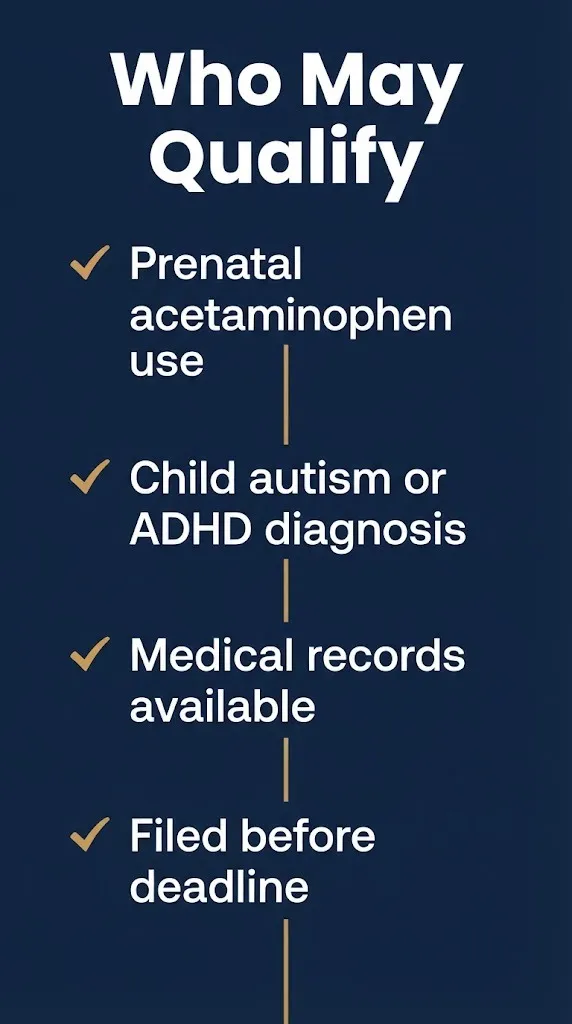
You may qualify for the Tylenol autism lawsuit if you used acetaminophen during pregnancy and your child was later diagnosed with autism or ADHD. But qualification requires medical records and expert review.
Here are the general eligibility factors discussed in legal filings:
- Prenatal acetaminophen use during pregnancy.
- A child diagnosed with autism spectrum disorder or ADHD.
- A plausible connection between the exposure and the diagnosis.
- Filing within the applicable statute of limitations.
These factors do not guarantee eligibility. Each case requires individual medical review. No claims administrator is accepting claims because no settlement exists.
Reality Check: No one can file a Tylenol autism claim online through a settlement website right now. There is no claim form, no administrator, and no deadline. Any site asking for your information to “start your claim” is a lead generation platform, not a court-approved settlement process.
How Do You Join the Tylenol Autism Lawsuit?
You join the Tylenol autism lawsuit by hiring a lawyer who files an individual case in federal court. You cannot join through a website or a toll-free settlement hotline.
Here are the steps:
- Gather your prenatal medical records showing acetaminophen use.
- Gather your child’s medical records showing an autism or ADHD diagnosis.
- Contact a law firm with mass tort experience.
- Complete a medical records review with the firm.
- The firm files an individual complaint in the multidistrict litigation.
- Your case proceeds through the pretrial process.
The statute of limitations varies by state and is a critical factor. Waiting to contact a lawyer can bar your claim.
Key Takeaway: Joining the litigation means hiring a lawyer and filing a case, not completing a web form.
What Is the Tylenol Autism Lawsuit Statute of Limitations?
The statute of limitations for the Tylenol autism lawsuit depends on state law. Most states have a two to three year limit for personal injury claims, but the clock may start at diagnosis or discovery of the connection.
For many families, the diagnosis happened years ago, which complicates the filing window. Some states have exceptions for minors. Others have statutes of repose that bar claims after a set number of years regardless of discovery.
This is exactly why individual legal review matters. A lawyer licensed in your state must evaluate when your clock started and whether your claim is timely.
What Evidence Do You Need for the Tylenol Autism Claim?
You need evidence of prenatal acetaminophen exposure and a qualifying diagnosis. The strongest cases typically have both.
| Evidence Type | Why It Matters |
|---|---|
| Prenatal medical records | Shows acetaminophen use during pregnancy |
| Pharmacy records | Corroborates purchase history |
| Pediatric records | Documents autism or ADHD diagnosis |
| Educational records | Shows developmental impact |
| Expert medical review | Links exposure to diagnosis |
Records from years ago can often be obtained from medical providers. Start gathering them now, even before contacting a lawyer.
Has the FDA Taken a Position on Tylenol and Autism?
The FDA has not issued a warning linking acetaminophen to autism. The agency has stated that it reviews emerging data but has not changed its labeling requirements.
That regulatory position is a hurdle for plaintiffs. Defendants point to the lack of an FDA warning as evidence that no warning was required. Plaintiffs argue that manufacturers had a duty to warn based on scientific literature independent of FDA action.
The FDA’s ongoing review is separate from the litigation. A future regulatory change could strengthen the plaintiffs’ position.
Key Takeaway: The FDA’s silence is not a legal shield for defendants, but it complicates the failure-to-warn theory.
What Is the Science Behind the Tylenol Autism Claims?
The science behind the Tylenol autism claims comes from observational studies that found an association between prenatal acetaminophen use and increased autism or ADHD risk. These studies do not prove causation.
Multiple meta-analyses published in peer-reviewed journals have reported modest increased risk estimates. But observational studies have limitations. They rely on self-reported exposure and cannot control for every variable.
Defense experts argue the studies are flawed and that other factors, including maternal illness and genetics, explain the association. The court’s expert rulings will determine which scientific opinions the jury hears.
Who Are the Defendants in the Tylenol Autism Lawsuit?
The defendants in the Tylenol autism lawsuit include major retailers and generic acetaminophen manufacturers. The litigation targets store-brand products, not only the Tylenol brand itself.
Defendants named in court filings include Walmart, CVS, Walgreens, Costco, and various generic drug manufacturers. The legal argument is that retailers who sold store-brand acetaminophen bear responsibility for inadequate warnings.
This structure is unusual. Many plaintiffs took generic store-brand acetaminophen, not brand-name Tylenol. The litigation reflects that reality.
What Happens Next in the Tylenol Autism Litigation?
The next phase of the Tylenol autism litigation focuses on expert admissibility and bellwether case selection. No settlement or trial date has been confirmed.
- Expected late 2026 to 2027: Expert admissibility rulings from the court.
- Expected 2027: Bellwether case selection and trial scheduling.
- No confirmed date: Any global settlement negotiations.
- No confirmed date: Claims administrator appointment or claim deadline.
The timeline is speculative. Mass tort litigation often takes years. The absence of dates is normal, not alarming.
Frequently Asked Questions
Is the Tylenol autism lawsuit a class action?
No. It is a multidistrict litigation, not a class action.
Each plaintiff files an individual case with individual facts.
Payouts, if any, would vary by individual severity.
How much can I get from the Tylenol autism lawsuit?
No settlement exists, so no payout amount is confirmed.
Any dollar figure online is speculation.
In mass torts, payouts vary by injury severity and medical costs.
Can I still join the Tylenol autism lawsuit in 2026?
You may be able to join if your statute of limitations has not expired.
Contact a mass tort lawyer for an individual review.
Gather prenatal and pediatric medical records first.
Is there a Tylenol autism claim deadline?
No claim deadline exists because no settlement exists.
A deadline would be set by the court only after a settlement is approved.
Watch the official court docket for updates.
What proof do I need for the Tylenol autism lawsuit?
You need prenatal records showing acetaminophen use and pediatric records showing an autism or ADHD diagnosis.
Pharmacy records and educational records strengthen the case.
A lawyer will arrange expert medical review.
Has Tylenol been recalled over autism concerns?
No recall has been issued over autism concerns.
The FDA has not changed its position on acetaminophen safety during pregnancy.
The litigation focuses on warning labels, not product recall.
Is acetaminophen safe during pregnancy?
Major medical organizations still consider acetaminophen safe when used as directed.
The litigation alleges that warnings were inadequate, not that the product was defective.
Pregnant women should consult their doctors about any medication use.
What is the difference between a mass tort and a class action?
A mass tort involves individual cases consolidated for efficiency.
A class action involves one representative plaintiff for a defined class.
Mass tort payouts vary by individual; class action payouts are typically uniform.