David Bar Lawsuit 2026: Consumer Claims, Settlement Status, and What to Know
Quick Answer
- No confirmed class action settlement for a “David Bar” product exists in public court records.
- Any text, email, or social media post claiming a David Bar payout is likely unverified.
- Check the official settlement website or federal court docket before providing any personal information.
If you searched for a David Bar lawsuit, you likely saw something online: a social media post, a YouTube video, or a forum thread claiming you can get money from a protein bar company.
The verified truth is less exciting. No major class action settlement involving a product specifically named “David Bar” or “David’s Protein Bar” is currently listed in federal court records or on major settlement administrator platforms as of September 1, 2026. That does not mean one never existed or never will. It means right now, no verified payout exists.
The Facts
| Fact | Details |
|---|---|
| Case | No verified class action under “David Bar” found |
| Status | Not confirmed |
| Fund Size | Not confirmed |
| Est. Per Person | Not determined |
| Claim Deadline | Not confirmed |
| Administrator | Not appointed |
| Proof Needed | Unknown |
Is the David Bar Lawsuit Real or a Scam?
The David Bar lawsuit is not confirmed as real. No federal court docket shows an active or settled class action using that exact product name as of September 1, 2026.
That matters because scam settlement notices are a known problem. Fraudsters create fake settlement websites, buy lookalike domains, and send mass texts promising easy money. They harvest names, addresses, and sometimes Social Security numbers.
If you received a message about a David Bar lawsuit, treat it as unverified until you confirm it on a government court database like PACER or an official settlement administrator site.
Is There a David’s Protein Bar Lawsuit in 2026?
No verified David’s Protein Bar lawsuit appears in federal court records as of September 1, 2026. Searches of major class action news databases and settlement administrator platforms return no active case with that name.
This does not mean no protein bar company has ever been sued. The food and supplement industry faces labeling lawsuits regularly. But those cases involve specific brands and specific claims, such as misleading protein content, false health claims, or undisclosed ingredients.
Without a named defendant, a case number, or a court filing, any online claim about a David’s Protein Bar lawsuit remains unverified.
Key Takeaway: A lawsuit exists only when court records say it exists, and no such record has surfaced for this product name.
Why Do People Think There Is a David Bar Class Action?
People think there is a David Bar class action because misleading content spreads faster than verified court news. YouTube channels, TikTok posts, and spammy “settlement finder” websites often recycle generic lawsuit headlines with a product name swapped in.
The pattern is familiar. Someone sees a headline like “You May Be Owed Money From a Protein Bar Settlement.” They click. The page is vague, has no case number, and pushes them to enter personal information.
It works because the promise of free money is powerful. It works even better when the product is something ordinary people actually bought.
What Kind of Lawsuits Do Protein Bar Companies Face?
Protein bar companies face lawsuits over labeling, ingredient claims, and marketing. The most common claims are false protein content, misleading “natural” labels, hidden sweeteners, and failure to disclose heavy metals.
Here are the types of claims seen in food class actions:
| Claim Type | What It Alleges |
|---|---|
| Mislabeled protein | Product contains less protein than the label states |
| False “natural” claims | Product contains synthetic ingredients |
| Heavy metal contamination | Product tested positive for lead or cadmium |
| Sugar misrepresentation | Product labeled low sugar but contains sugar alcohols |
| Allergen failure | Undisclosed nuts, dairy, or soy |
These cases are real and common. But each one names a specific company and product. A generic “David Bar” lawsuit does not match any verified filing.
Key Takeaway: Real food lawsuits are specific, and the lack of specificity here is the first red flag.
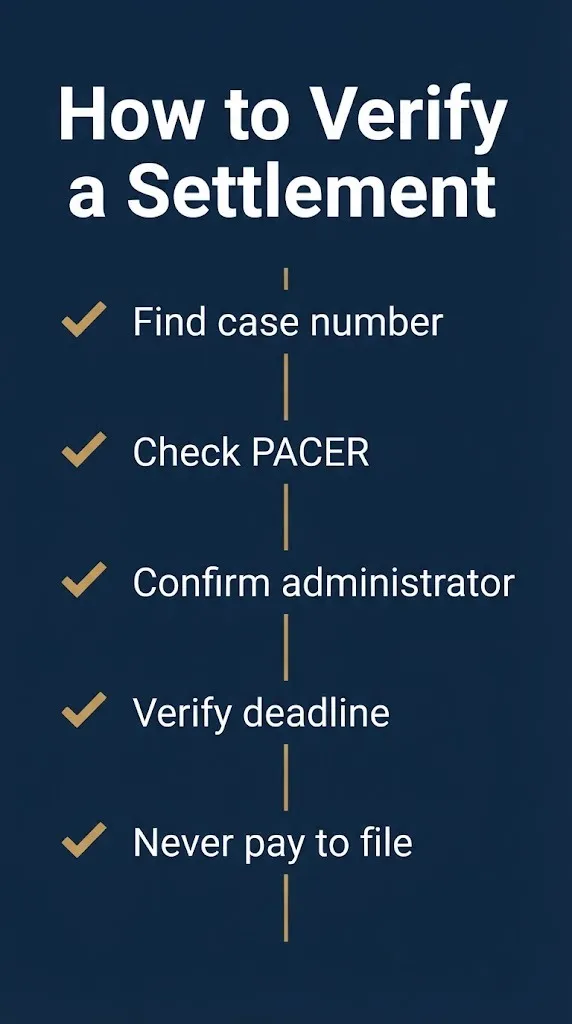
How Do You Check If a David Bar Settlement Is Legitimate?
You check a settlement’s legitimacy by finding the case in a court database, not by trusting the text or email that told you about it.
Follow these five steps:
- Search PACER, the federal court records system, for the case name or product.
- Check the Consumer Financial Protection Bureau’s enforcement action database.
- Look for a settlement administrator website with a .gov or known administrator domain.
- Search the Federal Trade Commission’s press release archive.
- Search established legal news outlets, not social media, for the case name.
If none of these sources show the case, the settlement is not verified.
What Should You Do If You Got a David Bar Settlement Text?
You should not click any link, enter any personal information, or call any number in an unverified settlement text. Legitimate settlement administrators send notices by mail or email from verifiable addresses.
A text message promising settlement money is almost always a scam. Legitimate administrators rarely, if ever, use text messages for first contact.
If you received such a text, report it to the Federal Trade Commission and your state attorney general. Do not reply. Do not send money. No legitimate settlement charges a fee to file a claim.
Reality Check: No one legitimately contacts you by text to give you settlement money first. Filing a claim is always free. Any request for payment, gift cards, or bank login details is a scam, full stop.
Are There Any Real Protein Bar Settlements in 2026?
Yes, real protein bar settlements exist, but none carry the name “David Bar.” Several food labeling class actions have settled or are pending involving well-known brands.
These cases typically involve allegations of misleading protein content or natural claims. Settlement amounts vary widely, from a few dollars per claimant to larger amounts for consumers with proof of purchase.
The existence of real protein bar cases is exactly why fake ones spread. Scammers borrow the credibility of real litigation and attach it to a made-up product name.
What Happens If a David Bar Lawsuit Gets Filed Later?
If a David Bar lawsuit gets filed later, it would follow the standard class action path. A named plaintiff files a complaint in federal or state court. The court certifies a class. The parties either settle or go to trial.
A settlement would then require court approval, a claims administrator, and a notice program. That process takes months or years, not days.
For now, no such case exists. Any website claiming otherwise is ahead of the facts.
Key Takeaway: Class actions move slowly through public court records, and a real case would leave a paper trail.
What Are the Red Flags of a Fake Settlement Notice?
Fake settlement notices share common red flags. They promise large payouts. They use urgency. They ask for personal information upfront.
Here is a checklist of warning signs:
- The notice does not name a court or case number.
- The message arrives by text or social media direct message.
- The website asks for your Social Security number or bank account.
- The “settlement” has no fund size or claim deadline.
- The site charges a fee to file or “expedite” your claim.
- The product name sounds generic or slightly off.
One or two of these is suspicious. Three or more means scam.
How Do Real Class Action Settlements Work?
Real class action settlements follow a fixed legal process. A court approves a settlement fund. A claims administrator sends notice to potential class members. Consumers file claims with proof of purchase.
Here is the timeline:
- A lawsuit is filed and class certification is sought.
- The parties negotiate a settlement and ask the court for preliminary approval.
- A claims administrator creates a website and notice program.
- Consumers file claims before a court-set deadline.
- The court holds a final approval hearing.
- Valid claims are paid from the settlement fund.
Every step generates public court filings. That is why a real case is verifiable.
What Is the Best Way to Find Legitimate Class Action Settlements?
The best way to find legitimate class action settlements is to use trusted aggregators and government sources. Check the FTC, state attorney general press releases, and well-known legal news publishers.
You can also search your email for settlement notices. Legitimate notices come from administrators like Kroll, Epiq, or JND. These companies run official settlement websites.
Avoid random “settlement finder” apps that ask you to create an account before showing details. They often mix real and fake cases.
Could a Company Named David’s Produce a Protein Bar?
Yes, a company could exist with a product called David’s Protein Bar. But existence of a product is not evidence of a lawsuit. Many small brands use first names in their branding.
Without a named defendant, a court, and a filing date, any litigation claim remains unverified. If you know of a specific company with this product name, search PACER using the company’s legal name, not the product nickname.
Key Takeaway: Product names are not the same as company names, and lawsuits name companies, not products.
What Should You Do If You Want to Monitor This Topic?
You should monitor federal court records and trusted legal news sources, not social media. Class action lawsuits are public records. When one is filed, it appears in PACER within days.
Set a calendar reminder to check quarterly. Sign up for email alerts from your state attorney general. Follow consumer protection news from established publishers.
The cost of monitoring is zero. The cost of falling for a fake settlement can be identity theft.
What Happens Next
Until a verified filing appears, there is no timeline to track. Here is what to watch for:
- If a lawsuit is filed: A complaint will appear in federal or state court records.
- If a class is certified: The court will issue a scheduling order.
- If a settlement is reached: A claims administrator will launch an official website.
- If no filing appears: The current absence of records remains the only verified fact.
The single most important action is verification. Do not act on unverified settlement claims. Do not share personal information. Check court records first.
Frequently Asked Questions
Is there a class action lawsuit for David’s Protein Bar?
No verified class action lawsuit exists for David’s Protein Bar as of September 1, 2026.
No federal court docket lists a case with that product name.
Any online claim about such a lawsuit is unverified.
How much is the David Bar settlement payout?
There is no confirmed David Bar settlement payout because there is no confirmed settlement.
Any amount you see online is invented.
Verified payouts require a court-approved settlement fund.
What is the David Bar lawsuit deadline?
There is no verified David Bar lawsuit deadline.
A deadline exists only if a court approves a settlement and sets a claim period.
No such court order has been found.
Is the David Bar settlement text message real?
No verified David Bar settlement text message is real.
Legitimate settlement administrators rarely use text messages for first contact.
Report any such text to the Federal Trade Commission.
Can I file a David Bar claim online?
There is no verified David Bar claim form to file online.
Filing a claim requires an official settlement website with a case number and administrator.
No such website has been confirmed.
What if I bought David’s Protein Bar and feel misled?
You may have rights under state consumer protection laws.
Contact your state attorney general’s office to report misleading labeling.
A private lawsuit or regulatory complaint starts with specific evidence.
How do I know if a class action settlement is real?
A real class action settlement has a court case number and a named administrator.
It appears on a .gov court database like PACER.
It never asks for money to file a claim.
Where can I report a fake settlement notice?
You can report a fake settlement notice to the Federal Trade Commission and your state attorney general.
You can also report it to the Better Business Bureau’s scam tracker.
Do not reply to the sender or click any links.