Tylenol Autism Lawsuit Sign Up 2026: Eligibility, Deadlines, and How to File
Quick Answer
- Sign up means requesting a free case review with a mass tort attorney, not filling out a court form yourself.
- No settlement amount is confirmed; any dollar figure you see online is a projection, not a result.
- The most urgent step is checking your state’s filing deadline, which varies and can end your right to claim.
If you took Tylenol or generic acetaminophen during pregnancy and your child was later diagnosed with autism or ADHD, you may be wondering how to sign up for the lawsuit. The answer is simpler than most people expect: there is no official sign-up form, no class action to join, and no settlement website accepting claims. Instead, you contact a mass tort attorney for a free case review, and that attorney files an individual lawsuit on your family’s behalf if the facts fit.
This matters because the litigation is still in its early stages. The Second Circuit revived the cases on July 13, 2026, but it did not decide whether Tylenol causes autism . No settlement has been reached, and no payout has been ordered. That means anyone promising you a specific dollar amount is guessing. What you can do right now is confirm whether your family’s facts fit the litigation criteria and make sure you don’t miss your state’s filing deadline.
The Facts
Case | In re Acetaminophen ASD-ADHD Products Liability Litigation, MDL No. 3043
Status | Active after July 13, 2026 Second Circuit revival; no settlement reached
Fund Size | Not yet confirmed; no settlement fund exists
Est. Per Person | Not yet determined; no court-approved payout schedule
Claim Deadline | Varies by state statute of limitations; consult an attorney
Administrator | Not yet appointed
Proof Needed | Prenatal acetaminophen use records and child’s ASD/ADHD diagnosis
Is the Tylenol autism lawsuit real or a scam?
The Tylenol autism lawsuit is real, active federal litigation, but you should be skeptical of anyone who contacts you promising money. The cases are consolidated in the Southern District of New York under MDL No. 3043 before Judge Denise Cote . On July 13, 2026, the Second Circuit Court of Appeals revived roughly 550 cases that had been dismissed in 2024 .
The scam risk is real, though. Because no settlement exists, predatory lead-generation sites and “claim aggregators” often use the lawsuit’s name to collect your personal information. They may promise a payout that doesn’t exist or charge a fee to “register” your claim. The legitimate path is a free case review with a qualified mass tort attorney who works on contingency. You should never pay upfront to join this litigation.
Kenvue, the maker of Tylenol, continues to deny any causal link between acetaminophen and autism or ADHD. In a statement after the July ruling, the company said the decision “doesn’t change the fact that credible, independent science shows no proven link” and that it is “exploring all options” including a rehearing request . That defense posture means the litigation will likely take years to resolve.
How much could you get from the Tylenol autism lawsuit?
The amount you could receive is not yet determined because no settlement has been reached and no payout matrix exists. Every dollar figure circulating online is a projection from attorneys or commentators, not a court-approved amount. Some law firm pages discuss severity-based ranges, but they consistently include caveats that no settlement exists and no outcome can be guaranteed .
What factors will likely drive individual case value if a settlement eventually happens?
- Severity of the autism diagnosis. Cases involving Level 3 autism, which requires very substantial daily support, are evaluated differently from milder profiles .
- Quality of documentation. Clear records linking prenatal acetaminophen use to the child’s diagnosis strengthen causation arguments .
- Duration and timing of exposure. Use during the second and third trimesters, and repeated use rather than a single dose, may be more central to the claims .
- Child’s age and custody status. Most firms currently accept cases where the child is under 18 and the mother has custody .
Key Takeaway: There is no confirmed settlement amount for Tylenol autism claims, and any specific dollar figure you see today is an estimate, not a promise. The litigation is active, but the science and the damages remain contested.
Reality Check: No legitimate settlement administrator will text or call you first offering money for a Tylenol autism claim. There is no settlement fund. Filing a case review is free, and attorneys work on contingency. Anyone charging you an upfront fee to “sign up” is not part of the official litigation process.
Who qualifies to sign up for the Tylenol autism lawsuit?
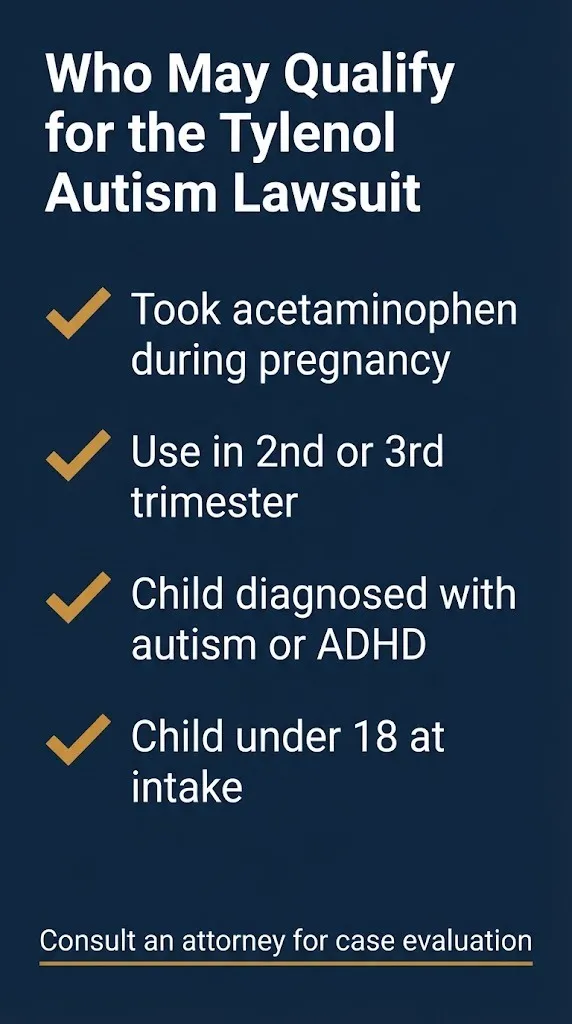
You may qualify to sign up if you took acetaminophen during pregnancy and your child was later diagnosed with autism or ADHD, but eligibility criteria vary by firm and state. Most firms handling these cases describe the following requirements:
- Prenatal exposure: The mother took Tylenol, generic acetaminophen, or store-brand acetaminophen during pregnancy .
- Timing of use: Use occurred during the second or third trimester, according to many firm intake criteria .
- Child’s diagnosis: The child received a formal diagnosis of autism spectrum disorder (ASD) or ADHD from a qualified professional .
- Child’s age: Most firms currently accept cases where the child is under 18 at the time of intake .
- Custody: The mother or legal guardian has custody and is willing to pursue the claim on the child’s behalf .
Some firms note that cases involving only post-birth acetaminophen use typically do not qualify, and cases where the mother cannot document any prenatal use are also weaker .
Tylenol autism lawsuit age limit: What are the rules?
The Tylenol autism lawsuit age limit is generally 18, meaning the child must be under 18 for a parent to file on their behalf, though some states allow claims up to age 20 and minority tolling rules may preserve claims longer. Most current intake criteria specify that the child must be under 18 at the time of screening . Once a child turns 18, they can file on their own behalf, but many firms are not currently accepting adult claimants .
The age limit matters because of how statutes of limitations work for minors. Most states have minority tolling provisions, which pause the filing clock while the child is a minor. In practice, this means the statute of limitations for a child’s claim often does not begin running until they turn 18 . A child diagnosed with autism in 2015, for example, may have a claim preserved until 2033 in a state with minority tolling and an 18-year-old threshold .
This does not mean you should wait. The discovery rule and state-specific rules can complicate the timeline, and attorneys need time to gather records. The safest approach is to contact an attorney now, even if the child is young, so they can evaluate your specific state’s deadline.
How do you sign up for the Tylenol autism lawsuit?
Signing up for the Tylenol autism lawsuit means requesting a free case review and letting an attorney evaluate your family’s facts. There is no court form you fill out yourself. Here are the steps:
- Request a free case review. Contact a mass tort firm handling Tylenol autism cases. The review is confidential and costs nothing .
- Confirm your eligibility. The attorney will ask whether you took acetaminophen during pregnancy and whether your child has an ASD or ADHD diagnosis .
- Gather your documents. Prenatal records, pharmacy history, and your child’s diagnostic evaluation reports are the most important documents. You don’t need everything to start .
- Review and sign a contingency agreement. If the firm accepts your case, you sign an agreement stating you pay no attorney’s fee unless there is a recovery .
- Let the attorney file your claim. The firm prepares and files the lawsuit as part of the MDL and manages the court process for you .
- Stay in contact with your attorney. The litigation will take time, and updates will come through your legal team, not directly from the court.
What documents do you need to sign up?
You do not need every document to start a case review, but having these records ready can speed the process and strengthen your claim:
- Proof of prenatal acetaminophen use. Prenatal visit notes, pharmacy records, receipts, or a consistent account of when and why you used Tylenol .
- Your child’s diagnosis records. Evaluation reports from a physician or psychologist, treatment notes, or school assessments confirming ASD or ADHD .
- Key dates. The approximate dates of your pregnancy and acetaminophen use, and the date of your child’s diagnosis .
- Basic identification. Contact details for you and your child.
If you cannot find some records, attorneys can help request them. Do not let missing documents stop you from making the initial call.
What happens next in the Tylenol autism lawsuit?
The next stages of the litigation are uncertain because Kenvue is seeking a rehearing of the July 13 decision.
Now through late 2026: The Second Circuit will decide whether to grant Kenvue’s petition for rehearing, which was filed on September 10, 2026 . If rehearing is denied, the cases proceed in the district court.
Expected 2027: If the revival stands, the district court will reopen expert proceedings and begin planning for bellwether trials. A trial date is not yet set .
2027 and beyond: Bellwether trials, if they occur, will shape settlement discussions. Any settlement would take additional time to administer and distribute.
For families, the immediate priority is confirming eligibility and filing before any state deadline expires. The litigation’s revival is good news for claimants, but it does not create a settlement or a payout timeline.
Frequently Asked Questions
Is there an official Tylenol autism lawsuit sign-up website?
No, there is no official sign-up website. You sign up by contacting a mass tort attorney for a free case review.
Can I join the Tylenol autism lawsuit if my child is over 18?
Most firms are not currently accepting cases where the child is 18 or older, though the child may be able to file on their own behalf.
How much does it cost to sign up for the Tylenol autism lawsuit?
Nothing. These cases are handled on contingency, meaning you pay no attorney’s fee unless there is a recovery.
What is the deadline to file a Tylenol autism lawsuit?
Deadlines vary by state statute of limitations. Minority tolling may preserve a child’s claim, but consulting an attorney promptly is critical.
Has any Tylenol autism case gone to trial or settled?
No. No case has gone to trial, no settlement has been reached, and no court has found that Tylenol causes autism or ADHD.
What evidence do I need to prove my Tylenol autism claim?
You need proof of prenatal acetaminophen use and your child’s formal ASD or ADHD diagnosis. Attorneys can help gather records.
Can I file a Tylenol autism claim if I used store-brand acetaminophen?
Yes, store-brand acetaminophen is included in the litigation. Retailers like CVS, Walmart, and Walgreens are named as defendants .
The Bottom Line
Signing up for the Tylenol autism lawsuit starts with a free case review, not a court form or a settlement website. The litigation is active again after the July 2026 Second Circuit ruling, but no settlement exists and no payout is confirmed. If you took acetaminophen during pregnancy and your child has an ASD or ADHD diagnosis, contact a qualified mass tort attorney now. The deadline varies by state, and waiting could end your family’s right to file.