Toxic Baby Food Lawsuit 2026: MDL Status, Settlement Outlook, and Which Families May Qualify
Quick Answer
- Is it legit? Yes. Over 100 lawsuits are consolidated in MDL No. 3101 in California.
- How much could you get? Not yet determined. No settlement exists and causation evidence was weakened by a 2026 ruling.
- Key deadline? No claim deadline has been set. Statutes of limitations vary by state and by when you discovered the injury.
You fed your child what you thought was safe food. Years later, they received an autism or ADHD diagnosis. You started searching for answers and found headlines about heavy metals in baby food, congressional reports, and lawsuits against the biggest brands.
The toxic baby food litigation is real, and it’s massive. Hundreds of families have filed claims against Gerber, Beech-Nut, Earth’s Best, Happy Baby, and others. The cases are consolidated in a federal court in California.
But here’s what most headlines don’t tell you: the litigation hit a wall in 2026. A judge excluded the plaintiffs’ key scientific experts, and that ruling could reshape the entire case. No money has been paid. No settlement exists.
The Facts
| Case | In re: Baby Food Products Liability Litigation, MDL No. 3101 |
| Court | U.S. District Court, Northern District of California |
| Status | Active, summary judgment briefing ongoing as of August 2026 |
| Fund Size | Not applicable. No settlement fund exists |
| Est. Per Person | Not yet determined. Speculative at this stage |
| Claim Deadline | TBD. State statutes of limitations vary |
| Administrator | Not yet appointed |
| Proof Needed | Proof of purchase, feeding history, medical diagnosis |
Is the Toxic Baby Food Lawsuit Real or a Scam?
The toxic baby food lawsuit is real, well-documented, and grounded in a 2021 congressional investigation. But scams exist around every high-profile lawsuit, and this one is no exception.
No one will text you about settlement money from this case. There is no fund to distribute. Any message promising payment is a fraud.
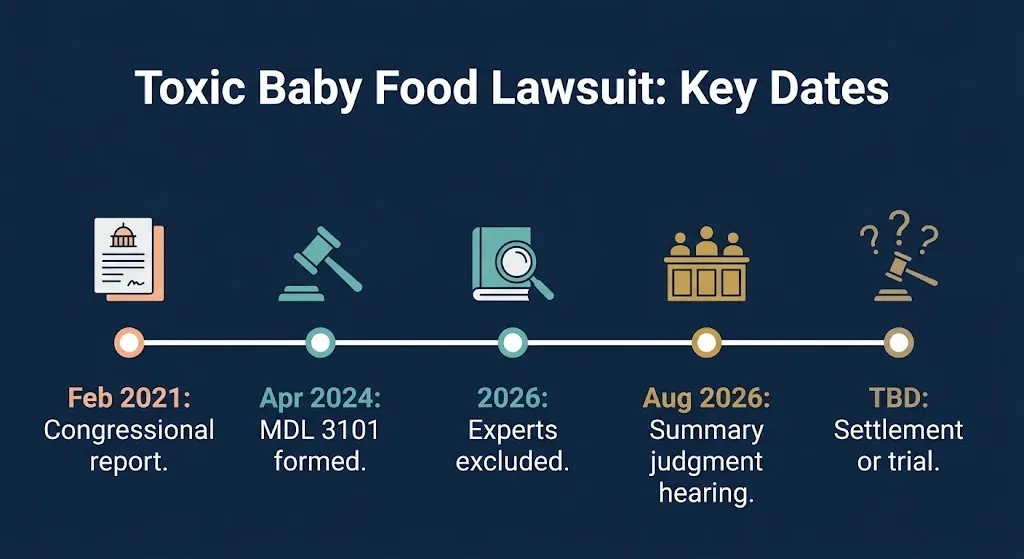
The legitimate litigation traces back to a February 2021 report from the U.S. House Committee on Oversight and Reform. That report found dangerous levels of arsenic, lead, cadmium, and mercury in baby foods from major manufacturers . Internal company documents showed some manufacturers knew about contamination and didn’t warn parents.
Lawsuits followed. By April 2024, the Judicial Panel on Multidistrict Litigation consolidated more than 100 cases into MDL No. 3101, assigned to Judge Jacqueline Scott Corley .
Key Takeaway: This is a real, court-supervised MDL with named defendants and verified congressional findings, not an internet rumor.
How Much Is the Toxic Baby Food Lawsuit Worth?
No settlement amount has been established because no settlement exists. Any dollar figure you see online is speculation.
In April 2026, ConsumerShield published estimated ranges of $350,000 to $1.5 million per case based on the severity of injury . Those are projections, not confirmed payouts. No attorney can promise a specific amount.
Here’s what matters right now: the litigation suffered a major setback in 2026. Judge Corley excluded most of the plaintiffs’ causation experts, ruling that their hypothetical exposure models didn’t represent realistic consumption patterns . Without expert testimony linking baby food to autism or ADHD, plaintiffs face a harder path to proving their claims.
Potential damages categories if cases succeed:
| Damages Type | What It Covers |
|---|---|
| Economic | Medical expenses, therapy, special education, lost earning capacity |
| Non-economic | Pain and suffering, loss of enjoyment of life |
| Loss of consortium | Impact on family relationship |
Who May Qualify for the Toxic Baby Food Lawsuit?
You may qualify if your child regularly consumed a named brand of baby food during infancy and later received a diagnosis of autism, ADHD, or a related neurodevelopmental condition.
The qualification criteria most law firms use include:
- Feeding history: Your child consumed a qualifying product regularly, often defined as at least one year during infancy.
- Diagnosis: A formal medical diagnosis of autism spectrum disorder, ADHD, or another neurodevelopmental condition.
- Timing: The diagnosis occurred after exposure, though the exact window varies.
- Brand connection: You can identify which brand or brands your child consumed.
Brands named in the MDL include Gerber, Beech-Nut, Happy Baby (Nurture, Inc.), Earth’s Best Organic (Hain Celestial), Plum Organics (Campbell Soup), Sprout Organic Foods, and Parent’s Choice (Walmart) .
You don’t need a receipt for every jar. Feeding logs, photos, pediatric records, and your own recollection can help establish the pattern.
Key Takeaway: If your child ate these brands regularly and has a diagnosis, consult an attorney about whether your specific timeline and evidence support a claim.
Reality Check: No Settlement Money Exists in This Case
The toxic baby food lawsuit has not settled. Not one dollar has been paid to any family through this litigation. Anyone claiming otherwise is lying.
Scammers often piggyback on high-profile lawsuits. They call, text, or email claiming you’re owed money from a “baby food settlement” and ask for bank details or upfront fees. Real claim processes are announced through court-approved notices and official settlement websites, never cold calls.
Filing a claim is always free. You never pay to join a lawsuit.
How to File a Toxic Baby Food Lawsuit
Filing a toxic baby food lawsuit starts with a consultation, not a form. Here are the steps:
- Gather your child’s records. Medical diagnosis, treatment history, and any feeding documentation.
- Identify the brand or brands. Which products did your child consume? For how long?
- Consult a mass tort attorney. Most offer free evaluations and work on contingency.
- Check your state’s deadline. Statutes of limitations vary, typically two to four years from discovery .
- Preserve evidence. Save any remaining product packaging, lot numbers, and receipts.
- Understand the MDL process. Your case stays individual for damages, but pretrial proceedings are coordinated.
- Don’t pay anyone upfront. Legitimate attorneys don’t charge fees to evaluate or file claims.
What Happened With the MDL in 2026?
The MDL suffered a significant setback in 2026 when Judge Corley excluded the plaintiffs’ causation experts. That ruling made it harder to prove that heavy metals in baby food caused autism or ADHD.
At an August 2026 hearing, Judge Corley pressed attorneys on the summary judgment motion. She asked plaintiffs to identify injuries beyond autism and ADHD, since the complaints focused on those diagnoses . Defense attorneys argued that references to learning disabilities or speech delays were simply symptoms of the core conditions.
The judge also noted that a plaintiff’s attempt to remand to state court was a “tactical move” . The case remains in federal court.
In a related development, the Supreme Court ruled in February 2026 that a Texas couple could pursue their case against Whole Foods in state court rather than federal court . That ruling addressed jurisdiction, not the merits of whether baby food caused harm.
Which Baby Food Brands Are Named in the Lawsuit?
The lawsuit names most major baby food manufacturers. The 2021 congressional report identified contamination across brands, both conventional and organic.
| Manufacturer | Brand | Products |
|---|---|---|
| Gerber Products | Gerber | Jars, cereals, snacks |
| Beech-Nut | Beech-Nut | Jars, cereals |
| Nurture, Inc. | Happy Baby | Pouches, puffs, cereals |
| Hain Celestial | Earth’s Best Organic | Jars, pouches, cereals |
| Campbell Soup | Plum Organics | Pouches, meals |
| Walmart | Parent’s Choice | Jars, cereals |
| Sprout Foods | Sprout Organic | Pouches, meals |
Organic certification does not mean a product is free of heavy metals. A Healthy Babies Bright Futures study found that 95% of commercial baby food, including organic brands, contained detectable levels of toxic metals .
What Toxic Heavy Metals Were Found in Baby Food?
Four heavy metals were found in baby food products: arsenic, lead, cadmium, and mercury. Each is linked to neurodevelopmental harm.
Inorganic arsenic is linked to central nervous system damage and lowered IQ. Lead has no safe level of exposure for children and is associated with cognitive impairment and behavioral disorders. Cadmium accumulates in growing tissues and may cause learning disabilities. Mercury can cross the blood-brain barrier and disrupt early development .
The congressional report found that some manufacturers tested only individual ingredients, not finished products. That practice allowed contaminated ingredients to slip through without detection in the final food.
Key Takeaway: The FDA has acknowledged that heavy metals occur naturally in soil and water, but lawsuits allege manufacturers could have done more to reduce levels before selling products.
What Happens Next in the Toxic Baby Food Lawsuit
August 2026: Judge Corley held a hearing on the defendants’ summary judgment motion. No ruling has been issued yet .
Expected late 2026: A ruling on summary judgment could dismiss many or all claims if the judge finds insufficient causation evidence.
TBD: Bellwether trials, if the case survives summary judgment.
TBD: Any settlement would be announced through court records and official notices.
Ongoing: New cases are still being filed, though the window narrows as statutes of limitations expire .
Frequently Asked Questions
Is there a toxic baby food settlement in 2026?
No settlement exists as of October 2026. The litigation is in the summary judgment phase with no payout fund.
How much will families get from the baby food lawsuit?
No amount has been determined. Any figures online are speculative estimates, not confirmed payouts.
Which baby food brands are in the lawsuit?
Gerber, Beech-Nut, Happy Baby, Earth’s Best, Plum Organics, Sprout Organic, and Parent’s Choice are named.
How long do I have to file a baby food lawsuit?
Statutes of limitations vary by state, typically two to four years from when you discovered the injury.
What evidence do I need to file a claim?
Proof of purchase, feeding history, and medical records documenting your child’s diagnosis.
Did the baby food lawsuit get dismissed?
No. The case remains active. A judge excluded some expert testimony, but the litigation continues.
Is organic baby food safer than conventional?
Research shows both organic and conventional baby foods contain heavy metals at similar rates.
Can I still file a baby food lawsuit in 2026?
Yes, but time is limited. Consult an attorney about your state’s deadline.
What You Should Do Now
If your child consumed these brands and has an autism, ADHD, or developmental diagnosis, consult a mass tort attorney soon. The statute of limitations clock may already be running in your state.
Gather your records now: medical documentation, any purchase receipts, and a written timeline of what your child ate and when. That preparation strengthens any potential claim.
The most important date is not on a court calendar. It’s the deadline in your state that determines whether you can file at all.