Monsanto Lawsuit 2026: Roundup Litigation Status, Settlement Tiers, and What Claimants Should Know
Quick Answer
- The Monsanto Roundup litigation is real and ongoing, covering individual lawsuits alleging glyphosate causes non-Hodgkin lymphoma.
- No new global settlement exists; prior settlements totaling billions have already resolved many claims, but new cases continue.
- Deadlines are case-specific, not class-wide; anyone with a diagnosis must file individually through retained counsel.
The Monsanto lawsuit landscape in 2026 is not a single class action. It is thousands of individual product liability lawsuits filed against Monsanto and its parent company Bayer. The plaintiffs allege Roundup weed killer, and specifically its active ingredient glyphosate, causes non-Hodgkin lymphoma. Bayer denies the allegations and says the science supports glyphosate’s safety.
Bayer has already paid billions in prior settlements. In 2020, the company announced a settlement framework totaling roughly $10 billion to resolve tens of thousands of claims. That program closed to new entrants. But new lawsuits are still being filed. No new global settlement covers all current cases in 2026.
This article explains what is verified: the status of the litigation, how the prior settlement worked, who may have a current claim, and how to evaluate whether to file. One fact that surprises many readers: there is no class action. Each case is individual, and the strength of your case depends on exposure history, diagnosis, and timing.
The Facts
| Case | Individual product liability lawsuits against Monsanto and Bayer over Roundup |
| Status | Active litigation; no new global settlement in 2026 |
| Fund Size | No new global fund; prior settlement framework totaled roughly $10 billion |
| Est. Per Person | Varies by diagnosis, exposure, and case tier; prior settlements averaged $50,000 to $200,000 per claim |
| Claim Deadline | No class deadline; individual statutes of limitations apply |
| Administrator | Prior settlement used a claims administrator; current cases handled by courts |
| Proof Needed | Medical records, employment or exposure history, diagnosis of non-Hodgkin lymphoma |
Is the Monsanto lawsuit real or a scam?
The Monsanto Roundup litigation is real. It is one of the largest product liability litigations in United States history. The first trials produced verdicts for plaintiffs, including a $289 million award in 2018 that was later reduced but still signaled jury willingness to hold Monsanto accountable.
The litigation is not a class action. It is a mass tort. Each plaintiff files an individual lawsuit. The cases are coordinated in state and federal courts for pretrial purposes, but each case retains its own identity and value.
What is a scam: any text, email, or website that promises you a guaranteed Roundup settlement payout. No guarantee exists. Settlement values depend on medical records, exposure history, and the strength of your specific case. Law firms evaluate cases individually.
You also should not pay upfront fees for a Roundup case. Reputable firms work on contingency. They are paid only if the case resolves in your favor.
Bayer, which acquired Monsanto in 2018, has consistently denied that glyphosate causes cancer. The company points to regulatory decisions from the Environmental Protection Agency and other bodies. The litigation continues despite those regulatory positions.
Key Takeaway: The Monsanto Roundup litigation is a real mass tort, not a class action, and no legitimate lawyer will guarantee a specific payout before reviewing medical records.
How much does a Monsanto lawsuit pay per person?
There is no single answer. Settlement values in the Roundup litigation have varied widely based on diagnosis, exposure length, and whether the case resolved early or late. The 2020 settlement framework allocated payouts based on tiered categories.
Here is what published reports and settlement documents from the 2020 framework indicate for average ranges.
| Claim Tier | Typical Settlement Range | Description |
|---|---|---|
| Tier 1: Limited exposure | $5,000 to $25,000 | Shorter exposure, weaker causation evidence |
| Tier 2: Moderate exposure | $25,000 to $100,000 | Documented occupational or regular use |
| Tier 3: Strong exposure and diagnosis | $100,000 to $250,000 | Long-term use, clear medical record |
| Trial verdict | $500,000 to $2 billion | Jury awards, subject to appeal |
These ranges are historical from the 2020 settlement and prior verdicts. They are not guarantees. New cases filed in 2026 may resolve differently. The legal landscape has shifted as Bayer has won some recent trials and lost others.
The highest values go to cases with long-term occupational exposure, a confirmed non-Hodgkin lymphoma diagnosis, and no significant alternative risk factors. Cases with shorter exposure or ambiguous medical records settle for less.
Reality Check: No one will text you first about a Roundup settlement payment. Legitimate law firms do not charge upfront fees for Roundup cases. Third-party lead generators selling your information to multiple firms can delay your case and create conflicts.
What is the Monsanto lawsuit about?
The Monsanto lawsuit centers on Roundup weed killer and its active ingredient glyphosate. Plaintiffs allege glyphosate causes non-Hodgkin lymphoma, a cancer of the lymphatic system. The litigation began after the International Agency for Research on Cancer, a World Health Organization body, classified glyphosate as probably carcinogenic to humans in 2015.
Monsanto and Bayer argue the weight of evidence shows glyphosate is safe. They cite regulatory approvals from the EPA, the European Food Safety Authority, and other agencies. The company has won several recent trials, which has slowed the filing of new cases.
The legal claims include strict product liability, negligence, failure to warn, and wrongful death. The plaintiffs argue Monsanto knew about the cancer risk and failed to warn consumers, farmers, and groundskeepers.
The litigation has produced mixed trial outcomes. Early verdicts favored plaintiffs with large awards. More recent trials have favored Bayer. The mixed results have made settlement negotiations more complex.
Key Takeaway: The litigation alleges Roundup’s glyphosate causes non-Hodgkin lymphoma, and the mixed trial record has made both settlement and continued litigation uncertain.
Who qualifies for a Monsanto Roundup lawsuit?
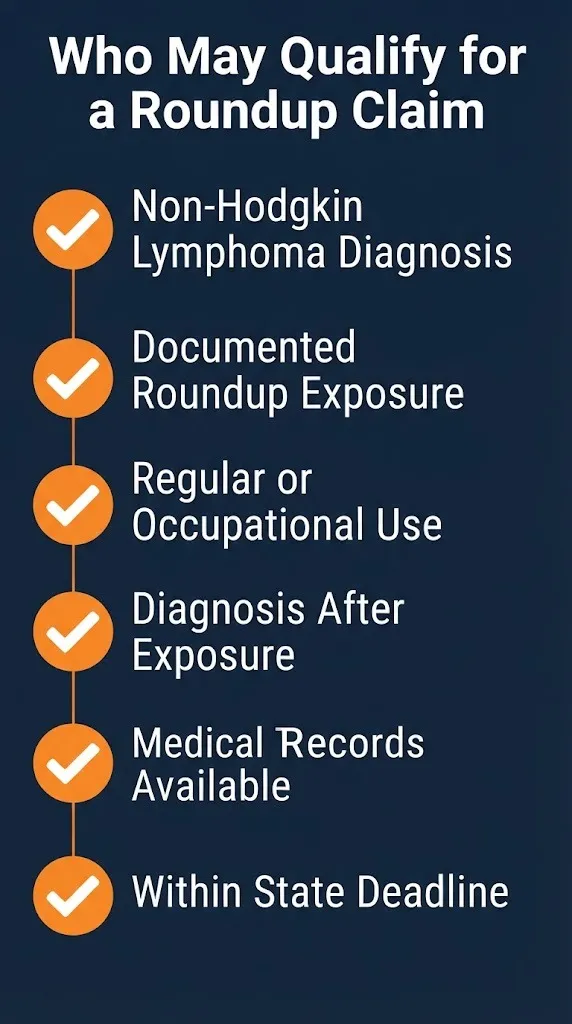
Qualification is determined case by case. There is no class definition. There is no form to file. But the general criteria follow a consistent pattern.
You may have a case if all of the following are true.
- You have a diagnosis of non-Hodgkin lymphoma.
- You used Roundup or other glyphosate-based herbicides.
- Your use was regular or occupational, not a single casual exposure.
- Your diagnosis came after the exposure period.
- You are within the applicable statute of limitations.
The strongest cases involve agricultural workers, groundskeepers, landscapers, and farmers who used Roundup regularly for years. Homeowners who used Roundup occasionally may have weaker cases, but some have still filed successfully.
The diagnosis is the most important fact. The litigation is specific to non-Hodgkin lymphoma. Other cancers are not part of this litigation.
The statute of limitations varies by state. Most states allow two to three years from diagnosis for personal injury claims. Wrongful death claims have separate deadlines. If the diagnosis happened years ago, the deadline may already have passed. The only way to know is to consult a lawyer immediately.
Key Takeaway: Strong cases involve a non-Hodgkin lymphoma diagnosis plus regular, documented Roundup exposure, but statutes of limitations vary by state and can bar late claims.
How do I file a Monsanto Roundup claim?
There is no class claim form. The process starts by contacting a law firm that handles Roundup litigation. The firm reviews your medical records and exposure history. Here is the typical sequence.
- Obtain your complete medical records confirming the non-Hodgkin lymphoma diagnosis.
- Document your Roundup exposure: years, frequency, job titles, and product purchases.
- Contact a law firm with Roundup mass tort experience.
- Sign a medical records release so the firm can obtain records directly from your doctors.
- The firm’s medical expert evaluates whether the case is viable.
- The firm files an individual lawsuit in the appropriate state or federal court.
- The case proceeds through discovery, settlement negotiations, or trial.
The process is more like a warranty claim with full documentation than a quick application. You need the medical records and the exposure history. Without both, the firm cannot evaluate the case.
Do not wait. Records can be lost. Statutes of limitations can expire. The sooner you act, the more options you have.
What happened to the 2020 Monsanto settlement?
The 2020 Monsanto settlement was real. Bayer announced a framework totaling roughly $10 billion to resolve tens of thousands of pending Roundup lawsuits. The settlement was structured in phases and did not resolve all future claims.
The settlement included several components. The largest portion went to resolving current claims. A separate portion addressed future claims through a class agreement, which a court later rejected. Another portion addressed scientific research and safety measures.
The settlement closed to new entrants. If you did not participate in that settlement and your diagnosis came later, you are not bound by it. New cases are filed separately.
The 2020 settlement did not require Bayer to admit wrongdoing. It resolved litigation to reduce uncertainty and legal costs.
Key Takeaway: The 2020 settlement resolved tens of thousands of claims but is closed, and new cases filed in 2026 proceed separately.
Is there a Monsanto class action?
No. The Roundup litigation is a mass tort, not a class action. A class action bundles thousands of similar claims into one case with one settlement fund. A mass tort keeps each case individual.
The difference matters. In a mass tort, each plaintiff has their own medical records, exposure history, and settlement value. One plaintiff’s outcome does not automatically determine another’s.
The Roundup litigation was consolidated into multidistrict litigation in federal court for pretrial purposes. That is a procedural coordination, not a class action. The cases were later remanded to their home courts for trial.
Some law firm advertising uses the word class action loosely. That is inaccurate. There is no certified Roundup class action in 2026.
When will Monsanto Roundup payouts happen?
For new cases filed in 2026, no payment timeline exists. Settlement depends on the strength of the individual case, the court’s schedule, and Bayer’s litigation strategy. Some cases settle within 12 to 18 months. Others go to trial.
Here is the typical timeline for a new Roundup case.
| Stage | Typical Timeframe |
|---|---|
| Case evaluation and filing | 1 to 3 months |
| Discovery | 6 to 12 months |
| Settlement negotiations | 12 to 24 months |
| Trial, if no settlement | 2 to 3 years |
| Appeal, if any | 6 to 18 months |
The timeline is comparable to a delayed tax refund. You file. You wait. The process moves. You wait more. The final amount is uncertain until the end.
Bayer has shown a willingness to settle strong cases and defend weak ones. The mixed trial record means the company is more selective than it was in the early years of the litigation.
What is the statute of limitations for a Monsanto lawsuit?
The statute of limitations varies by state. Most states allow two to three years from the date of diagnosis for personal injury claims. Wrongful death claims have separate deadlines, usually one to three years from the date of death.
The clock starts at diagnosis, not at exposure. Roundup has been used for decades, but the legal deadline runs from when the cancer was discovered. If you were diagnosed with non-Hodgkin lymphoma in 2024, you may still have time depending on your state.
Some states apply a discovery rule. The clock starts when you knew or should have known the cancer was linked to Roundup. That could extend the deadline in some cases. Do not rely on that exception without legal advice.
Here are common state deadlines for personal injury claims.
| State | Deadline from Diagnosis |
|---|---|
| California | 2 years |
| Texas | 2 years |
| Florida | 4 years |
| New York | 3 years |
| Pennsylvania | 2 years |
| Illinois | 2 years |
This is a sample, not a complete list. Your state’s law may differ. The only safe move is to contact a lawyer immediately after diagnosis.
Key Takeaway: Statutes of limitations run from diagnosis, not exposure, but deadlines vary by state and waiting can permanently bar a claim.
What should I do if I have a potential Monsanto claim?
Take these steps now.
- Confirm the non-Hodgkin lymphoma diagnosis with your oncologist.
- Write down your complete Roundup exposure history: years, frequency, job titles.
- Gather any product receipts, purchase records, or employment records.
- Gather medical records, including pathology reports and treatment summaries.
- Contact a law firm with Roundup experience for a free case evaluation.
- Do not sign any settlement offer or release from Bayer without legal review.
- Keep a symptom and treatment journal for medical and legal records.
The exposure history is the most valuable document you can create. Memory fades. Coworkers die. Records get lost. Write it down now.
What Happens Next
Within weeks of diagnosis: Meet with a specialist and document exposure history.
Within 1 to 3 months: Your lawyer gathers medical and exposure evidence.
Within 6 to 12 months: Discovery and case evaluation occur.
Within 12 to 24 months: Settlement negotiations may produce an offer.
If no settlement: Trial dates are set, potentially 2 to 3 years out.
These timelines are estimates. Each case moves on its own schedule.
Frequently Asked Questions
Is the Monsanto Roundup settlement still open?
No. The 2020 settlement framework closed to new claimants. New cases are filed individually.
Can I still file a Roundup lawsuit in 2026?
Yes, if you have a non-Hodgkin lymphoma diagnosis and documented Roundup exposure within the applicable statute of limitations.
How much is the average Roundup settlement?
Historical averages from the 2020 framework ranged from $50,000 to $200,000 per claim, but each case depends on exposure and diagnosis strength.
Is there a Monsanto class action for Roundup?
No. The litigation is a mass tort with individual lawsuits, not a class action.
What cancer does the Roundup lawsuit cover?
The litigation covers non-Hodgkin lymphoma specifically. Other cancers are not part of this mass tort.
Do I need a lawyer for a Roundup claim?
Yes. These are complex product liability cases requiring medical experts. Reputable lawyers work on contingency.
What proof do I need for a Roundup lawsuit?
A confirmed non-Hodgkin lymphoma diagnosis and documentation of regular Roundup exposure are essential.
Can family members file for a deceased Roundup victim?
Yes. Wrongful death claims are available to spouses, children, and sometimes other dependents. Deadlines apply.
The Monsanto Roundup litigation is real, active, and individual. No class action exists. No new global settlement covers current cases. The 2020 settlement resolved many older claims but closed to new entrants. If you have a non-Hodgkin lymphoma diagnosis and a history of Roundup exposure, the most important action is to document everything and contact a qualified lawyer now. The statute of limitations runs from diagnosis, not exposure. Waiting is the single most common way people lose valid claims. The people who recover the most are the ones who act before deadlines pass and keep their records intact.