Toyota UA80 Transmission Lawsuit 2026: Defect Claims, Affected Models, and What Owners Should Know
Quick Answer
- The Toyota UA80 lawsuit is real and alleges the 8-speed automatic transmission has shifting defects and premature failures.
- No settlement fund exists; payout amounts are not determined pending class certification and discovery.
- No claim deadline applies because the class has not been certified and no settlement has been approved.
The Toyota UA80 transmission lawsuit is real. It targets the 8-speed automatic transmission used in several Toyota and Lexus models. Owners allege the transmission hesitates, jerks, slips, and fails prematurely. The case is pending in federal court as a proposed class action.
If you own a Toyota or Lexus with the UA80 transmission and experienced shifting problems, you may eventually be included in a class. No class has been certified yet. No settlement exists. No recall has been issued for this specific defect.
This article explains the verified facts: what the UA80 transmission is, which vehicles use it, what the lawsuit alleges, who may qualify, and what to do now. One fact that surprises many owners: Toyota has issued technical service bulletins about the transmission, but those bulletins are not the same as a recall and do not automatically extend your warranty.
The Facts
| Case | Proposed class action against Toyota over UA80 transmission defects |
| Status | Active federal litigation, class certification pending |
| Fund Size | Not applicable; no settlement exists |
| Est. Per Person | Not determined; similar transmission cases have paid $1,000 to $5,000 per vehicle |
| Claim Deadline | None; no class certified |
| Administrator | None appointed |
| Proof Needed | Likely vehicle records, repair invoices, and proof of ownership if a settlement occurs |
Is the Toyota UA80 transmission lawsuit real or a scam?
The Toyota UA80 transmission lawsuit is real. It is a filed federal class action, not a social media rumor. The case is pending in the U.S. District Court for the Central District of California. The docket is public. The allegations are specific and documented.
The lawsuit alleges the UA80 8-speed automatic transmission suffers from a design defect that causes harsh shifting, delayed engagement, shuddering, and in some cases complete transmission failure. The plaintiffs claim Toyota knew about the defect and failed to disclose it.
Toyota denies the allegations. The company has not issued a recall for the UA80 transmission. It has issued technical service bulletins for certain shifting behaviors, but those bulletins are not admissions of a defect.
What is a scam: any message or website claiming you can join the Toyota transmission lawsuit by paying a fee. You never pay to join a class action. There is no registration. If a settlement is approved, the claim process will be free.
Also be wary of sites claiming a Toyota transmission settlement is open now. No settlement exists. No claim window is open. Any site asking for your vehicle information and payment is likely a lead-generation or phishing operation.
Key Takeaway: The Toyota UA80 lawsuit is a real class action in federal court, but no settlement or claim process exists, and no legitimate class action charges a fee to join.
How much could the Toyota transmission lawsuit pay per vehicle?
No settlement amount is determined. The case has not reached the settlement stage. Any number online is speculation. But similar transmission defect class actions provide a useful reference.
| Case Type | Typical Per-Vehicle Payout |
|---|---|
| Transmission defect with repair reimbursement | $1,000 to $5,000 |
| Diminished value claim without repair | $500 to $2,000 |
| Full transmission replacement reimbursement | $3,000 to $7,000 |
These ranges come from prior automotive defect class actions involving transmissions from Ford, Nissan, and Honda. They are not predictions for Toyota. The UA80 case could settle for more or less.
The potential payout depends on several factors. Did you pay for repairs? Do you have repair invoices? How many miles were on the vehicle when the problem started? Did Toyota deny a warranty claim? Vehicles with documented repair costs and denied warranty claims typically receive higher payments.
If the case settles, the claim process would likely require proof of ownership and repair records. Owners who paid out of pocket for transmission repairs would likely receive more than owners who only experienced shifting roughness without repairs.
Reality Check: No one will call you to confirm a Toyota transmission settlement payment. Filing a claim is always free. Third-party services that charge to file on your behalf are unnecessary and may be data collection operations.
What is the Toyota UA80 transmission?
The UA80 is an 8-speed automatic transmission used in several Toyota and Lexus vehicles. It is also known as the AWF8F35 in some applications. The transmission debuted in the mid-2010s and is used in front-wheel-drive and all-wheel-drive platforms.
The UA80 is a conventional torque-converter automatic, not a continuously variable transmission or dual-clutch unit. It is designed for smooth shifts and fuel efficiency. Toyota has used it across a wide range of models, from the Camry to the Highlander to the Sienna.
The transmission is built in multiple factories, including Toyota’s plants in Japan and the United States. The lawsuit alleges the defect exists across model years and production locations.
Owners report several symptoms. The most common are hard shifts between first and second gear, delayed engagement when shifting from park to drive, shuddering under light acceleration, and in severe cases, complete loss of drive.
Key Takeaway: The UA80 is Toyota’s 8-speed automatic transmission used in several popular models, and the lawsuit claims a design defect causes shifting problems across the lineup.
Which Toyota models use the UA80 transmission?
The UA80 transmission is used in a broad range of Toyota and Lexus vehicles. The exact model years vary by vehicle. Here are the most common applications, based on the lawsuit allegations and public vehicle specifications.
| Vehicle | Approximate Model Years |
|---|---|
| Toyota Camry | 2018 to present |
| Toyota Avalon | 2019 to 2022 |
| Toyota Highlander | 2020 to present |
| Toyota Sienna | 2021 to present |
| Toyota RAV4 | 2019 to present |
| Lexus ES | 2019 to present |
| Lexus RX | 2016 to present |
This list is not exhaustive. The transmission is also used in some Toyota Corolla and Lexus NX applications, depending on the engine and drivetrain configuration. The exact affected years will be defined by the class certification order if the case reaches that stage.
Do not assume your vehicle is included based on this list alone. The class definition will specify the exact models, years, and production ranges. The complaint provides allegations. The court will decide the scope.
What does the lawsuit allege Toyota did wrong?
The lawsuit alleges Toyota knew about the UA80 transmission defect and failed to disclose it. The plaintiffs claim the company sold vehicles with a transmission that was not fit for normal use and then denied warranty claims when owners complained.
The specific allegations include design defect, breach of express and implied warranty, and violations of state consumer protection laws. The plaintiffs also allege Toyota’s technical service bulletins prove the company knew about the shifting problems but did not tell consumers.
Here is the core claim sequence.
- Toyota designed and manufactured the UA80 transmission with a defect.
- The defect causes harsh shifting, shuddering, and premature failure.
- Toyota knew about the problem through warranty claims and dealer reports.
- Toyota failed to disclose the defect to consumers.
- Owners paid for repairs or received diminished-value vehicles.
Toyota denies these allegations. The company has argued in court filings that the transmission operates as designed and that shifting characteristics vary based on driving conditions and maintenance history.
Key Takeaway: The lawsuit claims Toyota knew about the transmission defect and failed to disclose it, while Toyota argues the transmission operates as designed.
How do I check if my Toyota has the UA80 transmission?
You can identify the transmission in several ways. The most reliable is the vehicle identification number, or VIN. A Toyota dealer can decode the VIN and confirm the transmission type.
Here are the steps.
- Locate your VIN on the driver’s side dashboard or door jamb.
- Contact a Toyota or Lexus dealer and ask for the transmission code.
- Check your vehicle’s window sticker or original sales documents.
- Look for the transmission code on the driver’s side door sticker.
- Compare the code to the UA80 or AWF8F35 designation.
The door sticker often shows a transmission code. The code for the UA80 may appear as 8AT or a specific production code. If you are unsure, the dealer is the fastest confirmation source.
Do not rely on online forums alone. Transmission codes vary by engine, drivetrain, and model year. A forum post may reference a different configuration than your vehicle.
What should I do if my Toyota transmission is having problems?
Take these steps now. Documentation is the most important factor in any potential future claim.
- Note the symptoms: when they occur, under what conditions, and how often.
- Take video of the tachometer or shifting behavior if it is visible.
- Schedule a diagnosis with a Toyota or Lexus dealer.
- Ask for a written diagnostic report and repair estimate.
- Keep all repair invoices and service records.
- If the dealer denies a warranty claim, request the denial in writing.
- Check for open technical service bulletins that apply to your vehicle.
- File a complaint with the National Highway Traffic Safety Administration, or NHTSA.
The NHTSA complaint matters. A high volume of complaints can trigger an investigation. It also creates a public record that strengthens the class action.
The process is like a warranty claim. The manufacturer will ask for proof of the problem. Your records are the proof. The stronger the paper trail, the stronger your position.
Key Takeaway: Document every symptom, keep every repair record, and file an NHTSA complaint if your UA80 transmission is misbehaving.
Is there a Toyota UA80 transmission recall?
No. There is no recall for the UA80 transmission as of August 2026. Toyota has issued technical service bulletins for certain shifting behaviors, but those bulletins are not recalls.
A recall is a formal notice to NHTSA that a vehicle has a safety defect. It requires the manufacturer to notify owners and repair the defect at no cost. A technical service bulletin is an internal document for dealers. It describes how to diagnose and repair a known condition. It is not sent to owners.
The distinction matters. A technical service bulletin does not extend your warranty. It does not require Toyota to repair your vehicle for free. If your vehicle is outside the warranty period, a bulletin may not help you unless Toyota decides to offer a customer satisfaction program.
Some automakers issue customer satisfaction programs or extended warranties after a pattern of complaints. Toyota has done this for other components. It has not done so for the UA80 transmission as of this writing.
When will the Toyota transmission lawsuit settle?
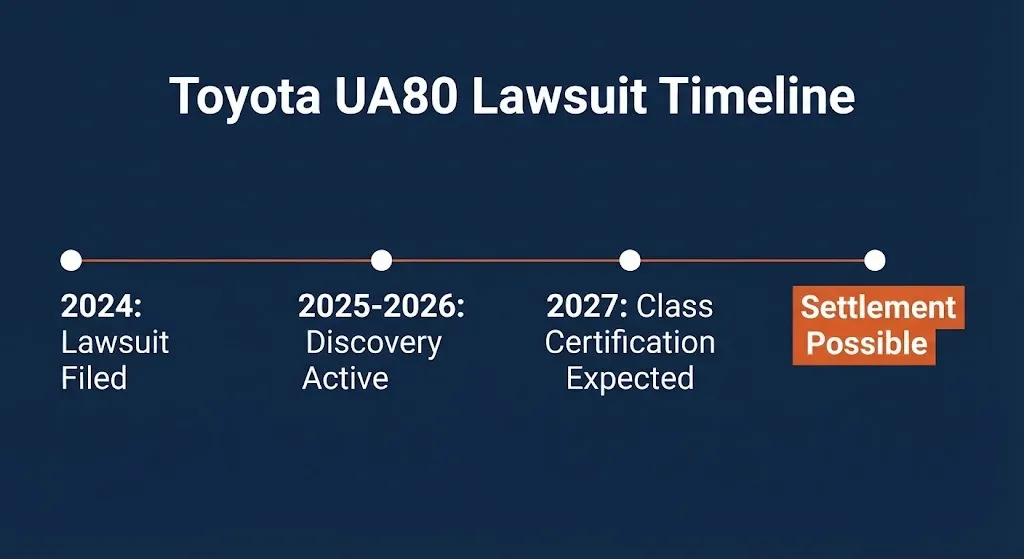
No settlement has been reached. No date is scheduled. The case is still in the pre-certification stage. Class certification is the next major milestone.
Here is the expected timeline, based on similar automotive class actions.
| Milestone | Expected Timing |
|---|---|
| Class certification decision | 2027 |
| Discovery and expert reports | 2027 to 2028 |
| Settlement or trial | 2028 to 2029 |
| Claim window if settled | 2029 |
| Payments issued | 2029 to 2030 |
This timeline is an estimate. Automotive class actions are slow. They involve engineering experts, vehicle testing, and large volumes of warranty data. The outcome depends on how the court rules on class certification.
If the court denies certification, the named plaintiffs may appeal. The case could end or continue in a different form. If certification is granted, settlement pressure increases significantly.
Key Takeaway: The earliest realistic settlement window is 2028 or later, and class certification in 2027 is the next major decision point.
What Happens Next
2027: The court is expected to rule on the class certification motion.
2027 to 2028: If certified, the case moves into deeper discovery and expert analysis.
2028 to 2029: Settlement negotiations or trial preparation intensify.
2029: A claim window could open if a settlement is approved.
2029 to 2030: Payments could be issued, assuming no successful appeals.
These dates are estimates. They can change.
Frequently Asked Questions
Is the Toyota UA80 transmission lawsuit a class action?
Yes. It is a proposed class action pending in federal court. The class has not been certified yet.
Which vehicles are affected by the UA80 lawsuit?
The proposed class includes several Toyota and Lexus models from roughly 2016 onward, including Camry, Highlander, Sienna, RAV4, and Lexus ES and RX.
Is there a Toyota transmission recall?
No. There is no recall for the UA80 transmission. Technical service bulletins exist but are not recalls.
How do I join the Toyota transmission lawsuit?
You cannot join. If a class is certified, you may be automatically included if you meet the class definition.
What proof do I need for a Toyota transmission claim?
Nothing is required now. If a settlement occurs, proof of ownership and repair records would likely be required for higher payment tiers.
How much will I get from the Toyota lawsuit?
Nothing is determined. Similar transmission cases have paid $1,000 to $5,000 per vehicle with repair documentation.
What should I do if my transmission is failing?
Document the symptoms, get a dealer diagnosis, keep repair records, and file an NHTSA complaint.
Will Toyota extend my transmission warranty?
No extension has been announced. The technical service bulletins do not extend warranty coverage.
The Toyota UA80 transmission lawsuit is real but unresolved. No class has been certified. No settlement exists. No recall has been issued. The next major milestone is the class certification decision, expected in 2027. If you own an affected vehicle, the most important thing you can do is document everything: symptoms, dealer visits, repair invoices, and NHTSA complaints. That paper trail is what will protect your position if the case eventually settles. The people who recover the most are the ones who kept records before the settlement was announced.