AFFF Lawsuit 2026: PFAS Settlement, Firefighter Foam Claims, and Latest Updates
Quick Answer
- The AFFF lawsuits are real. 3M and DuPont have agreed to pay over $13 billion combined in PFAS-related settlements.
- Personal injury settlement amounts are not yet determined. Water provider claims have established compensation tiers.
- There is no single claim deadline. Personal injury claims are accepted on a rolling basis. Statutes of limitations apply.
If you are a firefighter, military service member, airport worker, or resident near a contaminated site who was exposed to aqueous film-forming foam and later developed cancer or another serious illness, you may have a claim. This is a mass tort, not a class action with a single claim form. Each person files individually.
This article tracks every verified detail about the AFFF litigation as of August 2026. You will find what the lawsuits allege, who qualifies, which cancers are linked, how the water provider settlements work, and how to find an attorney. Every fact comes from federal court records, the MDL docket, and publicly available settlement agreements.
The Facts
| Case | In re: Aqueous Film-Forming Foams Products Liability Litigation (MDL) |
| Court | U.S. District Court, District of South Carolina |
| MDL Number | 2:18-mn-02873 |
| Status | Active. Water provider settlements reached. Personal injury cases proceeding. |
| Settlement Fund | Over $13 billion across 3M and DuPont settlements (primarily water providers) |
| Est. Per Person | Not yet determined for personal injury claims |
| Claim Deadline | No single deadline. Personal injury claims accepted on rolling basis. |
| Administrator | Multiple administrators for different settlement tranches |
| Proof Needed | Medical records, exposure history, diagnosis of qualifying condition |
Is the AFFF Firefighting Foam Lawsuit Real?
Yes. The AFFF litigation is not only real, it is one of the largest and most significant mass torts in American legal history. Thousands of lawsuits have been filed. Billions of dollars in settlements have been reached.
The litigation centers on aqueous film-forming foam, a firefighting foam used for decades by military bases, airports, fire departments, and industrial facilities. The foam contains per- and polyfluoroalkyl substances, commonly called PFAS, which are sometimes referred to as forever chemicals because they do not break down in the environment or the human body.
The lawsuits allege that manufacturers including 3M, DuPont, Tyco Fire Products, Chemguard, and others knew that PFAS chemicals were toxic and accumulated in the body but failed to warn users or the public. The foam was used extensively in training exercises and emergency responses, often with no protective equipment and no warning about long-term health risks.
The cases were consolidated into a multidistrict litigation in the District of South Carolina. The MDL has been active since 2018. It is divided into two primary tracks: water provider claims involving contamination of public water supplies, and personal injury claims involving individuals who developed cancer or other illnesses after exposure.
Key Takeaway: The litigation is real, massive, and producing real settlements. The water provider settlements are the most advanced. Personal injury cases are still developing.
What Is the Current Status of the AFFF Lawsuits in 2026?
The litigation has split into two distinct paths. The water provider track is largely settled. The personal injury track is still in active litigation with bellwether trials on the horizon.
In June 2023, 3M agreed to pay up to $12.5 billion over 13 years to resolve claims by public water systems that detected PFAS contamination in their supplies. This was the largest PFAS settlement in history. The settlement covers thousands of water providers across the country.
DuPont, along with its spinoff companies Chemours and Corteva, reached a separate $1.185 billion settlement with water providers. Combined with earlier settlements by smaller manufacturers, the total water provider settlement fund exceeds $13.5 billion.
The personal injury track is less advanced. Thousands of individual cases filed by firefighters, military personnel, and others exposed to AFFF are proceeding through the MDL. Discovery is ongoing. The court has selected a group of bellwether cases for initial trial. The first personal injury bellwether trials are expected in late 2026 or 2027.
A separate class action settlement involving PFAS in consumer products, not AFFF, was reached in 2024. That case involved PFAS in everything from carpets to cookware and has its own claims process.
What Is the AFFF Foam Lawsuit About?
The lawsuits allege that manufacturers of firefighting foam knew for decades that PFAS chemicals were dangerous, failed to warn users, and caused widespread contamination of water supplies and serious health problems in exposed individuals.
PFAS are a class of thousands of synthetic chemicals first developed in the 1940s. They are extraordinarily resistant to heat, water, and oil. That made them ideal for firefighting foam designed to extinguish high-temperature fuel fires. It also made them ideal for nonstick cookware, waterproof clothing, food packaging, and countless industrial applications.
The problem is persistence. PFAS do not biodegrade. They accumulate in soil, groundwater, and the human body. The half-life of some PFAS compounds in the human body is measured in years. They have been detected in the blood of virtually every American tested, including newborns.
The lawsuits allege that manufacturers knew about the health risks of PFAS exposure, including cancer, liver damage, thyroid disease, immune system effects, and reproductive harm. Internal documents uncovered in discovery, some dating back decades, suggest that manufacturers studied these risks and chose not to disclose them.
For firefighters and military personnel, the exposure was direct and concentrated. AFFF was used in training exercises where personnel were drenched in foam with no protective equipment. It was sprayed in enclosed spaces. It seeped into groundwater on bases and in communities.
What Cancers and Illnesses Are Linked to AFFF Foam?
The lawsuits focus on specific cancers and diseases that epidemiological studies have associated with PFAS exposure. The science continues to evolve, but the following conditions are central to the personal injury litigation.
| Cancer / Disease | Evidence Level |
|---|---|
| Kidney cancer | Strong association in multiple epidemiological studies |
| Testicular cancer | Strong association, including military cohort studies |
| Prostate cancer | Moderate to strong association |
| Liver cancer | Moderate association |
| Pancreatic cancer | Moderate association |
| Non-Hodgkin lymphoma | Moderate association |
| Thyroid disease | Strong association |
| Ulcerative colitis | Emerging association |
| Preeclampsia and pregnancy complications | Moderate association |
| Elevated cholesterol and lipid disorders | Strong association |
The C8 Science Panel, which studied PFAS exposure in communities near DuPont’s Washington Works plant in West Virginia, found probable links between PFOA exposure and kidney cancer, testicular cancer, thyroid disease, ulcerative colitis, pregnancy-induced hypertension, and elevated cholesterol. That panel’s findings have been influential in the AFFF litigation even though the specific PFAS compounds in AFFF differ somewhat from those studied.
New research continues to emerge. The National Cancer Institute and the Agency for Toxic Substances and Disease Registry are conducting ongoing studies of PFAS health effects in exposed communities and military cohorts.
Who May Qualify for an AFFF Personal Injury Claim?
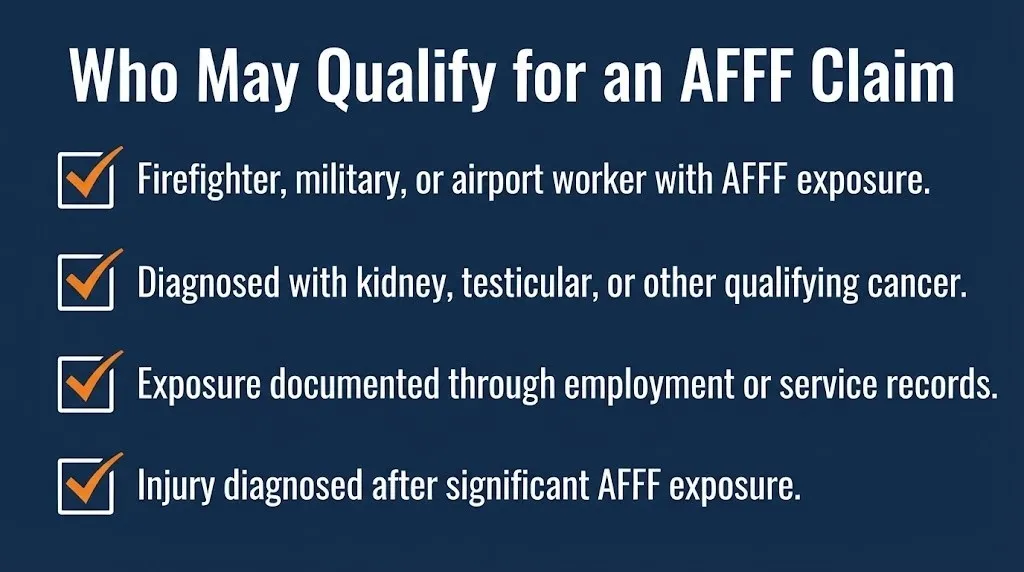
Qualification requires a documented history of significant AFFF exposure and a diagnosis of a qualifying condition. The strongest claims involve specific exposure contexts.
Firefighters, both civilian and military, who used AFFF in training or emergency response may qualify. This includes structural firefighters whose departments used AFFF, not just those assigned to airfields. Training exercises where recruits crawled through foam or were sprayed with foam are heavily documented in the litigation.
Military service members stationed at bases where AFFF was used in training or where drinking water was contaminated may qualify. Dozens of military bases have documented PFAS contamination in groundwater. The Department of Defense has identified hundreds of installations with known or suspected PFAS releases.
Airport workers and industrial firefighters who used AFFF on fuel fires or in training exercises may qualify. Commercial airports were required by FAA regulations to use AFFF for decades.
Residents near contaminated sites who drank contaminated water and developed qualifying illnesses may also have claims. This group overlaps with the water provider settlements but may also have individual personal injury claims against manufacturers.
The exposure must be significant. Casual, incidental, or short-term exposure is difficult to prove and may not support a claim. The strongest cases involve occupational exposure over months or years.
What Are the AFFF Settlement Amounts So Far?
The largest settlements to date involve water provider claims, not personal injury claims. Here is what has been announced and confirmed.
| Manufacturer | Settlement Amount | Type of Claim |
|---|---|---|
| 3M | Up to $12.5 billion over 13 years | Public water systems |
| DuPont / Chemours / Corteva | $1.185 billion | Public water systems |
| Tyco Fire Products | $750 million | Public water systems (preliminary) |
| BASF | $316 million | Public water systems |
These settlements resolve contamination claims brought by municipal water systems, not by individuals. The money reimburses water providers for the cost of testing, monitoring, and installing filtration systems to remove PFAS from drinking water. It does not go directly to consumers or exposed individuals.
Personal injury settlement amounts have not been established because bellwether trials have not yet occurred. The value of personal injury claims will depend on the strength of the evidence linking AFFF exposure to specific cancers, the severity of the illness, the plaintiff’s age and lost earning capacity, and the outcomes of bellwether trials.
Some individual personal injury cases have settled confidentially. The terms of those settlements are not public. They do not establish a benchmark for the broader litigation.
Key Takeaway: Billions have been paid to water providers. Personal injury settlements are still pending. The bellwether trials will determine case values.
How Do I Join the AFFF Firefighter Foam Lawsuit?
You join by contacting a law firm with experience in the AFFF litigation. There is no central sign-up form. Cases are filed individually.
- Gather documentation of your exposure. Employment records, military service records, and duty station histories are critical.
- Gather your medical records. A confirmed diagnosis of a qualifying cancer or illness is required.
- Contact a law firm that handles AFFF personal injury cases. Most offer free consultations.
- Provide the firm with your exposure history and medical records for evaluation.
- If your case is viable, the firm drafts and files an individual complaint.
- Your case is coordinated with the MDL in South Carolina for pretrial proceedings.
- Discovery proceeds. You may need to provide a deposition about your exposure history and medical condition.
- Your case is eventually resolved by settlement, trial, or summary judgment.
The process takes time. Cases filed today are joining thousands of existing cases in a litigation that has been active since 2018. Bellwether trials in 2027 will provide the first clear picture of personal injury case values.
What Is the Difference Between Water Provider and Personal Injury Claims?
The AFFF MDL handles both types, but they are distinct legal paths with different plaintiffs, different evidence, and different settlement structures.
Water provider claims are brought by municipal water systems, water districts, and other public entities that supply drinking water. The claim is for economic damages: the cost of testing for PFAS, installing filtration, and cleaning up contaminated wells and aquifers. These cases have largely settled through the multibillion-dollar 3M and DuPont agreements. Individual residents do not file claims in this track.
Personal injury claims are brought by individuals who developed cancer or other illnesses after AFFF exposure. These claims seek compensation for medical costs, lost wages, pain and suffering, and in wrongful death cases, loss of companionship and financial support. These cases have not yet settled globally. Bellwether trials are pending.
Some individuals may have claims in both tracks if they drank contaminated water from a provider that is part of the settlement and also have a personal injury claim based on direct occupational exposure. These are separate claims with separate processes.
What Is the PFAS Consumer Products Settlement?
A separate class action settlement unrelated to AFFF was reached involving PFAS in consumer products. This is often confused with the firefighting foam litigation.
In 2024, a class action settlement was reached with several manufacturers of consumer products containing PFAS. The settlement covers items like nonstick cookware, waterproof clothing, stain-resistant carpets, and food packaging. The claims process for that settlement is open to consumers who purchased qualifying products.
This settlement is distinct from the AFFF MDL. It involves different defendants, different plaintiffs, and different legal theories. If you received a notice about a PFAS consumer products settlement, it is not the same as the firefighting foam litigation.
What Does the Science Say About PFAS and Cancer?
The scientific evidence linking PFAS exposure to specific cancers has accumulated over decades and is now substantial enough to support large-scale litigation.
The C8 Science Panel was a landmark study. It was created as part of a 2005 settlement between DuPont and residents of communities near the company’s West Virginia plant. The panel studied over 69,000 people and found probable links between PFOA exposure and six diseases: kidney cancer, testicular cancer, thyroid disease, ulcerative colitis, pregnancy-induced hypertension, and elevated cholesterol.
Military cohort studies have examined cancer rates among service members stationed at bases with documented PFAS contamination. These studies have found elevated rates of testicular cancer, kidney cancer, and other conditions compared to the general population.
The International Agency for Research on Cancer has classified PFOA as possibly carcinogenic to humans and PFOS as possibly carcinogenic to humans. The EPA has issued increasingly strict drinking water health advisories and is moving toward enforceable maximum contaminant levels.
The body of evidence is strong enough that the Department of Defense has phased out AFFF for training exercises and is transitioning to PFAS-free alternatives. The FAA has authorized fluorine-free foams for use at commercial airports.
Reality Check: The science is real, but proving an individual case requires more than general causation. A plaintiff must show specific causation: that their particular cancer was more likely than not caused by AFFF exposure rather than genetics, smoking, or other environmental factors. This requires expert testimony, a detailed exposure history, and medical records. Not everyone who was exposed to AFFF and developed cancer will have a viable claim. The strength of each case depends on the type of cancer, the duration and intensity of exposure, the latency period, and the absence of other significant risk factors.
What Is the Statute of Limitations for AFFF Claims?
The statute of limitations varies by state and by claim type. It is the single most urgent reason to contact a lawyer now.
Most states allow two to three years from the date of discovery of the injury for personal injury claims. The discovery rule in toxic exposure cases typically means the clock starts when the plaintiff knew or should have known that their illness was linked to the exposure.
For many AFFF plaintiffs, the connection between their cancer and firefighting foam became clear only after the MDL was publicized or after their doctor raised the possibility. The clock may have started recently, even if the exposure occurred decades ago.
Wrongful death claims have their own statutes of limitations, typically running from the date of death. These deadlines are rigid.
Do not assume you are too late. Do not assume you have plenty of time. Only a lawyer reviewing your specific diagnosis, exposure history, and state of residence can tell you whether you are within the statute of limitations. The consultation is free. Waiting can cost you your claim.
What Happens Next in the AFFF Litigation?
The litigation is entering a critical phase for personal injury claims. Here are the expected next stages.
- Late 2026: Bellwether case selection finalized. The specific personal injury cases to be tried first are chosen.
- 2027: First personal injury bellwether trials begin in the South Carolina MDL.
- 2027 to 2028: Multiple bellwether trials occur. Outcomes will shape settlement posture.
- 2028: If bellwether verdicts favor plaintiffs, global personal injury settlement negotiations expected.
- 2028 to 2029: Settlement implementation or continued litigation, depending on bellwether outcomes.
These are estimates based on the court’s scheduling orders and the typical pace of large toxic exposure mass torts. Delays are common. The litigation has been pending since 2018 and will continue for years.
Frequently Asked Questions
Is there an AFFF class action lawsuit?
No. The AFFF litigation is a mass tort MDL, not a class action.
Each plaintiff files individually. Each case is valued on its own facts.
How much is the AFFF settlement per person?
No per-person amount has been established for personal injury claims.
Water provider settlements total over $13 billion but go to municipal systems, not individuals.
What cancers qualify for the firefighter foam lawsuit?
Kidney cancer, testicular cancer, prostate cancer, liver cancer, and non-Hodgkin lymphoma.
Thyroid disease and ulcerative colitis are also among the qualifying conditions.
Can family members file if the exposed person died?
Yes. Spouses, children, and other heirs may file wrongful death claims.
The statute of limitations runs from the date of death. Act promptly.
Does it cost money to join the AFFF lawsuit?
No upfront cost. Firms handle cases on contingency.
You pay only if you recover compensation. Fees are typically 33% to 40%.
What if I was exposed in the military?
Military exposure claims are a major part of the MDL.
Service members stationed at contaminated bases may qualify. Your DD-214 is important.
How long does an AFFF lawsuit take?
Personal injury cases in mass torts typically take two to four years.
Bellwether trials in 2027 will provide the first resolution benchmarks.
Is the AFFF lawsuit the same as the PFAS consumer settlement?
No. The consumer products settlement is a separate class action.
The AFFF MDL involves firefighting foam specifically.
The AFFF firefighting foam litigation is real, massive, and producing real results for water providers. Personal injury claims are still in active litigation with bellwether trials approaching. No global personal injury settlement exists yet. No per-person payout has been established. What exists are thousands of individual cases, a well-funded MDL, and law firms actively evaluating new clients.
If you are a firefighter, veteran, or others exposed to AFFF and later diagnosed with cancer, the next step is to contact a qualified law firm for a case evaluation. The call costs nothing. The statute of limitations is running. Do not wait to find out whether you have a claim.