Roundup Cancer Lawsuit 2026: Settlement Status, Payout Amounts, and What Claimants Should Know
Quick Answer
- The Roundup cancer lawsuit is real. Bayer has paid or agreed to pay over $10 billion to resolve claims.
- Individual payouts vary widely, from a few thousand to over $100,000 depending on diagnosis and exposure.
- Deadlines depend on when you were diagnosed and when you filed. New cases may still be possible.
If you or someone you know used Roundup and developed cancer, you have probably seen headlines about billions of dollars in settlements. The numbers are real. The details are complicated.
Bayer, which bought Monsanto in 2018, has spent years resolving Roundup claims. The company says most eligible claims have been settled. But new cases continue to be filed by people who were diagnosed later.
This article explains where the litigation stands in 2026, what the settlements actually pay, and whether you can still file. One verified detail most coverage misses: Bayer announced in 2021 it would stop selling glyphosate-based Roundup for residential use in the U.S., a move that did not end the litigation but changed the product landscape.
The Facts
| Case | In re Roundup Products Liability Litigation |
| Status | Settlements ongoing; new cases still filed |
| Fund Size | Over $10 billion committed by Bayer |
| Est. Per Person | Varies; average $50,000 to $100,000 for non-Hodgkin lymphoma |
| Claim Deadline | No single deadline; depends on diagnosis date |
| Administrator | Multiple; BrownGreer PLC for some settlement programs |
| Proof Needed | Medical records, diagnosis date, exposure history |
Is the Roundup Cancer Lawsuit Real?
Yes. The Roundup cancer lawsuit is one of the largest product liability litigations in U.S. history.
The litigation centers on glyphosate, the active ingredient in Roundup. Plaintiffs allege that glyphosate exposure causes non-Hodgkin lymphoma, a cancer of the lymphatic system.
Bayer has consistently denied that glyphosate causes cancer. The company points to regulatory findings from the Environmental Protection Agency and other agencies that glyphosate is not carcinogenic.
The litigation has produced real results. Jury verdicts in the first three trials totaled over $2 billion in combined awards, though those were later reduced. Bayer then shifted to a settlement strategy.
The case is real. The question is whether you qualify and whether you can still file.
What Is the Current Status of the Roundup Litigation in 2026?
The litigation is in a long tail phase.
Bayer has resolved most of the claims filed before 2022. The company reported in its financial disclosures that it had settled approximately 100,000 claims.
New claims continue to be filed. People diagnosed with non-Hodgkin lymphoma after using Roundup are still coming forward. Bayer has set aside additional funds for future claims.
The active litigation now focuses on cases that did not settle, new filings, and appeals of earlier rulings.
The settlement framework Bayer established does not have a single claim deadline. Eligibility depends on diagnosis date, exposure history, and whether the claim falls within settlement parameters.
Key Takeaway: Bayer has resolved most older claims, but the litigation is not closed. New filings continue in 2026.
How Much Is the Roundup Settlement Total?
Bayer has committed over $10 billion to resolve Roundup claims.
The company announced a settlement framework in 2020 that included up to $9.6 billion for current claims. That was later supplemented by additional allocations.
Bayer’s public statements and financial filings confirm the overall commitment exceeds $10 billion. The exact total continues to rise as new claims are resolved.
The money is divided among tens of thousands of claimants. The average per-person amount depends on the diagnosis, the strength of the case, and the settlement tier.
What Is the Average Roundup Settlement Per Person?
The average settlement per person varies widely.
For non-Hodgkin lymphoma claims that fit the settlement criteria, reported averages range from $50,000 to $100,000. Some claimants received more. Some received less.
The first bellwether trials produced jury verdicts in the tens of millions. But those were outlier cases. Settlements are negotiated, and they reflect the risk of trial.
The settlement program uses tiers. A claimant with a strong medical record, long exposure history, and a clear diagnosis may qualify for a higher tier. A claimant with a weaker case may receive a lower amount.
Here is a realistic range table.
| Case Strength | Typical Settlement Range |
|---|---|
| Weaker diagnosis, short exposure | $5,000 to $25,000 |
| Standard non-Hodgkin lymphoma | $50,000 to $100,000 |
| Strong case, long exposure | $100,000 to $250,000+ |
| Trial verdict (rare, reduced) | $250,000 to $1,000,000+ |
These are estimates based on public reports and settlement program data. Individual results vary.
Does Roundup Cause Cancer?
The scientific question remains contested.
The International Agency for Research on Cancer, a World Health Organization body, classified glyphosate as probably carcinogenic to humans in 2015.
The U.S. Environmental Protection Agency has consistently concluded that glyphosate is not likely to be carcinogenic to humans when used according to label directions.
European agencies have split. Some reached conclusions similar to the EPA. Others raised concerns.
In court, the question is not settled science. It is whether a specific plaintiff’s cancer was caused by glyphosate exposure. Juries have found causation in several cases.
The legal standard and the scientific standard are different. That difference drives the litigation.
Key Takeaway: Regulators disagree on whether Roundup causes cancer. Courts have found causation in individual cases, which is why settlements continue.
What Cancers Are Linked to Roundup Lawsuits?
The primary cancer in the Roundup litigation is non-Hodgkin lymphoma.
Non-Hodgkin lymphoma is a cancer of the lymphatic system. It includes several subtypes, such as diffuse large B-cell lymphoma, follicular lymphoma, and mantle cell lymphoma.
Some claims involve other cancers, but non-Hodgkin lymphoma is the overwhelming focus. The settlement framework prioritizes non-Hodgkin lymphoma diagnoses.
If you have a different cancer, your claim may be weaker. Consult an attorney with Roundup experience to assess your specific diagnosis.
What Proof Do You Need for a Roundup Claim?
The proof requirements are specific.
First, you need medical records confirming a non-Hodgkin lymphoma diagnosis. The diagnosis date matters for eligibility.
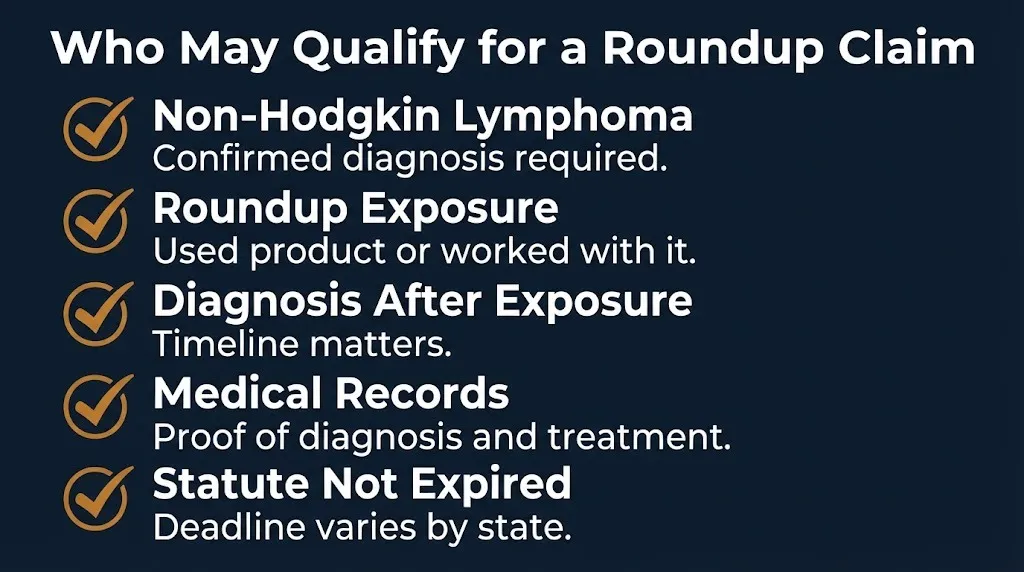
Second, you need exposure history. You must show you used Roundup or were exposed to glyphosate. Purchase records, employment records, or detailed testimony can establish exposure.
Third, you need a timeline. The diagnosis must come after the exposure. The latency period for non-Hodgkin lymphoma varies but is often years.
The settlement administrator reviews these documents. Incomplete claims are delayed or denied.
If you are considering a claim, gather your medical records and any evidence of Roundup use now.
Is There a Deadline to File a Roundup Claim?
There is no single global deadline, but time is not unlimited.
The settlement program for existing claims had internal deadlines. Many of those have passed.
For new claims, the deadline is governed by the statute of limitations in your state. The statute of limitations for personal injury claims varies by state and runs from the date of diagnosis or the date you discovered the connection.
Some states allow one year. Others allow two or three. The clock starts when you knew or should have known your cancer was linked to Roundup.
If you were diagnosed years ago and did not file, your claim may be barred. If you were recently diagnosed, you may still have time.
How Do You File a Roundup Lawsuit?
Filing a Roundup lawsuit is not a do-it-yourself process.
- Confirm your diagnosis with medical records.
- Document your Roundup exposure history.
- Consult an attorney experienced in Roundup litigation.
- The attorney evaluates your case and the applicable statute of limitations.
- If you qualify, the attorney files a claim in the appropriate court or settlement program.
- You provide medical records and exposure documentation.
- The claim is evaluated and either settles or proceeds in litigation.
- If it settles, you receive a payment after fees and expenses.
Most Roundup attorneys work on contingency. You pay nothing upfront. The attorney takes a percentage of any recovery.
Reality Check: No one will call you out of the blue to offer Roundup settlement money. Real settlements require a signed retainer, medical records, and a claim process. Anyone asking for an upfront fee to “expedite” your claim is likely running a scam.
What Happened in the First Roundup Trials?
The first trials produced enormous verdicts that were later reduced.
The first case, Johnson v. Monsanto, resulted in a $289 million verdict in 2018. The judge reduced it to $78 million.
The second case ended in an $80 million verdict. The third produced a $2 billion verdict. These numbers made headlines and drove Bayer to settle.
But trial verdicts are not settlements. The settlements that followed paid far less per person than the jury awards.
The trials mattered because they showed juries were willing to find causation. That leverage pushed Bayer to the table.
What Did Bayer Do After the Verdicts?
Bayer shifted to a settlement strategy.
The company announced a framework in 2020 to resolve the bulk of pending claims. It set aside billions and created a claims process.
Bayer also announced it would stop selling glyphosate-based Roundup for residential use in the U.S. starting in 2023. The company continues to sell glyphosate products for agricultural use.
The residential exit did not end the litigation. It changed the product available to consumers but did not resolve existing claims or bar new ones.
Key Takeaway: Bayer’s settlement framework resolved most older claims, but the company continues to face new filings from people diagnosed after the framework was announced.
How Much Do Lawyers Take in Roundup Settlements?
Contingency fees in Roundup cases typically range from 33 to 40 percent of the recovery.
The fee is deducted from your settlement before you receive your share. Expenses are also deducted.
If your settlement is $100,000 and the fee is 40 percent, the attorney receives $40,000. You receive $60,000 minus expenses.
Some cases have different fee arrangements. The specific terms are in your retainer agreement.
Do not sign a retainer without understanding the fee structure.
What Should You Do If You Used Roundup and Have Cancer?
The steps you take now determine whether you have a viable claim.
First, confirm your diagnosis and gather medical records. The diagnosis date is critical.
Second, document your exposure. Write down when you used Roundup, how often, and for how long.
Third, consult an attorney with Roundup experience. Most offer free case evaluations.
Fourth, do not delay. The statute of limitations is running.
Fifth, be realistic about the value. Settlements average far less than the headline verdicts.
What Happens Next in the Roundup Litigation?
The litigation continues to wind down but is not over.
Expected late 2026: New filings from recently diagnosed claimants continue.
Expected 2027: Remaining unsettled cases proceed through the courts.
Ongoing: Bayer continues to fund settlement programs and litigate cases that do not settle.
If you have a potential claim, the next step is to consult an attorney before your state’s deadline passes.
Frequently Asked Questions
Is the Roundup lawsuit still active in 2026?
Yes. Bayer has settled most older claims, but new cases are still being filed.
The litigation is in a long tail phase.
How much will I get from a Roundup settlement?
Most non-Hodgkin lymphoma claims settle for $50,000 to $100,000 on average.
Weaker cases settle for less. Strong cases settle for more.
What is the deadline to file a Roundup claim?
The deadline depends on your state’s statute of limitations.
The clock runs from diagnosis or discovery of the connection to Roundup.
Does Roundup cause cancer?
The scientific question is contested.
Regulators disagree. Courts have found causation in individual cases.
Do I need a lawyer for a Roundup claim?
Yes. Roundup litigation is complex and not a do-it-yourself matter.
Most attorneys work on contingency, with no upfront fee.
What proof do I need for a Roundup lawsuit?
Medical records confirming a non-Hodgkin lymphoma diagnosis.
Evidence of Roundup exposure, including purchase or employment records.
How long does a Roundup settlement take?
Settlements can take months to years after filing.
The timeline depends on the case and the settlement program.
The single most important action is to consult a Roundup attorney before your state’s statute of limitations expires. The deadline runs from diagnosis, not from when you heard about the lawsuit.