How Long Does a Nursing Home Lawsuit Take? 2026 Timeline and Settlement Guide
Quick Answer
- A typical nursing home lawsuit takes 6 to 24 months from filing to resolution, depending on complexity and whether it settles.
- The average nursing home neglect settlement in 2026 is $406,000, though payouts range from thousands to over $4 million.
- The statute of limitations for filing ranges from 1 to 6 years by state, but most states allow 2 to 3 years.
When you suspect a loved one has suffered abuse or neglect in a nursing home, the first question is often: how long will this take? The answer depends on a combination of factors, including the complexity of the injuries, how willing the facility is to negotiate, and the court’s schedule. Most nursing home lawsuits resolve through settlement within one to two years.
The timeline matters for another reason. Every state has a statute of limitations that sets a hard deadline for filing your lawsuit. If you miss that deadline, you lose the right to sue, no matter how strong your evidence is. This article breaks down the typical timeline, the factors that speed up or slow down a case, and what you need to know about filing deadlines in 2026.
The Facts
| Case | Nursing Home Lawsuit (civil claim type) |
|---|---|
| Status | Active legal process, timelines vary by state and case complexity |
| Fund Size | Not applicable |
| Est. Per Person | Average settlement: $406,000 |
| Claim Deadline | Statute of limitations: 1 to 6 years by state |
| Administrator | Not applicable |
| Proof Needed | Medical records, incident reports, witness statements |
Is a Nursing Home Lawsuit Legit or a Scam Risk?
A nursing home lawsuit is a legitimate civil action. You are not suing because you are angry. You are suing because a facility violated its legal duty of care and your loved one suffered harm as a result.
The scam risk runs in two directions. First, some facilities pressure families to accept quick, low settlements before they understand the full extent of damages. Second, unlicensed “advocates” may charge fees for services that a licensed attorney would provide on a contingency basis.
Legitimate nursing home attorneys work on contingency. They get paid only if you recover compensation. You do not pay upfront. If someone asks for an upfront fee to file a nursing home claim, that is a red flag.
Key Takeaway: Nursing home lawsuits are legitimate civil claims. Reputable attorneys work on contingency and do not charge upfront fees.
How Much Is a Nursing Home Lawsuit Worth?
The average nursing home neglect settlement in 2026 is $406,000, according to industry data. But that average masks an enormous range. Some cases settle for tens of thousands of dollars. Others result in multimillion-dollar verdicts.
Here is the verified range of settlement amounts by case type:
| Case Type | Settlement Range |
|---|---|
| Medication Errors | $914,000 to $4,100,000 |
| Pressure Injuries (Bedsores) | $500,000 to $2,800,000 |
| Resident Falls | $510,000 to $2,700,000 |
| Wrongful Death | $400,000 to $2,700,000 |
| Infections | $475,000 to $862,500 |
| Malnutrition/Dehydration | $500,000 to $1,000,000 |
| Fractures | $510,000 to $800,000 |
These figures come from real case results compiled by nursing home litigation firms. They are not guarantees. Your case value depends on the severity of injuries, the strength of evidence, and the facility’s available insurance coverage.
Not yet determined: The exact payout in any individual case cannot be predicted. A nursing home attorney can evaluate your specific circumstances and provide a realistic range.
Key Takeaway: The average settlement is $406,000, but payouts vary widely. Severe injuries like bedsores, falls, and medication errors push settlements into the millions.
How Long Does It Take to Settle a Nursing Home Lawsuit?
A nursing home lawsuit typically takes 6 to 24 months to settle, according to multiple legal sources. Cases that settle early, before formal litigation begins, can resolve in a few months. Cases that go to trial take longer.
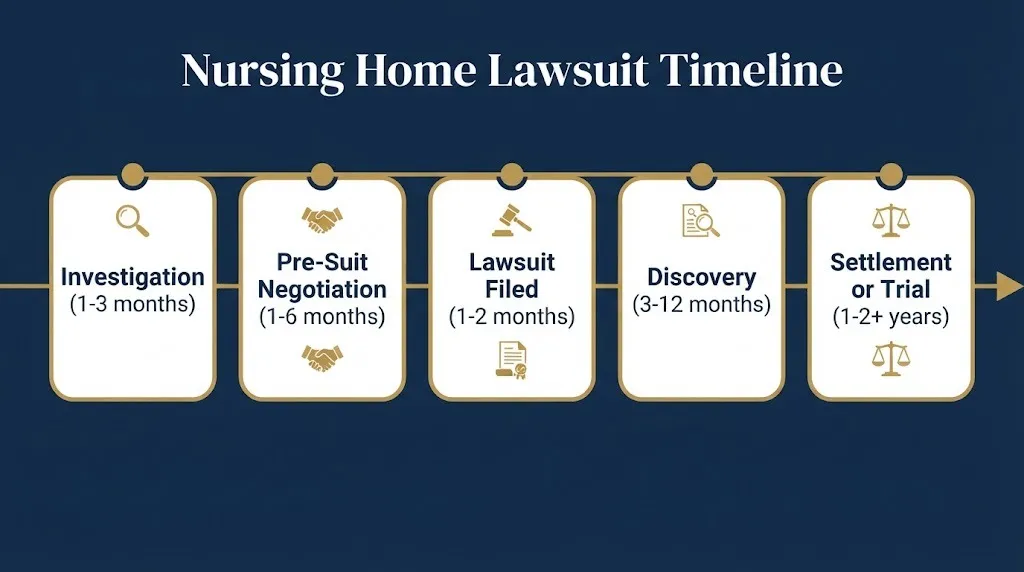
Here is the typical breakdown of the timeline:
| Stage | Time Estimate |
|---|---|
| Investigation and evidence gathering | 1 to 3 months |
| Pre-suit negotiation and demand | 1 to 6 months |
| Lawsuit filing and response | 1 to 2 months |
| Discovery (records, depositions) | 3 to 12 months |
| Mediation or settlement talks | 1 to 6 months |
| Trial (if no settlement) | 1 to 2+ years |
Most cases never reach trial. Settlement is the most common resolution because both sides usually prefer to avoid the cost and uncertainty of a jury verdict.
The “settle early” scenario happens when the facility’s insurance company makes a fair offer before you file a formal lawsuit. If the offer is adequate, the case can end within a few months.
Key Takeaway: Most nursing home lawsuits settle within 6 to 24 months. Early settlement before filing can resolve in months. Trial extends the timeline beyond two years.
What Factors Affect the Nursing Home Lawsuit Timeline?
Several factors determine how long your nursing home lawsuit will take. Understanding these helps you set realistic expectations and avoid frustration.
Case complexity is the biggest driver. A case involving a single incident, like a fall, with clear documentation moves faster. Cases involving multiple incidents, severe injuries, or disputed facts require more investigation and expert testimony.
Willingness to negotiate matters enormously. If the facility and its insurer are open to settlement, the case can resolve quickly. If they deny liability or make lowball offers, you may need to push toward trial.
Court backlog varies by jurisdiction. Busy courts have longer waits for hearings, motions, and trial dates. This is outside anyone’s control.
Evidence availability affects speed. If medical records are incomplete, witnesses are unavailable, or experts need time to review documents, the process slows down.
Witness availability can create scheduling conflicts. Doctors, staff, and other witnesses may not be available when needed, delaying depositions and hearings.
Wrongful death complications add time. If your loved one died, the case may involve probate court in addition to the civil lawsuit, adding weeks or months.
Key Takeaway: Complexity, cooperation from the defense, court backlog, and evidence availability are the main factors that speed up or slow down a nursing home lawsuit.
Reality Check: A nursing home lawsuit is not a criminal case. The facility will not go to jail. The lawsuit seeks financial compensation for your loved one’s injuries and losses. Criminal charges, if any, are filed separately by the state. Filing a civil lawsuit does not require you to pay anything upfront if you hire a contingency-fee attorney.
What Is the Statute of Limitations for Nursing Home Lawsuits?
The statute of limitations is the deadline for filing your lawsuit. Miss it, and your case is dismissed. The deadline varies by state, ranging from 1 to 6 years from the date of injury or discovery.
Here are the filing deadlines for a sample of states:
| State | Statute of Limitations |
|---|---|
| California | 2 years |
| Texas | 2 years |
| Florida | 2 years |
| New York | 3 years |
| Illinois | 2 years |
| Pennsylvania | 2 years |
| Ohio | 2 years |
| Tennessee | 1 year |
| Kentucky | 1 year |
| Maine | 6 years |
| Minnesota | 6 years |
| North Dakota | 6 years |
Most states apply a discovery rule, which means the clock starts when you knew or reasonably should have known about the injury, not necessarily when it happened. This matters for injuries like bedsores, infections, or malnutrition that develop gradually and may not be immediately apparent.
Government-operated facilities have shorter deadlines. Claims against county, state, or VA nursing homes often require a formal notice of claim within 90 days to 6 months, followed by a lawsuit filed within a shorter window than standard civil claims.
Key Takeaway: Statute of limitations ranges from 1 to 6 years by state. The discovery rule may extend the deadline for hidden injuries. Government facility claims have much shorter deadlines.
How Do You File a Nursing Home Lawsuit?
Filing a nursing home lawsuit follows a structured process. Here are the steps:
- Document everything immediately. Gather medical records, photos, incident reports, and witness names.
- Report the abuse. Contact your state’s long-term care ombudsman and adult protective services.
- Consult a nursing home attorney. Most offer free consultations and work on contingency.
- Confirm the statute of limitations. Your attorney will calculate the filing deadline for your state.
- Send a demand letter or notice of claim. Some states require pre-suit notice before filing.
- File the lawsuit in the correct court. This is usually the county where the facility is located.
- Complete discovery. Both sides exchange evidence, conduct depositions, and consult experts.
- Negotiate or go to trial. Most cases settle. If not, the case proceeds to trial.
The investigation phase is critical. Attorneys review medical records, interview staff and family members, and photograph injuries. This evidence builds the foundation for your claim.
What Happens Next
Immediately: If you suspect abuse or neglect, ensure your loved one is safe. If they are in immediate danger, call 911.
Within days: Gather documentation. Request medical records, photograph injuries, and write down what you observed.
Within weeks: Consult a nursing home attorney. They will confirm the statute of limitations and evaluate your case.
Within months: Your attorney will complete the investigation and either negotiate a settlement or file a lawsuit.
If the case goes to trial: Expect the process to take 1 to 2 years or longer from filing to verdict.
Frequently Asked Questions
How long does a nursing home lawsuit take?
Most nursing home lawsuits take 6 to 24 months to resolve. Cases that settle early can finish in a few months. Cases that go to trial take two years or longer.
What is the average nursing home neglect settlement?
The average nursing home neglect settlement is $406,000 in 2026. Individual settlements range from thousands to over $4 million depending on injuries and evidence.
How long do I have to file a nursing home lawsuit?
The statute of limitations ranges from 1 to 6 years by state. Most states allow 2 to 3 years from the date of injury or discovery. Government facility claims have shorter deadlines.
What factors affect the timeline of a nursing home lawsuit?
Case complexity, willingness to settle, court backlog, evidence availability, and witness scheduling are the main factors that affect how long a case takes.
Can I file a nursing home lawsuit if my loved one died?
Yes. Families can file wrongful death lawsuits to recover burial costs, medical expenses, and compensation for loss of companionship.
Do I need a lawyer to file a nursing home lawsuit?
Strongly recommended. Nursing home cases are complex and heavily contested. Attorneys work on contingency, meaning no upfront cost to you.
What happens if the nursing home wants to settle quickly?
A quick settlement offer may be lower than the case is worth. Consult an attorney before accepting. Once you sign a settlement, you waive future claims.
What is the discovery rule in nursing home cases?
The discovery rule delays the statute of limitations until you knew or reasonably should have known about the injury. This applies to hidden injuries like bedsores or infections.