Oklahoma Workers Compensation Commission 2026: Filing Rules, Deadlines, and What Injured Workers Should Know
Quick Answer
- The Oklahoma Workers Compensation Commission is the state agency that oversees workers’ comp disputes and compliance.
- Injured workers must report injuries to employers within 30 days, but filing a formal claim has longer windows.
- No consolidated settlement or payout fund exists through the Commission. Each claim resolves individually.
If you were hurt on the job in Oklahoma, the Workers Compensation Commission is the agency that handles your dispute if your employer or its insurance carrier denies your claim. The Commission does not pay benefits directly. It resolves fights over benefits through an administrative court process. That distinction matters. People who call the Commission expecting a check are often confused about how the system actually works.
The Commission was created in 2014 when Oklahoma moved from a court-based system to an administrative one. That change altered deadlines, procedures, and appeal rights. The law is now called the Administrative Workers’ Compensation Act. It lives in Title 85A of the Oklahoma Statutes.
Here is what’s verified for 2026: the reporting deadline, the claim filing windows, how the Commission’s hearing process works, what benefits exist, and the biggest mistakes that cause claims to stall.
The Facts
| Item | Detail |
|---|---|
| Governing Law | Administrative Workers’ Compensation Act, Title 85A |
| Agency | Oklahoma Workers Compensation Commission |
| Reporting Deadline | 30 days from injury to employer |
| Formal Claim Filing | Generally 1 year, with exceptions |
| Benefit Types | Medical, temporary disability, permanent impairment |
| Weekly Benefit Cap | Set annually by state average weekly wage |
| Dispute Resolution | Commission administrative hearings |
| Administrator | None, benefits paid by employer or insurer |
Is the Oklahoma Workers Compensation Commission Legit?
The Oklahoma Workers Compensation Commission is a legitimate state agency, not a scam. It was created by the Oklahoma Legislature in 2013 and began operating in 2014. The Commission has offices in Oklahoma City and Tulsa. It employs administrative law judges who hear disputes between injured workers and employers.
Scam risk exists around the edges. Some companies advertise “workers comp claim services” that charge fees for forms that are free through the Commission. Others may call claiming to be from the Commission and ask for personal information. The Commission does not cold-call injured workers asking for Social Security numbers or banking details.
If you receive a call from someone claiming to be the Commission and they ask for money, hang up. The Commission never charges a fee to file a claim or request a hearing. Its forms are free on its official website.
Key Takeaway: The Oklahoma Workers Compensation Commission is a real state agency. Its services are free. No legitimate Commission employee will ask for payment.
How Much Does Oklahoma Workers Compensation Pay in 2026?
Oklahoma workers compensation pays benefits based on a formula tied to your average weekly wage. Temporary total disability benefits generally equal 70 percent of your average weekly wage, subject to a weekly cap. The cap is recalculated annually based on the state average weekly wage.
The exact 2026 maximum is not yet confirmed in a single published source as of February 26, 2026. The Oklahoma Workers Compensation Commission typically publishes the annual rate in early spring. Check the Commission’s official website for the current year’s maximum.
Here is how the benefit formula works at different wage levels, assuming the 2026 cap follows recent trends near $1,100 to $1,200 per week:
| Average Weekly Wage | Benefit Rate (70%) | Cap Applied |
|---|---|---|
| $600 | $420 | $420 |
| $900 | $630 | $630 |
| $1,500 | $1,050 | $1,050 |
| $2,000 | $1,400 | Capped at state maximum |
| $3,000 | $2,100 | Capped at state maximum |
These figures are illustrative based on the formula. The actual 2026 cap must be confirmed through the Commission. Never rely on an unverified number when calculating what you are owed.
What Is the Reporting Deadline for Oklahoma Workers Compensation?
The reporting deadline for Oklahoma workers compensation is 30 days from the date of injury. You must notify your employer in writing or verbally within that window. Missing the 30-day deadline can bar your claim unless you can show a valid reason for the delay.
The law is strict. Section 69 of Title 85A states that no compensation is payable unless the employee gives notice within 30 days. There are exceptions for cases where the employer had actual knowledge of the injury or where the employee was physically unable to give notice.
Do not wait. Report the injury the day it happens. Even a minor injury can become serious. A report protects your rights and starts the claims process.
Key Takeaway: The 30-day reporting deadline is the single most important date in any Oklahoma workers comp claim.
How Do You File a Workers Compensation Claim in Oklahoma?
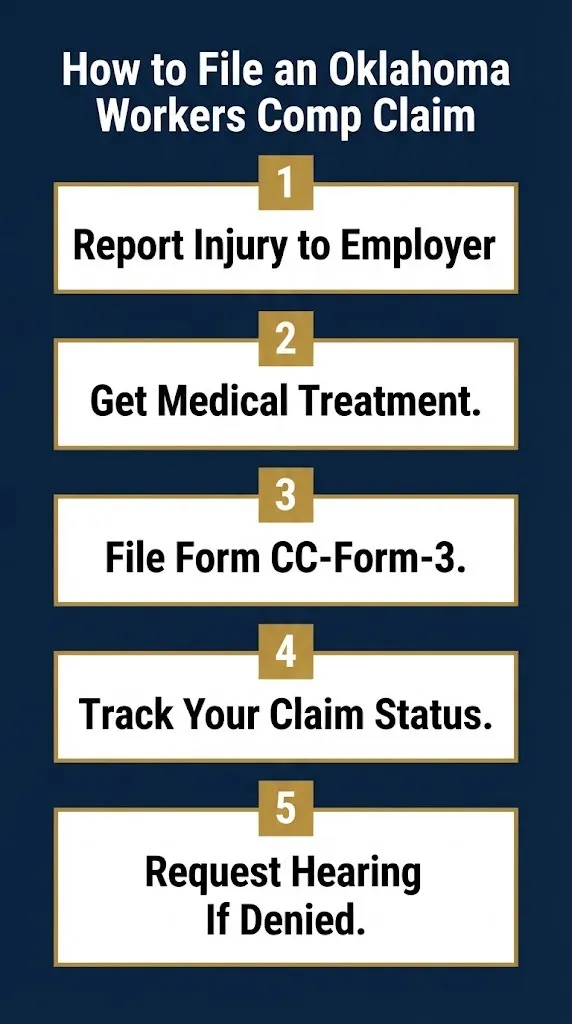
Filing a workers compensation claim in Oklahoma follows a defined sequence. Here are the steps:
- Report your injury to your supervisor immediately.
- Seek medical treatment from an authorized provider if your employer has a managed care plan.
- Complete Form CC-Form-3, the Employee’s Notice of Injury, available on the Commission’s website.
- File the form with the Commission within one year of the injury date.
- Keep copies of all medical records, work status notes, and correspondence with the insurer.
- If the insurer denies the claim, file a request for hearing with the Commission.
- Attend all hearings and mediations as scheduled.
- Follow all work restrictions and treatment plans from your authorized doctor.
The Commission does not charge a filing fee for the initial claim form. You can file online, by mail, or in person at the Commission’s Oklahoma City or Tulsa offices.
What Does Oklahoma Workers Compensation Insurance Cover?
Oklahoma workers compensation insurance covers medical treatment, temporary disability, permanent impairment, and vocational rehabilitation in some cases. The insurer pays for authorized medical care related to your work injury. That includes doctor visits, surgery, physical therapy, prescriptions, and mileage to appointments.
Employers in Oklahoma must carry workers compensation insurance if they have employees, with limited exceptions. Certain agricultural employers, small family businesses, and sole proprietors may be exempt. Construction employers face stricter rules.
Here is a breakdown of covered versus not covered:
| Covered | Not Covered |
|---|---|
| Authorized medical treatment | Unauthorized treatment |
| Temporary total disability | Pain and suffering |
| Permanent partial impairment | Punitive damages |
| Vocational retraining in some cases | Wages above the weekly cap |
| Death benefits for dependents | Emotional distress without physical injury |
How Do You Check Your Oklahoma Workers Compensation Claim Status?
You can check your Oklahoma workers compensation claim status through the Commission’s online portal or by contacting the insurance carrier directly. The Commission maintains a case management system where you can look up your claim by case number.
Your employer must provide the insurance carrier’s name and contact information after your injury. The adjuster assigned to your claim is your main point of contact for benefit questions. Ask for the claim number, adjuster name, and direct phone number.
If the carrier is not responding, contact the Commission’s Counselor Program. Counselors answer questions about the process and can help you understand your rights. They cannot give legal advice, but they can explain procedures and deadlines.
Key Takeaway: The Commission’s online portal and its Counselor Program are free resources for checking claim status.
What Is the Oklahoma Workers Compensation Commission Hearing Process?
The Oklahoma Workers Compensation Commission hearing process is an administrative dispute resolution system. If your claim is denied or benefits stop, you can request a hearing. An administrative law judge hears the evidence and issues a decision.
The process is less formal than a traditional court trial, but rules of evidence still apply. You can represent yourself or hire an attorney. Many injured workers choose to hire an attorney when a hearing is scheduled because the insurer will have one.
Here is how the hearing process flows:
- You file a request for hearing with the Commission.
- The Commission schedules a mediation or prehearing conference.
- Both sides exchange evidence and witness lists.
- The administrative law judge holds a hearing.
- The judge issues a written decision.
- Either side may appeal to the Commission en banc.
- Further appeals go to the Oklahoma Court of Civil Appeals.
How Long Do Oklahoma Workers Compensation Benefits Last?
Oklahoma workers compensation benefits last until you reach maximum medical improvement or until the statutory limits apply. Temporary total disability benefits can continue for up to 156 weeks in most cases, with extensions for certain catastrophic injuries.
Permanent partial impairment benefits are paid on a schedule based on the body part and impairment rating. The number of weeks varies by injury type. For example, a hand injury may be worth fewer weeks than a back injury.
Permanent total disability benefits are rare and require a finding that you cannot return to any gainful employment. Oklahoma tightened the standard for permanent total disability in the 2014 reforms.
Key Takeaway: Temporary benefits have a 156-week cap. Permanent benefits depend on your impairment rating and body part.
What Are Common Reasons Oklahoma Workers Compensation Claims Are Denied?
Common reasons Oklahoma workers compensation claims are denied include missed deadlines, disputes over whether the injury is work-related, and pre-existing conditions. Insurers also deny claims when the employee did not seek treatment promptly or when the injury report is inconsistent with medical records.
Here are the top denial reasons:
- Failure to report within 30 days
- No medical evidence linking the injury to work
- Pre-existing condition that was not aggravated by work
- Injury occurred outside the scope of employment
- Drug or alcohol involvement at the time of injury
- Claim filed after the one-year deadline
A denial is not the end. You can request a hearing and present evidence to challenge it. The Commission’s administrative law judges decide these disputes.
Key Takeaway: A denial is not final. You have the right to a hearing before an administrative law judge.
What Should You Do If Your Oklahoma Workers Compensation Claim Is Denied?
If your Oklahoma workers compensation claim is denied, file a request for hearing with the Commission as soon as possible. There are deadlines for requesting a hearing after a denial. Waiting too long can forfeit your right to challenge the denial.
Gather all your evidence. That includes medical records, witness statements, photos of the injury scene, and any correspondence with the insurer. Organize everything chronologically.
Consider hiring an attorney. Oklahoma workers compensation attorneys typically work on contingency, meaning they take a percentage of your recovery. Many offer free initial consultations. An attorney can help you navigate the hearing process and negotiate with the insurer.
Reality Check: No legitimate workers compensation claim requires a filing fee paid to the Commission. The forms are free. Third-party services that charge for “expedited processing” are unnecessary. The Commission does not text injured workers asking for personal information. If someone demands payment to process your Oklahoma workers comp claim, it is a scam.
How Does the Oklahoma Workers Compensation Commission Differ From the Old Court System?
The Oklahoma Workers Compensation Commission replaced the old Workers’ Compensation Court in 2014. The change was part of a legislative overhaul designed to reduce costs and speed up dispute resolution. The new system uses administrative law judges instead of traditional court judges.
The change altered several key rules. The standard for permanent total disability became stricter. The benefit formula changed from a court-calculated rate to a statutory percentage. Appeal rights also changed. Appeals now go through the Commission en banc before reaching the Court of Civil Appeals.
For injured workers, the practical difference is that cases move through an administrative process rather than a courtroom. The rules are less formal, but the deadlines are just as strict.
Key Takeaway: The 2014 shift to an administrative system changed deadlines, benefit formulas, and appeal rights. Current law is Title 85A.
What Happens If Your Employer Does Not Have Oklahoma Workers Compensation Insurance?
If your employer does not have Oklahoma workers compensation insurance, you may still have options. You can file a claim with the Commission. The Commission can investigate the employer and impose penalties. You may also have a civil lawsuit against the employer outside the workers comp system.
Oklahoma law requires most employers to carry coverage. An employer without coverage is in violation. The Commission can issue fines and stop-work orders. In some cases, injured workers can sue the employer in district court for damages, including pain and suffering, which is not available in a normal workers comp claim.
If you suspect your employer is uninsured, contact the Commission’s compliance division. You can also check the Oklahoma Insurance Department’s verification database to see if your employer has coverage.
What Happens Next?
Oklahoma’s workers compensation system will continue under Title 85A through 2026. Here is the expected timeline:
- March 2026: The Commission typically publishes the annual maximum weekly benefit rate.
- July 2026: New fiscal year begins for state agencies.
- Ongoing: Commission hearings and mediations continue year-round.
- January 2027: Next legislative session may consider proposed changes.
- TBD: Any major statutory changes would require legislative action.
Watch the Oklahoma Workers Compensation Commission’s official website for rate announcements and procedural updates.
Frequently Asked Questions
What is the Oklahoma Workers Compensation Commission?
The Oklahoma Workers Compensation Commission is the state agency that administers workers compensation claims, resolves disputes, and enforces coverage requirements. It was created in 2014.
How long do you have to report a work injury in Oklahoma?
You have 30 days to report a work injury to your employer. Missing this deadline can bar your claim.
How much does Oklahoma workers compensation pay?
Oklahoma pays 70 percent of your average weekly wage for temporary total disability, subject to an annual cap. The exact 2026 cap is set by the state average weekly wage.
Do you need a lawyer for Oklahoma workers compensation?
You do not need a lawyer to file a claim. Many injured workers hire one if the claim is denied or a hearing is scheduled.
Can you sue your employer in Oklahoma for a work injury?
Generally no. Workers compensation is the exclusive remedy for work injuries. You can sue outside the system in limited cases, such as uninsured employers or intentional harm.
How do you check your Oklahoma workers compensation claim status?
Check the Commission’s online portal or contact your insurance adjuster. The Commission’s Counselor Program can also help.
What is the deadline to file a workers comp claim in Oklahoma?
The formal claim form, CC-Form-3, must be filed within one year of the injury date in most cases. Some exceptions apply.
Does Oklahoma workers compensation cover mental health injuries?
Mental health injuries are only covered if they accompany a physical injury. Standalone stress or emotional claims are generally not compensable.