What Is the Average Settlement for an Asbestos Claim in 2026?
Quick Answer
- Asbestos settlements range widely, from a few thousand dollars to over a million, depending on disease and defendants.
- Mesothelioma claims typically pay more than asbestosis or pleural plaque claims.
- No central settlement fund exists. Each claim resolves separately through trusts or lawsuits.
If you or a family member received an asbestos diagnosis, the first question is usually about money. How much will this pay? The honest answer is frustrating: there is no single average that applies to you. Asbestos claims do not work like a class action with a fixed payout grid. They work like individual negotiations against bankrupt companies’ trusts or active defendants in court.
What can be said with confidence is this: mesothelioma claims generally settle higher than lung cancer claims, which generally settle higher than asbestosis claims. The difference is disease severity. The more serious the illness, the more defendants pay to resolve the claim.
Here is what’s verified for 2026: the factors that drive settlement amounts, the difference between trust claims and lawsuits, the role of disease type, and the timelines you can expect.
The Facts
| Item | Detail |
|---|---|
| Claim Type | Individual, not class action |
| Average Settlement | No official single average exists |
| Key Factor | Disease type and severity |
| Trust Claims | Separate from lawsuit settlements |
| Filing Deadline | Statutes of limitations vary by state |
| Administrator | Trust-specific administrators |
| Proof Needed | Medical records, exposure history, work records |
Are Asbestos Claims and Settlements Legitimate?
Asbestos claims and settlements are legitimate legal processes, not a scam. They have existed for decades. Thousands of companies have faced asbestos liability. Many filed for bankruptcy and created trust funds to pay present and future claims. Those trusts are real and they pay real money.
That said, scam risk exists. Some companies target asbestos victims with promises of guaranteed payouts for an upfront fee. No legitimate asbestos attorney charges upfront fees. They work on contingency, taking a percentage only if you recover money. Anyone asking for payment before you receive a settlement is running a scam.
The bankruptcy trust system is regulated by federal courts. Each trust has a claims administrator and published payment percentages. Those percentages are public. You can verify them without paying anyone.
Key Takeaway: Asbestos settlements are real, but no legitimate lawyer or trust charges upfront fees. Contingency is the standard.
What Is the Average Asbestos Settlement Amount?
There is no verified single average for asbestos settlement amounts. Published figures vary so widely that an average would be meaningless. One claimant with mesothelioma might settle for $1 million. Another with pleural plaques might receive $10,000. Both are “asbestos settlements.”
That said, industry sources and legal publications have reported ranges. Mesothelioma cases often settle in the low six figures to over $1 million per defendant in active litigation. Trust claims typically pay less because trusts apply payment percentages to scheduled values.
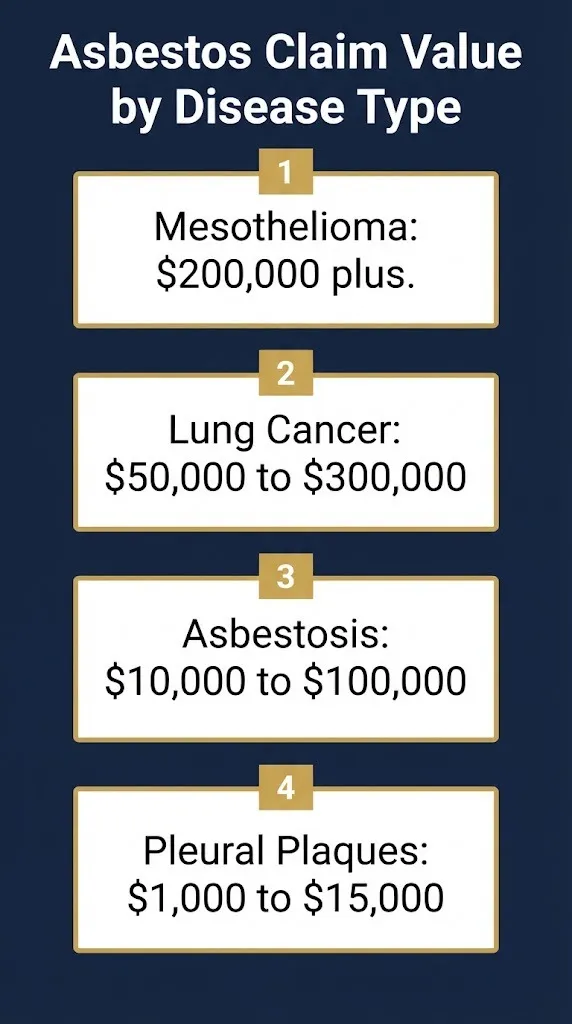
Here is how disease type drives settlement potential:
| Disease Type | Typical Range | Key Factors |
|---|---|---|
| Mesothelioma | $200,000 to $1 million plus | Terminal illness, high medical costs, multiple defendants |
| Lung cancer | $50,000 to $300,000 | Smoking history affects value, proof of asbestos exposure |
| Asbestosis | $10,000 to $100,000 | Non-cancerous scarring, depends on impairment level |
| Pleural plaques | $1,000 to $15,000 | Often minimal impairment, lower settlement value |
These ranges reflect patterns from published case results and trust schedules, not guaranteed amounts. Your case depends on your specific facts.
What Factors Determine an Asbestos Settlement Amount?
Several factors determine an asbestos settlement amount. The most important is your diagnosis. Mesothelioma is the most valuable because it is terminal and clearly linked to asbestos. Lung cancer requires proof of asbestos exposure and often involves smoking history complications. Asbestosis is less severe and pays less.
Exposure history matters next. Where did you work? What products did you handle? Which companies made those products? The more identifiable defendants, the more sources of recovery. A Navy veteran who worked in shipyards may have claims against multiple trust funds.
Here are the key factors:
- Disease type and severity
- Age and life expectancy
- Medical costs and lost wages
- Number of identifiable defendants
- State where you file
- Defendant solvency and trust payment percentages
- Smoking history for lung cancer claims
Key Takeaway: Your diagnosis and exposure history are the two biggest drivers of settlement value.
What Is the Difference Between Asbestos Trust Claims and Lawsuits?
Asbestos trust claims are filed against bankruptcy trusts established by companies that went bankrupt due to asbestos liability. Lawsuits are filed against companies that are still in business. Many asbestos victims pursue both.
Trust claims follow a scheduled process. Each trust has a published list of disease values and payment percentages. For example, a trust might value mesothelioma at $100,000 with a 25 percent payment percentage, meaning the claimant receives $25,000. The percentages change over time based on the trust’s assets and claim volume.
Lawsuits involve negotiation or trial. Settlements in lawsuits are often higher because the defendant faces trial risk. A jury verdict can exceed settlement offers. But lawsuits take longer and require more proof.
Key Takeaway: Trust claims pay according to fixed schedules. Lawsuits pay based on negotiation and trial risk.
How Do Asbestos Bankruptcy Trusts Work?
Asbestos bankruptcy trusts work like claim processing centers. When a company with asbestos liability files for bankruptcy, the court may require it to create a trust fund for present and future claimants. The trust is funded with company assets and insurance proceeds.
Each trust publishes procedures and payment percentages. Claimants submit medical and exposure evidence. The trust reviews the claim and offers payment based on its schedule. The process is designed to pay large numbers of claims without individual lawsuits.
Dozens of trusts exist. Major ones include the Johns Manville Trust, the Owens Corning Trust, and the WR Grace Trust. Each operates independently with its own administrator and rules.
How Long Does an Asbestos Settlement Take?
An asbestos settlement can take months to years depending on the route. Trust claims typically process faster than lawsuits. A well-documented trust claim might resolve in 3 to 6 months. Lawsuits can take 1 to 3 years or more if they go to trial.
Mesothelioma cases often move faster because courts recognize the urgency. Many jurisdictions expedite terminal illness cases. Some trusts offer expedited review for claimants with short life expectancies.
Here is a typical timeline comparison:
| Route | Typical Timeframe |
|---|---|
| Single trust claim | 3 to 6 months |
| Multiple trust claims | 6 to 18 months |
| Lawsuit settlement | 12 to 24 months |
| Lawsuit trial | 2 to 4 years |
| Expedited mesothelioma claim | 1 to 3 months |
Key Takeaway: Trust claims are generally faster than lawsuits. Mesothelioma cases often get expedited treatment.
What Proof Do You Need for an Asbestos Claim?
You need medical proof of an asbestos-related disease and evidence of exposure history. The medical proof comes from your doctor. A pathology report confirming mesothelioma or lung cancer is essential. For asbestosis, pulmonary function tests and imaging are required.
Exposure proof comes from work history, military records, union records, and witness statements. You need to show where you worked, what products you handled, and which companies made those products. An experienced asbestos attorney helps identify the defendants and gather this evidence.
Here is a checklist:
- Medical records with diagnosis
- Pathology reports
- Imaging studies
- Work history and job descriptions
- Military service records if applicable
- Union records
- Witness statements from coworkers
- Product identification documents
Key Takeaway: Medical proof of disease plus exposure history forms the foundation of every asbestos claim.
What Is the Statute of Limitations for Asbestos Claims?
The statute of limitations for asbestos claims varies by state. Most states start the clock when you are diagnosed, not when you were exposed. That is because asbestos diseases develop decades after exposure. The rule is called the discovery rule.
Typical deadlines range from 1 to 3 years from diagnosis for personal injury claims. Wrongful death claims have separate deadlines starting from the date of death. Some states have shorter windows for trust claims.
Do not wait. An attorney can tell you which deadlines apply to your case. Missing the deadline bars your claim forever.
Key Takeaway: The clock usually starts at diagnosis, not exposure. Deadlines vary by state and claim type.
Reality Check: No one calls you out of the blue with an asbestos settlement. Legitimate settlements come through your attorney or a trust administrator. You never pay upfront fees. If someone demands money to “process” your asbestos claim, it is a scam. Legitimate attorneys work on contingency, meaning they take a percentage only if you win.
How Do You File an Asbestos Claim?
Filing an asbestos claim follows a structured process. Here are the steps:
- Get a confirmed diagnosis from a qualified physician.
- Gather all medical records and pathology reports.
- Compile your work history and exposure evidence.
- Contact an experienced asbestos attorney for a free case evaluation.
- Your attorney identifies liable companies and applicable trusts.
- Your attorney files trust claims or a lawsuit on your behalf.
- Trusts review your evidence and issue payment offers.
- Settlements are negotiated and disbursed.
The process works best when you act quickly after diagnosis. Evidence is easier to gather early. Witnesses are easier to find. Deadlines are less likely to be missed.
What Are the Largest Asbestos Trusts in 2026?
The largest asbestos trusts in 2026 are those created by major bankrupt companies. The Johns Manville Trust remains one of the largest, established after the company’s 1982 bankruptcy. The Owens Corning Fibreboard Trust handles claims against multiple entities. The WR Grace Trust covers claims from asbestos-contaminated vermiculite.
Other significant trusts include those for Babcock & Wilcox, Pittsburgh Corning, and US Gypsum. Each operates independently. Each has its own payment schedule and procedures.
The total amount held in all asbestos trusts is estimated in the tens of billions of dollars, though exact figures vary by source. These funds continue to pay claims decades after the underlying bankruptcies.
How Do Asbestos Settlements Get Paid?
Asbestos settlements get paid by check or electronic transfer from the trust or defendant. In trust claims, the payment percentage is applied to the scheduled disease value. The remainder stays in the trust for future claimants.
In lawsuits, settlements are typically paid as a lump sum. Structured settlements that pay over time are also possible. Your attorney handles the disbursement, deducting the agreed contingency fee and any case expenses.
The payment process after a settlement is finalized usually takes 30 to 60 days. Trust payments may take longer if the trust has a backlog.
Key Takeaway: Payments are made after settlement finalization. Trust payments follow the trust’s published percentage schedule.
What Happens Next?
The asbestos litigation landscape continues to evolve. Here is the expected trajectory for 2026 and beyond:
- 2026: Existing trusts continue processing claims under current procedures.
- 2026: New trust claims are filed daily by recently diagnosed workers.
- 2027: Some trusts may adjust payment percentages based on claim volume.
- Ongoing: Asbestos litigation remains active in state and federal courts.
- TBD: Legislative changes could affect future claim procedures.
Watch trust-specific announcements and consult with an asbestos attorney for your individual case timeline.
Frequently Asked Questions
What is the average payout for asbestos claims?
There is no verified single average. Mesothelioma claims typically pay more than asbestosis. Trust claims follow scheduled values with payment percentages applied.
How much can you get from an asbestos trust?
Trust payments vary by trust and disease type. A mesothelioma claim might receive tens of thousands of dollars per trust, subject to the trust’s payment percentage.
Do you need a lawyer for an asbestos claim?
You do not legally need one, but practically you do. Identifying liable companies and navigating trust procedures is complex. Attorneys work on contingency.
How long do you have to file an asbestos claim?
Deadlines vary by state and claim type. Most start at diagnosis and run 1 to 3 years. Check with an attorney immediately after diagnosis.
Can family members file asbestos claims?
Yes. Family members may file wrongful death claims if the asbestos victim has died. Spouses and dependents may also have loss of consortium claims.
Are asbestos settlements taxable?
Most personal injury settlements for physical illness are not taxable. Trust payments for medical expenses are generally not taxable. Consult a tax professional.
How many asbestos trusts are there?
There are dozens of active asbestos trusts. Estimates range from 50 to 60, though the exact number changes as new trusts are created.
Can you file claims against multiple asbestos trusts?
Yes. Most asbestos victims file against every trust where they have exposure evidence. Multiple trust claims are standard practice.