Real Estate Litigation Attorneys 2026: Claim Deadlines, Settlement Updates, and What It Means for You
Quick Answer
- Real estate litigation attorneys handle lawsuits over property transactions, disclosures, commissions, and construction defects.
- No single national settlement fund exists in 2026, but several active cases may produce payouts this year or next.
- The most important deadline right now is your state’s statute of limitations, not a class action deadline.
Real estate litigation attorneys are lawyers who represent buyers, sellers, investors, homeowners associations, and commercial landlords in property-related lawsuits. Their cases cover everything from failed transactions and nondisclosure of defects to broker commission disputes and construction defect claims.
If you got a notice, email, or saw a headline about a real estate lawsuit settlement in 2026, the details matter more than the headline. Some cases are active. Some are settled but not paying yet. Some are still just proposed class actions with no approved fund.
This article breaks down what is verified, what is still pending, and what it means for anyone who bought, sold, or financed property in the last decade.
| The Facts | |
|---|---|
| Case | Multiple active real estate class actions, no single consolidated settlement |
| Status | Varies by case; no nationwide final approval in 2026 |
| Fund Size | Not yet confirmed |
| Est. Per Person | Not yet determined |
| Claim Deadline | Varies by case, most not yet set |
| Administrator | Not yet appointed in most cases |
| Proof Needed | Purchase records, agent agreements, closing documents, or construction contracts |
Is there a real estate lawsuit settlement I can claim in 2026?
There is no single national real estate settlement fund open for claims right now. What exists is a patchwork of state and federal cases at different stages.
The biggest real estate litigation story in recent years was the National Association of Realtors commission settlement. That case produced proposed settlements with several large brokerages. Some received preliminary approval. Some are still working through final approval and appeals.

A settlement being announced does not mean checks are ready. It means the court process is moving.
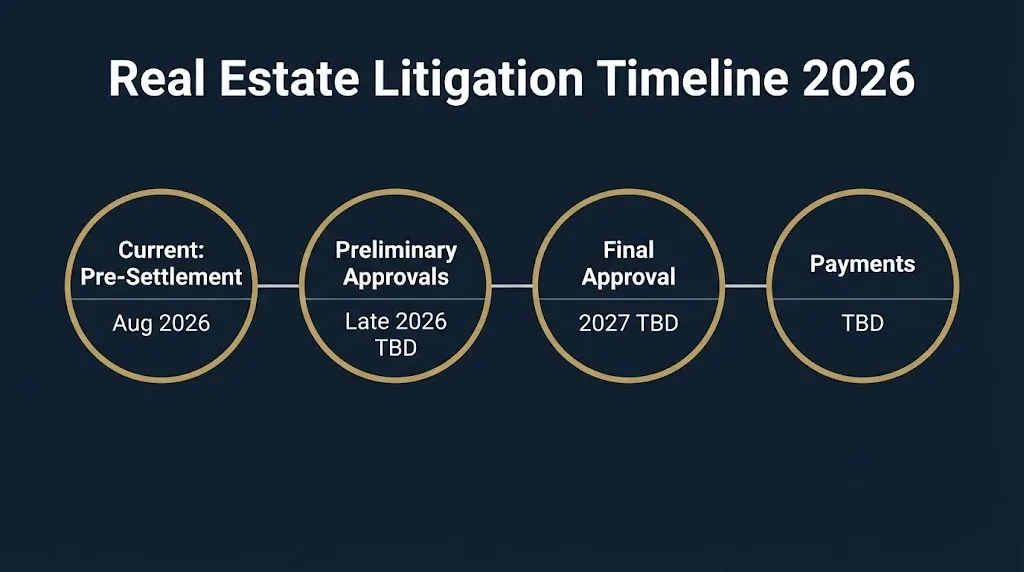
The key distinction is between settled cases and merely filed cases. A filed lawsuit has no payout. A preliminarily approved settlement has a proposed fund but no checks. Only a finally approved settlement has a real payment timeline.
How much could I get from a real estate settlement in 2026?
Amounts depend entirely on the specific case, your role in the transaction, and the size of the class.
The NAR commission settlement involved claims from home sellers who paid buyer broker commissions. Estimated amounts varied widely because the settlement was structured to compensate a large class over time.
No per-person amount is confirmed for any major real estate case in 2026. Any website or person quoting a specific dollar figure is guessing unless they cite a final approval order.
Here is what typically controls payout size in real estate litigation:
- Total settlement fund size
- Number of approved claims filed
- Your documented financial loss
- Whether you are a lead plaintiff or class member
- Attorneys’ fees and administration costs deducted from the fund
Key Takeaway: Never budget around an unconfirmed payout figure from a real estate lawsuit.
How do I know if a real estate settlement notice is real?
Real settlement notices come by mail or email from a court-appointed administrator. They include the official case name, court, case number, and a website ending in .com or .org run by the administrator.
Scam settlement notices often ask for payment upfront, request bank details, or use urgent language about limited time.
You can verify any notice by searching the case name in the federal PACER system or your state court’s public docket. The official settlement website will also be listed in the notice.
Third-party claim services may contact you offering to help for a fee. You never need to pay someone to file a claim. Filing is free on the official site.
Reality Check: No legitimate settlement administrator texts you first and asks for money. No legitimate claim form requires a credit card.
What types of cases do real estate litigation attorneys handle in 2026?
Real estate litigation attorneys handle disputes over property ownership, transactions, and use. The most active categories right now include:
- Broker commission class actions
- Seller disclosure fraud cases
- Construction defect claims against builders and developers
- Homeowners association disputes
- Title defect and boundary lawsuits
- Commercial lease and rent disputes
- Mortgage servicing and foreclosure litigation
- Zoning and land use challenges
The attorney you need depends on your role. A seller with a commission claim has different legal needs than a condo association with a construction defect case.
Most real estate litigation attorneys work on contingency for class actions, meaning they get paid only if the case settles or wins. For individual disputes, they often charge hourly or flat fees.
What is the NAR commission lawsuit status in 2026?
The NAR commission litigation reshaped how buyer agent compensation is disclosed and negotiated.
The proposed settlement class includes home sellers who listed properties on multiple listing services and paid buyer broker commissions between specified dates. The settlement required changes to MLS rules and offered a compensation fund.
As of 2026, the operational rule changes are in effect. Commission offers can no longer be displayed on MLS platforms in many markets. Buyers now sign written agreements with agents before touring homes.
The financial payout portion remains subject to final approval and potential appeals. No checks have been mailed. Any claim deadline would be set only after final approval.
This case shows the gap between a headline settlement announcement and actual money in hand. It can take two to four years or longer.
Key Takeaway: Rule changes from the NAR settlement are already active, but monetary payouts are still pending final court approval.
Do I need a real estate litigation attorney to file a settlement claim?
For class action settlements, you do not need your own attorney to file a claim. The class attorneys represent you. You submit a claim form through the official settlement website.
For individual real estate disputes, hiring an attorney is often necessary. Contract and property disputes involve complex state laws and court procedures.
Free or low-cost options exist. Some legal aid organizations handle housing and foreclosure cases. Some bar associations offer limited-scope representation where an attorney handles part of your case for a flat fee.
Before hiring anyone, check their state bar record and ask about their specific real estate litigation experience. Many attorneys market real estate services but mostly handle closings, not lawsuits.
What proof do I need to file a real estate lawsuit claim?
Proof requirements vary by case type. Most settlement claims ask for documentation that establishes you were part of the affected group.
Common documents include:
- Closing statements or settlement statements
- Purchase and sale agreements
- Agent representation agreements
- Mortgage statements
- Inspection reports
- Construction contracts and warranties
- Email or written correspondence with brokers, agents, or sellers
For commission cases, you may need to show you sold a home and paid a buyer broker commission during the class period. For disclosure fraud cases, you may need evidence the seller knew about a defect and did not disclose it.
Keep digital copies of everything. Screenshot important emails. Download your closing packet. These records are easier to produce years later if a settlement is approved.
What is the statute of limitations for real estate litigation?
The statute of limitations is the legal deadline to file a lawsuit. It varies by state and by claim type.
Most states allow between two and six years for breach of contract and fraud claims related to real estate. Some states allow longer for construction defects, often up to ten years from completion.
The clock usually starts when you discovered or should have discovered the problem. That is why seller disclosure fraud cases often hinge on when the buyer found the defect.
Waiting for a class action does not stop your individual statute of limitations in every case. If you believe you have a claim, talk to a real estate litigation attorney in your state. Do not assume a pending class action protects you forever.
What is the difference between a class action and a mass tort in real estate?
A class action groups many similar claims into one lawsuit. Class members are usually bound by the result unless they opt out.
A mass tort involves many individual lawsuits with similar facts but separate damages. Construction defect cases against large builders sometimes proceed as mass torts or consolidated litigation.
Class actions are more common for commission and fee disputes where damages are similar across the class. Mass torts are more common where each property owner has different damage levels.
Your rights differ. In a class action, you may need to opt out to preserve your right to sue separately. In a mass tort, you generally maintain your own case from the start.
Key Takeaway: Read any class notice carefully. Opt-out deadlines are usually short and are strictly enforced.
How do I check the status of a real estate settlement?
The fastest way is to visit the official settlement website listed in the notice. Most administrators post court dates, status updates, and payment timelines.
You can also check the court docket directly. Federal cases are searchable in PACER. State cases are searchable through your state court’s online portal.
Class counsel websites often post updates. But the official administrator site is the authoritative source for claim deadlines and payment dates.
Set a calendar reminder for the final approval hearing and any claim deadline. These dates can shift, so check the official site monthly after you file.
What happens after a real estate settlement is approved?
Final approval is not the last step. Here is the typical sequence after final approval:
- Final approval hearing occurs and the court signs an order.
- A notice of appeal period begins, usually 30 days.
- If no appeal, the administrator reviews and validates claims.
- Any disputes over claim denials are resolved.
- Attorneys’ fees and administration costs are deducted.
- Payments are calculated and distributed.
The process from final approval to payment can take six months to a year or more. If appeals are filed, payment waits until the appellate court rules.
For the NAR commission settlement, the appeals process alone could extend the timeline significantly. No payment estimate is reliable until appeals are exhausted.
Are real estate litigation settlements taxable?
The IRS generally treats lawsuit settlements as taxable income unless the payment compensates for physical injury or illness. Property damage claims often restore the value of the asset rather than create new income.
Portions allocated to attorneys’ fees are usually taxable to the plaintiff even though the attorney receives the money directly. That can create a surprising tax bill.
Back pay and interest portions are taxable. Punitive damages are taxable. Emotional distress damages are taxable unless tied to a physical injury.
Consult a tax professional before spending a settlement check. The allocation in the settlement agreement matters, but the IRS is not bound by it.
What real estate lawsuits are actively paying in 2026?
No major real estate class action settlement is actively mailing checks in August 2026 according to verified court records.
Several smaller state-level cases are in payment phases, mostly involving:
- Local condominium construction defect settlements
- Regional title insurance overcharge cases
- Municipal property tax refund settlements
These are not national cases. You would have received a direct notice if you were a class member.
The bigger cases are still in pre-settlement or approval stages. The difference between filed, settled, approved, and paying is the most important distinction in this area of law.
Key Takeaway: Most 2026 real estate litigation is still moving through the courts, not paying out.
How do I find the right real estate litigation attorney?
Finding the right attorney starts with identifying your case type. A commission dispute attorney may not be the right fit for a construction defect claim.
Ask these questions before hiring:
- How many real estate trials or class actions have you handled?
- Have you represented plaintiffs or defendants in my type of dispute?
- What is your fee structure and what costs am I responsible for?
- How long do you expect the case to take?
- Who will handle day-to-day communication?
Check the attorney’s state bar record for discipline history. Look for peer reviews in legal directories like Martindale-Hubbell. Ask for recent case results in similar matters.
Many attorneys offer a free initial consultation. Use it to evaluate whether they listen and explain clearly.
What states have the most active real estate litigation in 2026?
California, Florida, Texas, New York, and Georgia consistently see the most real estate litigation due to transaction volume and population growth.
California leads in construction defect and disclosure fraud cases. Florida sees high volumes of condo association and investor fraud litigation. Texas and Georgia have active commission and title dispute dockets.
Your state’s laws control your rights. A claim that is valid in California may fail in Texas due to different disclosure requirements.
Do not rely on national averages or national settlement news. Real estate law is state-specific. That is why hiring a local attorney matters.
What is a special master or claims administrator in real estate litigation?
A claims administrator is a court-appointed third party that manages class member notice, claim intake, validation, and payment distribution.
A special master is usually appointed by the court to oversee specific technical or accounting issues in complex litigation.
Both are neutral parties. They do not work for the plaintiffs or defendants. Their fees are paid from the settlement fund.
When a notice tells you to contact the administrator, that means you should direct your questions to that office, not to the court clerk. The court will not answer individual claim status questions.
Key Takeaway: The claims administrator, not the court, is your point of contact after a settlement is approved.
How long does a real estate lawsuit take?
Most real estate lawsuits take two to four years from filing to resolution. Complex class actions can take five years or more.
The phases include:
- Pre-filing investigation and demand
- Complaint filing and response
- Discovery and document production
- Depositions and expert reports
- Summary judgment motions
- Mediation or settlement negotiations
- Trial if no settlement
- Post-trial motions and appeals
- Final approval and claims process for class actions
Each phase involves deadlines and delays. Courts are still working through backlogs from earlier years, which extends timelines further.
What should I do right now if I think I have a real estate claim?
Start with documentation. Gather every paper and electronic record related to your transaction or dispute.
Then contact a real estate litigation attorney in your state. Most offer free consultations. Bring your documents and a one-page timeline of what happened.
Do not wait for a class action notice. Your individual deadline may be running even if no settlement has been announced.
Do not sign anything from the other party or their insurance company before getting legal advice. Early settlement offers are often far below what the claim is worth.
What Happens Next
- Expected September 2026: Court rulings expected in several pending broker commission cases.
- Expected Late 2026: Preliminary approval hearings scheduled in multiple state-level real estate class actions.
- Expected Early 2027: Claim deadlines likely to open for at least two real estate settlements.
- Expected Mid 2027: First payouts possible if current proposed settlements receive final approval without appeals.
- Ongoing: Check official settlement websites monthly and monitor court dockets for updates.
Frequently Asked Questions
How do I know if I am part of a real estate class action?
You may receive a notice by mail or email if the administrator identifies you as a potential class member.
You can also search the case name on the official settlement website.
Not receiving a notice does not always mean you are excluded, so check the class definition in the settlement documents.
Do I need a lawyer to join a real estate class action?
No, you do not need your own lawyer to remain in the class and file a claim.
The class attorneys represent the entire class.
You only need your own attorney if you want to opt out and sue separately.
How long after final approval do real estate settlement checks go out?
Typically six to twelve months after final approval if no appeals are filed.
Appeals can delay payment by a year or more.
The claims administrator publishes a payment timeline on the official site.
Can I file a real estate lawsuit if I signed an arbitration clause?
Many real estate contracts, including agent agreements and builder contracts, contain mandatory arbitration clauses.
Arbitration does not prevent recovery, but it changes the forum and rules.
A real estate litigation attorney can review your contract and explain your options.
What is the biggest active real estate lawsuit in 2026?
The NAR broker commission settlement remains the largest and most consequential real estate litigation by class size and industry impact.
Its rule changes are already in effect, but monetary payouts are still pending final approval.
Are real estate settlement payments split among all class members equally?
No, payments usually vary based on your documented loss, transaction value, and other factors.
Some settlements use tiered compensation models.
The claim form and settlement agreement explain the allocation formula.
What happens if I do nothing after receiving a real estate settlement notice?
If you do nothing, you generally stay in the class but receive no payment.
You also give up your right to sue separately over the same claims.
The opt-out deadline is your only chance to preserve individual legal rights.