Is the Zillow lawsuit real?
Quick Answer
- No confirmed consumer settlement fund is open for Zillow claims as of August 24, 2026; four separate lawsuits are active or recently resolved.
- The FTC’s antitrust suit against Zillow and Redfin settled today with a conduct order, not a payout to renters or landlords.
- The homebuyer mortgage-steering case, Taylor v. Zillow, was revived on August 17, 2026, after an earlier dismissal; no class exists yet.
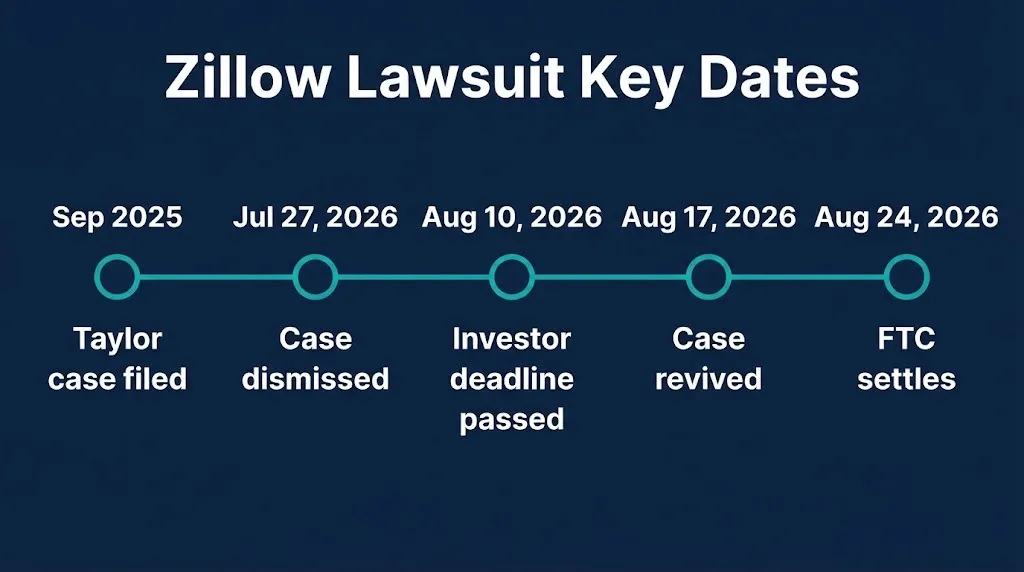
If you searched “zillow lawsuit” hoping for a check, here’s the direct answer: there isn’t one to claim right now. Zillow and Redfin reached a settlement with the Federal Trade Commission on August 24, 2026, over claims that their multifamily listings partnership violated antitrust law. That deal does not send money to individual consumers.
A second, more consumer-relevant case just came back to life. Plaintiffs filed a third amended complaint reviving claims that Zillow tied buyer leads to Zillow Home Loans referrals, citing an estimate that affected borrowers paid about $2,881 more per loan. No settlement, no fund, no claim form yet.
This article breaks down all four active Zillow legal matters in 2026: the RESPA homebuyer case, the FTC antitrust resolution, the investor securities suit, and the smaller claims you may see referenced elsewhere. One detail worth noting: the judge who dismissed the homebuyer case in July gave plaintiffs a second chance rather than killing it outright.
The Facts
| Case | Taylor v. Zillow Group, Inc., et al. (combined with Armstrong) |
| Court | U.S. District Court, Western District of Washington |
| Status | Revived; third amended complaint filed August 17, 2026 |
| Fund Size | Not yet confirmed, no class certified |
| Est. Per Person | Not yet determined |
| Claim Deadline | Not applicable, no claims process is open |
| Administrator | Not yet appointed |
| Proof Needed | Not yet determined at this stage |
Is the Zillow lawsuit real?
Yes, and it’s actually four different lawsuits, not one. One class action, filed in Washington district court in November 2025, alleges Zillow issued illegal kickbacks to brokers by tying access to consumer leads to referrals for Zillow Home Loans. A separate case, Taylor v. Zillow, alleged Zillow violated the Real Estate Settlement Procedures Act, state consumer protection laws, and the Racketeer Influenced and Corrupt Organizations Act through its Flex program.
On top of that, a securities fraud lawsuit accuses Zillow and certain officers of making misleading statements to shareholders. And the FTC sued Zillow and Redfin in September 2025, alleging their rental listing syndication deal suppressed competition, a case that just settled.
None of these four cases has produced a live consumer claims process yet. If a website or text message tells you a Zillow settlement check is waiting, verify it against the actual court docket before you act.
How much money can you get from the Zillow lawsuit?
Not yet determined. No class has been certified in any of the current consumer-facing Zillow cases, and no settlement fund has been confirmed.
The homebuyer case gives the clearest early number. The amended complaint cites a study estimating ZHL borrowers paid about $2,881 more per comparable loan, adding up to roughly $31.6 million across the proposed class. That figure is an allegation in a complaint, not a court-approved payout.
Key Takeaway: No verified Zillow consumer settlement fund exists yet; every number circulating online right now is an allegation, an estimate, or a figure tied to a different, unrelated case.
Is there a Zillow class action settlement you can join right now?
No. As of August 24, 2026, none of the four active Zillow legal matters has reached the stage where consumers can file a claim form.
The closest case to a resolution involving Zillow’s conduct is the FTC settlement, and that one does not include individual payments. Redfin agreed to end certain advertising contracts and transfer them to Zillow, while Zillow agreed to waive noncompete agreements with employees who want to work at Redfin. That’s a business-conduct remedy, not compensation.
You may see other sites reference a separate agent-focused advertising settlement with a specific dollar figure. LawCompensate could not independently confirm the details of that matter through court records or an official settlement administrator site as of this writing, so treat any specific dollar amount tied to it as not yet confirmed.
Zillow investor lawsuit: how much could shareholders recover?
Not yet determined, and this case works differently from a consumer class action. The lawsuit seeks to represent purchasers of Zillow Group Class A or Class C common stock between February 11, 2025, and May 7, 2026.
Investors who suffered losses and wanted to serve as lead plaintiff needed to move the court by August 10, 2026. That date has already passed.
What this means if you owned Zillow stock during that window:
- You do not need to have acted by August 10 to remain part of the class later.
- You automatically stay an absent class member unless you opt out.
- No payout amount exists until the case settles or a jury verdict is reached.
- Watch for a future notice from a claims administrator, not a text message or unsolicited email.
Who is filing these Zillow lawsuits, and why
The Zillow hidden-fees case is being led by Hagens Berman and DiCello Levitt, the same firms behind major commission lawsuits against national brokerages. A separate agent lawsuit filed by a Kitsap County, Washington real estate team leader claims Zillow’s Preferred Agent program illegally ties lead access to mortgage referrals.
The securities case, Breidert v. Zillow Group, Inc., Case No. 26-cv-02016, was brought by shareholders through firms including Rosen Law Firm, Pomerantz LLP, and Kahn Swick & Foti.
A plain-life comparison helps here: think of these four cases like four separate insurance claims filed against the same driver after one accident. Each one moves on its own timeline, with its own adjuster, its own payout rules, and its own deadline. Winning one doesn’t automatically resolve the others.
How to check if you qualify for a Zillow lawsuit
- Identify which case applies to your situation: homebuyer, agent, or investor.
- Confirm the relevant date window; for the securities case that’s February 11, 2025, through May 7, 2026.
- Check whether a class has actually been certified before assuming you’re covered.
- Search the official court docket number, not a marketing site, for the current status.
- Bookmark the case and check back monthly rather than filing anything today.
- Save any relevant documents now: mortgage statements, closing disclosures, or brokerage statements.
- Ignore any message asking for an upfront fee to “register” your claim.
- Watch for a settlement administrator notice if and when a deal is reached.
Key Takeaway: There is nothing to file yet in any of the four active Zillow cases, so the most useful action today is gathering documents, not submitting a claim.
Reality Check: No legitimate settlement administrator contacts you first by text message asking you to click a link before a case even settles. Filing a real claim form is always free. If a “claims helper” asks for payment to file paperwork on your behalf for a Zillow case that hasn’t settled, that’s a red flag, not a shortcut.
Zillow lawsuit update: what happened this week
The pace of news around Zillow’s legal exposure has been unusually fast this month. A federal judge granted Zillow’s motion to dismiss the class action over its Flex Program on July 28, 2026, a case that had struck at the core of Zillow’s business model by challenging how it charges agents for placement.
That dismissal wasn’t the end. Judge Robart allowed plaintiffs to file an amended complaint by August 17, 2026, saying the court could not conclude they were entirely incapable of fixing the defects in their filing. Plaintiffs filed that third amended complaint on Monday, August 17, 2026, reviving both RESPA and Washington Consumer Protection Act claims.
Then, on the same day this article was researched, Zillow and Redfin announced a settlement with the FTC and five state attorneys general resolving the antitrust case over their rental listing partnership. The deal came on the eve of trial, after a federal judge had declined the FTC’s request in July to immediately block the partnership.
What is the Zillow FTC antitrust lawsuit about?
The FTC alleged Zillow effectively paid Redfin $100 million to stop competing in the rental listings business for nine years, with Redfin agreeing to transfer its advertising customers to Zillow. New York Attorney General Letitia James said the agreement threatened to raise costs for renters and landlords and make it harder to find housing.
| Detail | What’s confirmed |
|---|---|
| Original deal | Zillow agreed in February 2025 to pay Redfin $100 million for exclusive multifamily listing syndication rights |
| Lawsuit filed | FTC sued in September 2025; five state AGs consolidated similar suits in December 2025 |
| Outcome | Settlement reached August 24, 2026, no admission of liability |
| Duration | Syndication partnership will continue through at least June 30, 2030 |
| Consumer payout | None. This is a conduct-based order, not compensation. |
Under the resolution, Zillow and Redfin will offer standalone multifamily advertising products beginning in 2027, in addition to the existing partnership. If you’re a renter or landlord who used either platform, this settlement changes how the companies compete going forward, but it does not put money in your pocket.
What is Taylor v. Zillow about, and does it affect regular homebuyers?
This is the case most likely to matter to an ordinary homebuyer. The lawsuit is Taylor v. Zillow Group Inc., et al., Case No. 25-cv-01818, filed in the U.S. District Court for the Western District of Washington.
Plaintiffs allege Zillow’s Flex program, which charges agents a referral fee on closed transactions tied to performance targets involving Zillow Home Loans, inflated commissions and blocked buyers from securing better mortgage terms. One named plaintiff claims her agent pushed her toward Zillow’s loan program even though a more affordable option, like a loan from the U.S. Department of Veterans Affairs, may have been available.
Zillow argued the plaintiffs’ complaint was “heavy on filler but thin on substance” and lacked statutory standing because they didn’t directly pay for the contested settlement services. Judge Robart agreed and dismissed the case in July, while noting plaintiffs failed to identify deceptive conduct given Zillow’s disclosures about how it connects customers to partner agents.
The revived complaint, filed August 17, cites a study putting the total alleged overcharge at roughly $31.6 million. That number reflects an allegation still being litigated, not a confirmed damages figure.
Who is Zillow Home Loans and why does it keep coming up in these lawsuits?
Zillow Home Loans, or ZHL, is Zillow’s in-house mortgage lending arm. Multiple lawsuits allege Zillow created a tying arrangement between its lead-generation marketing platform and ZHL, pressuring participating agents to steer clients toward ZHL for mortgage pre-approval.
One complaint alleges Premier Agents were required to meet specific ZHL-related quotas as a condition of keeping access to high-value consumer leads. Lawyers tied this pattern to Zillow’s stated ambition of building a “super app” that captures every stage of the home-buying journey on a single platform, citing investor materials from February 2025.
Think of it like a car dealership that only lets you finance through its own lender if you want the best trade-in offer. Whether that’s legal under federal mortgage rules is exactly what the RESPA claims in these cases are testing.
What is the Zillow investor securities lawsuit about?
The securities case concerns whether Zillow and certain officers or directors engaged in securities fraud or other unlawful business practices. The complaint alleges Zillow misleadingly classified the Redfin agreement as a “partnership” when it functioned more like an acquisition, and that the company failed to disclose the antitrust risk that arrangement created.
After Reuters reported on May 7, 2026, that a federal judge had rejected Zillow and Redfin’s request to end the FTC lawsuit, Zillow’s Class C stock fell $0.85, or 1.9%, to close at $43.68. The following day it fell a further $2.25, or 5.15%, to $41.43. Class A shares saw a similar drop, falling 1.76% and then another 4.76% over the same two days.
Now that the FTC case has settled, it’s worth watching whether that resolution affects how the securities case is argued going forward, since the underlying regulatory risk the plaintiffs cited has been resolved.
Are there other Zillow lawsuits you should know about?
Several smaller matters get referenced online, and it’s worth separating what’s confirmed from what isn’t. Hagens Berman has represented homebuyers who scheduled a tour or contacted an agent through buttons on Zillow’s property listing pages and were connected with a Zillow-affiliated agent, feeding into the broader Taylor and Armstrong litigation.
Some legal-marketing sites reference a separate agent advertising settlement with a specific dollar figure and a mid-2026 approval timeline. LawCompensate was not able to independently verify the fund size, claim deadline, or approval status of that matter through a court record or an official settlement website. Treat any specific numbers you see attached to it as not yet confirmed until you find them on a primary source.
There are also older, closed matters. Zillow settled a wage-and-hour class action from former inside sales consultants for up to $6.0 million, with the court granting final approval in October 2017. That case is fully closed and unrelated to anything active in 2026.
What happens next in the Zillow lawsuit
- August 17, 2026: Third amended complaint filed in Taylor v. Zillow, reviving RESPA and consumer protection claims.
- August 24, 2026: FTC and Zillow/Redfin antitrust settlement announced, no consumer payout involved.
- Expected fall 2026: Zillow will likely file a new motion to dismiss the amended Taylor complaint; a ruling could take several months.
- Expected 2026 to 2027: Court will rule on whether a class can be certified in the homebuyer case, a required step before any settlement talk.
- TBD: Securities case proceeds toward a ruling on Zillow’s expected motion to dismiss; no trial date confirmed.
Frequently Asked Questions
Is there a Zillow lawsuit settlement check being mailed right now?
No confirmed settlement fund is open for consumer claims as of August 24, 2026.
The FTC’s antitrust settlement with Zillow does not include individual payouts.
If you receive a message claiming otherwise, verify it against the official court docket first.
Did Zillow settle with the FTC?
Yes. Zillow and Redfin settled the FTC’s antitrust lawsuit over their rental listings partnership on August 24, 2026.
The deal preserves the partnership and adds standalone advertising options starting in 2027.
No admission of liability was made, and no consumer compensation is included.
What is Taylor v. Zillow and is it still active?
Taylor v. Zillow is a RESPA and consumer protection lawsuit over Zillow’s Flex program and Zillow Home Loans referrals.
It was dismissed in July 2026 but revived with a new complaint filed August 17, 2026.
No class has been certified yet.
Can I join a Zillow lawsuit as a homebuyer?
Not yet, because no class has been certified in the active homebuyer case.
If you used a Zillow-connected agent and Zillow Home Loans, keep your closing documents.
Watch the docket for a class certification ruling before assuming you qualify.
What is the Zillow stock lawsuit about?
Investors allege Zillow misled shareholders about antitrust risk tied to its Redfin rental listings deal.
The class period runs from February 11, 2025, through May 7, 2026.
The lead plaintiff deadline of August 10, 2026, has passed, but the case itself continues.
How much could I get from a Zillow lawsuit?
Not yet determined for any active consumer or investor case.
One complaint estimates a total alleged overcharge of roughly $31.6 million across a proposed class, but that figure is unproven.
Any specific per-person dollar amount you see elsewhere should be treated with caution until a settlement is court-approved.
Is the Zillow lawsuit a scam?
The lawsuits themselves are real, filed in federal court and covered by mainstream legal and business press.
Scams tend to show up around real cases, usually as fake “claim helper” services asking for upfront fees.
Filing a real claim, once one exists, will always be free.
Where can I check the official status of these cases?
Check the U.S. District Court for the Western District of Washington docket for Taylor v. Zillow and the securities case.
For the FTC matter, check the FTC’s own press releases and case filings.
Avoid relying only on marketing sites that don’t cite a docket number or court filing.
Nothing here means you should file anything today, since no Zillow case currently has an open consumer claims process. The one action worth taking now: calendar a check-in for late 2026, when a class certification ruling in Taylor v. Zillow is more likely to land.