Cadence Bank Data Breach Settlement in 2026: What Customers Need to Know
Quick Answer
- No verified Cadence Bank data breach settlement exists in U.S. court records as of August 15, 2026.
- No settlement fund, claims administrator, or consumer payout has been established.
- Any post claiming a Cadence Bank data breach payout is unverified and likely a scam.
Cadence Bank, a regional bank operating across the Southeast and Texas, has faced data security questions like many financial institutions. If you searched for a Cadence Bank data breach settlement in 2026, you likely saw a post, an email, or a headline claiming the bank is paying customers after a breach. You want to know if it is real, how much you might get, and how to file.
The verified answer is that no Cadence Bank data breach class action settlement exists as of August 15, 2026. No court has approved a settlement. No claims administrator has been appointed. No fund has been created for consumer payouts.
This guide explains how to verify data breach settlement claims, what typically happens when a bank faces a breach lawsuit, and how to protect yourself from fake settlement scams.
The Facts
| Case | No verified Cadence Bank data breach settlement as of August 15, 2026 |
| Status | Not confirmed in U.S. federal or major state court databases |
| Fund Size | Not applicable; no settlement fund exists |
| Est. Per Person | Not applicable; no consumer claims process |
| Claim Deadline | Not applicable |
| Administrator | Not applicable |
| Proof Needed | Not applicable |
Is There a Real Cadence Bank Data Breach Settlement in 2026?
No real Cadence Bank data breach settlement has been verified in 2026. No active class action settlement naming Cadence Bank appears in PACER, the federal court records system, or in major state court databases as of August 15, 2026.
Data breach class actions do happen. When they settle, they create a court-approved settlement website, a claims administrator, and a deadline for filing claims. None of those exist for a Cadence Bank data breach settlement right now.
What people are likely seeing are recycled posts, mislabeled content, or outright fabrications. Data breach settlement scams are common. They use the names of real banks to collect personal information from worried customers.
A real settlement leaves a paper trail. A fake one leaves only a link asking for your data.
Key Takeaway: No verified Cadence Bank data breach settlement exists in U.S. court records as of August 15, 2026.
Has Cadence Bank Experienced a Data Breach?
No verified Cadence Bank data breach has been confirmed through official regulatory filings or court records as of August 15, 2026. That does not mean a breach never happened. It means no confirmed breach has produced a public settlement.
Banks face constant cyber threats. Some breaches are reported to state attorneys general and federal regulators. Others are discovered internally and never become public. The absence of public confirmation does not guarantee no breach occurred.
Cadence Bank, like all financial institutions, is subject to data security regulations. The bank is required to notify customers and regulators if a breach compromises sensitive personal information. No such notification has been verified in 2026.
If a breach is confirmed in the future, affected customers would receive a notice letter. That letter would explain what happened, what data was exposed, and what steps to take.
Key Takeaway: No verified Cadence Bank data breach has been confirmed through public regulatory or court records in 2026.
How Do Data Breach Settlements Typically Work?
Data breach settlements follow a predictable pattern. A class action lawsuit is filed after a breach is disclosed. The plaintiffs allege the company failed to protect their data. The parties negotiate a settlement.
The settlement creates a fund for affected consumers. A claims administrator is appointed. A settlement website goes live. Affected customers receive notice by mail or email and can file a claim.
Payouts vary widely. Reimbursement for out-of-pocket losses, like fraudulent charges or credit monitoring costs, is common. Small cash payments for inconvenience are also common, often $25 to $100 per person. Some settlements offer free credit monitoring instead of cash.
The claim deadline is usually 60 to 120 days after the settlement website launches. Payments follow final approval, which can take months.
Key Takeaway: Real data breach settlements create a fund, a claims administrator, and a deadline; none exist for Cadence Bank in 2026.
What Should You Do If You Received a Cadence Bank Data Breach Notice?
If you received a Cadence Bank data breach notice in 2026, read it carefully before acting. Determine whether it is real or fake.
A real breach notice comes from Cadence Bank or a court-appointed administrator. It includes specific information: the date of the breach, the type of data exposed, and steps to protect yourself. It never asks you to pay a fee.
A fake notice may use the Cadence Bank name but lack specifics. It may ask you to click a link, enter personal information, or pay a processing fee. It may create urgency with a short deadline.
If you are unsure, contact Cadence Bank directly through their official customer service number. Do not use contact information provided in the notice itself until you verify it independently.
Reality Check: No legitimate data breach settlement asks you to pay a fee to file a claim. No real administrator texts you first. Any Cadence Bank payout post that requires payment or urgent action is a scam.
Key Takeaway: Verify any Cadence Bank data breach notice through official bank channels before responding or providing information.
How Can You Protect Yourself After a Bank Data Breach?
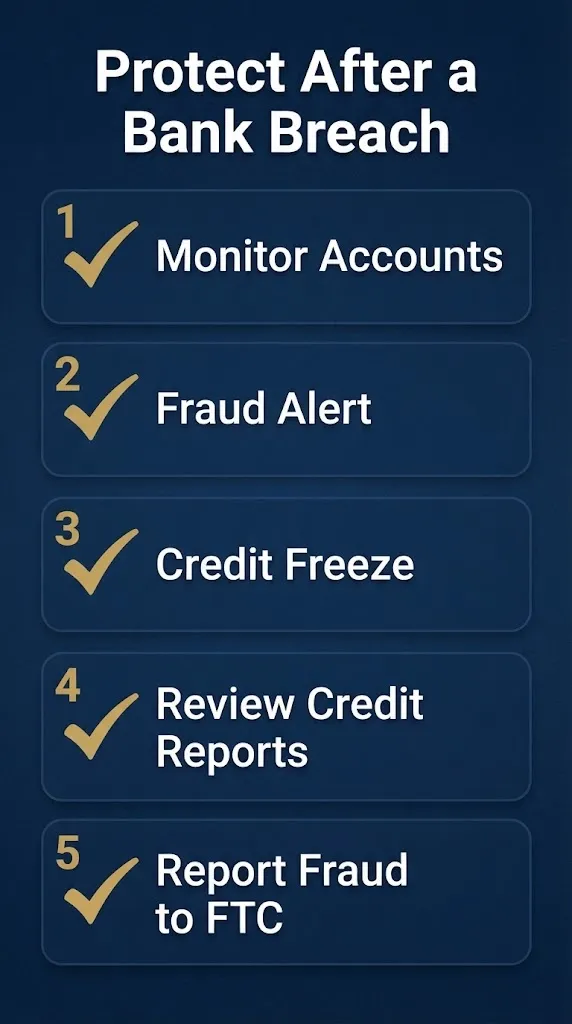
If you believe your bank data was compromised, several steps protect your finances. The first is to monitor your accounts closely. Check for unauthorized transactions daily for at least several months.
The second step is to place a fraud alert on your credit reports. A fraud alert tells creditors to verify your identity before opening new accounts. You can place one by contacting any of the three major credit bureaus.
The third step is to consider a credit freeze. A freeze blocks new creditors from accessing your credit report, making it harder for identity thieves to open accounts in your name. Freezes are free and can be lifted temporarily when you need credit.
- Monitor bank and credit card accounts for unauthorized activity
- Place a fraud alert with Equifax, Experian, or TransUnion
- Consider a credit freeze for stronger protection
- Review your credit reports for unfamiliar accounts
- Report any fraudulent activity to the FTC and your bank immediately
Key Takeaway: Fraud alerts, credit freezes, and account monitoring are the core protections after any bank data breach.
What Are the Signs of a Fake Data Breach Settlement Post?
Fake data breach settlement posts share common characteristics. They promise a specific payout, like $500 or $1,000 per person. They create urgency with a short deadline. They ask for personal information upfront.
Real settlement notices never promise a specific per-person amount before claims are processed. They never ask for your Social Security number upfront. They never require payment to file.
Fake posts often use slightly altered bank names or logos. They link to websites that look official but are not. They may ask for your online banking credentials, which no legitimate settlement ever requires.
The best defense is verification. Check PACER, check the official Cadence Bank website, and check the FTC for scam alerts. If the settlement does not appear in any of those places, it is not real.
Key Takeaway: Fake posts promise specific payouts and urgent deadlines; real settlements never do either.
What Is Cadence Bank and Where Does It Operate?
Cadence Bank is a regional financial institution headquartered in Tupelo, Mississippi, and Houston, Texas. The bank operates branches across the Southeast and Texas.
Cadence Bank was formed through mergers. The current name came from the 2021 merger of BancorpSouth Bank and Cadence Bancorporation. The combined bank operates under the Cadence Bank name.
The bank offers personal banking, business banking, mortgage, and wealth management services. It has over 400 branches across its footprint.
Understanding the bank’s size matters for data breach claims. Larger banks face more frequent cyber threats. But no verified Cadence Bank data breach settlement exists in 2026.
Key Takeaway: Cadence Bank is a regional bank operating across the Southeast and Texas; no verified breach settlement exists for it in 2026.
Could a Cadence Bank Data Breach Lawsuit Be Filed in the Future?
Yes, a Cadence Bank data breach lawsuit could be filed in the future if a breach is disclosed. But no such lawsuit exists as of August 15, 2026.
If a breach occurs, affected customers would receive notice under state and federal law. A class action lawsuit would likely follow. Settlement negotiations could take one to three years after filing.
The timeline from breach disclosure to settlement payout typically runs two to four years. That means even if a breach were disclosed today, a settlement would not open for claims until 2028 or later.
For now, there is nothing to track. No breach, no lawsuit, no settlement.
Key Takeaway: Even if a future breach occurs, a settlement would not open for claims until at least 2028.
What Happens Next With Any Potential Cadence Bank Data Breach Matter?
No Cadence Bank data breach matter is active or confirmed in 2026. The next steps depend on whether any breach is ever disclosed.
Ongoing: No verified breach, lawsuit, or settlement exists.
If a breach is disclosed: Customers would receive notice letters, and a class action would likely follow.
If a lawsuit is filed: The case would proceed through federal or state court.
If a settlement is reached: A claims administrator would be appointed and a claim period opened.
None of these steps have occurred. The verified status is that there is nothing to report.
Frequently Asked Questions
Is there a Cadence Bank data breach settlement in 2026?
No verified settlement exists as of August 15, 2026.
No court has approved a settlement or appointed a claims administrator.
Any post claiming a payout is unverified.
Was Cadence Bank hacked in 2026?
No verified data breach has been confirmed through regulatory filings or court records.
The bank has not issued a public breach notification in 2026.
No confirmed breach exists.
How much would a Cadence Bank data breach settlement pay?
No settlement exists, so no payout amount has been determined.
Typical data breach settlements pay $25 to $100 plus reimbursement for losses.
Any specific figure is fabricated until a settlement is approved.
Can I file a claim in a Cadence Bank settlement?
No, there is no settlement to file a claim in.
No claims process exists.
Any site offering a claim form is fraudulent.
How do I check if a data breach settlement is real?
Search PACER for the case name.
Check the official bank website for breach notifications.
Look for a court-approved settlement website with a case number.
What should I do if I got a fake Cadence Bank settlement text?
Delete it and do not click any links.
Report it to the FTC.
Monitor your accounts for suspicious activity.
Where can I report a Cadence Bank settlement scam?
Report to the FTC through its official complaint portal.
Report to your state attorney general’s office.
Notify Cadence Bank through its official fraud department.
The Cadence Bank data breach settlement you may have seen online is not verified. No court record, settlement notice, or official filing exists as of August 15, 2026. The posts claiming otherwise are not based on facts.
Your next step is simple. If you see a settlement claim about any bank, check PACER, check the official bank website, and check the FTC. If none of those sources confirm it, treat it as noise. Protect your personal information and do not engage.