Spectrum Class Action Lawsuit 2026: Claim Status, Settlement Amounts, and Filing Deadlines
Quick Answer:
- Multiple class actions allege Spectrum charged hidden fees and misrepresented internet speeds to customers.
- Estimated per-person recovery ranges from $50 to $500 depending on the specific case and your service history.
- No claim deadline exists yet; you cannot file a claim until a settlement receives court approval.
If you received a notice about a Spectrum lawsuit or saw a headline about potential payouts, you probably have one question: is this real, and is there money coming your way. The short answer is yes, real lawsuits are moving through courts. But no settlement fund exists yet for consumers to tap. The cases accuse Charter Communications, which operates under the Spectrum brand, of charging undisclosed fees, throttling internet speeds below advertised levels, and making it unreasonably difficult to cancel service. These are not fringe complaints. They are certified or proposed class actions with millions of potential class members.
This article covers every verified detail about the Spectrum class action, what you may qualify for, how much you could receive, and exactly what to watch for as the cases move toward resolution. One case alone involves over 16 million current and former subscribers.
| The Facts | |
|---|---|
| Case | Multiple proposed class actions against Charter Communications Inc. (Spectrum) |
| Status | Active litigation; class certification pending or granted depending on case |
| Fund Size | Not yet established |
| Est. Per Person | $50 to $500 estimated range across various cases |
| Claim Deadline | Not yet set |
| Administrator | Not yet appointed for most cases |
| Proof Needed | Likely account records, billing statements, or customer ID |
Is the Spectrum Class Action Lawsuit Real or a Scam?
The Spectrum class action is real. Multiple lawsuits are active in federal courts, and at least one has received class certification. These are not solicitations from third-party claim filers. They are actual court cases with docket numbers and judicial oversight.
You may have seen ads or texts about a Spectrum settlement. Some of those are legitimate attorney advertising. Others are scams. The safest approach is to ignore any message that asks for payment to “process your claim” or requests your Social Security number upfront. Legitimate class action claims never charge a filing fee. If there is a real settlement, you will be able to file for free through the official settlement administrator.
The most prominent case is pending in the U.S. District Court for the District of Colorado under the name In re Spectrum Internet Speed Litigation. The court certified a class of New York subscribers in 2024 and later expanded the scope. Another major case concerns broadcast TV and regional sports fees that plaintiffs say were hidden from advertised pricing. Both cases name Charter Communications Inc. as the defendant.
Key Takeaway: Real lawsuits exist, but no settlement has been finalized. Anyone asking for money now to file a claim is running a scam.
How Much Money Could I Get From the Spectrum Lawsuit?
No settlement amount has been determined yet. The cases are still in litigation. However, you can look at similar lawsuits against internet providers for a rough estimate.
In cases where ISPs have been accused of hidden fees or speed misrepresentation, per-person payouts have ranged from $20 to over $200. The Spectrum internet speed case involves a much larger class, which tends to push per-person amounts lower. Consumer advocates following the case estimate that individual payments could fall between $50 and $500, but that depends entirely on the final settlement fund size, the number of claims filed, and how the court allocates the fund.
| Scenario | Estimated Payout Range | Notes |
|---|---|---|
| Internet speed claims (New York class) | $50 to $150 | Depends on subscription length and proof |
| Hidden fee claims (broadcast TV fee case) | $75 to $500 | May factor in months of service and fee amounts |
| Combined cases (if consolidated) | $100 to $400 | Speculative; no consolidation announced |
| All cases (lowest estimate) | $25 to $50 | Possible if claims volume is very high |
These numbers are projections based on comparable settlements. The actual amounts could be higher, lower, or zero if the cases do not settle. Do not budget around a Spectrum payout. Treat it as an uncertain future event.
Key Takeaway: Estimated payouts range from $50 to $500 based on comparable ISP settlements, but no fund exists yet and nothing is guaranteed.
Who Is Eligible for the Spectrum Class Action?
Eligibility depends on which case ultimately settles and what the court approves. Each lawsuit defines its own class. You may qualify if you were a Spectrum internet or cable subscriber during specific time periods.
For the internet speed litigation, the certified New York class includes residential subscribers who paid for a specific speed tier but allegedly received slower speeds. The time period runs from approximately 2016 through the present, though the final class definition may shift. A separate proposed class action over hidden fees covers Spectrum TV subscribers nationwide who were charged broadcast TV fees or regional sports surcharges that were not clearly disclosed in advertised pricing.
You do not need to register or sign up anywhere right now. If a settlement is approved, the administrator will attempt to contact eligible class members by mail or email using Charter’s customer records. If you have moved, update your address with Spectrum or check the eventual settlement website once it launches.
Key Takeaway: Current and former Spectrum internet and TV subscribers from roughly 2016 onward may qualify, but precise eligibility will be defined when a settlement is reached.
Reality Check: No One Will Text You a Settlement Check
Reality Check: Class action settlements never arrive by text message, WhatsApp, or an unsolicited phone call asking for your bank details. If someone contacts you claiming you won a Spectrum settlement and needs a “processing fee,” it is a scam. Real settlement checks arrive by mail or direct deposit through a verified administrator. Filing a claim is always free. Third-party services that charge to file on your behalf add no value. You can complete the same form yourself in minutes.
How to File a Spectrum Lawsuit Claim
No claim form exists yet. When a settlement is reached, here is what the process will look like, based on standard class action procedure.
- Wait for the court to grant preliminary approval of a settlement.
- Look for a notice by mail or email from the settlement administrator.
- Visit the official settlement website, which will have a .com or .org domain and the case name.
- Locate your notice ID and confirmation code from the mailed or emailed notice.
- Complete the online claim form with your name, address, and service details.
- Upload any required proof, such as a Spectrum billing statement showing your account number.
- Select your payment method, usually a digital payment, paper check, or prepaid card.
- Submit before the deadline, which will be clearly posted on the settlement site.
If you do not have your old billing statements, you may still be able to file. Many settlements allow claims with minimal documentation for lower-tier payouts. The key is to act before the deadline once it is announced. Bookmark the idea of checking the official settlement site quarterly if you believe you are a class member.
Spectrum Lawsuit 2026 Update: Where Each Case Stands
The Spectrum litigation landscape in 2026 involves at least three distinct tracks. Each is at a different stage.
The internet speed litigation is the furthest along. The U.S. District Court for the District of Colorado certified a class of New York subscribers in 2024. Discovery is ongoing. A trial date has not been set, and no settlement has been announced. Charter denies the allegations and is defending the case.
The hidden fee litigation focuses on broadcast TV and regional sports fees. Plaintiffs argue Spectrum advertised one price and then added mandatory fees that were not optional and not clearly disclosed. This case is in earlier stages. Class certification is pending. No trial date is set.
A separate case addresses cancellation practices. Plaintiffs allege Spectrum made it intentionally difficult to cancel service, requiring lengthy phone calls with retention agents. This case is also in early litigation.
| Case | Court | Status | Key Date |
|---|---|---|---|
| Internet speed litigation | D. Colorado | Discovery; class certified for NY | No trial date set |
| Hidden broadcast fee case | Pending confirmation | Class certification pending | TBD |
| Cancellation practices case | Pending confirmation | Early litigation | TBD |
Charter Communications has publicly stated that it intends to “vigorously defend” against all claims. The company maintains its fees are disclosed and its speeds are delivered as advertised.
Spectrum Settlement: Has Any Deal Been Reached?
No settlement has been reached in any of the Spectrum class actions as of July 2026. Every case remains in litigation. The word “settlement” appears in search results and ads because law firms are advertising for clients and because some SEO-driven pages use the term loosely to capture traffic. Do not confuse attorney advertising with an actual approved settlement.
When a real settlement does happen, it will follow a predictable path. First, the parties will announce a proposed settlement. The court will hold a preliminary approval hearing. If granted, the administrator will launch a settlement website and begin notifying class members. A final approval hearing will follow, typically 90 to 120 days later. Only after final approval will payments be processed.
This timeline means that even if a settlement were announced tomorrow, you would not see a check until mid-2027 at the earliest. Class action settlements are slow by design. Courts review them carefully to ensure they are fair to class members.
What Is the Spectrum Lawsuit About?
The Spectrum lawsuits center on three core allegations. Understanding them helps you assess whether you might be a class member.
The speed misrepresentation claim is the most developed. Plaintiffs say Spectrum advertised internet plans at specific speeds, such as 200 Mbps or 400 Mbps, but delivered consistently slower speeds. The complaint alleges this was not a technical glitch but a systematic practice. The certified class includes New York subscribers who paid for plans that allegedly underperformed.
The hidden fee claim covers broadcast TV fees and regional sports surcharges. Spectrum advertises cable packages at one price. After signup, customers see additional line items on their bills. Plaintiffs argue those fees are not really taxes or government charges. They are part of the cost of service that should be in the advertised price. This case seeks to represent a nationwide class.
The cancellation claim is simpler. Former customers say they spent hours trying to cancel, were transferred repeatedly, and faced retention scripts designed to wear them down. The goal, plaintiffs say, was to keep billing them for as long as possible.
Key Takeaway: The core allegations involve speeds slower than advertised, fees higher than disclosed, and cancellation processes designed to frustrate.
How Long Will the Spectrum Class Action Take?
Class actions against large corporations typically take three to six years from filing to payout. The Spectrum internet speed case was filed around 2017 or earlier, depending on the specific complaint. It is now in its eighth or ninth year and still in discovery.
If a settlement is announced in late 2026 or early 2027, payments might reach class members by late 2027 or 2028. That timeline can stretch if Charter continues to litigate rather than settle. Cases that go to trial and appeal add years. The hidden fee case is younger and is likely farther from resolution.
This is the normal pace of complex federal litigation. It is frustrating, but it is not a sign that the cases are weak or stalled. It means the discovery process, which involves millions of pages of internal Charter documents, takes time.
How to Check Your Spectrum Lawsuit Status
There is no central dashboard for checking your status as a potential class member because no settlement claims process exists yet. Here is what you can do now.
Keep any old Spectrum bills or account statements. If you closed your account, save your final bill. Those documents may help you prove your subscription dates and service tier if a claim form requires them.
Watch for official mail from a settlement administrator. These notices are typically postcards or letters with the court case name clearly printed. They will direct you to an official .com or .org website. They will never ask for payment.
Check the official court docket if you want to follow the litigation itself. The internet speed case is publicly accessible through the PACER system under the District of Colorado. Searching “In re Spectrum Internet Speed Litigation” will bring up the docket.
Ignore unsolicited calls, texts, and emails about Spectrum settlements unless you have verified the source independently. Scammers follow class action news and launch fake claim sites when cases get media attention.
Who Is the Settlement Administrator for the Spectrum Lawsuit?
No settlement administrator has been appointed because no settlement has been approved. When a settlement is reached, the court will select an independent administrator. Past major class actions have used firms like Epiq, Kroll, JND Legal Administration, or Angeion Group.
The administrator’s job is to process claims, verify eligibility, distribute payments, and handle class member inquiries. The administrator’s website will be the only official place to file a claim. Any other site claiming to process Spectrum settlement claims is not legitimate.
Once an administrator is named, this section will be updated with the name, website, and contact information. Until then, there is no one to call and no form to fill out.
Key Takeaway: No administrator exists yet. Any site offering to file your Spectrum claim today is not authorized.
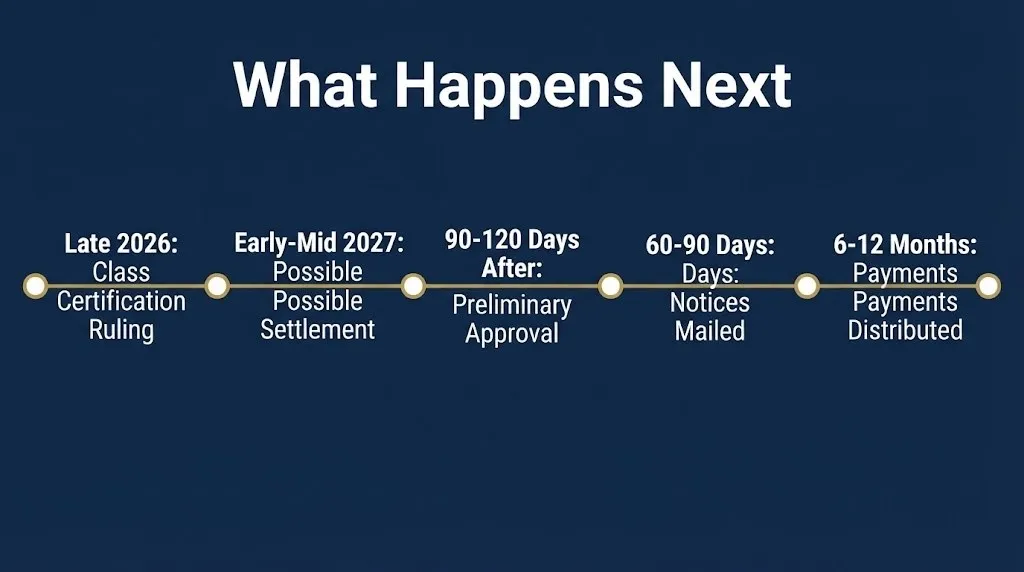
What Happens Next
Here are the expected next stages based on the current posture of the cases.
| Expected Late 2026 | Class certification ruling in the hidden fee case |
|---|---|
| Expected Early to Mid 2027 | Possible settlement announcement or trial date setting in the internet speed case |
| 90 to 120 days after settlement | Preliminary approval hearing if a deal is reached |
| 60 to 90 days after preliminary approval | Notice mailed to class members, claim site launches |
| 90 to 120 days after notice | Claim filing deadline, typically |
| 6 to 12 months after deadline | Payments distributed if no appeals delay the process |
Every date in this timeline is an estimate based on standard class action procedure. The actual pace depends on the court’s calendar and whether Charter settles or continues litigating.
Frequently Asked Questions
Is the Spectrum class action lawsuit real?
Yes, multiple real lawsuits are active in federal courts.
At least one has received class certification.
No settlement has been reached yet.
Do I need to sign up for the Spectrum lawsuit?
No, there is no signup process while cases are in litigation.
If a settlement is approved, you will receive notice by mail or email.
You cannot file a claim until a settlement website launches.
How much will I get from the Spectrum settlement?
No amount is set because no settlement exists.
Comparable ISP cases have paid $50 to $500 per claimant.
Actual amounts depend on the fund size and claim volume.
When will Spectrum settlement checks be mailed?
No checks will be mailed until a settlement receives final approval.
Even if a settlement is announced in 2026, payments are unlikely before late 2027.
Class action payouts always take months after the claim deadline passes.
How do I know if I qualify for the Spectrum class action?
Eligibility depends on which case settles and the court-approved class definition.
You may qualify if you were a Spectrum internet or TV subscriber from roughly 2016 onward.
Wait for the official notice rather than relying on third-party eligibility tools.
Is there a claim deadline for the Spectrum lawsuit?
No deadline exists because no settlement has been approved.
Once a settlement site launches, the deadline will be clearly posted.
You will typically have 60 to 120 days to file.
Can I file a Spectrum claim without proof of service?
It depends on the settlement terms, which do not exist yet.
Some settlements allow claims without documentation for a lower payout.
Keep any old Spectrum bills to maximize your potential recovery.
Should I pay a company to file my Spectrum claim?
No. Legitimate class action claims are always free to file.
Third-party claim filers charge fees for a service you can do yourself.
Paying for claim filing does not increase your payout or speed.
The Spectrum class action cases are real, significant, and worth watching if you were a subscriber. But no money is available yet, and no claim form exists. Anyone telling you otherwise is either mistaken or running a scam. Keep your old billing records. Watch for official mail from a court-appointed administrator. And check back periodically for updates as these cases move toward resolution, possibly in 2027.