Gmail Lawsuit Claim Form 2026: Why No Official Form Exists Yet and What You Need to Know
Quick Answer
- No official claim form exists for the $425 million Gmail privacy verdict as of October 2026. Google is appealing the judgment, and payments cannot begin until all appeals are resolved .
- If you used Gmail with Web & App Activity turned off between July 2016 and September 2024, you may be a class member in the Rodriguez case, but no money is available yet .
- Any website or email asking you to file a Gmail claim form right now is a scam. The official settlement website confirms no claims are being accepted .
The Gmail lawsuit claim form does not exist yet in October 2026, and any source telling you otherwise is wrong. The $425.7 million verdict in Rodriguez v. Google LLC is under appeal, and class members will not receive payment until that appeal resolves, which could take two to four years .
That timeline surprises people who saw headlines about a “Gmail settlement” and assumed checks were imminent. A jury verdict is not a settlement. It is a judgment, and judgments get appealed. Until the Ninth Circuit rules, no money moves.
This article explains what the Rodriguez case actually decided, who may qualify if the verdict stands, why no claim form exists yet, and how to spot scams pretending otherwise. You will also see what other Google privacy settlements are actually paying in 2026, because some of those are real.
Is the Gmail lawsuit claim form real or a scam?
Any website or email claiming you can file a Gmail claim form right now is a scam. The Rodriguez v. Google LLC case remains on appeal, and no claims process has been authorized by the court .
Legitimate class action settlements only accept claims after a court grants final approval and the appeals period expires or is exhausted. Rodriguez has not reached that stage. A jury returned a verdict, the judge denied Google’s motion for judgment notwithstanding the verdict, and Google appealed .
Scammers exploit this gap. They build fake claim pages, send phishing emails asking for your Google password, or charge “processing fees” to file a claim that does not exist. Real settlement administrators never charge you to file, and they never ask for your bank account number or Gmail password.
The official settlement website for Rodriguez is GoogleWebAppActivityLawsuit.com, and it does not offer a claim form . If you land on a different site asking for payment or personal information, close it.
Key Takeaway: No legitimate Gmail claim form exists in October 2026, and any site asking you to file one or pay a fee is a scam.
How much will the Gmail lawsuit payout be if the verdict stands?
If the $425.7 million verdict survives appeal, class members could receive roughly $4 to $5 per person, with plaintiffs’ counsel seeking to increase that to about $24 per person. The final amount depends on how many of the 98 million class members file valid claims and whether the court adjusts the award .
The math is simple. A $425.7 million judgment divided across approximately 98 million class members yields about $4.34 per person before fees and costs . Class counsel has argued for a higher per-person recovery, suggesting $24 as a target, but that number is not guaranteed .
Here is what different scenarios could produce:
| Scenario | Estimated Per-Person Payout |
|---|---|
| Current verdict, all 98 million class members | ~$4.34 |
| Plaintiffs’ sought increase | ~$24 |
| Actual payout after fees and costs | TBD until appeal resolves |
Those numbers assume the verdict is affirmed. If Google wins the appeal, the judgment could be vacated entirely, and class members would receive nothing. That risk is real in privacy cases, which often turn on contested legal standards .
No claim form is required for Rodriguez. Class members are included automatically unless they opt out, and the settlement administrator will use Google’s records to identify eligible users .
Key Takeaway: The Gmail payout could be $4 to $5 per person if the verdict stands, or up to $24 if the court increases the award, but nothing is guaranteed while the appeal is pending.
Do you need to file a Gmail lawsuit claim form to get paid?
No, you do not need to file a claim form for the Rodriguez Gmail case. Class members are included automatically, and payment will be distributed based on Google’s records if the verdict survives appeal .
This is different from many class actions where you must submit a claim to receive money. Rodriguez is an “automatic inclusion” case. If you had a Gmail account with Web & App Activity turned off during the class period, Google’s records should identify you .
What you should do instead of filing a fake claim:
- Do nothing for now. No action is required until the appeal resolves.
- Watch for official notices from the settlement administrator if the verdict is affirmed.
- Keep your contact information current with Google, since that is how you will be reached.
- Do not opt out unless you have a strong individual case worth far more than a few dollars.
- Report scam emails asking you to file a claim or pay a fee.
If you moved or changed your email since the class period, the settlement administrator will attempt to locate you through Google’s records. You may need to update your contact information once a claims process begins, but that has not happened yet .
Key Takeaway: Rodriguez is an automatic inclusion case, meaning you do not need to file a claim form, and your only job right now is to avoid scams and wait for the appeal.
What is the Reality Check on Gmail lawsuit claim form scams?
Reality Check: The biggest myth right now is that you can file a Gmail claim form and get paid quickly. You cannot. The Rodriguez case is on appeal, and no court has authorized any payment process. Any website, email, or text message asking you to submit a claim form, pay a processing fee, or provide your Google password is a scam. The official settlement website does not have a claim form, and legitimate class action administrators never charge you to participate. If someone guarantees you a specific payout, that is a sales pitch, not a legal fact.
What is the Rodriguez v. Google LLC case about?
Rodriguez v. Google LLC is a privacy class action alleging that Google tracked users’ activity through Gmail and other apps even after they turned off Web & App Activity settings. A jury found Google liable and awarded $425.7 million in September 2025 .
The lawsuit claimed Google continued collecting data from users who had disabled “Web & App Activity” or “Web & App Activity Supplemental” between July 1, 2016, and September 23, 2024 . The class includes approximately 98 million Gmail users in the United States .
Google argued that its disclosures adequately informed users about data collection. The jury disagreed. On August 28, 2026, Judge Richard Seeborg denied Google’s motion to overturn the verdict, keeping the $425.7 million judgment intact for now .
Google has appealed to the Ninth Circuit. The company has not commented on settlement talks, and no settlement has been announced .
Key Takeaway: Rodriguez is a privacy case about Gmail tracking, a jury awarded $425.7 million, and Google is appealing, which is why no payments are happening.
Who may qualify for the Gmail lawsuit payout?
You may qualify if you had a Gmail account and had Web & App Activity or Web & App Activity Supplemental turned off at any point between July 1, 2016, and September 23, 2024. The class covers approximately 98 million US Gmail users .
The class definition excludes:
- Enterprise Google accounts (Google Workspace for businesses)
- Google accounts supervised for users under 13
- Google employees, executives, and their family members
- Anyone who already settled or dismissed claims in this matter
If you are unsure whether your settings were disabled during the class period, you likely do not need to prove it yourself. The settlement administrator will use Google’s records to determine eligibility .
Key Takeaway: The class covers most US Gmail users who disabled activity tracking between 2016 and 2024, but enterprise and supervised child accounts are excluded.
What other Google privacy settlements are actually paying in 2026?
While the Gmail Rodriguez case is stalled on appeal, other Google privacy settlements are paying real money in 2026. The Google Play Store settlement and the Google Assistant privacy settlement have active or completed payment processes.
The Google Play Store settlement is a $700 million agreement with 52 state attorneys general over anticompetitive Play Store practices . Most affected consumers receive automatic payments through PayPal or Venmo without filing a claim. The final approval hearing was scheduled for April 30, 2026 .
The Google Assistant privacy settlement involved claims that Google recorded users without consent. That settlement has an active claim form process, with payments distributed through A.B. Data, the settlement administrator .
Here is a comparison of active Google settlements in 2026:
| Settlement | Status | Claim Form Required? |
|---|---|---|
| Google Play Store ($700M) | Final approval April 2026 | No, automatic payments |
| Google Assistant Privacy | Active claims | Yes, through A.B. Data |
| Gmail Rodriguez ($425.7M) | On appeal | No form exists yet |
The Play Store settlement is the most likely to pay you something soon. If you made purchases on Google Play between August 2016 and September 2023, check your PayPal or Venmo for a payment or notice .
Key Takeaway: The Google Play Store settlement is paying automatically, the Google Assistant settlement has a real claim form, and Gmail Rodriguez has neither.
How do you check if you are included in a Google class action settlement?
You can check if you are included in a Google class action by visiting the official settlement website named in the court order or checking your state attorney general’s announcement. For Rodriguez, the official site is GoogleWebAppActivityLawsuit.com .
Follow these steps to verify any Google settlement:
- Find the official website named in court documents, not a site you found through search ads.
- Check your email spam folder for notices from settlement administrators like Angeion Group or A.B. Data.
- Verify the case number on CourtListener or PACER to confirm the settlement is real.
- Never pay a fee to check eligibility or file a claim.
- Call the official administrator phone number if you have questions.
For Rodriguez specifically, the settlement administrator is Angeion Group, and the case number is 3:20-cv-04688 in the Northern District of California . You can call 1-855-822-8821 to reach the official administrator, but do not expect a claims process to be open.
Key Takeaway: Always verify settlement information through official court records and administrator websites, never through search ads or unsolicited emails.
What happens next in the Gmail lawsuit appeal?
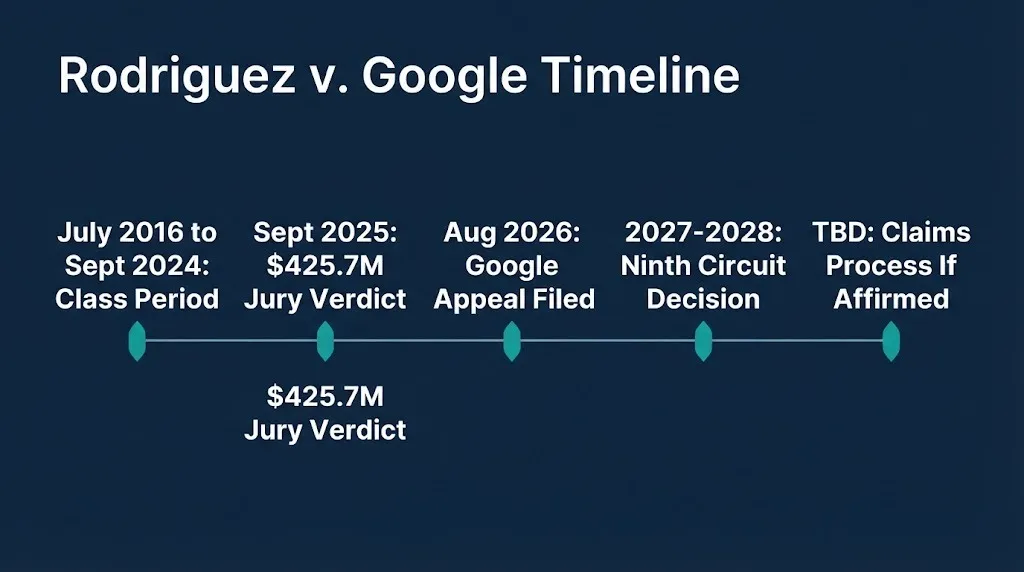
The Gmail lawsuit appeal will take 12 to 24 months or longer before the Ninth Circuit rules. If Google wins, the verdict is vacated and no one gets paid. If the verdict stands, a claims process will begin .
Here is the expected timeline:
Filed August 2026: Google’s appeal to the Ninth Circuit.
Expected 2027: Briefing and oral argument.
Expected 2027 or 2028: Ninth Circuit decision.
If verdict affirmed: Settlement administrator begins payment process.
If verdict vacated: Case may be retried or dismissed, and no payouts occur.
The two-to-four year estimate for appeals in complex privacy cases is common. During that time, no claim form will be available, and no payments will be made .
Frequently Asked Questions
Is the Gmail lawsuit claim form real or a scam?
The Gmail claim form does not exist yet, so any site offering one is a scam. The Rodriguez case is on appeal, and no claims process has been authorized.
How much will the Gmail lawsuit payout be?
If the $425.7 million verdict survives appeal, class members could receive about $4 to $5 each, or up to $24 if the court increases the award. Nothing is guaranteed until the appeal resolves.
Do I need to file a claim form for the Gmail lawsuit?
No. Rodriguez is an automatic inclusion case, meaning you do not need to file a claim. Payment will be based on Google’s records if the verdict stands.
When will Gmail lawsuit payments be sent?
Payments cannot begin until Google’s appeal is resolved, which could take 12 to 24 months or longer from August 2026. No payment date has been set.
How do I know if I qualify for the Gmail lawsuit?
You may qualify if you had a Gmail account with Web & App Activity disabled between July 2016 and September 2024. Enterprise and supervised child accounts are excluded.
Can I opt out of the Gmail lawsuit?
Yes, but you should not opt out for a few dollars. Only opt out if you have a strong individual privacy claim worth significantly more than the class payout.
What should I do if I receive a Gmail settlement email?
Do not click links or provide personal information. Verify the sender against official court records. If the email asks for payment or your Google password, it is a scam.
Are there other Google settlements I can claim in 2026?
Yes. The Google Play Store settlement is paying automatically, and the Google Assistant privacy settlement has an active claim form. Both are separate from the Gmail case.
Your next step
Do not file any Gmail claim form, and do not pay anyone promising a payout. Bookmark the official Rodriguez settlement website and check it periodically for updates. The appeal will take time, and the only thing you can control right now is avoiding scams. If you made Google Play purchases between 2016 and 2023, check your PayPal or Venmo for a real payment from that separate settlement.